Newport KY
USA
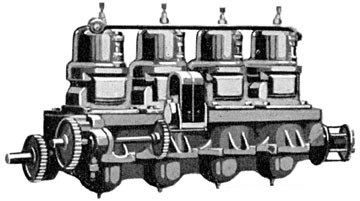
During 1911-1912 the Fox Dean Mfg Co produced various ‘Aero Motor’ of 3-, 4-, 6-, and 8-cylinder, inline watercooled configuration. They produced 36-200 hp.
Newport KY
USA
During 1911-1912 the Fox Dean Mfg Co produced various ‘Aero Motor’ of 3-, 4-, 6-, and 8-cylinder, inline watercooled configuration. They produced 36-200 hp.
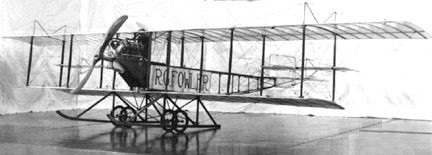
Four or five 1912 Fowler-Gage were built for exhibition pilots Robert Fowler (aka Fowler-Gage with 80hp Hall-Scott A-3, occasionally on floats), Roy Francis, Phil Parmalee, and J Clifford Turpin.
The design was carried forward to the twin-prop Patterson-Francis.
The Fowler-Gage was donated to Smithsonian in 1950 and restored for display by NASM in 1988.
Engine: 60-80hp Hall-Scott A-2/-3
Wingspan: (upper) 41’0″ to 42’8″
Wingspan: (lower) 30’0″
Speed: 60 mph
Seats: 1
The 1910 Fournier monoplane was designed and built by Heraclio Alfaro Fournier in Spain.
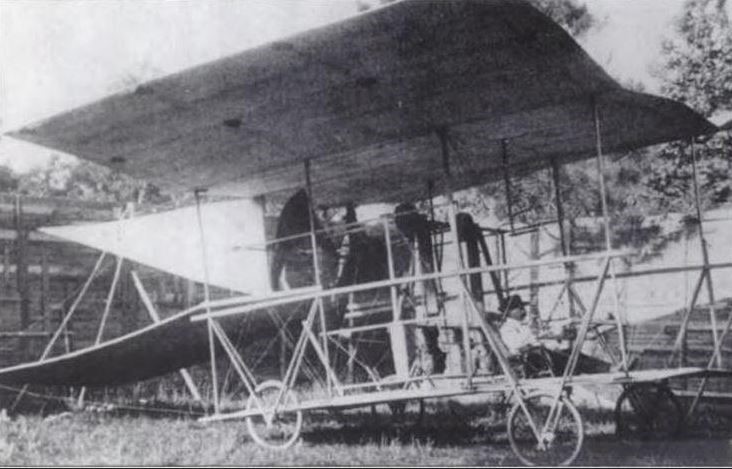
This aircraft was built by John Ellis Fowler, around 1902.
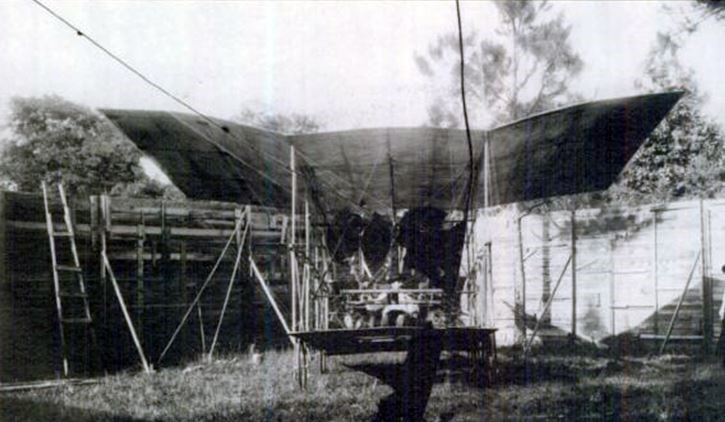
It was built and tested at Monroe Park, a baseball sportsground in Mobile, Alabama.
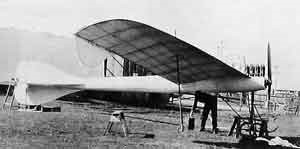
This large monoplane, Louis Fortney’s third, was powered with a 4-cylinder Knox engine of 60 hp weighing 400 lbs. Viewed from a distance the machine had a very fine appearance, but under closer inspection revealed a number of weak points in construction. After two short jumps Fortney met with the usual fate of the novices –yet deserves credit for staying in the game– as this was also his third machine to be destroyed.
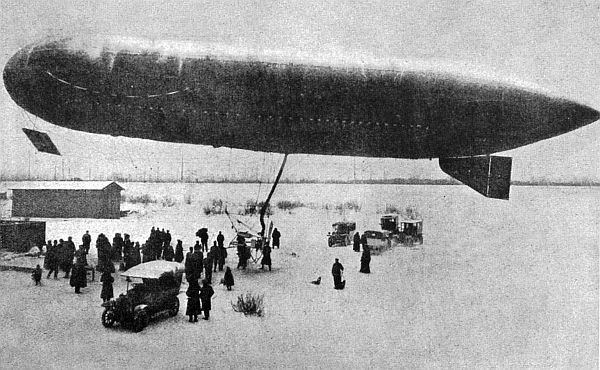
In 1910, Villehad Henrik Forssman (1884–1944) had graduated from the Riga Polytechnic Institute as a mechanical engineer and then moved to Germany that same year. Thereabouts, the Swede had been contracted by the Russian army to deliver a dirigible and was there to be used for intelligence services, which was constructed at “August Riedinger Ballonfabrik” in Augsburg. It is not known whether or not the Russian military ever took delivery of the airship. The dirigible was only 35 meters long with a maximum diameter of 6 meters, and held 800 cubic meters of hydrogen gas. It could be dismantled very quickly and just as fast, later be ready to fly. Because of lift-force limitations a gondola was not available, only a single bench seat with the engine, where the pilot and a mechanic had a place to sit. The 28 hp motor, which was also built by Forssman, weighed only 38 kg, and the cooling 4 1/2 kg. Reportedly the entire craft weighed 450 kg and capable of attaining a maximum speed of 43 km/h.
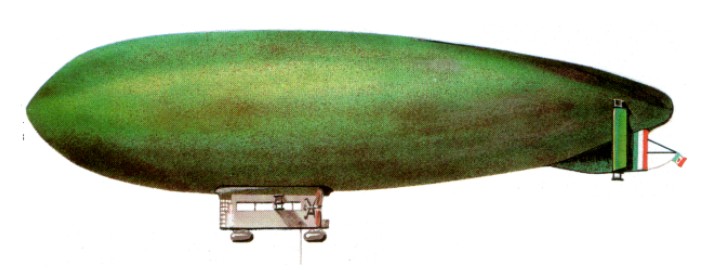
Manufactured by the Società Leonar¬do da Vinci in Milan, the ‘Forlanini’ class airships (designed by Enrico Forlanini and the firm’s engineer Luigi Crescentini) may be regarded as the most successful of the Italian semi¬rigid vessels, winning a number of re¬cords during the years immediately preceding World War 1. Early versions had carried their structural girder externally, but this was eventually placed within the hull as a truss from which the central car with its crew compartment, motors and flotation bags protruded, the leading edge being glazed and an unusual tri¬plane set of control surfaces being car¬ried at each side of the F.3. To the rear of the car the propellers, arranged as pushers, were carried on outriggers with an extended linkage to the en¬gines, the reversible propellers being capable of variable pitch.
An interesting design feature of the envelope was its double surface with a space between the inner and outer fabric, which served as a ballonet to maintain the shape of the envelope. In addition a climbing well was included together with a ladder by which to gain access to a platform on top of the hull.
There were five initial ‘Forlanini’ airships with progressively improved performance, the best showing a rate of climb of 1000 m (3,300 ft) per minute. One such airship setting up an endur¬ance record of eight hours, in the course of which the average altitude maintained was 3960 m (12,992 ft) although at one time 5335 m (17,503 ft) was attained.
Perhaps the most unusual feature of the Forlanini was the construction of the tail. This did not terminate in the conventional cruciform pattern but had instead a robust ventral fin of thick section. To each side of this and below the centreline a series of high aspect ratio rudders was carried (five to a side) with biplane horizontal surfaces above and below.
A Forlanini F.3 was built to a British Admiralty order in 1913, and to be known as Naval Airship No.11, but ws appropriated by the Italian Government at the outbreak of war in 1914. Two further airships of this design, No.12 and No.13, were to be built under licence by Armstrong Whitworth but were not proceeded with due to pressures of other war work.
A considerably smaller Forlanini airship was the ‘P’ class (Piccolo, or small) with a fixed vertical fin and out rigged rudders at the ends of very wide span elevators. This model was 63.0 m (206 ft 8.3 in) in length, with a diameter of 12.0 m (39 ft 4.4 in).
P Class
Propulsion: Four FIAT S.54-A, 80 hp
Volume: 13,790 cu.m
Maximum speed: 80 km/h
Flight endurance: 24 hr
Useful payload: 6 tonne
Forlanini F.3
Type: sea patrol and bombing airship
Powerplant: two 74. 6-kW (100-hp) Fiat A six-cylinder water-cooled piston
Maximum speed 80 kph (50 mph)
Service ceiling 5480 m (17979 ft)
Range 650 km (404 miles)
Useful lift 2720 kg (5997 lb)
Diameter 20.34 m (66 ft 8.8 in)
Length 95.1 m (296 ft 11.4 in)
Volume 13800 cu.m (487,343 cu ft)
Forlanini F.3
Engines: 2 x Isotta Fraschini V5 8-cyl, 180 hp
Envelope: 421,000 cu.ft
Length: 234 ft
Diameter: 58 ft
Height: 73 ft
Gross lift: 11.5 ton
Disposable load: 4.2 ton
Speed: 40 mph
Range: 600 miles
Crew: 10
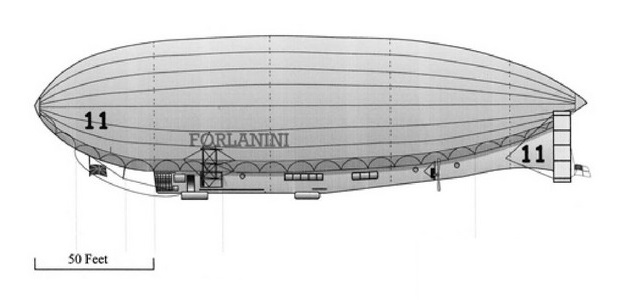

Enrico Forlanini designed and built a series of dirigibles, notably, in 1912, the Città di Milano, dedicated to his beloved home town. It showed exceptionally good characteristics of stability and controllability that won Forlanini international renown.
The F.2’s gondola was divided in three compartments: the command cabin, passenger cabin, and machine room. For safety all the material was treated with a fire suppressant and the envelope was double-skinned.
A coning tower was situated at the bow connected to a deep, V-shaped keel, which allowed access to the eight separate gas bags and the engine cars in a similar arrangement to the Zeppelins. The gass bags were in turn enclosed within an annular air ballonet positioned between the gas bags and outer cove. The 2 inch air space served the double purpose of acting as a ballonet and as an insulating air cushion to minimisw the effects of external temperature changes on the hydrogen gas.
Owned by the Royal Italian Army (Regio Esercito) and first flown on 17 August 1913, the Città di Milano completed 43 flights.
On 9 April 1914 the Città di Milano made an emergency landing during a storm, then was damaged by trees and terrain while moored. While attempting to deflate gas cells, it caught fire and was destroyed.
Propulsion: Two Isotta Fraschini petrol engine, 80 hp
Volume: 12,000 cu.m / 421,000 cu.ft
Length: 72 m
Gas cells: 12
Maximum speed: 70 km/h / 40 mph
Flight ceiling: 2400 m
Useful payload: 5 tonne

Construction started in 1900 collaboration with Cesare del Fabbro. Its first flight was 2 July 1909. Like all the Forlanini airships, except the Omnia Dir, the empennage comprised groups of multiple planes at the poop and at the tail.
A mishap befell the Forlanini dirigible during a trial trip from its shed at Crescenzago to Parie in 1910. When about 3 km from Parie one of the motors stopped, and Signor Forlanini decided to land in order to effect repairs. This was accomplished satisfactorily, but when starting again the balloon was driven against a tree and a hole torn in the envelope. This allowed the gas to escape, and although the vessel rose to a fair height, it suddenly dropped to earth again, but fortunately the three occupants of the car escaped without injury.

The Leonardo da Vinci completed a total of 38 flights, covering a total distance of 850 km. The longest flight duration was 90 minutes.
Propulsion: One Antoinette steam engine, 40 hp
Volume: 3,265 cu.m / 132,000 cu.ft
Length: 40 m
Maximum speed: 52 km/h

In 1877, Enrico Forlanini developed an early helicopter powered by a steam engine. It was the first of its type that rose to a height of 13 meters, where it remained for some 20 seconds, after a vertical take-off from a park in Milan.
 All Aero