Gabriel Eindecker

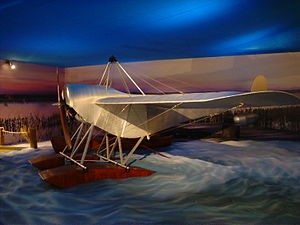
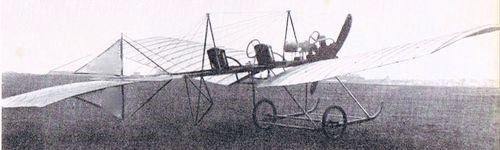
The Gabriel Eindecker of 1912 was a copy of the Fokker Spinne built by twin brothers Willi and Walter Gabriel of Bromberg, Germany, just 18 years old at the time. It was the third flying machine that the brothers had built – aptly a two-seater – on which Willi earned his pilot’s brevet on August 12, 1912. Both Willi and Walter went on to become fighter pilots during World War One – Willi, an ace.
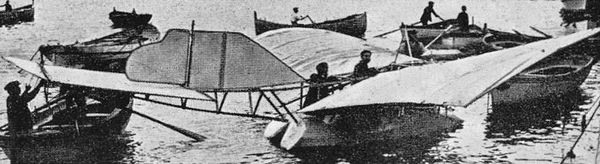
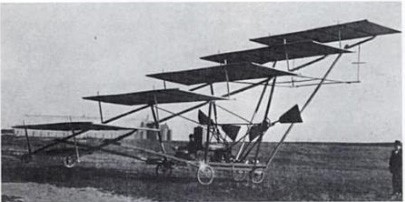
Fyodorov Split-wing Machine

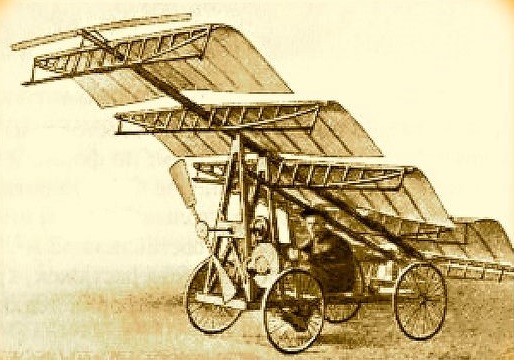
Designed and built by Yevgeny Stepanovich Fyodorov (Евгений Степанович Фёдоров) during the period 1895 until 1903. Fyodorov had a career in the military as an engineer, where in 1895 he presented a model aeroplane project with a “split-wing” (самолёта-пятиплана). This model was successfully flown behind an automobile, which towed the model. On the results of the tests with this model Fyodorov decided to build a full scale aeroplane at his own expense. According to sources it was finished, but never flight tested. The machine of Fyodorov is considered the second constructed flying machine after the one of Mozhaiski (Можа́йский).

Fuseri-Miller Ortoelicottero

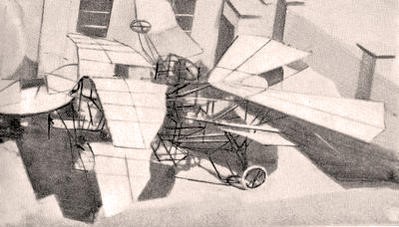
Italian ornithopter, designed by Dr. Fuseri, a pharmacist living in the small town of Fossano in the province of Piemonte, and built by Franz Miller, one of Italy’s first aeronautical engineers, as a contractor. In 1908 the firm “Società anonima italiana per l’esperimento dell’ortoelicottero Fuseri” was formed in Fossano and construction of the aircraft was initiated in 1909 by the factory of Miller in Torino where it was never flown and unlikely to have ever been tried. This sort of machine (VTOL) is along the lines of the somewhat later machines of deCazes where it is named a Hélicoplane, just as the Fuseri Ortoelicottero, a mix of helicopter (vertical take-off and landing) and aeroplane.

Fünfdecker Himmelsleiter

Built and demonstrated at Flugplatz Johnannisthal in 1911, but apparently did not fly. Later, the machine was modified, and it appears questionable whether the revision flew either. The secretive Merx Fünfdecker had “Himmelsleiter” (sky ladder) built and kept in its shed – hidden from prying eyes. When the first flight test was to take place, it turned out that the apparatus was higher than the door and could not be pulled out of the shed. Also known as the Mehrdecker-Versuchsflugzeug von J. Merx, (multiplane-experimental).

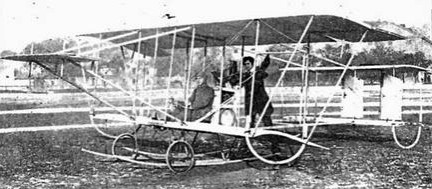
Fruchtermann 1911 Biplane

This small biplane of generally Farman-like configuration was built in Pressburg, Austria-Hungary (today Bratislava, Slovakia). The elevators and the ailerons were operated by a lever, while the rudder was operated by a separate lever. It was powered by a German-built 25 hp 3-cylinder engine, driving a propeller of 1.8 m diameter.

Engine: 25 hp
Prop diameter: 1.8 m
Span: 6.5 m
Length: 7.5 m
Wing area: 25 sq.m
Take-off weight: 250 kg