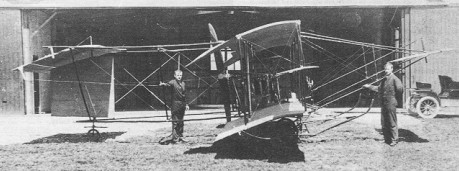
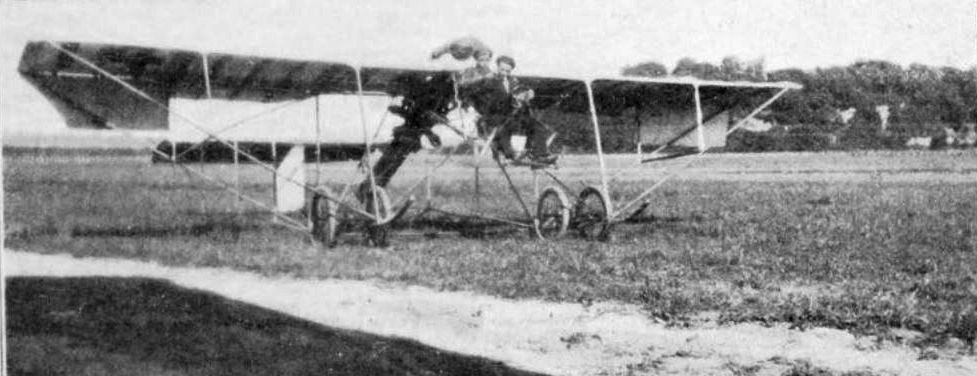
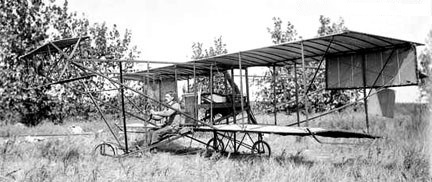
In 1910, an aeroplane was designed and built by George & Jobling, a Newcastle motor engineering firm with premises behind the Central Station in what used to be Robert Stephenson’s locomotive works. Arthur George was the driving spirit. As an engineer he put great emphasis on lightness, which was evident in the design of his aeroplane. His aeroplane was built by two car mechanics, Billy O’Hara and Artie Walker. The aeroplane was quite successful by the standards of the day. It resembled the contemporary Voisin and Farman, but was an original design not a copy. Before it flew, it was shown at the Aero and Motor Boat Exhibition at Olympia from March 11 to 19, 19 10. The contemporary aviation press gave it high praise for the quality of its workmanship and the ingenuity of its design.
Its maiden flight was at the Royal Aero Club airfield at Eastchurch on Sheppey in May 1910. By September 1910 George was “flying faultlessly covering 7 or 8 miles on Monday and Tuesday 4th and 5th, and carried a passenger on Tuesday evening. On Wednesday 6th he gained his certificate in fine style.” His certificate was No 19. Alliott Verdon Roe got No 18.
Back home on Tyneside, however, the Freemen of Newcastle refused Mr George permission to fly from the Town Moor, but he was able to operate from Gosforth Park race course nearby. His longest flight at Eastchurch had been 14 minutes, but he beat this at Gosforth with one of 18 minutes, by which time he had amassed over 300 miles (483km) in the air. (At an average of 35mph [56km/h] and 15 minutes per flight, this would represent about nine flying hours composed of 35 to 40 separate flights.) It is believed that during the autumn of 1910 the aeroplane was exhibited in Paris and several provisional orders were obtained for copies.
Unfortunately, in October 1910 George had an accident. “The machine ran about 150 yards and rose to about 60 feet. After a half mile he was making a wide sweep to get back to the shed when he struck an air pocket. The machine dropped into the golf course and capsized into a bunker. Mr George was unhurt but the propeller and landing gear were smashed.”
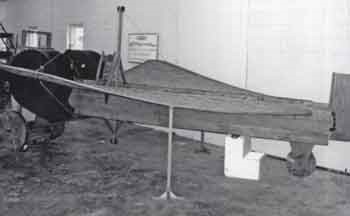
No doubt the aeroplane could have been repaired and flown again, but it seems to have been at this point that George & Jobling’s bank manager refused finance for any more aviation work. So the aeroplane was dismantled. During World War One all the sections and parts were thrown out except the propeller and the patented control column. Ironically the firm then went on to build aircraft components as part of the war effort.
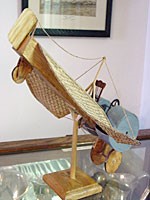
No drawings have been traced, but many details can he found in contemporary journals. It was a biplane with a span of 30ft (9m) and a length of 30ft. Wing area was 426sq ft (39m2), with a chord of 5ft 6in (1.67m), plus 15in (38cm) extra chord at the trailing edge of the warping wing tips. The gap was 5ft (1.5m). Like the Farman, it had a forward elevator and a fixed horizontal tailplane (to the trailing edge of which a small auxiliary elevator was later added). The wing section was ‘single surfaced’, that is to say the ribs were like narrow hockey sticks with top and bottom curves parallel.
The structure was a typical birdcage of struts and bracing wires, but very well fashioned and light in weight. The principal struts were American elm and the smaller ones spruce, all carefully hollowed out. The wings were in three sections with the outer panels detachable for transport. The whole airframe, not counting the engine, but including the steel tube undercarriage, weighed only 412 lb (187kg).
The engine was a 60hp (44kW) four cylinder Green, water cooled. With a stroke of 146mm and bore of 140mm was nearly 9 litres, but it ran at only 1,200rpm. It weighed 250 lb (113kg) and cost £350, some three years’ wages for an average man in 1910. It is believed that George intended to replace the Green with a Gnome rotary, but funds ran out. During the initial flights it gave 280 lb (127kg) static thrust. The radiators were designed by George himself and consisted of a double series of longitudinal copper tubes forming the lower part of the centre section.
The propeller was also made by George & Jobling. Its diameter was 9ft (2.7m) with a pitch of 10ft (3m), and it was geared down 2:1 from the engine by a chain. It was mounted on a stationary axle on struts on the engine mountings so that it was entirely independent of the airframe structure, and could be removed by a single nut like a sports car wheel. The first chain shed rollers copiously but was replaced by a better one.
All up weight, including fuel and the ‘driver’ (as he was described), was 862 lb (391kg). This gave a wing loading of 2.6 lb/sq.ft. Its maximum speed was said to be 48 mph (77km/h).
George & Jobling patented the shock absorbing undercarriage in 1909 while the machine was still on the drawing board, but of more interest was the patent for the control column. This “combined all motions for the control of the machine by one hand but each motion independent of the others.” The rudder was operated by a handwheel, with the geometry of the pulley cables so designed that the stick could be moved fore and aft or sideways for elevator and banking without affecting the rudder and vice versa. Incidentally, the rudder appears from photographs to have a balance area ahead of the hinge fine. This principle had long been applied to ship’s rudders to reduce steering effort. The tailwheel was linked to the rudder for taxiing.
The front elevator was worked by a pushrod, and as already mentioned, a supplementary moving surface was added to the tail after the first flights. Lateral control was by wing warping, but with the interesting addition of some sort of aileron surfaces midway between the upper and lower wings which moved in conjunction with the flexible wings themselves. Whether they were intended as the primary lateral controls supplemented by the wing warping or vice versa is not clear, nor can their effectiveness be judged.
Span: 30′
Length: 31′
Weight allup: 862 lb
Speed: 48 mph
 All Aero