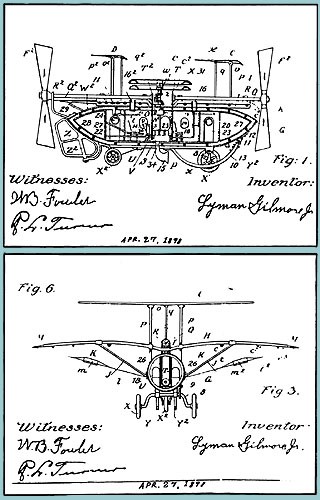
Copies exist of patent drawings of an aeroplane designed by Lyman Wiswell Gilmore Jr., although the April 27, 1898, date ascribed to them (and written on them in a hand other than the patent artist’s) is unsubstantiated, as far as can be determined.
The Gilmore Monoplane design – said to date from 1898
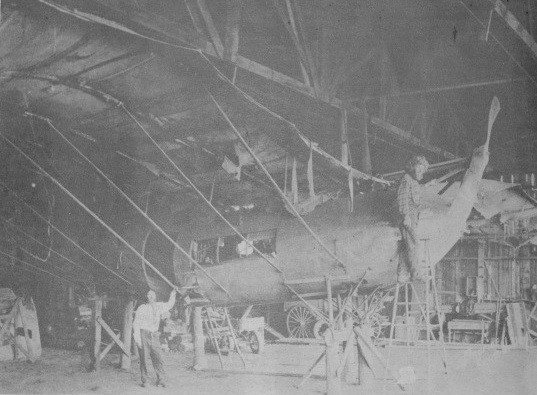
About 1909 Gilmore built a large machine of his 1898 design. Gilmore kept both the smaller monoplane and the large “1898”-type monoplane in a barn at his modest ranch, “The Lyman Gilmore Aerodrome,” in Red Bluff, California.
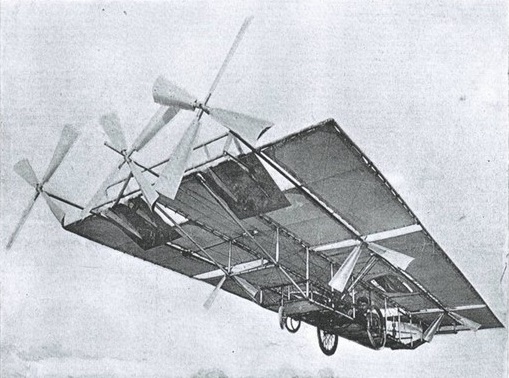
During the 1910’s Gilmore’s efforts picked up ‘steam’ and he built a large monoplane, apparently patterned to a degree after Louis Bleriot’s Bleriot XII (not Bleriot XI) monoplane of 1909. Gilmore seems to have claimed that he built that machine in 1908, but that assertion, as with so much of Gilmore’s story, seems to be lacking corroboration. During August and September of 1909, Gilmore was experimenting with what seems to have been a clockwork-powered large model aeroplane, which was apparently successfully demonstrated to a small number of people.
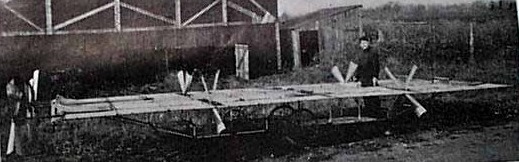
The Gilmore Monoplane “1898” design and the smaller monoplane, right, built about 1911
Gilmore would often roll the machines outside for the display until 1935, when the barn and the two machine were destroyed in a fire. His smaller (although still quite large) monoplane was apparently flight tested on September 21, 1911, although the crankshaft on his monoplane’s Roberts engine broke before the machine could be flown. A second attempt, before a large crowd on March 17, 1912, proved the machine, at 1,600 lb., to be too heavy for flight.
Lyman Gilmore, Jr., standing on the ground, Charles Lyman on a ladder
Lyman Wiswell Gilmore’s first attempt at flight apparently occurred at Red Bluff, California, during July of 1894, when he reportedly built a glider (whether biplane or monoplane is not known) with a wing span of 18 feet and went aloft under tow by a horse. The source of this story, as with many of the assertions surrounding Lyman’s efforts, seems to have been Lyman Wiswell Gilmore, Jr., himself.
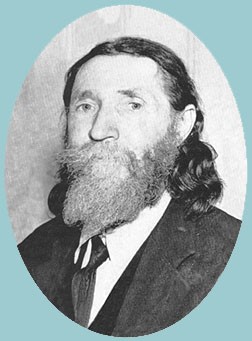
Lyman Wiswell Gilmore, Jr., was born on June 11, 1874, at Beaver Creek, Thurston County, in Washington, USA. He had three sisters and seven brothers. Gilmore’s first attempt at flight apparently occurred at Red Bluff, California, during July of 1894, when he reportedly built a glider (whether biplane or monoplane is not known) with a wing span of 18 feet and went aloft under tow by a horse. The source of this story, as with many of the assertions surrounding Lyman’s efforts, seems to have been Lyman Wiswell Gilmore, Jr., himself.
In addition to aeronautics, Gilmore had an active interest in gold mining, an aspect of his story which runs parallel to his aviation experiments. He wrote in 1898 that he was an “aerial Fulton,” someone who would open up the skies in the same way that Robert Fulton’s steam-powered ship had opened the waters. He also foresaw, in 1898, the use of dynamite dropped from aerial machines to sink enemy ships.
Copies exist of patent drawings of an aeroplane designed by Gilmore, although the April 27, 1898, date ascribed to them (and written on them in a hand other than the patent artist’s) is unsubstantiated, as far as can be determined.
The design is of a pusher/tractor monoplane, featuring an enclosed fuselage, with supplementary surfaces above the main planes. A vertical rudder surface is attached much as on a boat hull. The design also features a tricycle landing gear. If the design actually dates from 1898, it is a rather forward-looking conception. One of a number of significant impediments to flight would have been the fact that the lifting surfaces were flat and were not set at a positive angle of inclination.
During 1902, while living at Red Bluff, California, Gilmore was apparently awarded a U. S. patent for a steam engine meant for use in aerial vehicles. At a much later time, Gilmore claimed that he had built and flown a monoplane with a 32 foot wing span during May of 1902 powered by his patented steam engine, although no supporting evidence has come forth.
In 1903, Gilmore wrote to Samuel P. Langley with an offer to “balance” the Large Aerodrome which had recently plunged into the Potomac River. Langley declined Gilmore’s offer. During the 1910’s Gilmore’s efforts picked up ‘steam’ and he built a large monoplane, apparently patterned to a degree after Louis Bleriot’s Bleriot XII (not Bleriot XI) monoplane of 1909. Gilmore seems to have claimed that he built that machine in 1908, but that assertion, as with so much of Gilmore’s story, seems to be lacking corroboration. During August and September of 1909, Gilmore was experimenting with what seems to have been a clockwork-powered large model aeroplane, which was apparently successfully demonstrated to a small number of people.
Like three other of his brothers, Lyman never married. Late in his life he was set upon in his small cold cabin by murderous thieves who had come to relieve him of his supposed cache of gold. He was very ill at the time and managed to convince them that he was, in fact, without any funds of any sort, gold or currency. In much of his aeronautical work, Gilmore was ably assisted by his brother, Charles. He continued to work on drawing of aeroplanes until his death in the Nevada County (California) Hospital on February 18, 1951.
According to his grandniece, Caroline Boudreaux Sullivan, and his niece, Lyman Gilmore, Jr., thought of himself as an engineer rather than an aviator. Caroline Boudreaux Sullivan’s Mother (Lyman Gilmore, Jr.’s, niece) recalls that he neither shaved nor cut his hair nor bathed, for he believed if he did so, he would “diminish his strength and vitality.”
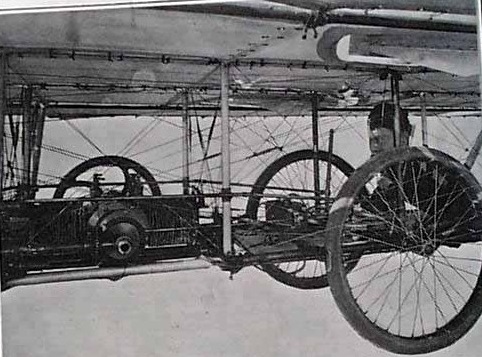
Designed by G. Curtis Gillespie and featured on the cover of Scientific American for June 26, 1905. Trussed frame of light aluminium tubing reinforced by piano wire 24 feet overall with a beam of 10 feet, covered in light duck and steered by two integrated flaps.
The motive power consisted of an air-cooled gasoline engine having six cylinders, opposed three to three in a horizontal plane with cranks set an an angle of 60 degrees.
The machine’s total weight was 150 pounds, and developed 20 horse-power.
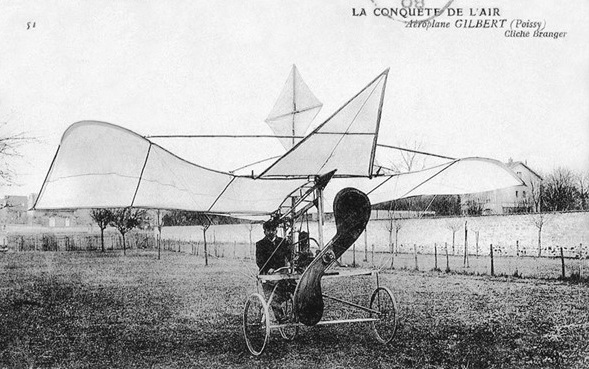
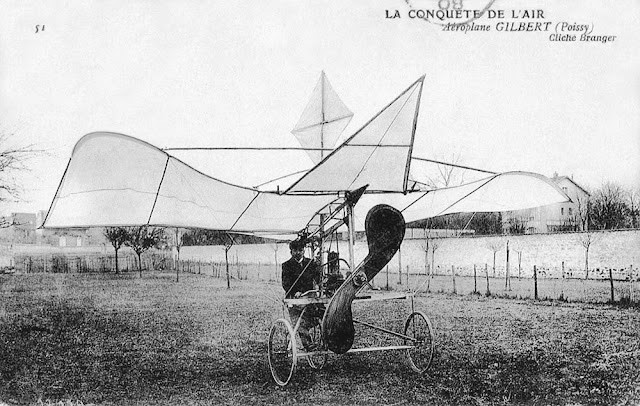
France 1906. Eugene Gilbert (19 July 1889-1918) became interested in flight in his teens and attempted to build his own version of a flying machine in 1906. The effort appears to have been unsuccessful.
Eugene Gilbert (19 July 1889-1918) became interested in flight in his teens and attempted to build his own version of a flying machine in 1906. The effort appears to have been unsuccessful.
That same year he entered the Bleriot flight school in Étampes, gaining his pilot’s license on 24 September 1910
Gilbert was in the 1911 Paris-to-Madrid race, (won by Jules Vedrines), held a little earlier that year. And was flying over the ‘Pyrenees’ Mountains when attacked by that giant eagle.
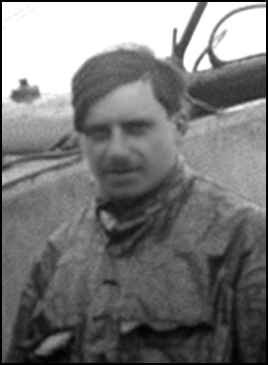
During World War One Gilbert had attained at least five victories as a fighter pilot
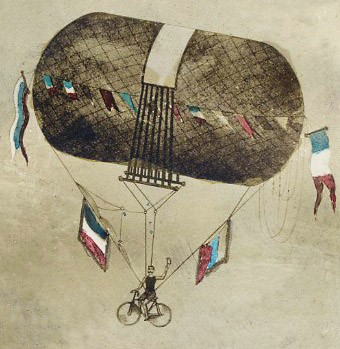
A combination gas balloon/parachute of 300 m³ volume employed by French aéronaute-constructeur Charles Gilbert, exhibited primarily throughout France, then in Russia, during the 1890s.
During these performances a bicyclette – likely a model built by the Paris firm of “Gladiator” – was suspended by ropes from the balloon in place of a basket, and while pedaling in the void, Gilbert naturally had to deal with the manoeuvring of his apparatus.
With his “rotateur” system enabling him to land at his discretion, at a given point, a kind of “rallye-ballon”, or balloon rally was organized. Velocemen who set off in pursuit of the balloon, joined the descent, and with folded balloon bagged, the aerocyclist returned with them on his bicyclette, to the place he had ascended from.
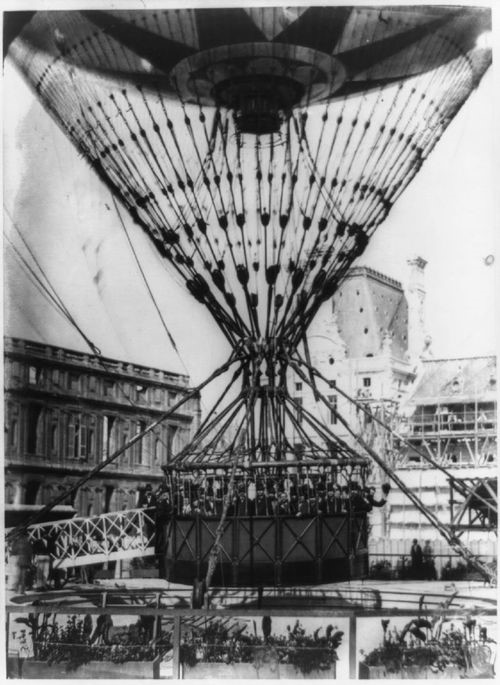
A captive balloon of 25,000 m³ built for the Universal Exhibition of Paris of 1878, Le Grand ballon captif à vapeur (The Large Steam Tethered Balloon) of Henry Giffard was capable of carrying 40 passengers.
Located at the courtyard of the Tuileries in Paris, it was one of the main attractions of the exhibition, making up to ten ascents per day to an altitude of 500-600 m. Using mechanical winches, its first ascent took place on July 19, 1878 and would eventually lift over 35,000 passengers on more than 1000 ascensions made.
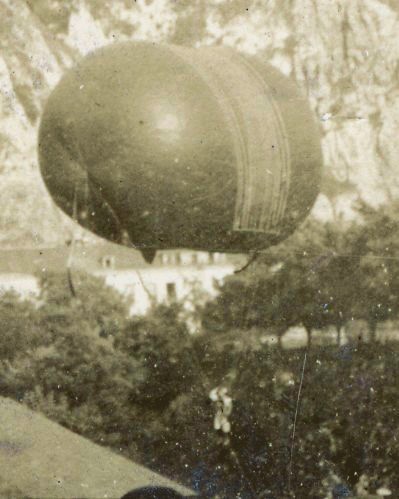
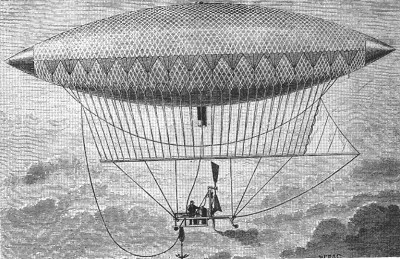
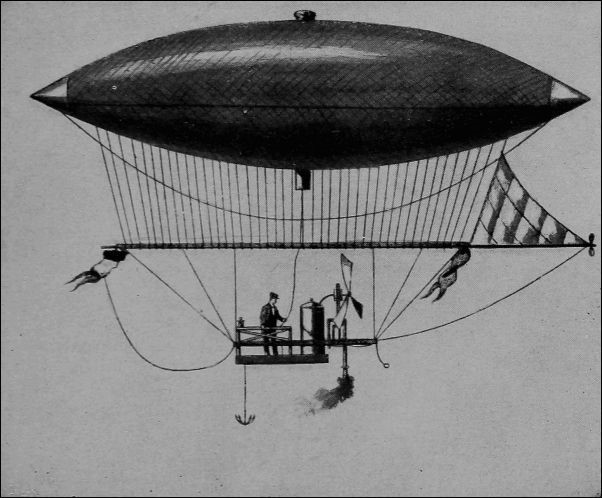
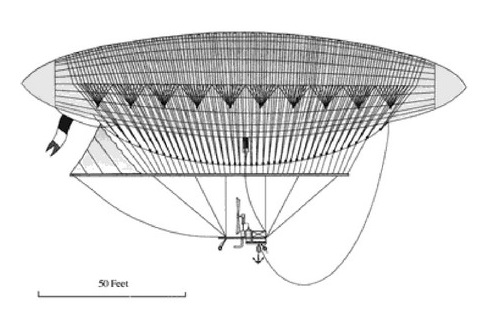
The first practical airship was the work of Frenchman Henri Gifard who in 1852 constructed a 143 ft long craft. Pointed at both ends and driven by a 3 hp steam engine; weighing, with its boiler, 350 lb and suspended 20 ft below the envelope, driving an 1 ft diameter propeller at 110 rpm to give it a still air speed of 6 mph.
On 14 September 1852 Giffard lifted off from the Hippodrome in Paris and, in near perfect weather conditions, flew 17 miles to Trappes, south of Paris in around 3 hours.
Whilst Giffard was able to effect a degree of control with the triangular sail that performed the function of a rudder in directing his flight, he was unable on this or later flights to either navigate in a circle or return to his starting point due to the low power of the engine.
Engine: 3 hp Length: 144.357 ft / 44.0 m Width of hull: 39.37 ft / 12.0 m Contained volume: 88300 cu.ft / 2500 cu.m Max. speed: 5 kts / 10 kph Gross lift: 2500 kg


 All Aero