
The 1911 Goupy Type AA tractor biplane was a rwo-seater with inset top-wing ailerons.
It was designed by Ambroise Goupy, built most likely by Bleriot factory.
Span: upper: 40’8″
lower: 32’10”
Length: 29’6″
The 1911 Goupy Type AA tractor biplane was a rwo-seater with inset top-wing ailerons.
It was designed by Ambroise Goupy, built most likely by Bleriot factory.
Span: upper: 40’8″
lower: 32’10”
Length: 29’6″

The 1911 “Concours Militaire” biplane was designed and built by Ambroise Goupy in France.
Span: 46’7″
Length: 34’9″

The 1912 Goupy “hydroaéroplane” was just a land plane set on floats with wheels and all, no further alterations. Typical was the fuselage “hung” between the wings and the sesquiplane construction with the struts somewhat at an angle. The construction at the nose looks like radiators, but are unlikely that as this design was fitted with a 100 hp Gnome rotary. Maybe a streamlined construction to get the engine neatly into the ‘square’ fuselage.
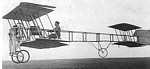
The 1909 Goupy II biplane, designed by Ambroise Goupy in France, powered by a REP or Anzani engine, was built at the Bleriot factory.
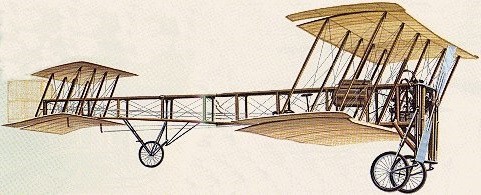
Span: 20′
Length: 23′
Weight gross: 630 lb
Wing area: 26 sq.m
The three-passenger Goupy biplane, type 1914-B, resembled in general construction other machines of this firm. The cell is composed of two staggered planes of unequal length: chord 1.6 m. top plane 19.75 m. long, lower one 10.35 m. long.
The cell is rigid and lateral balance is obtained by powerful conjoined ailerons. The fuselage is of quadrangular section. The monoplane tail is slightly lifting and approximately rectangular, terminated by a flap 3.1 by .7 m. serving as an elevator.
The quadrangular rudder, above the tail, is partly balanced and in front of it is a small vertical fin. The 100 hp Gnome supported between two bearings turns a 2.8 m. propeller, the axis being 1.8 m. above the ground. The chassis is of the usual type, skids and wheels: the wheels are far enough forward to prevent “capotage.” The skids, however, do not seem sufficient to protect the propeller in a bad landing on rough ground.

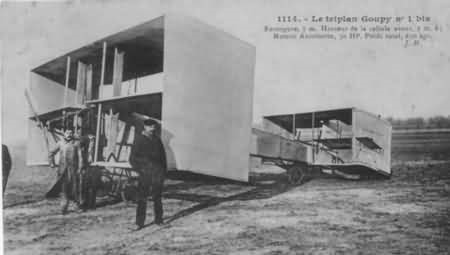
The Goupy I triplane was designed by Goupy, built by Voisin, in France 1909.
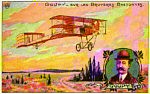
Span: 23′
Weight: 1430 lb
France
Company engaged largely in experimental work but built a few biplanes of its own design from around 1913.
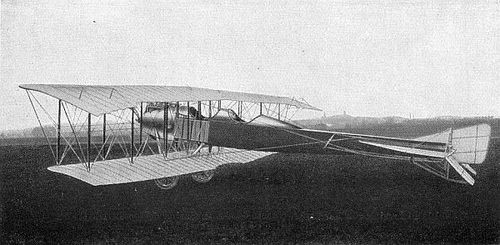
Bruno Büchner designed the 1913, 120 hp Argus powered, 20 m span Schuldoppeldecker biplane built by Gothaer Waggonfabrik.
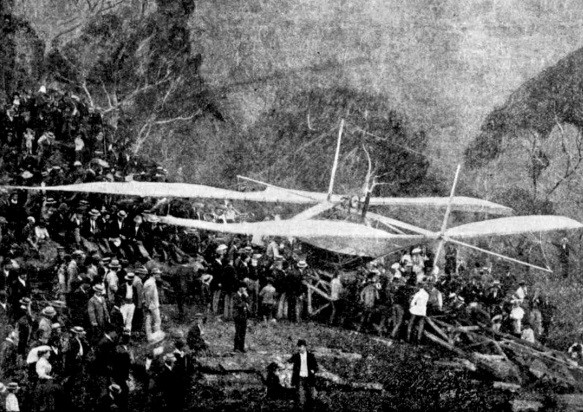
The creation of Australian inventor Newton Roberts Gordon, the “Air Ship” was the subject to a public test at Chowder Bay, Sydney, on December 26, 1894. The machine was a tandem-wing monoplane with steam-powered flappers between the sail-like wings. It slid down its starting ramp and crashed down onto the beach in front of thousands of spectators.
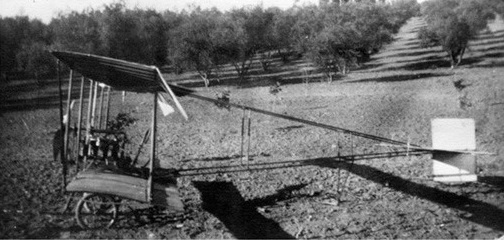
In 1903, Donald H. Gordon built a glider which took off from the top of the family barn. The contraption collapsed, and plane-building was suspended for several years. Gordon’s second aeroplane was built during 1911-1912.
 All Aero