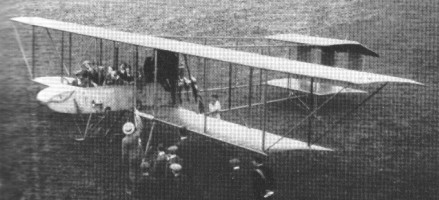
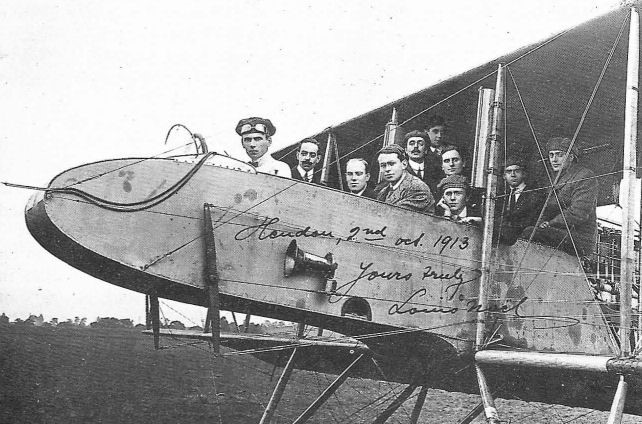
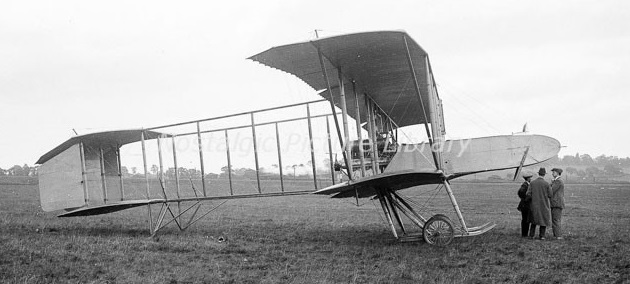
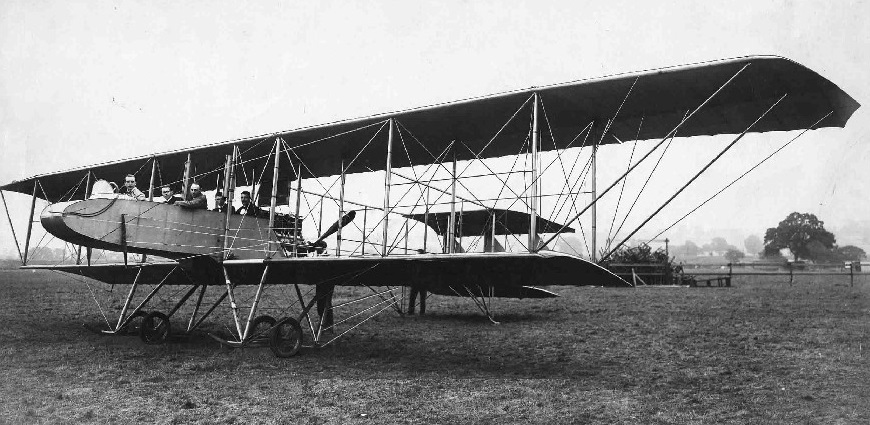
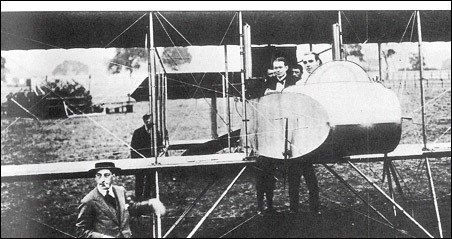
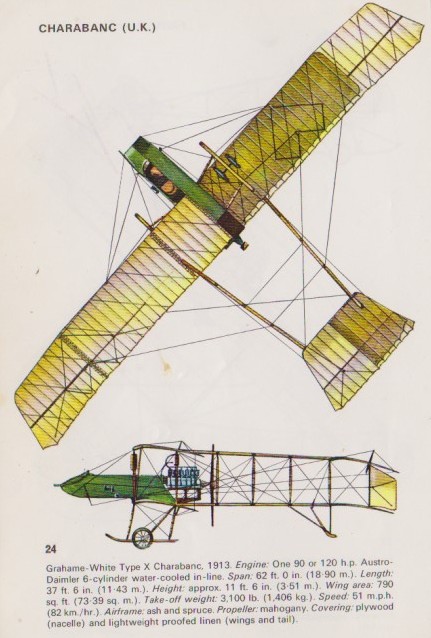
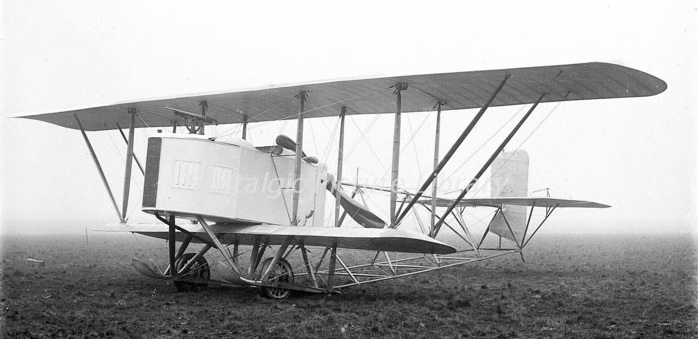
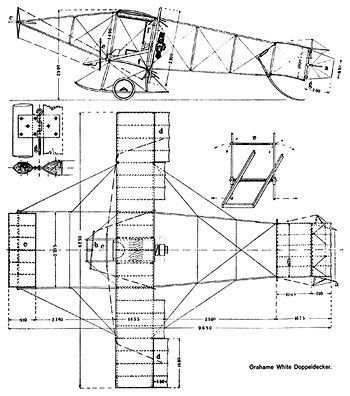
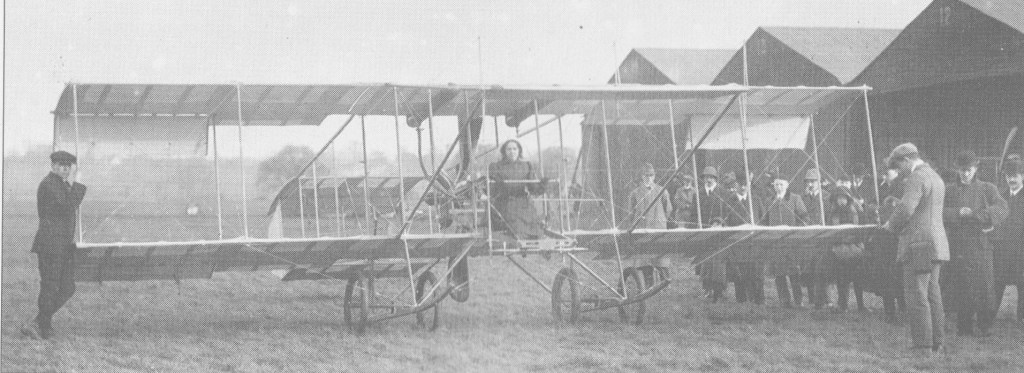
The Charabanc was built by the Grahame-White company to meet the demand for passenger-carrying flights, which could not be satisfied by the existing two-seat designs. Designed by J. D. North, it was an unequal-span pusher biplane with ailerons on both upper and lower wings and a biplane tail unit with three rudders mounted on booms. An elongated nacelle mounted on the lower wing housed the pilot in the front and four passengers in two rows of two seats behind. The wing spars, tail booms and outer interplane struts were of hollow section spruce, and the nacelle and inner struts were of ash.
It first flew in 1913 powered by a 120 hp (89 kW) Austro-Daimler engine, and in this form was flown by Louis Noel with seven passengers aboard to set a British world record on 22 September 1913: on 2 October, he set a world record in carrying nine passengers, staying aloft for nearly twenty minutes, obtaining a Royal Aero Club certificate for the record.
Hendon c 1913
To meet the entry requirements for the 1913 Michelin Cup, which required an all-British aircraft, the engine was replaced by a British-built 100 hp (75 kW) Green E.6 engine. The Charabanc went on to win the cup, covering a distance of over 300 miles on 9 November 1913 piloted by R.H. Carr.
Fitted with 100 hp Green 6 cyl engine, Grahame-White is here seen in the pilot’s seat. 1912
The first parachute descent from an aircraft in Great Britain was made by W. Newell from the aircraft at Hendon on 9 May 1914.
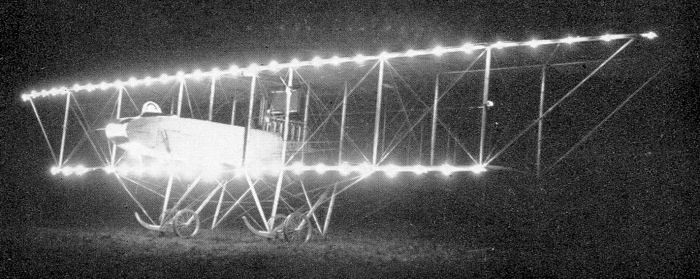
It was also equipped with lights for night flying.
Only one was built, and the Type X Charabanc was sold in March 1916 to the Japanese Naval Authorities.
Engine: 1 × Green E.6, 100 hp (75 kW) Wingspan upper: 62 ft 6 in (19.05 m) Wingspan lower: 43’8″ Wing area: 790 ft2 (73.39 m2) Length: 37 ft 6 in (11.43 m) Empty weight: 2000 lb (907 kg) Gross weight: 3100 lb (1406 kg) Maximum speed: 51 mph (82 km/h) Cruise speed: 45 mph (72 km/h) Crew: 1
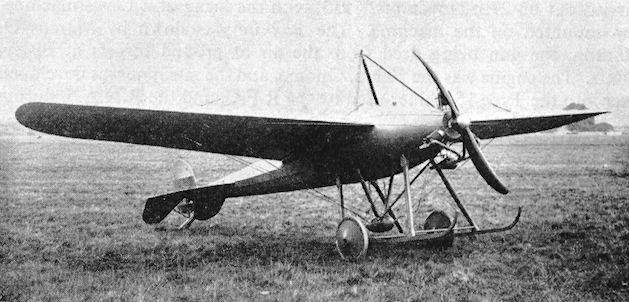
The Grahame-White Type IX of 1912 was a single seat tractor monoplane designed by W Rowland Ding. Gnome engine.
A conventional braced single-seat tractor monoplane with monocoque fuselage, warping wings and twin skid undercarriage, it was test-flown by Desoutter and found underpowered. It was re-engined but found unsatisfactory and never heard of anymore.
Engine: Anzani, 35 hp / Gnome, 50 hp Wingspan: 9.75 m Wing area: 19.32 sq.m Length: 6.40 m Height: 2.74 m Endurance: 3 hr 3 min / 4 hr Maximum speed: 89 kph / 105) kph Cruising speed: 80 km/h Seats: 1
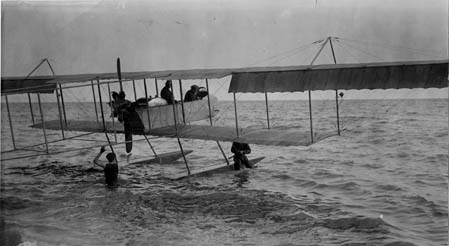
Built in 1913, Type VIII Tractor Hydro-Biplane was a tractor biplane seaplane of unequal span, designed by J. D. North, and meant for private owners. Power was Anzani or Gnome.
Only one was built; it was later modified as a landplane and acquired by the Royal Flying Corps, but was soon struck off-charge.
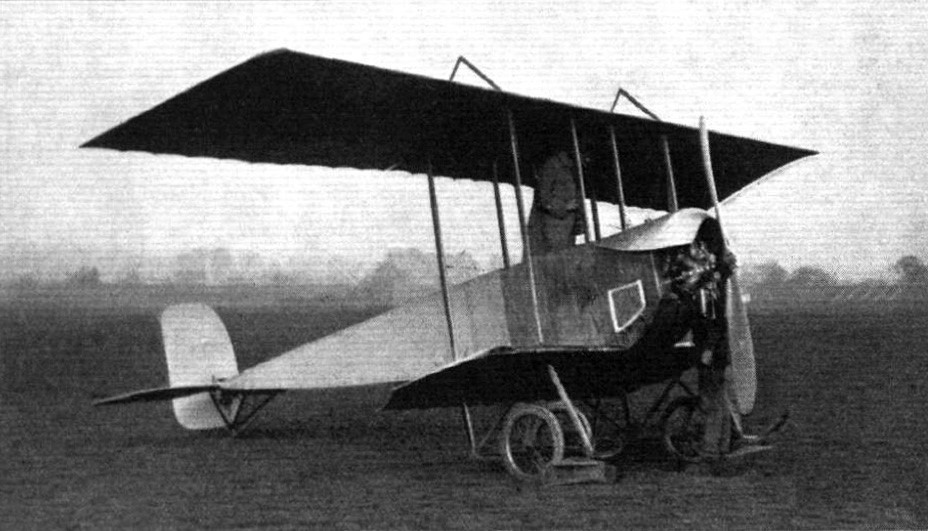
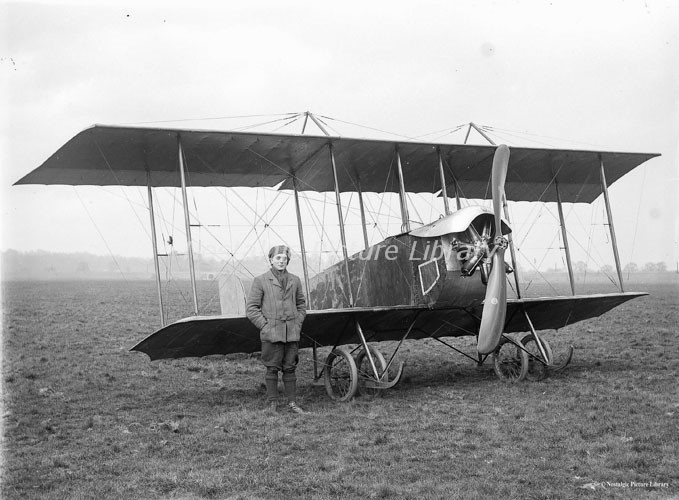
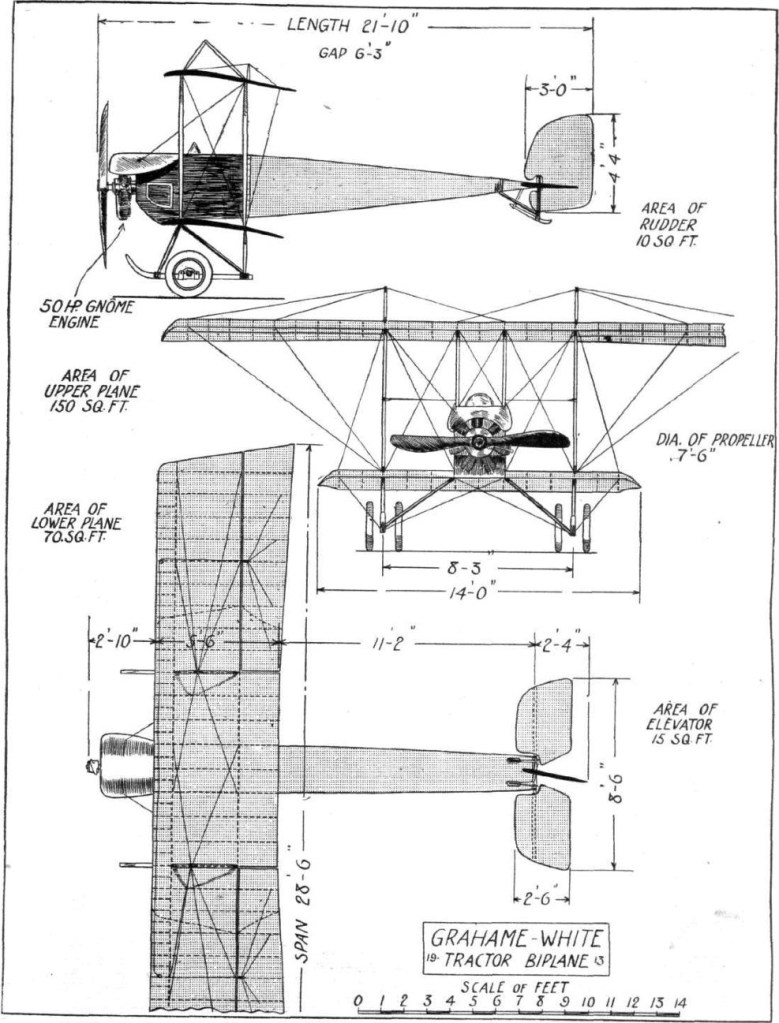
The 50-h.p. Grahame-White tractor biplane, “Lizzie” at Hendon, London, UK.
The Grahame-White Lizzie was a 1913 Sesqiplane tractor aircraft mating the wings of a Popular built on a Morane-Saulnier fuselage. Also known as the Tea-tray
R Carr at Hendon c 1913
Recognized by its very short lower wings, but a modified version appeared in 1914 with two bay wings, giving it a more “conventional” look.
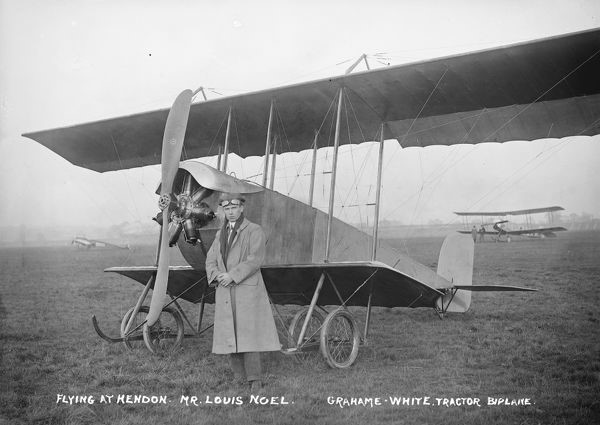
Louis Noel flying at Hendon and his Graham White tractor biplane 18 June 1921
A new, hopeful aviator purchased a veteran plane, a 50-h.p. Grahame-White tractor biplane that carried the moniker, “Lizzie”, at Hendon, near London. The year was 1914, and his intention was to teach himself to fly. His name was Mr. Charles Walter Graham, the son of Mr. C. K. Graham of 9, Kitson Road, Barnes, Southwest London, England. Soon Mr. Charles W. Graham was out on the field taxiing around to get familiar with the handling of the biplane, no doubt intending to remain on the ground. “Lizzie”, however, had other ideas, as related in the November 27, 1914, issue of Flight, the newsletter of England’s Royal Aero Club: It appears that a certain enthusiast has bought “Lizzie” with the object of teaching himself to fly, and that last Saturday was to be the dress rehearsal. Starting off from the corner at the top of the ex-half-crown enclosure, a very neat straight roll was accomplished in the direction of No. 4 pylon, with the tail well up. After some prancing about on the bad ground out by No. 4, “Lizzie” was persuaded to turn back in to the wind, and before anybody had realised what was happening, she shot up in the air at an angle of about 450, the pilot switching on and off all the while. By some kind whim of fate, which the newspaper correspondents would probably have described as superhuman efforts, “Lizzie” just managed to avoid a tail slide, and proceeded on a comparatively even keel towards No. 1 pylon, whisking her tail from side to side in the friskiest of ways. The pilot evidently considered this the moment appropriate for coming down, a performance which he seemed likely to accomplish in quite good style, for he descended in a pretty good glide switching on and off, but unfortunately he spoilt it at the last moment by not flattening out sufficiently and by keeping his engine running all out after touching the ground. The result was that “Lizzie” took matters into her own hands and did a loop the wrong way round, finishing on her back, whilst the pilot was seen to drop out of his seat on to the top plane. He was up again in a second, however, waving his hands to show the anxious onlookers that he was none the worse for his “spill.” As a fact, the only damage done was a broken propeller and a bent shaft. It is to be hoped that “Lizzie” will soon be out of hospital again, since her owner is evidently made of the right stuff, and should, with a little patience, turn out a good pilot. Most initiates would certainly have made a worse job of it than he did. On Christmas Day in 1914, Flight carried yet one more mention of “Lizzie” and Mr. C. W. Graham, who was attending a flight school at that point, having abandoned the idea of teaching himself: At the Hall school several new machines will be put into commission shortly, among others a two-seater biplane that will have dual controls. This firm has been repairing “Lizzie,” after her little spill recently, and she is now almost ready to take the air again, and looks as well as ever. While awaiting her return from “hospital,” “Lizzie’s” owner is getting a little preliminary experience on the dual-control two-seater Caudron biplane of the Ruffy school, so as to get used to the handling before taking “Lizzie” out again.
Derived from the Boxkite, rather than the Type VII, the 1913 Type VIc appears to be a variation evolved under Mr. Bill Law prior to the appointment of J.D. North as chief designer.
The sole example built was acquired by the War Office as No.354.
The Graham-White Type VII “Popular” designed by J. D. North was built with the intention of producing a low-cost aircraft to popularize aviation.
The aircraft was a pusher biplane with a square section nacelle mounted between the upper and lower wings, which were of two-spar construction, the spars being ash I-sections. To maintain the leading edge section there were half-ribs between each rib, these extending from the leading edge to the main spar. A single horizontal tailplane with a split elevator and a rudder divided into two part, half above and half below the tailplane, were carried on ash booms behind the wing, the booms being connected by hollow wooden vertical struts and tubular steel horizontal members. The booms were spindled to an I-section except at the points of attachment of the cross-members. The upper wing was double the span of the lower and had wide-span ailerons occupying the whole trailing edge outboard of the tail booms. The wings were connected by a single pair of struts on either side, the outer section of the upper wing being braced by wires leading to inverted-V kingposts. The wide-track undercarriage consisted of a pair of long laminated wood skids each bearing pair of wheels on a short axle. No tailskid was fitted.
First flown in 1913, it was initially produced with a 35 hp Anzani 3-cylinder Y configuration engine and offered for sale at a price of less than £400. The Type VII was built in both single and two seat versions and some were fitted with the 50 hp (37 kW) Gnome Omega engine, which would have increased the price considerably as well as improving performance, since this engine cost around £500.
Two very different versions of the Popular were marketed: a single-seater and a two-seat model (though the latter was apparently not built).
In March 1913, the British War Office, in an attempt to boost the numerical strength of the Royal Flying Corps announced the purchase of seven aircraft from the Grahame-White company, including two Type VII Populars and one two-seat VIIc Popular Passenger Biplane (which despite the name was unrelated to the single-seat Type VII). Although the purchase of two of the single-seat type VIIs was announced, it appears that only one was taken on charge. While allocated the serial number 283, the aircraft saw little if any use by the RFC.
Engine: 1 × Anzani 3-cylinder, 35 hp (26 kW) Propeller: 2-bladed wooden propeller Upper wingspan: 28 ft (8.5 m) Lower wingspan: 14 ft (4.3 m) Wing area: 205 sq ft (19.0 m2) Airfoil: Eiffel 13 bis Length: 23 ft 6 in (7.16 m) Gross weight: 600 lb (272 kg) Maximum speed: 50 mph (80 km/h; 43 kn) Endurance: 4 hours Crew: 1 Capacity: 1
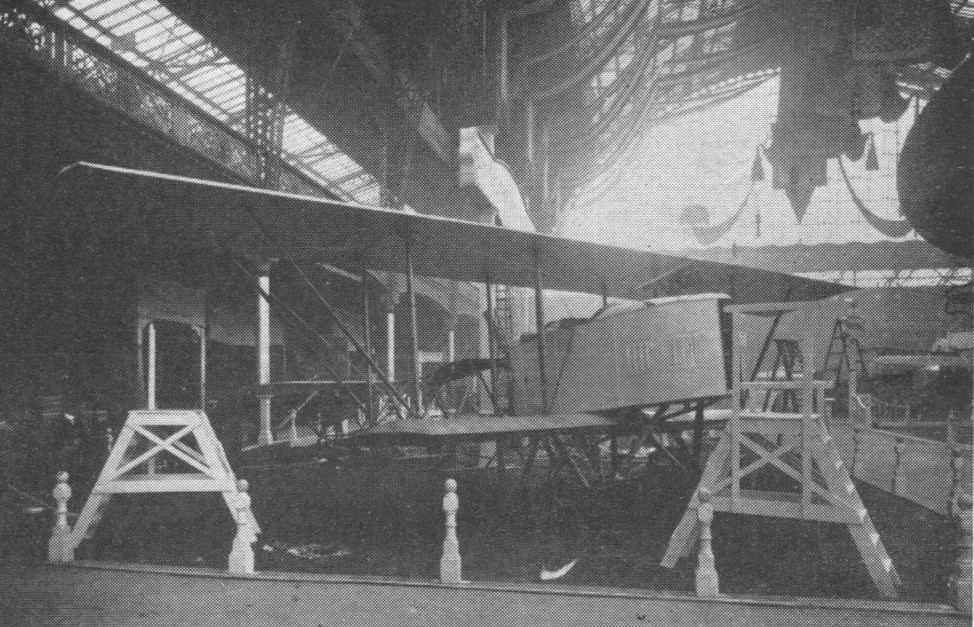
Designed by J.D. North, the Grahame-White Type VI was a pusher configuration unequal-span biplane. The tail surfaces were carried on three steel tube booms, with the single upper boom passing through the propeller shaft and the lower pair to the rear of the undercarriage. The propeller was driven by a large-diameter tubular driveshaft and a duplex chain, the propeller being mounted at the top of the rear of the nacelle. There were no centre-section cabane struts, the upper wing being supported solely by the interplane struts. The engine was mounted at the front of the rectangular section nacelle behind a specially made curved radiator. The two crew members were seated either side, the pilot seated behind them.
The control wires for the tail surfaces were carried inside the upper boom, an arrangement credited to Horatio Barber, for whose Aeronautical Syndicate Ltd North had worked. The aircraft was armed with a Colt .30-calibre machine gun on a flexible mounting at the front of the nacelle.
First type to officially carry a number in catalogues and publications of the time.
While it was originally intended to be powered by a 120 hp (89 kW) Austro-Daimler 6 cylinder inline, it was shown at the 1913 Olympia Aero Exhibition fitted temporarily with a 90 hp (67 kW) Austro-Daimler instead. Only one attempt was made to fly the Type VI. The underpowered aircraft only just managed to clear the hedge at the boundary of the airfield, and made a forced landing in the next field. North went on to design a broadly similar aircraft with a more conventional four-boom mounting for the tail surfaces, the Grahame-White Type XI.
Engine: 1 × Austro-Daimler 6-cyl., 90 hp (67 kW) Propeller: 2-bladed Chauvière, 10 ft (3.0 m) diameter Upper wingspan: 42 ft 6 in (12.95 m) Lower wingspan: 23 ft 0 in (7.01 m) Wing area: 390 sq ft (36 m2) Airfoil: Eiffel plane No. 8 Length: 33 ft 9 in (10.29 m) Empty weight: 2,200 lb (998 kg) Gross weight: 2,950 lb (1,338 kg) Maximum speed: 70 mph (113 km/h; 61 kn) at sea level Endurance: 2¾ hours Crew: 3 Armament: 1 Colt .30-calibre machine gun on flexible mounting
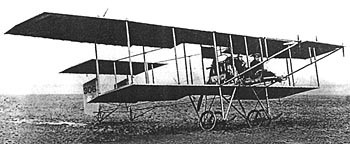
Though many aircraft of that time carried that name (most often as a simple nickname), it is generally associated with Bristol and Farman types. And of course Grahame-White’s Boxkite of 1912 owned a lot to the Farman design. This type can be recognized by the single rudder which prolongs the tail booms.
The 1911 New Baby was developed from the Baby and built by Grahame-White. Contrary to the Baby, it had no rigid enclosure.
Both the Baby and New Baby appeared on the racing circuit at the same time, being variously piloted by Grahame-White or other pilots. The New Baby was later modified with a single rudder that was split on either side of the elevator.
The Grahame White Baby was a single-seat biplane pusher, of the then orthodox “Farman” layout, with a frontal elevator and a rear-mounted empennage consisting of a biplane horizontal stabilisers with single elevator mounted on the top surface and a single central rudder. As the name suggests, it was considerably smaller than most contemporary aircraft of a similar layout, having a wingspan of only 27 ft (8.2 m). In comparison, the wingspan of a standard Bristol Boxkite was 34 ft 6 in (10.5 m). An unusual feature of the aircraft was the mounting for the 50 hp (37 kW) Gnome rotary engine, which was mounted on a pair of angled beams so that the engine was midway between the upper and lower wings.
It was built by Burgess to Grahame-White’s order and never produced in the United States. The Burgess Company in the United States purchased a licence to build it as the Model E.
First flying in 1911, about six were built in total.
Engine: 1 × Gnome, 50 hp (37 kW) Wingspan: 27 ft 1 in (8.25 m) Length: 31 ft 9 in (9.68 m) Height: 8 ft 6 in (2.59 m) Gross weight: 655 lb Maximum speed: 55 mph Endurance: 4 hours Capacity: 1
Burgess E Baby Span: 36’10” Length: 31’8″ Seats: 1-2



 All Aero