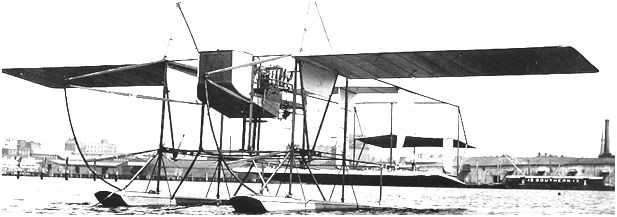
Built in the USA, R. R. Grant’s Aerostable hydroplane of 1913 featured a device whereby the angle of incidence could be changed while in flight. The operator turned a small wheel when changing or adjusting for the proper angle. The wing framework was built of white ash and steel tubing covered with Goodrich alumina cloth. The floats were of the catamaran type, each two ft wide by 21 ft long. Each pontoon was divided into five watertight compartments.
Engine: Emerson two-cycle, 100 hp Wingspan: 42 ft Length: 41 ft Weight: 1600 lb
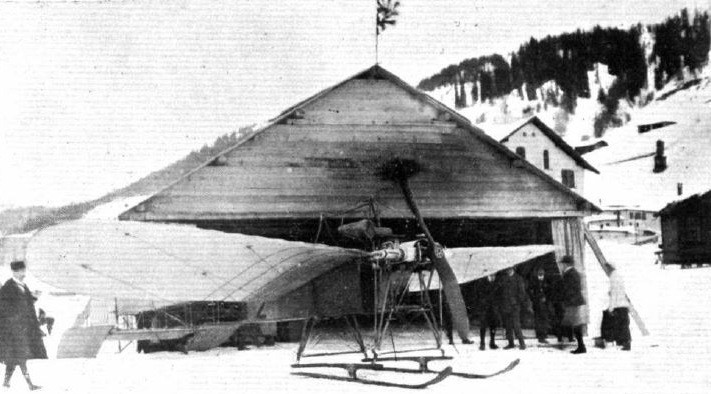
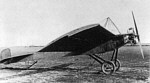
The 1909 Grandjean monoplane was designed and built by Rene Grandjean in Switzerland.
In December 1911 René Grandjean was invited at Davos to fly and here he got the idea to build a ski undercarriage. On 2 February 1912 he made the first take off and landing on skis in Switzerland. His self-built Blériot-like plane was powered by an opposed four-cylinder Oerlikon engine.
Constructed by engineer Einar Lilloe Gran, the first motorised airplane in Norway had a wing span of 10 meters and cost 12,000 kroner to build. Powered by a 30 hp 2-cylinder Darracq motor, the monoplane was originally put on display in Oslo during March 1910, and then taken to Ringerike where several attempts to get the machine airborne were made, but without any significant results.
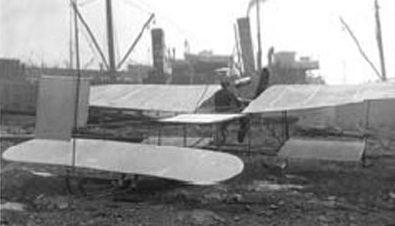
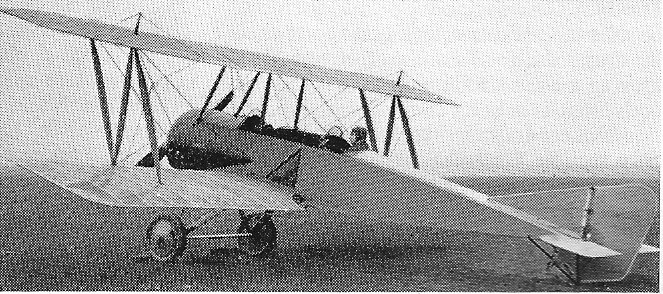
The 1913 Gramaticescu monoplane was designed by G. Gramaticescu (who died before the plane was finished) in Romania, and built by M. Herbster in France.
Appearing in 1914, the Grahame-White Military Biplane was designed by J.D. North as a conversion of the floatplane produced to take part in the Circuit of Britain seaplane race.
Powered by a 100 hp Monosoupupe-Gnome engine, it was damaged during a practise flight and, as the 1914-18 War prevented the seaplane race from being flown, it was rebuilt as a military landplane. It was not adopted for production.
Engine: 100 hp Monosoupupe-Gnome Wingspan: 27 ft 10 in Length: 26 ft 6 in Max speed: 80 mph Landing speed: 42 mph
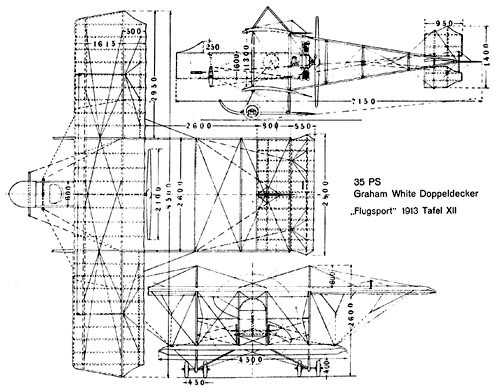
The Grahame-White Type XV (sometimes called “Bi-Rudder ‘Bus” or “Box-Kite” of 1915 was directly derived from the Type XII.
The aircraft itself was a pod-and-boom configuration biplane with three-bay un-staggered wings. In early models, two seats were fitted on the leading edge of the lower wing for the instructor and the trainee pilot; in later models, space was provided for them in tandem in an open-topped nacelle, with the engine mounted pusher-fashion behind them. The empennage was carried on four parallel beams extending two each from the top and bottom wings, and consisted of twin rudders and a horizontal stabiliser and elevator that were carried on the top two beams. Early production aircraft had wings of equal span, but later examples had long extensions fitted to increase the span of the upper wing. The landing gear comprised two separate, wing-mounted, ‘two-wheel plus skid’ assemblies and a tail-skid.
This military trainer biplane was built in quantity for the RNAS (as the Admiralty “Type 1600”) and later the RFC, for a total of 135 aircraft. It was known as the Admiralty Type 1600, since the first aircraft of the type purchased for the Royal Naval Air Service was given that serial number, and contemporary practice was to assign type numbers based on the serial number of the first example in service.
First flying in 1913, there were notable differences between the early and late examples produced, but they retained the same designation. They were made in a variety of forms from 1912 – 17, undergoing a gradual evolution, losing the front elevator and having a cockpit nacelle, aileron balance cables, top wing extensions and dual controls fitted. The Type XV can also be found as the “G.W.15” in some sources.
60hp Le Rhone, 70 & 80hp Gnome and 60hp Green engines were among those used to power the huge variation of types built under the general umbrella name of GW XV.
The Type XV was extensively used as a trainer by both the RNAS and RFC, with 135 machines being purchased for this purpose. In November 1913, one RFC Type XV was employed in the first British trials of firing a machine gun (a Lewis gun) from an aircraft at targets on the ground. Despite the number of aircraft produced, little documentation on the type has survived.
The XV trainers were the type used by No. 65 Squadron RFC, and 48 Reserve Sqn at Waddington from November 1916 to June 1917, as they were established for 18 machines, and A1700 was definitely on their charge. Along with Farman Shorthorns they were the first aircraft based here.
The Type XV was also operated by the Australian Flying Corps at Central Flying School, Point Cook, Victoria, Australia.
GW XV, c.1916
Three Type XVs survived the First World War to become civil aircraft, being some of the first aircraft to bear British aircraft registrations once civil flying was permitted in 1919.
Designed by J. D. North, the Type XIII Circuit Seaplane, originally known as the Circuit Seaplane, of 1914 was a twin-float two-seater tractor seaplane initially built to be flown by Claude Grahame-White in the Daily Mail’s 1914 “Circuit of Britain” air race that was cancelled due to the outbreak of World War I.
It was a conventional single-bay biplane with staggered wings of equal span braced by N-struts. The forward fuselage featured a highly streamlined aluminium engine cowling, with the rest of the construction being wood and fabric. The landing gear consisted of twin pontoons, with a small third pontoon carried beneath the tail.
First flown in 1914, the Type XIII was later converted into a landplane and marketed as the “Type 13 Scout” but no orders materialized.
Engine: 1 × Gnome Monosoupape, 100 hp (75 kW) Wingspan: 27 ft 10 in (8.48 m) Wing area: 290 ft2 (26.9 m2) Length: 27 ft 3 in (8.31 m) Empty weight: 1,040 lb (470 kg) Gross weight: 1,800 lb (820 kg) Maximum speed: 85 mph (136 km/h) Endurance: 5 hr 30 min Crew: One pilot Capacity: 1 passenger
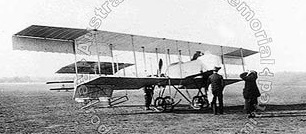
The Grahame-White Type XII “Bi-Rudder ‘Bus” of 1913 was sometimes dubbed the “School ‘Bus”.
This boxkite-type aircraft participated in numerous races before the war and led to the military Type XV. The designation “Type XII” is assumed to be right for this aircraft because the Type XV has been described as “derived from the Type XII”.
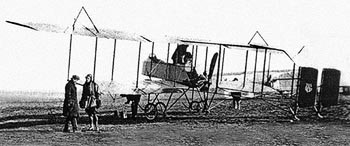
The Grahame-White Type XI (also known as the “Naval and Military Biplane”) was an early aircraft built in the United Kingdom and marketed as being particularly well-suited to military applications. Designed by J. D. North, it was a two-bay biplane of pod-and-boom configuration with un-staggered wings of slightly unequal span. The pilot and an observer sat in tandem, open cockpits in a streamlined nacelle, with the 100 hp Gnome engine mounted pusher-fashion behind them. Unusually for an aircraft of this period, the propeller was not driven directly by the engine, but rather, via a sprocket and chain system that geared it down in the ratio of 14/23. The undercarriage was of the fixed, tailskid type but was designed to be easily exchanged for pontoons. Construction throughout was fabric-covered wood, with the exception of a neat aluminium cowling for the engine and transmission.
A sample was exhibited at the Olympia Aero Show in 1914. It remained in prototype form.
Engine: 1 × Gnome Monosoupape 9 Type B-2, 100 hp (75 kW) Wingspan: 37 ft 0 in (11.28 m) Length: 26 ft 6 in (8.08 m) Empty weight: 1,000 lb (455 kg) Maximum speed: 80 mph (130 km/h) Endurance: 5 hours Crew: Two, pilot and observer
 All Aero