France
M. J. Guillemin designed a high-wing single-engine light postal or ambulance monoplane, the J.G.40, shown on the Bleriot Aeronautique stand at the 1930 Paris Air Show. The latter company acquired the license to build aircraft. A two-seat light aircraft, the J.G.10, competed in the French Air Ministry Light Aeroplane Competition of 1931, but retired with engine trouble.
Pioneers
Guillebaud Tandem-monoplane
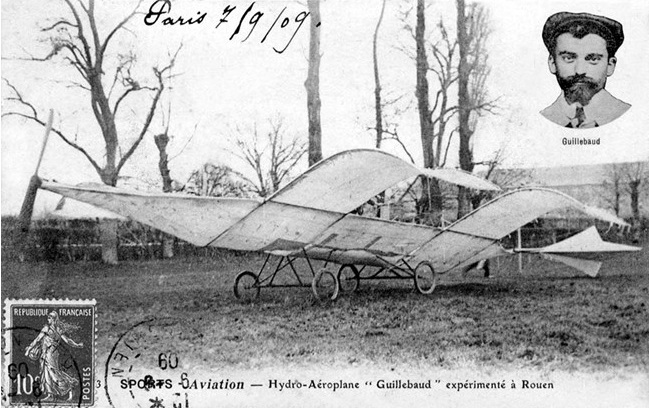
Designed and built by Charles Guillebaud in France 1910
Length: 13m
Weight: 220kg
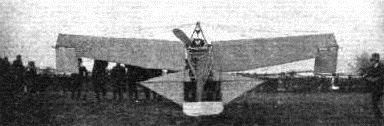
Grundner Taube
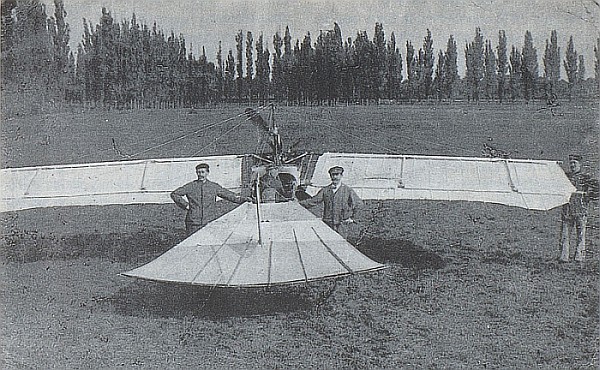
The first aeroplane built in Speyer (Pfalz), by a Leutnant Grundner with assistance of the officers of the Kgl. II Bayerische II. Pionierbataillon, which was stationed at Speyer. Details of its flying capabilities (if there were any) and other facts are missing. Flat wings without airfoil and exposed structure on the upper wing surface were for 1912 unusual features and not helpful to get the monoplane in the air.
Gross I / II / IV
The Gross I of 1908 was superior in every way to the contemporary British Nulli Secundus, with the British airship being capable of only 13 mph and only able to stay aloft for four hours.
Conversly, the efficient Gross II made a record flight of 13 hours in September 1908, and later the larger Gross IV of 1913 was accepted for service by the navy for use in the Baltic where it performed useful work during the war. The Gross II was frequently moored out to sea anchors, demonstrating its handiness to be speedily dispatched on patrol, and was one of the few airships to successfully make an attack on a British submarine in 1915.
The earlier Gross airships, although used by the army air battalion in a ground support role with the army, were not possessed of any distinctive transferable constructional features and contributed little to the development of the airship itself.
Gross
The German government ordered Major von Gross, the officer commanding the army balloon establishment outside Berlin, to commence the design of a large semi-rigid to match French efforts. Work began in 1906 under conditions of the greatest secrecy, and was to result in the construction of a series of airships distinguished by an envelope of elipsoidal form with a triangular-section, articulated tubular steel keel.
The structure evenly distributed the shear and compressive stresses that resulted from the weight of the cars and other loads, whilst allowing the envelope to retain its shape to the best aerodynamic advantage. The Gross airships were shown to be sturdy and well-engineered craft, the development of which benefited from the availability of almost unlimited resources provided by the German government.
Grose & Feary 1910 Monoplane / Oakington Monoplane
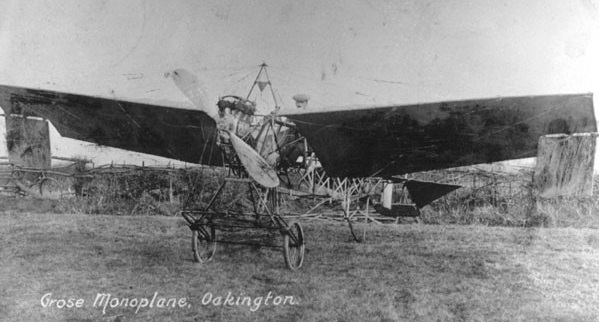
Built in the UK, construction commenced in 1909, and testing took place in April 1910, though no flights were ever reported.
Groos Quand même
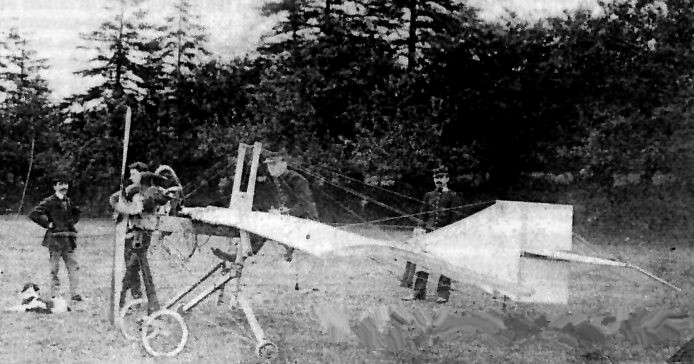
The second design of French military officer Alfred Groos. Produced in 1909, a small monoplane which was named “Quand même” [“Nevertheless”].
It was tested on 30 July 1909 as it flew about 100 meter with a speed of 55 km/hr at a height of ca. 2 meter. When it came down one part of the wing was damaged and the propeller broken. The monoplane had a four-wheel undercarriage (2 bigger in front and 2 small ones behind) and a very simple “fuselage” – about one piece of wood – and was powered by a 25 hp Anzani.
Groos, Alfred
French military officer Alfred Groos first produced in 1909 an unsuccessful little triplane. Also in 1909 he produced an equally small monoplane which was named “Quand même” [“Nevertheless”].
A third machine was designed by Groos, a further development along the lines of the “Quand Même”. It wasn’t named after Groos, but was known as the Paul Kaufmann monoplane of 1909.
Groombridge and South 1903 multiplane
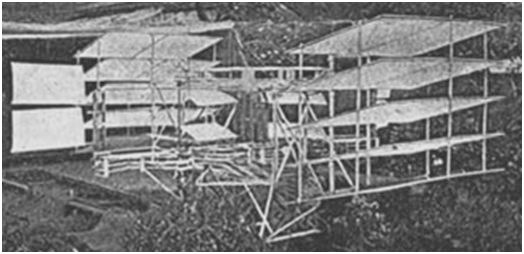
Built in the UK, this 1903 machine, which was about 80 feet in length and 60 feet in width, was to be supported on superposed planes attached to the framework both at the front and rear of the machine. It had three propellers on each side of the framework, and an extra one surmounting the whole structure. The propellers were carried on arms extending from the central driving shaft which form an axis within a rectangle, the two vertical sides of which form axes carrying the vanes of the propellers. During the driving stroke the vanes extended outside beyond the rectangle, while they returned edgewise, in a feathering position, inside it.
Grohmann Eindecker
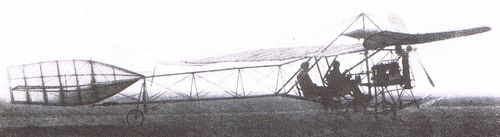
1910/11 two-seater monoplane of Dipl.-Ing. Karl Grohmann, with a high-positioned “Zanonia” wing and a fully open fuselage. It was powered by a 50 hp Argus engine, which drove the tractor screw via a chain. Immediately on its first flight the machine flew 300 meters. Later Grohmann built a single seat development of the 1911 machine. Sometimes the two-seater is identified as the Grohmann I and the single-seater as the Grohmann II, but this is probably a spurious coding introduced years after the event.
 All Aero