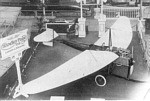
The 1911 Handley Page Type D monoplane was designed and built by Handley Page in the UK.
Span: 32′
Length: 22′
Weight: 420 lb
The 1911 Handley Page Type D monoplane was designed and built by Handley Page in the UK.
Span: 32′
Length: 22′
Weight: 420 lb
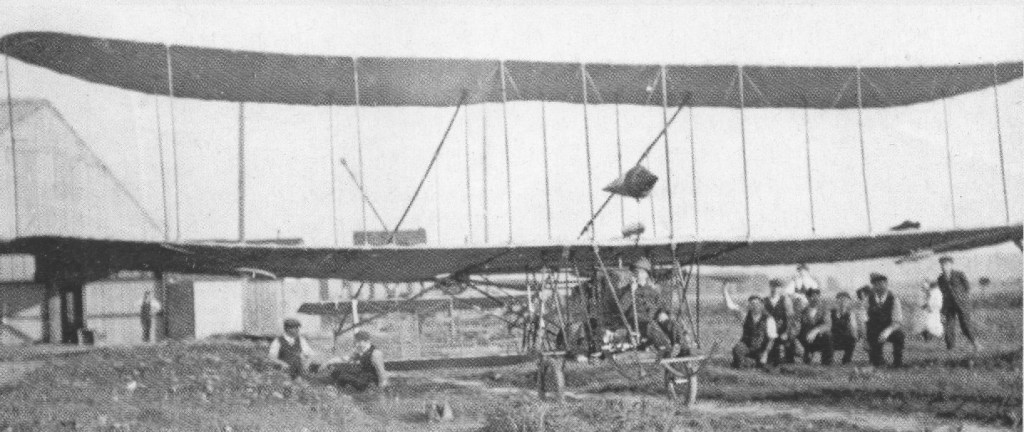
In 1909 Handley Page took a commission to build a prototype biplane aircraft, the concept of W.P.Thompson of Freshfield, Lancashire. Thompson had registered ideas of aircraft control by variable wing area and centre of gravity movement and was keen to build an aircraft with “pendulum stability”, with most of its mass mounted flexibly below the wings. The concept involved having pendulum stability by having the pilot, powerplant, and undercarriage suspended beneath the wing structure.
This was done with input from both Handley Page and Thompson’s assistant Robert Fenwick. The wide gap biplane wings were of two-bay form though in the absence of a fuselage between the wings there were further interplane struts. Two tail booms, each based on a cross-braced pair of members joined to the upper and lower wings, supported a biplane tail. It had no fuselage, the 60 hp Green engine was flexibly mounted below the lower wing and drove a pair of pusher propellers, mounted at lower wing level, via a pair of chains.
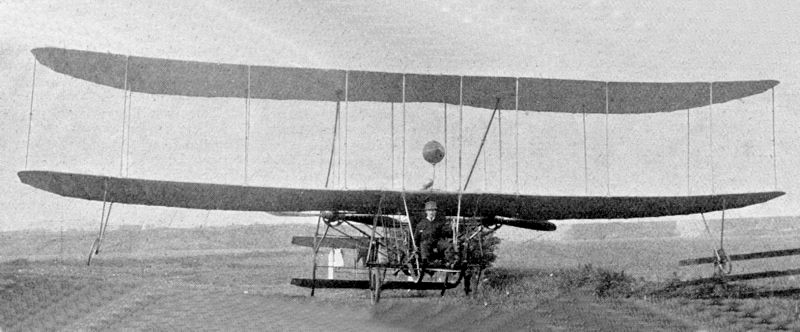
Designated the Handley Page Type B, the undercarriage collapsed on the first attempt at flight in late 1909. It was then wrecked when part of the works shed collapsed in a gale. Handley Page decided to have no more to do with what he considered a failure and nicknamed it “The Scrapheap”.
Repaired, it was delivered to Freshfield where Thompson, who had formed Planes Ltd, resumed trials.
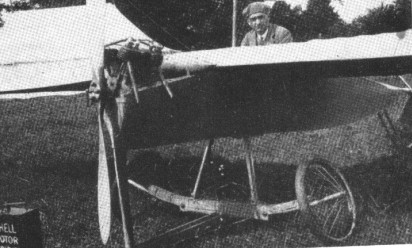
In June 1909 Frederick Handley Page (later Sir) established this company, building a series of monoplanes with crescent-shaped wings inspired by the Austrian designer Jose Weiss.
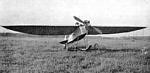
The first powered aeroplane was the type A, or Bluebird, with a 20 hp Advance V-4 engine. It was of wood construction with a tailskid landing gear, using a wing with a shape patented by José Weiss, which was claimed to provide automatic lateral stability, so there were no ailerons or wing warping mechanisms. The wings, fuselage and tail surfaces were covered with a blue-grey rubberised fabric, hence the nickname Bluebird. Priced at £376 at the March 1910 Olympia Aero Exhibition, it found no buyers.
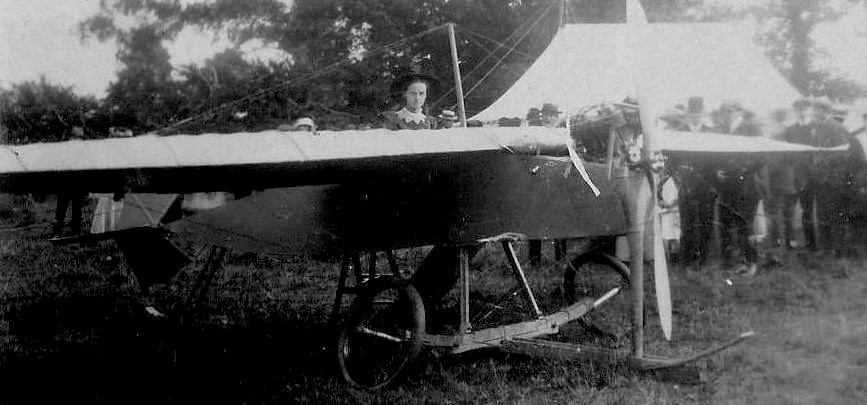
Even after adding a triangular tailplane to the all moving cruciform tail surfaces only a few straight hops were achieved.
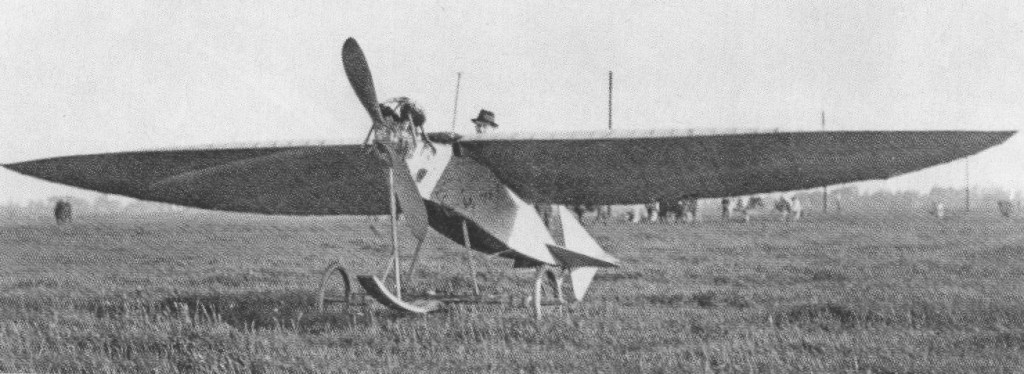
When FHP took off on May 26, 1910, the craft side slipped into the ground due to lack of lateral control at the first attempt to make a turn.
Adding wing warping and installing a 26 hp Alvaston engine did not help the redeignated Type C craft to fly.
Although a 50 hp Isaacaon was then fitted, it was abandoned unflown.
Span: 32’6″
Length: 20’6″
Weight: 450 lb
Speed: 35 mph
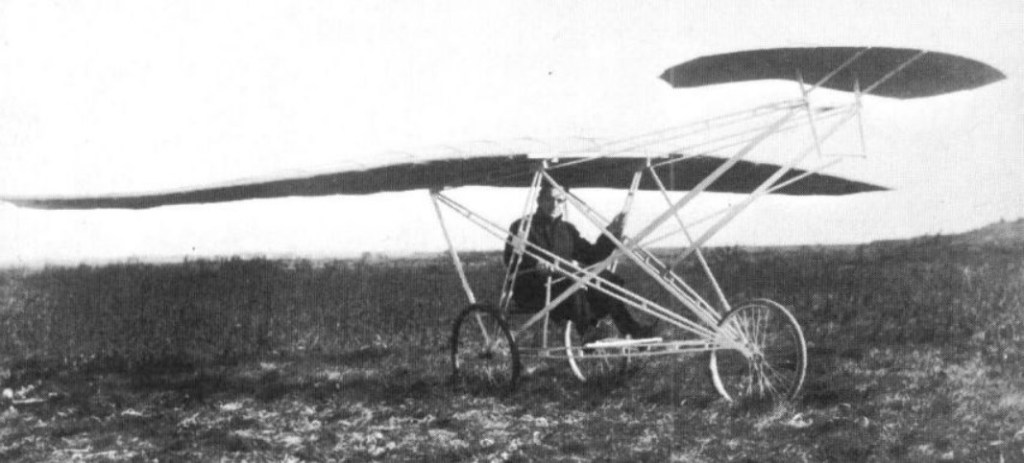
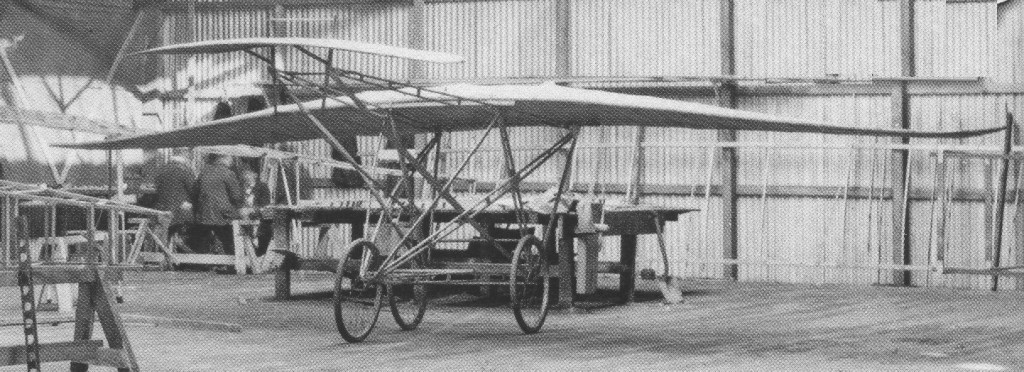
Soon after publication of Jose Weiss’s flexible wing patent (No. 17150) on 14 August, 1908, Handley Page began building his canard glider, with the help of his first employee, Tucker, and his first two premium pupils, Cyril W. Meredith and Arthur Dukinfield Jones.
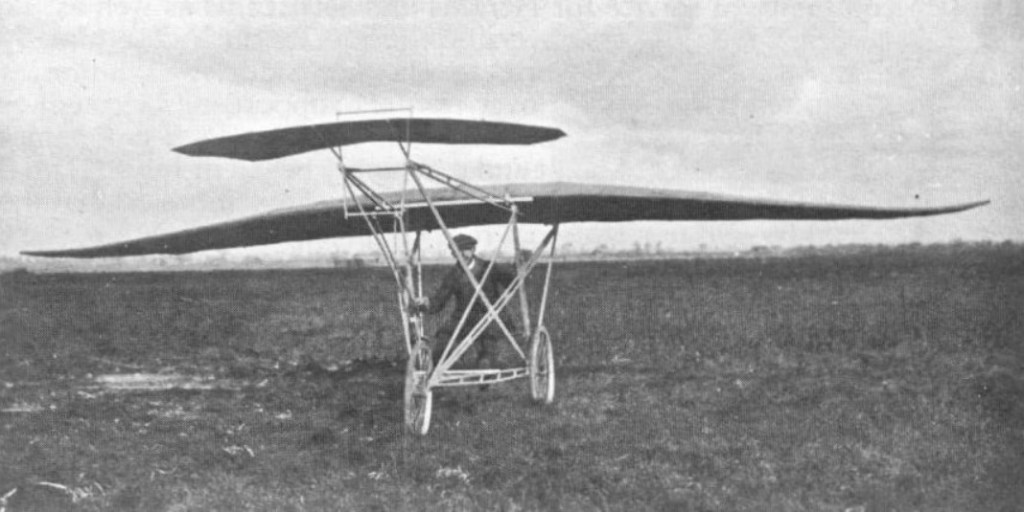
With this apparatus he hoped to emulate the Wright brothers by teaching himself to fly. His attempts to take off from the sloping dykes adjoining Barking Creek were unsuccessful, but at least he learned the necessity for a long skid to bridge the many ditches lying in wait to trip and break an unprotected wheeled chassis; these would have been fatal to an unguarded airscrew.
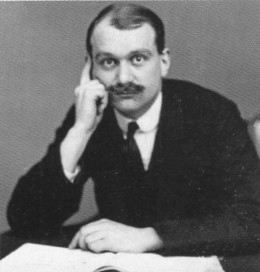
Born at Cranham Villa, Kings Road, Cheltenham, Gloucestershire, on November 15, 1885, Frederick Handley was the second son of Frederick Joseph Page and his Wife Arm Eliza, nee Handley. He always used the combination of “Handley Page”. A Cheltenham Grammar School report of 1896 placed him first in his class of 13 boys. He then studied electrical engineering at Finsbury Technical College, and in 1906 became chief designer for electrical machinery manufacturers Johnson & Phillips.
Already interested in mechanical flight, Frederick began experimenting with model gliders and ornithopters, eventually being invited to assist Maj R.F. Moore ,on the “Wings Committee” of the Aeronautical Society of Great Britain (ASGB).
In 1908 he was introduced to landscape artist Jose Weiss, who had patented a wing of distinctive shape, but Weiss was no engineer, so his gliders were rather crude. On June 10, 1908, FHP joined the Weiss Aeroplane & Launcher Syndicate.
While still at Johnson & Phillips he instituted some unauthorised aeronautical work using the factory track, but his employers took a dim view of this and dismissed him. Undeterred, FHP set up an office in a shed in Woolwich, even taking a stand at the Olympia Aero & Motor Boat Show in 1909, featuring the Weiss gliders and his own canard glider, of better construction but having the Weiss patent wing. He attempted to fly this from marshlands near Barking Creek, Dagenham, but without success. He was also manufacturing Weiss propellers and supplying small parts to budding aeronautical engineers and experimenters.
Frederick floated his new business as a private company on June 17, 1909, registering “Handley Page Ltd” for the express purpose of the design and manufacture of aircraft at Berking Creek, Essex. He always claimed that his was the first such company in the UK, but by this time Short Bros was well established as an aeroplane
manufacturer. However, Short Bros was a partnership, not a company.
The first Handley Page factory were some wooden huts on the banks of the Thames at Barking, operating from 1909 to 1912. The company’s aerodrome was a playing field at Fairlop.
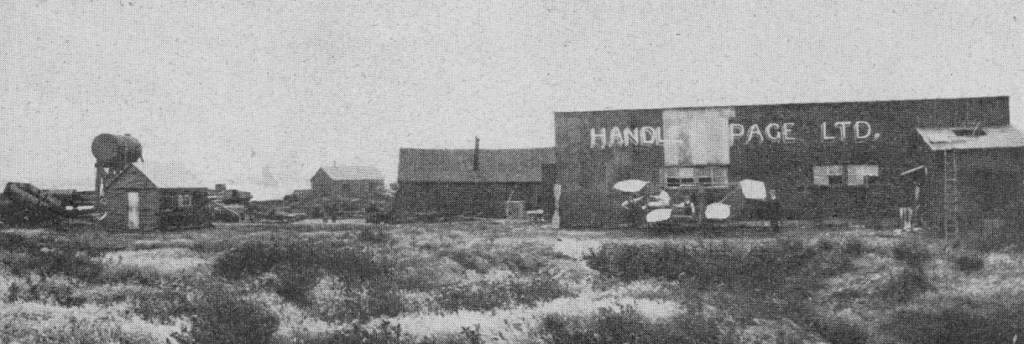
In September 1912, the H.P. works moved to 20,000 sq.ft of converted riding stables in Cricklewood, north London.
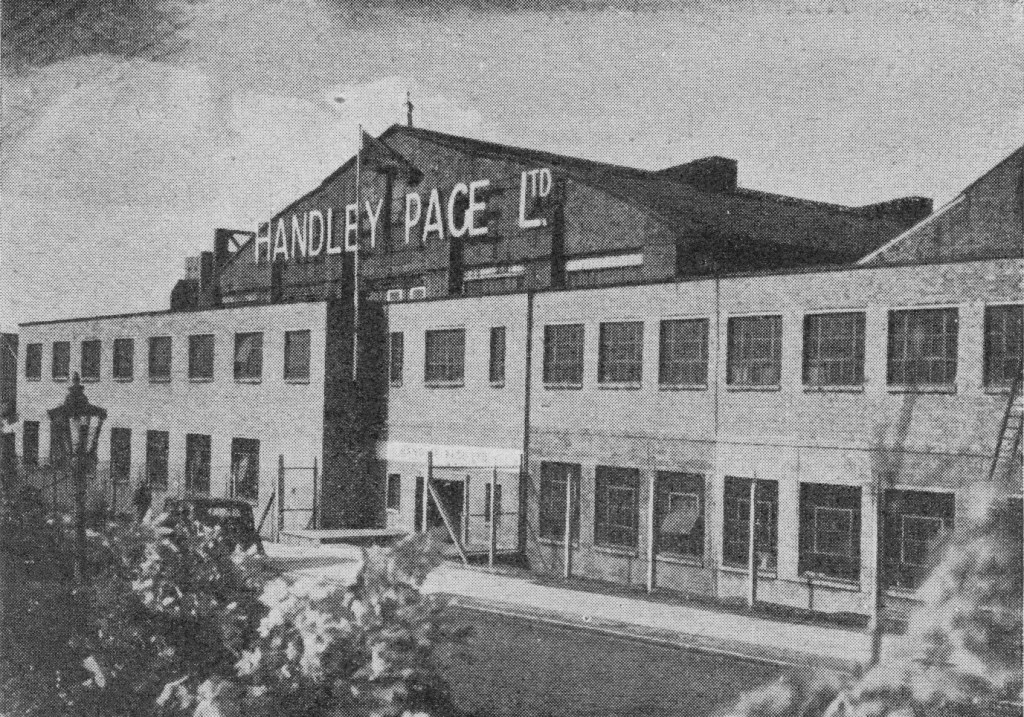
From Cricklewood, final assembly and flying was done from Radlett.
Until the start of the First World War the young company built very few aircraft.
As soon as civil aviation was permitted after the war’s end, FHP formed his own airline, using converted O/400 bombers and flying to France and the Netherlands. It was taken over by Imperial Airways in 1924. He also exported six aircraft to China.
A big coup was his acquisition, using a company called the Aircraft Disposal Co Ltd, of some 10,000 government surplus military airframes, 30,000 engines and a huge amount of stores, in 1920.
At the end of World War One orders and military work ceased abruptly. FHP weathered the ensuing lean years remarkably well, with a minimal staff. Volkert and his assistant, S.T.A. Richards, produced an inspired series of designs comprising different fuselages combined with a standard set of biplane wings and tail. This was the “W” series of airliners and bombers, built throughout the decade. They also introduced air-cooled engines and metal structures.
24 October 1919 Patent No 157567 is issued for the HP slotted wing.
During the rearmament programme of the mid-1930s the company developed modern monoplane wings for its stopgap Harrow aircraft, and also started designing for dispersed production of components with final “flowline” assembly. The H.R 52 Hampden medium bomber continued this principle, and was the first H.R aircraft to have a retractable undercarriage. Two-thirds of the Hampdens produced were built by other firms.
Despite his strong and prescient urging for a change in bombing policy, from large bombers with heavy and draggy defensive armament to smaller unarmed bombers relying on high speed, Volkert designed the Halifax to an Air Ministry specification. Neither the span limitation of less than 100 ft nor the use of watercooled engines were to his liking, and only when Bristol Hercules engines and increased span were introduced in 1942-43 did the aircraft became competitive with the Avro Lancaster. Nevertheless, the “Halibag” proved capable of operation in all theatres, particularly the Far East. The parent firm built only 1,590 of the 6,177 produced, the rest being made in “shadow” factories.
Handley Page (Reading) Ltd was formed on 5 July 1948 to take over Miles Aircraft Ltd of Woodley for production of Marathon four-engined feederliner aircraft.
Handley Page (Reading) produced the aircraft as a navigational trainer for the RAF, and also as a short-haul airliner. The Reading-based company was also responsible for development of the HPR.3 Herald airliner, which flew initially with four piston engines in 1955, and was subsequently manufactured with two Rolls-Royce turbines as the Dart Herald.
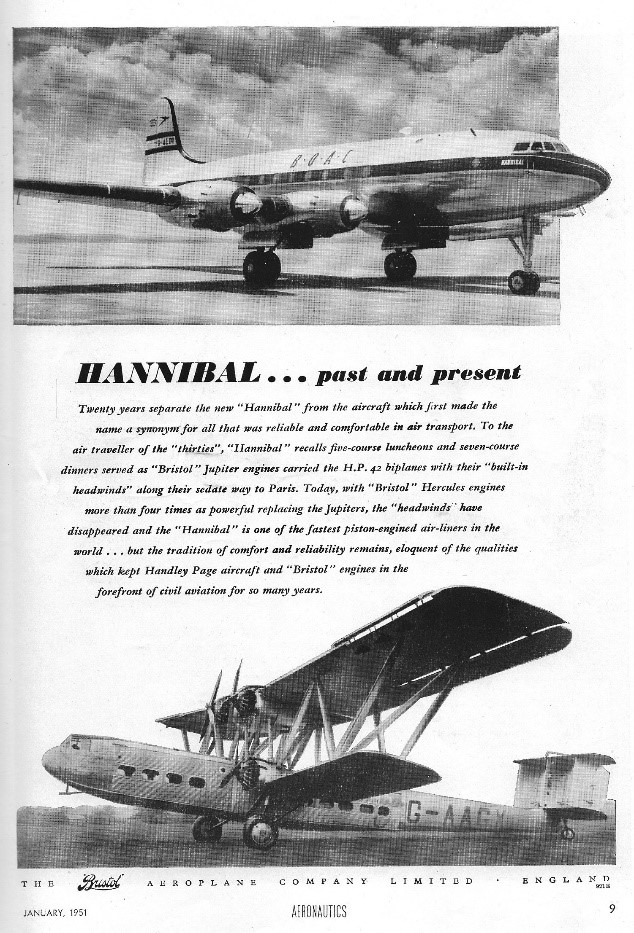
Sir Frederick died on April 21, 1962
The Handley Page company had completed the move of its headquarters from Cricklewood to its aerodrome at Radlett by 1966. It had facilities at Radlett and at Cricklewood for the manufacture and assembly of major components and the erection of complete aircraft. Total floor space available to the company was 971400 sq.ft and it employed some 4000 people.
Test facilities include a structural test rig for any specimen or structure up to 120 ft long by 70 ft wide and 26 ft high with a total applied load capacity of up to 400 tons; fatigue test equipment for 100 ton fluctuating load; water pressure tanks and a range of equipment for standard mechanical environmental, pneumatic and hydraulic tests, chemical and photoelastic analysis, metallography and radiography, and high- and low-speed wind tunnels. The aerodrome, which occupies more than 400 acres, has two paved runways, the longest being 6990 ft.
Directors of the Handley-Page company in 1966 were Air Chief Marshal Sir Walter Dawson, chairman; J. H. S. Green, managing director; C. F. Joy, chief designer; R. S. Stafford, technical director; G. C. D. Russell; S. L. Hastings; and E. Manley Walker. Senior executives are E. W. Pickston, general works manager; D. F Corbett, works manager at Radlett; K. Pratt chief engineer; E. P. Hessey, sales manager; J. Duthie, secretary; J. W. Allam, chief test pilot; and S. A. H. Scuffham, public relations manager.
The major sources of revenue of the company were aircraft sales, sub-contract manufacture, design and test facilities, aircraft overhaul, aviation equipment, domestic and industrial heating and ventilation equipment, food and chemical processing plant, and factory airconveyance installations. The factories were engaged on military contracts in connection with the conversion of Victor bombers, production and overhaul of the Herald, and the design and development of its new 8/18-seater HP137 Jetstream for which the first production line was being laid down in 1966. The company had sold 58 Heralds and was about to start production of more than 20 “off-the-drawing-board” Jetstream orders.
In 1966 feasibility and market studies revealed a definite market for a medium-sized turboprop mini-airliner for commuter and executive use. The H.P.137 Jetstrearn was launched, attracting nearly 200 orders and options in the first year. it even won the United States Air Force contest for the C- 10A transport. But it was a difficult aircraft for a firm used to large and expensive military designs, and development was prolonged. Its airworthiness category imposed a nominal limit in all-up weight which severely affected range/load performance. This was improved with the advent of higher-power engines and a change in category, which allowed take-off weight to rise to the level for which the Jetstream was designed. But it was too late. Development costs had risen to £13 million, and the backers pulled out; the company went into administration.
The death knell came on August 8,1969, when the company went into receivership. A reprieve seemed at hand when it was bought up by an American consortium, the K.R. Cravens Corporation, in January 1970 and rebranded Handley Page Aircraft Ltd. At the same time, however, the consortium’s head was diagnosed with terminal cancer and all foreign interests were dropped. By the end of February the company had ceased trading and on June 1, 1970, the name of Handley Page was consigned to history – after some six decades of aeronautical achievement.
The 1911 Hammond triplane was designed and built by E. V. Hammond in the UK.
The 1909 Hammond biplane was designed and built by E.V. Hammond in the UK.
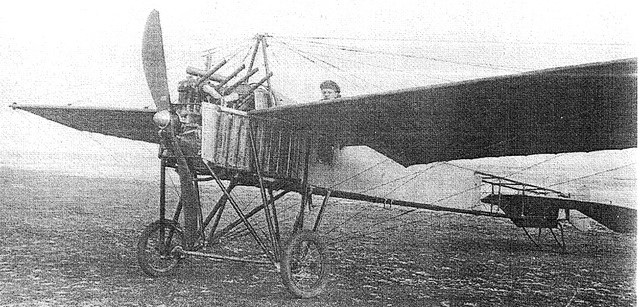
Hammer & Krollmann Eindecker of 1912. A conventional monoplane, powered by a 55 hp Hilz engine. August Birkmaier, Fluglizenz Nr 117, was killed in this plane on 4/10/1912 at Vahrenwalder Heide near Hannover.
The Hamiltonian-Christie aero engine built circa 1910 was a 110 hp V-8 water cooled. It was likely a Curtiss motor modified by Charles K Hamilton.
The 1909 Hamiltonian 60hp was a 4-cylinder inline water-cooled aero engine.
 All Aero