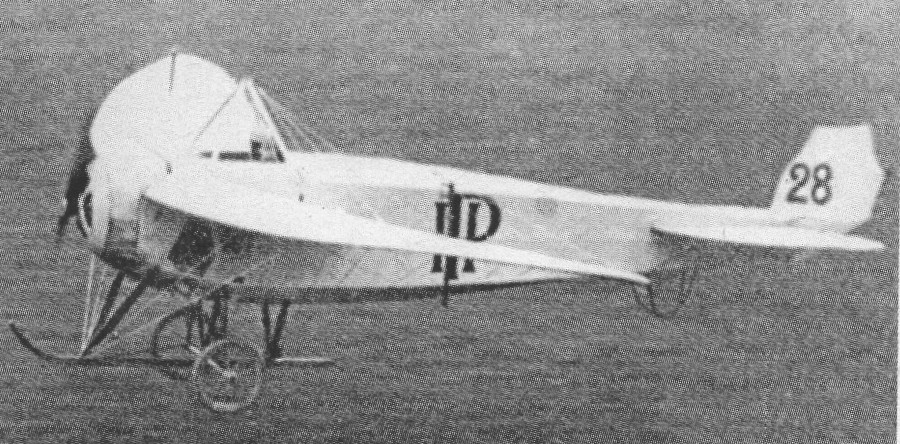
Hanriot VII

The Type VII appeared in 1911, after Clément-Bayard had built a 100 hp engine for. I always thought that had three sets of wires for the wings. Only I can’t prove this with photographs and I might be mistaken.

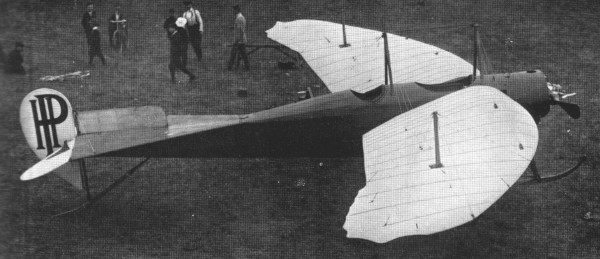
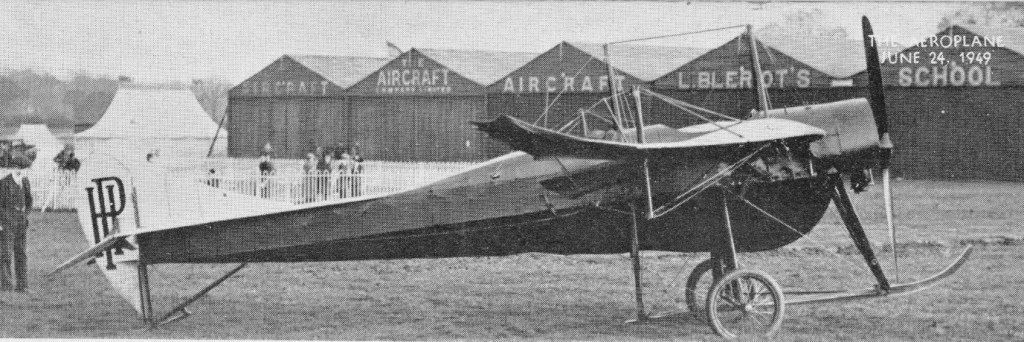
A single-seater similar to the VI, but without the extra inverted-V brace in the undercarriage or tailwheel. There’s a small fuel or oil tank suspended from the wing warping/bracing pylon. Possibly this is the machine shown at the 2nd Exposition de Locomotion Aerienne in Paris, Oct – Nov 1910, and also pictured on at least two postcards with Henri Lefargue.

Hanriot VI

This single-seat machine was introduced by Louis Wagner at the Budapest meet (No.3) in June 1910. Later that month Marcel Hanriot piloted such a type at the meeting of Rouen (No.20).

The VI seems to be the most successful and popular of all the Hanriots. A triangular-section fuse that is wood planked in front and fabric-covered in rear, six-legged undercarriage with an auxiliary diagonal inverted-V brace in the forward bay, no tank suspended from the pylon and what appears to be a small wheel at the end of the tailskid.

But the Type VI was then the high praised machine and entered to most of the important and less important meetings. The type V and type VI were used in 1910 by Marcel Hanriot in air meets.

The 1910-type Hanriot was flown by Georges Bathiat at the September 1910 Maubeuge meeting.

By the end of 1910 the Type VI had lost its tiny tailwheel and was eventually fitted with an 8-cylinder ENV (60 hp).

Engine: Grégoire-Gyp / 8-cylinder ENV, 60 hp
Wingspan: 43 feet
Wing area: 300 square feet
Total weight: 1,120 pounds

Hanriot V

The type V and type VI were used in 1910 by Marcel Hanriot in air meets.
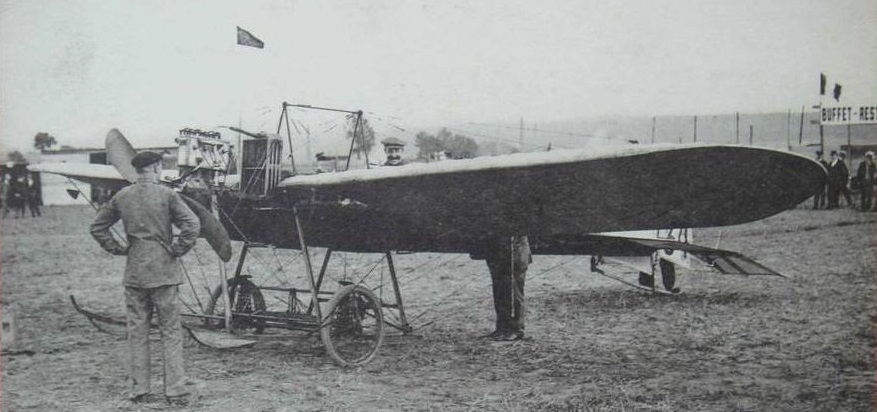
There is a postcard titled “Marcel HANRIOT – Monoplan № 5.” Unfortunately, it’s a closeup of Marcel in the cockpit and doesn’t show any identifiable features of the aeroplane. There are also a few photos of a machine with an all-wood fuselage and six-legged undercarriage (matching the Old Rhinebeck repro in most respects) marked with a large “5” on the fuse.

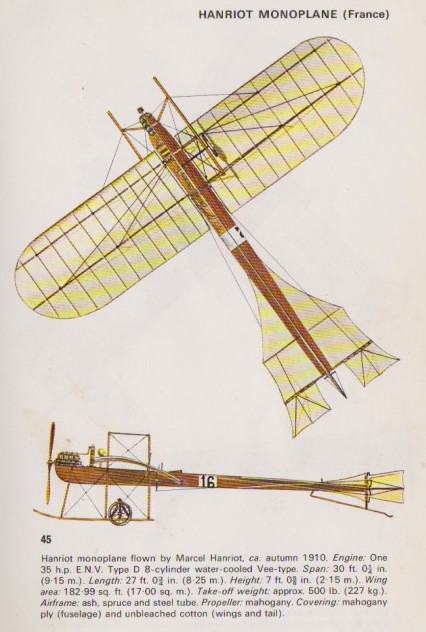
Although Hanriots first airframe had sustained damage during landing, it had nevertheless provided the foundation for a smaller, but similar monoplane which had sported a simple, elegant, aerodynamically-clean configuration when it had appeared in July of 1910. Constructed of ash, spruce, and steel tubes, the aircraft had a mahogany ply-covered, inverted, A-frame, and racing skiff-like fuselage.
On June 4, 1910, a sixteen year boy, Marcel Hanriot, takes off in a graceful aeroplane designed by his father, Rene Hanriot.
The light, but strong structure eliminated the need for the number and complexity of bracing wires traditionally required by box frame or girder build-up assembly. The main spars for the planes are made of wood in three layers and are 3 inches deep. The skids are fixed at the bottom of an A-type frame, the upper part of the A forming a triangular frame above the planes, to which the latter are fastened by stout wires.

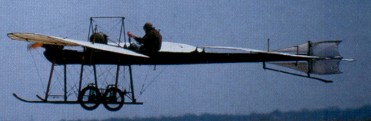
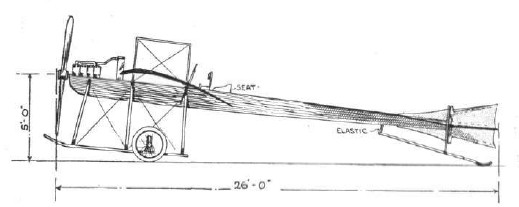
The landing gear is mainly on two strong skids at the front supported by three uprights of the A-type frame work; the axles of the two wheels are carried on vertical guides, and are suspended by rubber springs anchored to the skids. There is a small skid at the rear.

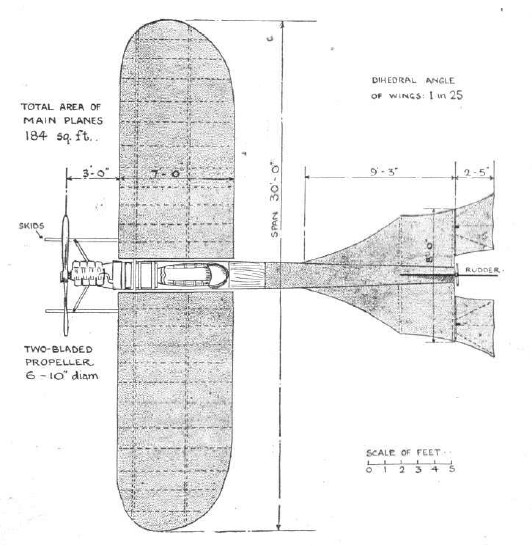
Cambered, rounded-tip wings, formed by two laminated spars and multiple ribs and covered with unbleached cotton fabric, were steel tape lashed to the fuselage and hinged, like those of the Wright Flyer and the Bleriot XI, to induce in-flight banking by means of wing-warping. The 30.5-foot span and seven-foot chord resulted in a 183 square foot area.

The large, triangular-shaped, fixed horizontal tail, measuring 9.3 feet long by eight feet wide and was also covered with unbleached cotton, extended to two separate, longitudinal-controlling elevators, while the fixed surface had been tightly stretched with the aid of two transverse spars and sported both unmoveable, dorsal and ventral, triangular-shaped fins to increase stability.

The laced fabric, scalloped, vertical tail was hinged to provide control about the yaw axis.

Power was provided by a 35-hp, eight-cylinder, water-cooled, V-type, E.N.V. engine, mounted on, and partially supported by, the A-frame struts, its two rows of cylinders set at 45-degree angles to the vertical and sharing a common crankshaft. It drove a single-bladed, mahogany propeller. The type also flew with a Clerget engine.
A four-cylinder 50 horse-power Clerget at 1.203 r.p.m with a Chauviere propeller, 7.2 feet in diameter and 3.8 feet pitch.

With a 27-foot, 3/4-inch airframe and a seven-foot, 5/8-inch height, the pioneer aircraft had a 500-pound gross weight.

The shallow cockpit featured little more than engine and axis-control levers. The right side stick moved forward and aft to actuate the hinged, fabric-covered elevators for pitch control, while the left side stick, moveable in a sideways direction, activated the wing-warping mechanism for in-flight banking, or lateral axis control. The rear spars are hinged, to permit of this. The elevators are 2 feet deep. The coupe atop it, informally known as a “blip switch” provided engine control, usually replacing the left-located throttle, since a hand was seldom free to operate it.

Fuel, stored in the cylindrical, metal tank, directly behind, and on the same level as, the engine, often required pressure to ensure continued flow, initiated by the squeezable rubber ball mounted on top of the right, pitch-control stick.

The scalloped single surface rudder, ensuring yaw-axis stability, was moved by means of a foot-depressed bar.
Initial taxi and direction were usually aided by the ground crew, who lifted the tail from the grass, but a significant power application made the vertical and horizontal tail surfaces effective.

Although there were no incremental throttle settings and the aircraft therefore flew at full, continuous power, its original, 35-hp engine had been inadequate to exert other than a sluggish, wing-warping created banking response.

Descent, induced by a combination of blip switch power interruptions and backward-stick, downward pitch, enabled the Hanriot to return to the ground.

The Old Rhinebeck Aerodrome has a reproduction constructed by Cole Palen, Mike Lockhart, and Andy Keefe with the aid of drawings published in Flight during the winter of 1974 in Florida, had originally been powered by a 1910, two-cycle, water-cooled Elbridge Featherweight engine, but it had later been retrofitted with a more capable, water-cooled, 50-hp Franklin after it had sustained connecting rod damage.

Reproduction:
Old Rhinebeck Aerodrome Hanriot V

Wingspan: 30.5-foot
Length: 27-foot, 3/4-in
Height: 7-foot, 5/8-inch
Wing chord: 7-foot
Wing area: 183 square foot
Tailplane span: 8 ft
Tailplane length: 9.3 feet
Gross weight: 500-pound
Speed: 51 mph approx
Total weight: 760 pounds
Aspect ratio: 4.2 to 1.

Hanriot I / 1907 Monoplane

In 1908, while the automobile races are in full swing, René Hanriot wins the World Championship (unofficial) in a Benz of 150 hp. In May he bought one of Léon Levasseur’s Antoinette monoplanes with a 25 hp motor. But by the end of 1908, the monoplane was not yet delivered and René Hanriot lost patience. This was when he decided to make his own machine. In February 1909 he creates the Hanriot Monoplane Corporation with 500,000 Francs capital. A shed was used as a hangar, workshop and office. His son assisted with the building of the aeroplane. In the summer of 1909, the first Hanriot I proudly left the workshop for its first flight. The motor seemed questionable as early as the departure. Hanriot bought a 6-cyl Buchet, that develops 45 hp and weighs 155 kg.
The machine was subsequently displayed at the Salon de la Aeronautique in 1909.

The aircraft, powered by a single, 50-hp Buchet engine, featured an open framework fuselage mated to two rectangular wings of 31.2 feet span.
Its slender lines and good looks instill confidence and Hanriot receives orders for about twenty of his machines, although it did not again fly. In October, the flights to Bétheny and those carried out at Reims by René and Marcel show that the motor is too heavy! The machine is unable to do more than short hops. He looks for another motor. A virtually unknown engineer by the name of Pierre Clerget, from la Maison Clément-Bayard, that he knows from his auto racing days designs a four cylinder in-line engine of 40 hp.
Although Hanriots first airframe had sustained damage during landing, it had nevertheless provided the foundation for a smaller, but similar monoplane which had sported a simple, elegant, aerodynamically-clean configuration when it had appeared in July of 1910.

Hanriot

In 1908, while the automobile races are in full swing, René Hanriot wins the World Championship (unofficial) in a Benz of 150 hp. But he already had another sport in mind. In May he bought one of Léon Levasseur’s Antoinette monoplanes with a 25 hp motor. But by the end of 1908, the monoplane was not yet delivered and René Hanriot lost patience. This was when he decided to make his own machine. In February 1909 he creates the Hanriot Monoplane Corporation with 500,000 Francs capital. A shed was used as a hangar, workshop and office. His son assisted with the building of the aeroplane. In the summer of 1909, the first Hanriot I proudly left the workshop for its first flight. The motor seemed questionable as early as the departure. Hanriot bought a 6-cyl
Buchet, that develops 45 hp and weighs 155 kg.
The machine was subsequently displayed at the Salon de la Aeronautique in 1909.

Hanriot Article

By this time, devoting himself to his aviation business, René Hanriot abandons autoracing permanently for the flying. In the winter 1909- 1910, he buys several motors that he installs in his monoplanes. By now several copies and versions of the engine are available:
the V8 E. N. V., 50hp, 105kg, designed in 1908 by the British engineer Paul Rath
the four cylinder Vivinus, 70hp, 159kg
the Grégoire GYP by Pierre Joseph Grégoire, weighing 115kg,
the two cylinder Darracq , 30hp, 55 kg,
and a four cylinder of the Même Marque, 60hp, 130 kg.
But it is with the 4-cylinder Clément-Bayard of 40hp that the best results are obtained. The motor, cooled by water, weighs in at just 78kg, in working condition, and it develops not 40hp, as its competitors, but close to 50 true hp. With this motor the flights during the winter 1909-1910 are successful. The monoplane sometimes being piloted by the father, sometimes by the son.

With money earned racing automobiles, René Hanriot continues to develop his aviation business. Committed to flying, he opens a piloting school in Bétheny in December 1909, then in London in January 1910 where he opens a commercial affiliate The Hanriot Monoplane Company Ltd, with 600,000 Francs capital. The first year, 1910, he gains notoriety in Paris, at the 14, place du Havre, and creates at vast workshop in Paris at 34, rue du Moulin. Prudent, he recruits an experienced airman, Emile Ruchonnet, to develop his flying machines, and serve as engineer and chief pilot in his flight school. Former carpenter and former foreman with Levavasseur, Ruchonnet, who was registered in Reims, August 1909, in an Antoinette monoplane, has had his pilot’s license in France’s flying club since June 21, 1910. In April René Hanriot hires autoracer Louis Wagner as test pilot. He is in charge of representing the company at international meetings. His first competition is in Budapest June 5.
Eugene Ruchonnet, Leon Levasasseurs engineer, subsequent designs, developments of the first constructed at his Rheims workshop, had included the 20-hp, Darracq-engined Libellule and a larger derivative powered by a 40-hp Gype, both of which had enabled him to establish a flying school in Betheney in 1910. Instrumental in these aircraft had been Louis Wagner who, like Hanriot himself, had risen from the ground up as a racing car driver, and Marcel Hanriot, Hanriots son, who, at the age of 15, had become the world’s youngest pilot.

In a few months, Hanriot and Ruchonnet designed a new lighter monoplane, the type II. Baptized “Dragonfly” it flew at Bétheny in April, equipped with a 40hp Clément-Bayard. Then, they create a third type of monoplane, more powerful, intended for the competitions. The type IV, a two place, interested the army.
The type V and type VI were used in 1910 by Marcel Hanriot in air meets. Finishing his school year, Marcel Hanriot spends his Sundays on the grass in Bétheny. His father asks him to try all monoplanes produced by their firm. May 17 in Bétheny, Marcel Hanriot takes engineer Etienne Grandjean, a professor at à l’Ecole supérieure de l’aéronautique, for a flight over Champangne in the two place.
June 9, Marcel Hanriot flies from Bétheny to Mourmelon in their model VI. It gets ahead of Marthe Niel, a woman, flying a slower Voisin biplane. The following day Marcel Hanriot obtains his pilot’s license, with the n° 95. He is the youngest licensed pilot in France and most likely in all of Europe. During the 1910 season, the Hanriot monoplanes, piloted by Wagner (Budapest), Marcel Hanriot (Rouen, Caen, Dijon, Reims, Bournemouth), René Vidart (Lanark) and several foreign pilots, achieve glory in the aerial meetings. They win a number of honors and have several victories, showing off the French brand to the entire world, and reaping great financial rewards for the firm.

Aerial demonstrations are organized throughout the year from April to October, in the field at Budapest, but the summit of the 1910 season was the Grand Prix, from 5 May to 15 May1910 in Vienna, then the big week of aviation, June 5 to June 12, with prizes for flight time, distance traversed, altitude, and best take-off, plus a special prize for the trip (230 km traversed in six hours), with 200,000 Francs payoff.

Beginning 1910, thirty competitors were registered in Hungary. France engaged its habitual stables: with Voisin Rougier, Croquet, the Italian Baron of Caters, the Viscount Montigny and John Adorjan, with H. Farman Paulhan, Nicolas Kinet, Chavez, Efimoff and Jullerot, with Sommer André Frey, Hélène Dutrieu and Amerigo, Latham with Antoinette, Alfred of Pischoff (pardon, von Pischoff it was born Vienna Austria!). Orville Wright registered and entrusted a biplane to Engelhardt. Several pilots of the Austro-Hongrois Empire appear in local machines: Agoston Kutany, Erno of Horvath, Aladan of Zsekely. The day of the competition half of the registered competitors were missing. Dutrieu s’est abattue sur son Sommer to Odessa, and this is the Baroness of La Roche that defends the colors Voisin; she had access to a big ENV engine, as did Frey (Sommer) and Pischoff. The Austrian Illner (Etrich) and the French Wagner (Hanriot) had access to a 40hp Clément-Bayard (Clerget) engine. Kinet, Efimoff and Paulhan had access to Gnome engine with a remarkably effective propeller. The wind was blowing strong during the ten days of the competition and caused several spectacular accidents.
On June 7, Efimoff lost some pieces and crashed. Injured to the forehead and to the leg the French pilot was taken to hospital. On June 9, Latham breaks a wing strap (flying wire?) and crashed. His machine was pulverized but the Frenchman was miraculously unharmed.
The pilot is but one of six injured. Later in the evening, Bielovucic crashed but he was fortunately unhurt. The next day Illner’s airplane returned to service. Louis Wagner succeeded taking off in the evening but is forced to the ground by the wind. His machine is irreparable. Thus begins for Hanriot the 1910 season, and Marcel will outshine his father.

Aeroplanes Hanriot et Cie was founded during the First World War. Its first design was the Le Rhone-engined HD.1 sesquiplane fighter, rejected by the French services but subsequently used very successfully by Italian and Belgian pilots. An HD.2 floatplane version and more-powerful HD.3 two-seat reconnaissance/escort fighter were also built. After the war Hanriot license-manufactured British Sopwith aircraft and produced the H.43 advanced biplane trainer, H.46 Styx liaison and ambulance monoplane, and the H.131 low-wing racing monoplane, which won the 1931 Coupe Michelin. In 1930 the company became a division of Societe General Aeronautique (SNCAC), manufacturing aircraft under the Lorraine-Hanriot name.
In France, the Socialist Government of the so called Popular Front brought all the companies building military aircraft, aero engines and ar¬mament under its control in 1936. The im¬mediate result was the socialized oblivion of such established companies as Marcel Bloch, Bleriot, Nieuport, Potez, Dewoitine, Hanriot and Farman within half a dozen nationalized groups or Societies Nationales, named ac¬cording to their geographical location (Nord, Ouest, Centre, Midi and so on).
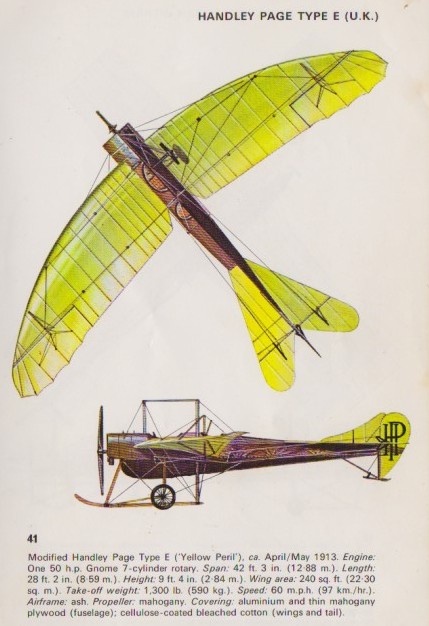
Handley Page Type F

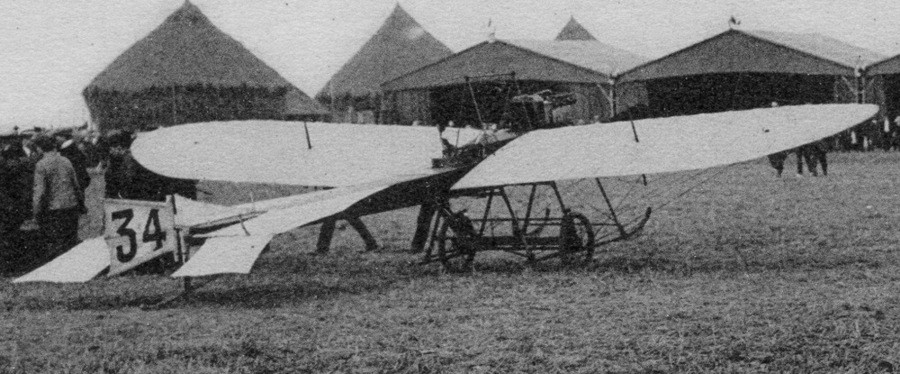
Testpilot Wilfred Parke flies the Type F of 1912.

The 1912 Type F flew well in Military Aeroplane Competitions that summer, flown by Lt. Wilfred Parks RN.

One day Parks and Hardwick started for Farnborough to have it approved, and over Wembley the engine cut out. Park turned down wind to land on the golf course, stalled over some trees and dived into the ground. The machine was not badly broken but they were killed on impact.

The Type F monoplane crashed and brought the first fatalities to Handley Page (H.P.), and it was said that the deaths, from a stall accident, resolved FHP to seek a cure to what was then a very common occurrence.

Engine: 80 hp Gnome