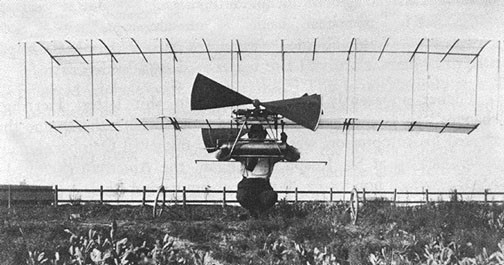
With M. Arnot as sponsor, Augustus M. Herring built in 1898 this Chanute-Herring-like motorised glider. It was built and flown (twice) at St Joseph, Michigan in 1898.
With M. Arnot as sponsor, Augustus M. Herring built in 1898 this Chanute-Herring-like motorised glider. It was built and flown (twice) at St Joseph, Michigan in 1898.
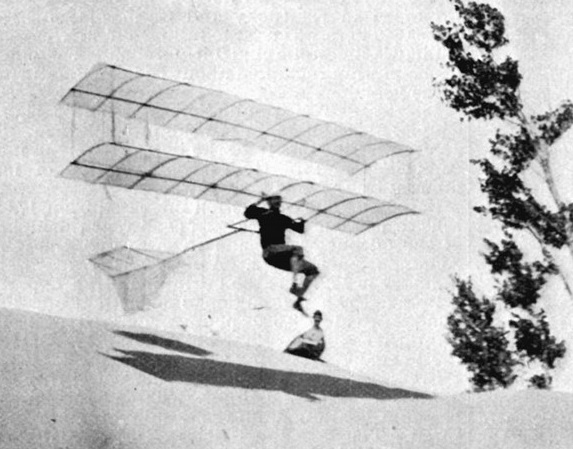
In 1897 Chanute inaugurated experiments with models for the purpose of testing still a third method of obtaining automatic equilibrium, but that these had not proceeded very far. Augustus Herring, having been requested by an amateur to supply him with a gliding machine, had built a new one with his regulating mechanism, and it being tested at Dune Park in September, 1897.
After arriving at the starting point the glider was held with the chord of the surfaces pointed downward at a considerable negative angle in order that the machine should sustain only its own weight, and at the same time the apparatus was directed squarely into the momentary wind so that both sides lifted equally, and, while the machine was thus poised, the operator (in front of the apparatus), released his hold and slipped quickly underneath, passing his arms over the longitudinal bars (called arm bars), beneath the lower surface, at the same time grasping the front pair of diagonal struts which joined these bars to the framing. This done, the whole machine was lowered until the small cross-piece in the rear of the operator rested on his hips or the small of his back. In this position a considerable leverage could be exerted, and with practice even a novice could soon hold the machine under perfect control until the actual start was made down the hill.

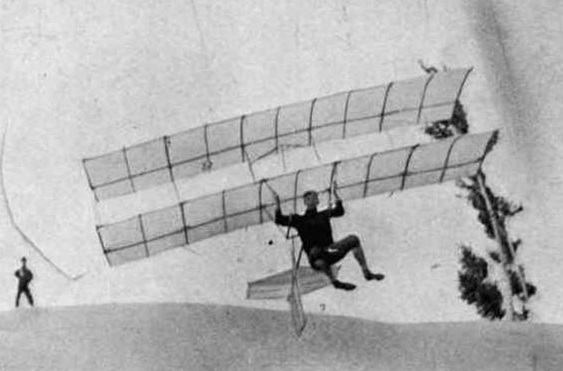
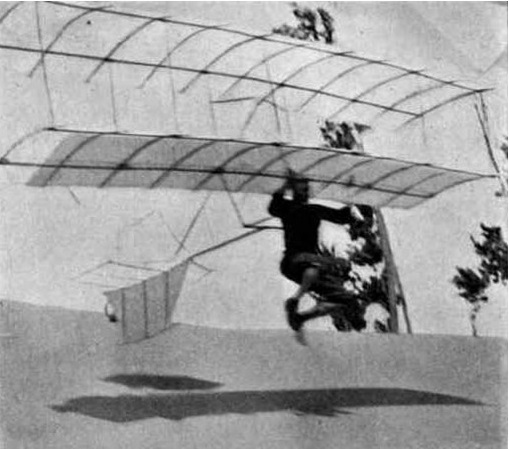
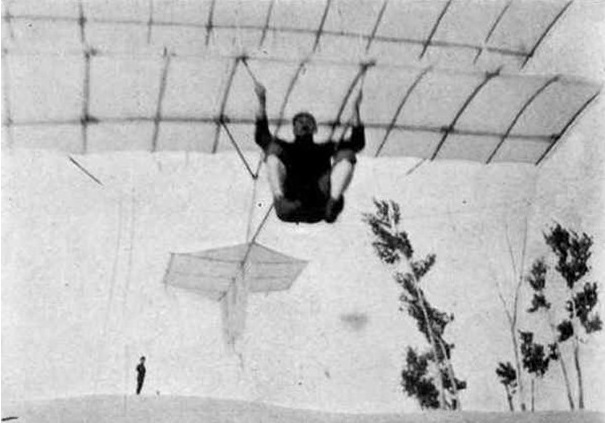
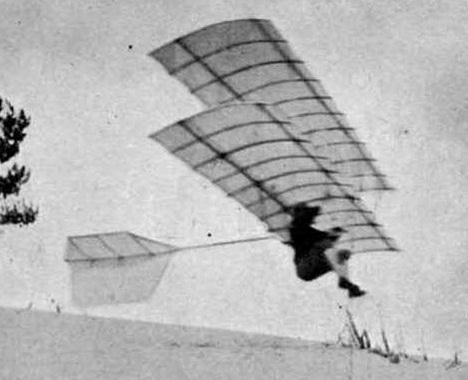
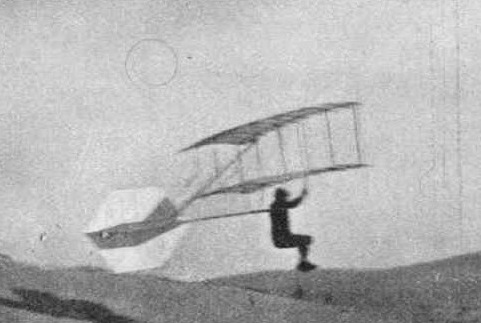
Mr. Herring and Mr. Avery, who were the experts who operated this machine at Dune Park, seldom or never struck the ground with greater force than would have been produced by jumping down one or two feet, and even when racing no sprained ankles occurred.
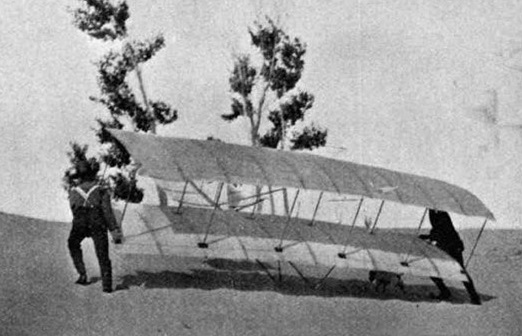
Glide were generally 200 or 300 feet long, and occupied 8 to 14 seconds. The operators generally alternate in taking such flights.
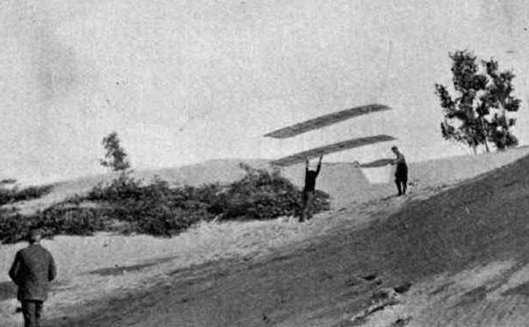
With a wing area of 131 square feet, they had been able to experiment in winds of 31 1/2 miles an hour.
The speed varied all the way from 10 to 40 miles an hour in reference to the ground or from 18 to 57 miles per hour in reference to the air, at the will of the aviator. The running start in a calm consisted of about half a dozen steps; in moderate winds, from two to three; and in high winds (those above 25 miles an hour), it was only necessary to give a slight positive inclination to the surfaces, when the machine and operator were raised high in the air, and then commenced their forward journey against the wind. After reaching a certain point over the hillside (approximately one-third the way down the hill), a sudden decrease in support was generally experienced, due, in all probability, to a mass of slower moving air between the base and top of the hill, as measurement with the anemometer showed very much higher wind at the starting point and at the foot of the hill (or over the level stretch below) than between the two.
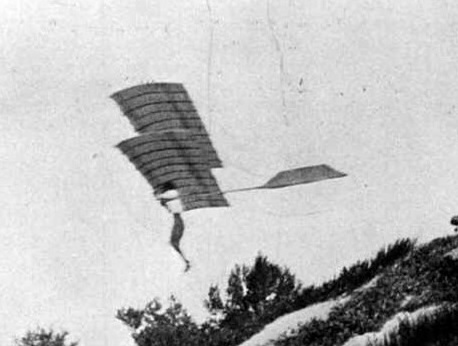
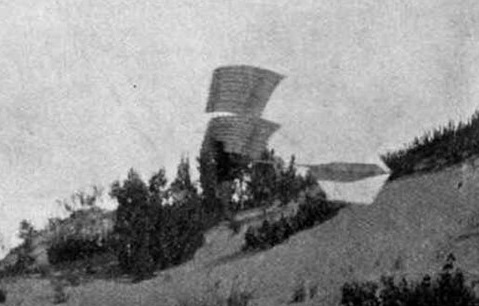
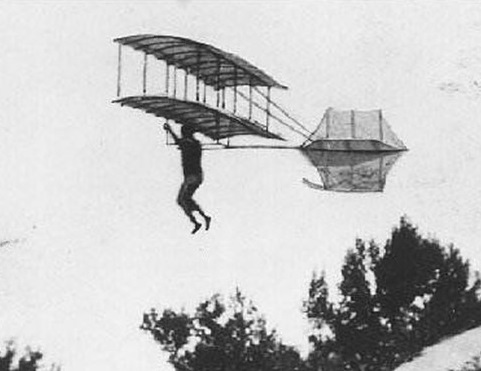
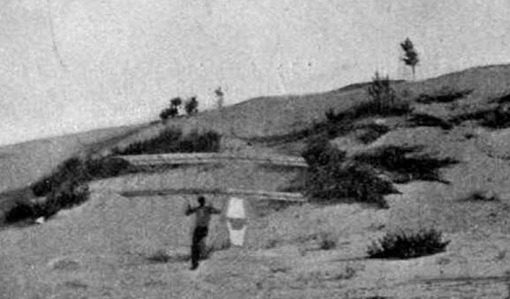
The length of flight being on an average 268 feet horizontally in a descent of 42 feet in windy weather, or 254 feet in a calm from the same point.
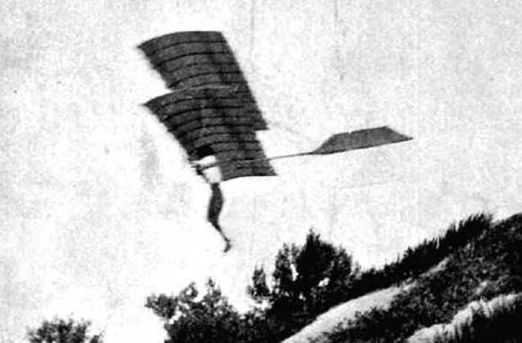
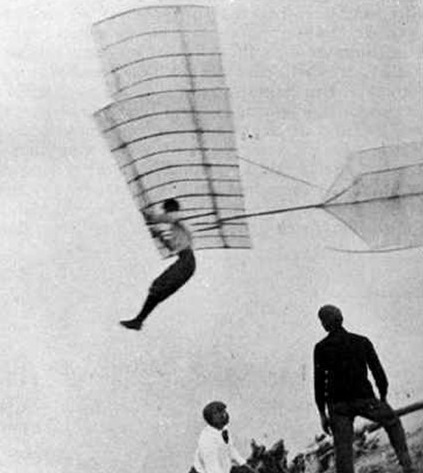

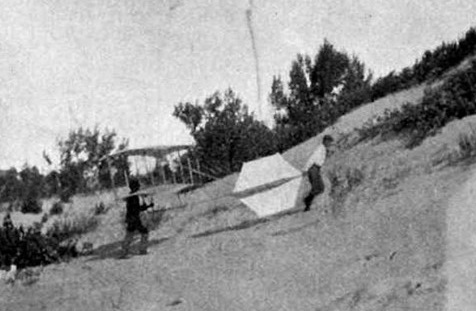
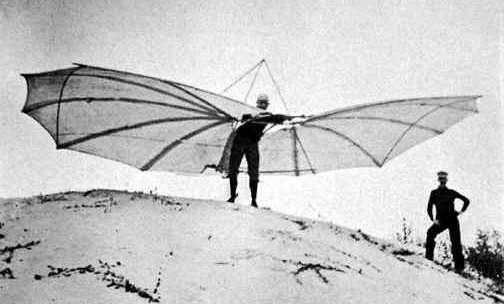
In December, 1895, Mr. Chanute secured the services of Mr. A. M. Herring, a civil and mechanical engineer, who had for some years been making experiments in Aviation, this being the recent name given to attempts to imitate the birds.
Chanute selected the sand dunes along the southern shore of Lake Michigan as the perfect place to test his creations. The area was close to Chicago. The little train station at Miller, Indiana served as an entry point into Dune country. The area offered a number of other important advantages, including steady winds, dunes from which a glider could be launched in any direction, an abundance of sand for soft landings, and, Chanute hoped, relative isolation.
Chanute and his four assistants pitched their tents on a spot within the present city limits of Gary, Indiana, on June 22, 1896. Augustus Herring, the most experienced member of the group, had brought a glider based on the standard Lilienthal monoplane design. William Avery, a Chicago carpenter, had constructed a multi-wing glider designed by Chanute, while William Butusov would attempt to launch his own glider, the Albatross, down a wooden ramp. Dr. James Ricketts, a Chicago physician with “a slack practice and a taste for aeronautics,” would cook for the group and provide emergency medical service as required. Chanute’s dogs, Rags and Tatters, rounded out the party.
Herring and Avery did most of the flying.
Herring rebuilt a machine, previously tested by him in New York, somewhat similar to that of Lilienthal, so that the known should be tested before passing to the unknown. With these two machines Mr. Chanute and Mr. Herring, and two assistants (Mr. Avery and Mr. Butusov), went in June, 1896, to the desert sand dunes at the south end of Lake Michigan, north of Miller Station, about thirty miles from Chicago. The Lilienthal-like machine was the first tested.
The machine spread 168 square feet of sustaining surface, was equipped with a double rudder, and weighed thirty-six pounds. With this about 100 glides were made, the longest being 116 feet. It proved from the outset an awkward machine to handle. Lilienthal, whose skill had been developed by four or five years of practice, obtained valuable and safe results with it, but it was otherwise with novices. Its operation involved a struggle with the wind before it could be brought under control, and this continued after the flight had begun.
Gliding a short height over the ground was practiced to avoid untoward accidents, for the winds experimented in, of 12 to 17 miles per hour, constantly varied the position of the center of pressure so far and so rapidly through their fluctuations, that the operator had to shift his position as actively as a tight-rope dancer, but to greater distances, to avoid being overturned. The body had to be moved at times some 15 or 18 inches, and not infrequently in landing the apparatus was broken. This involved less personal risk than might be supposed because the radiating ribs curve downward, so that they first come into contact with the ground when an awkward landing is made, and save the operator from harm.

The Lilienthal glider proved to be a disappointment. At last, after having been broken and mended a number of times, was finally discarded altogether. After abandoning this first form of machine, the experimenters in the sand dunes next tested the machine built after the fashion of the ladder kite which had proven so steady in the air.
In 1910 David L Herman built a 70 hp water-cooled V-8 aero engine.
In 1910 David L Herman built a 45 hp water-cooled V-8 aero engine.
Built aero engines in 1910.

The 1911 Herdler Hochdecker high-wing eindecker designed by Carl Herdler, had an “Absturzsicherung auf dem Flügel (ein sammengefalteter Luftsack) der bei Gefahr gespreizt werden konnte” – a security device, where the idea was to blow up the bag with air, to remain longer in the air whereas to lessen the force of impact in the event of a crash on the ground. The “air bag” may have also been somewhat based on the parachute.
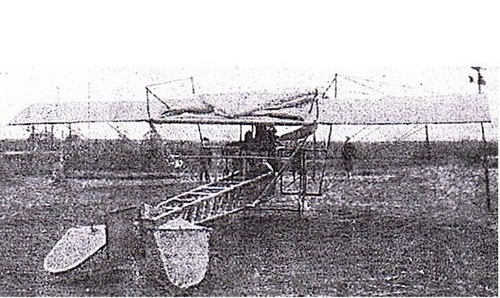
The machine made short hops in 1911.
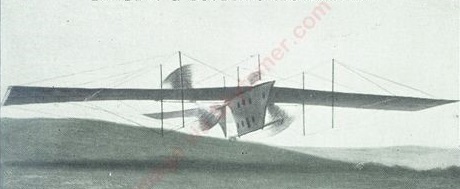
In 1843 William Samuel Henson patented about a proposed “Aerial Steam Carriage”. It seems more like a practical flying machine than anything hitherto suggested. Lacemaking industry engineer Henson, based in Somerset, has had a number of bright aviation ideas. This remarkable flying machine would be a monoplane, with two pusher propellers to be driven by a light steam engine of 25 to 30 hp. Henson actually ordered this engine from colleague John Stringfellow. Even if the Aerial Steam Carriage never flies, its impact has already been tremendous. Pictures of it appeared in magazines and newspapers, and is much talk about.
Also in 1843 William Samuel Henson and John Stringfellow filed articles of incorporation for the world’s first air transport company, the Aerial Transit Company.
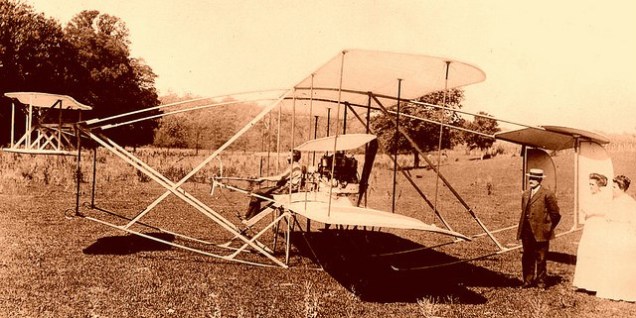
This somewhat Wright-like machine was constructed in Anderson, Indiana, USA, by Charles H. Hensley, a 40-year-old man who enjoyed building and flying box kites, and Levi Calvin Lambert, who was a 33-year-old plant manager and a member of the family that owned the Lambert Gas and Gasoline Engine Co., also of Anderson, which probably provided the engine. A grandson of Hensley stated that the plane flew around in a circle, for how long or at what height is unknown. He was told the plane was dismantled after its only flight.
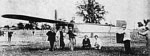
The circa 1910 Henry canard monoplane was designed and built by M. Henry in France.
 All Aero