An Advisory Committee for Aeronautics was formed in 1909, and a small dirigible, the Baby, was completed and flown. At the end of the year the Balloon School was made a separate establishment with Capper at its head, and the Factory became a civilian unit, although still under War Office direction.
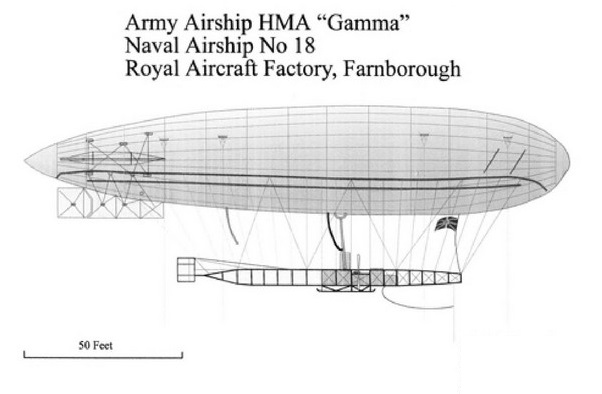
The airship Baby had been rebuilt and improved into the larger Beta, and followed by the progressively larger Gamma of 1910 and Delta. The airship was a considerable advance on Beta both in size and lift capacity, being 152 feet in length and 30 feet in diameter with an initial capacity of 75,000 cu.ft giving a gross lift of 2.1 tons.
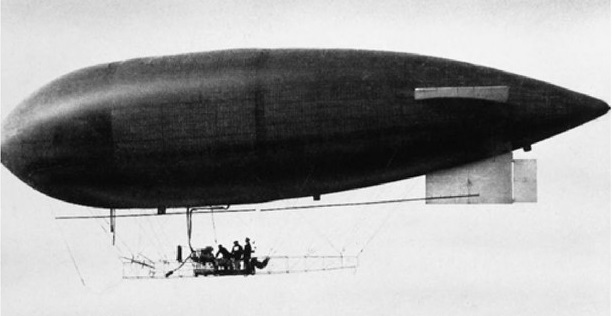
The airship Gamma, which had been designed by Colonel Capper, successfully made its maiden flight in February 1910 at Farnborough.
During the army manoeuvres of 1910 HMA Beta and recently completed Gamma were employed in evaluating their potential use to the army in warfare: in extended flights over Somerset, Dorset, Hampshire ad Wiltshire flying reconnaissance sorties; scouting for attacking and defending forces for a period of two months; covering, in the case of Beta, in excess of 1000 miles; spending most nights moored out in the open, using the cover afforded by a screen of trees; being maintained and serviced under these basic conditions, and on one occasion having a broken crankshaft replaced within the protection of a quarry.
During 1911 wireless experiments were carried out with Gamma, where messages were received at ranges of up to 30 miles distant.
Later in 1912 Gamma was reconstructed by lengthening the envelope, increasing the capacity to 101,000 cu.ft and lift to 2.9 tons. In her final form a long, metal-framed car was suspended below a bright yellow rubberised cotton fabric envelope made by the Astra-Torres company in Paris, earning her the nickname the Yellow Peril. Power was supplied by a 35 hp four cylinder, water cooled Green engine driving swivelling propellers mounted on out-riggers from the car, giving her a still air speed of 35 mph.
The swivelling propellers were capable of moving through 240 degrees about her longitudinal axis and were most effective in controlling the ship during climbing and landing. They represented a great technical achievement for the small balloon factory staff at the time.
The envelope was sub-divided by internal tranverse partitions to prevent surging of gas, and had multiple ballonets to preserve envelope pressure.
Capacity: 101,000 cu.ft Length: 152 ft Width: 30 ft Height: 52 ft Gross lift: 2.9 ton Disposable lift: 0.5 ton Engines: 2 x Green 80 hp Speed: 32 mph Crew: 5
An Advisory Committee for Aeronautics was formed in 1909, and a small dirigible, the Baby, was completed and flown. At the end of the year the Balloon School was made a separate establishment with Capper at its head, and the Factory became a civilian unit, although still under War Office direction.
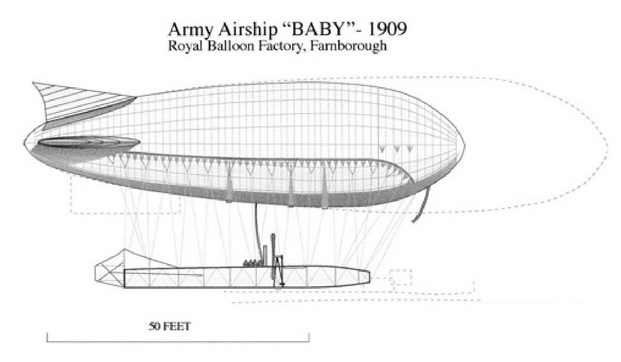
Launched in May 1909 the 22,000 cu.ft Baby was a more carefully conceived design incorporating some of the more advanced features seen in contemporary continental airships. In its original form the craft was 84 ft in length and 24 ft diameter, with bulbous air-filled fins at the stern. Unlike the earlier Gamma airship, Baby was fitted with an internal ballonet. Power initially came from to inadequate 8 hp Buchet petrol engines, these engines having previously been installed in an early version of the Dunne tail-less biplane.
After initial testing the air-filled fins were replaced with more suitable flat section steering planes, while a 25 hp REP engine was installed to provide more power. After this, and following a series of trials that highlighted poor controllability, she was further taken in hand during the winter. Emerging in the spring of 1910 in a reconstructed form and now known as Beta, her length had been increased to 116 ft with a capacity of 35,000 ft, giving her a gross lift of just over 1 ton together with a greatly improved all-round performance.
A further change of engine, a 35 hp four cylinder, water cooled Green engine, completed the conversion, giving an endurance of five hours with a crew of three.
This small craft was considered the first successful British airship, on one occasion staying aloft for eight hours. She made several flights of note, including flying over London at night in early experiments to determine the best means of defence. Beta was also the first airship to be fitted with a wireless apparatus, being used in early 1911 for experiments succeeding in sending and receiving messages at a distance of over 30 miles.
The airship Baby had been rebuilt and improved into the larger Beta, and followed by the progressively larger Gamma and Delta.
Army Airship Baby – Original configuration of 1909 Dashed outline indicates 1910 enlargement to 104 ft and capacity to 35,000 cu.ft
During the army manoeuvres of 1910 HMA Beta and recently completed Gamma were employed in evaluating their potential use to the army in warfare: in extended flights over Somerset, Dorset, Hampshire ad Wiltshire flying reconnaissance sorties; scouting for attacking and defending forces for a period of two months.
The airship was supported in the field by the old existing balloon gas train and workshop, drawn by a steam traction engine to provide a mobile base.
During the period of the manoeuvres Beta had to be deflated on only one occasion.
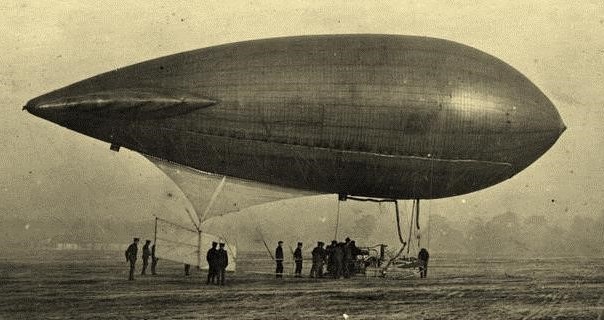
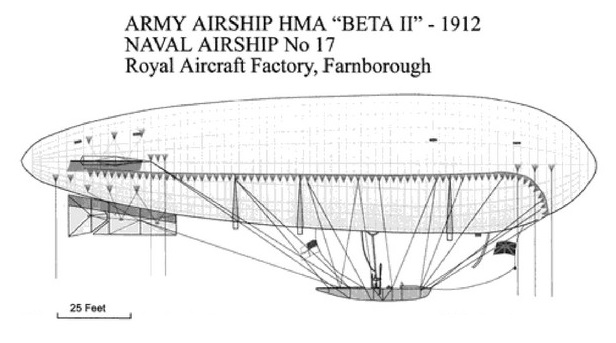
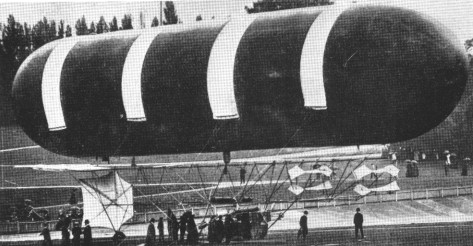
In 1912 Beta again underwent further modification, with her envelope being split lengthwise to accommodate an additional longitudinal gore. This increased her diameter to 28 ft and lengthened to 135 ft overall. The swivelling propellers were retained whereas the engine was once more changed, this time to a 45 hp Clerget, increasing the top speed to 35 mph.
Beta was also used in early mooring mast trials; using a mast designed by Commander Masterman RN at Farnborough, known as the ‘high mast’ system, whereby the airship floated free of the ground attached to the mast at the nose, using weighted rollers to keep the stern of the ship in trim as it vaned in the wind.
As Beta II she continued to give good service, taking part in the army war games on Salisbury Plain before the war and being involved in the early parachute experiments carried out from her by General E.M.Maitland. In January 1914 the navy took over the lighter-than-air operations from the army, with Beta II becoming HMA No.17 and initially used to familiarise naval personel with airship handling.
With the outbreak of war HMA No.17 was for a short time sent to France. Based near Dunkirk, she made several night flights during January 1915 over the German lines and was on artillery-spotting duties before such activities were deemed too dangerous.
Subsequently, HMA No.17 was used for training at RNAS Kingsnorth before finally being deleted in mid-1916.
The non-rigid airship “Baby” was built in 1908-1909, and subsequently enlarged and converted first to the British Army Dirigible No. 3 “Beta I” and then to Naval Airship No. 17 “Beta II”. It survived until 1916, thanks to several major rebuilds and modifications, including four different engine installations. Originally it had three inflatable fins on the tail of the envelope, which were found to be too unwieldy for practical work and were replaced by fixed fins.
1909 Baby Engine: 2 x Buchet, 8 hp Capacity: 21,000 ft Length: 84 ft Diameter: 26 ft Height: 38 ft Gross lift: 0.62 ton Useful lift: 400 lb Speed: 20 mph Endurance: 3 hr Crew: 3
1910 Baby Engine: REP, 25 hp Capacity: 35,000 ft Length: 104 ft
1910 Baby Engine: Green, 35 hp Length: 110 ft Capacity: 35,000 ft Endurance: 5 hr Crew: 3
1912 Beta II Engine: Clerget, 45 hp Capacity: 50,000 ft Length: 116 ft Width: 28 ft Height: 40 ft Gross lift: 1.22 ton Useful lift: 0.40 ton Speed: 32 mph Endurance: 8 hr Crew: 3
The first official government interest began in 1907 at Farnborough where, after receiving a small grant from the War Office of £2000, Colonels Capper and S.F.Cody wre able to start work on the first of the army airships, the Nulli Secundus.
The airship was designed as a semi-rigid and was to be built under conditios of the greatest secrecy. A noticeable feature of the completed craft was the long, uncovered square section metal keel suspended 12 feet below a cylindrical goldbeaters’ skin envelope of 56,000 cu.ft capacity. With a length of 120 ft, power was provided by a 50 hp Antoinette petrol motor, which doubled as the power unit for Cody’s Army Aeroplane No.1, and which drove two aluminium paddle propellers on each side of a small car suspended below the keel containing the crew of three.
An advanced feature of the propellers was that they represented the first use of a variable pitch mechanism in any aircraft, so that the blades coulb be set at an optimum angle of attack. The envelope lacked an internal balloonet compensating for the expansion of gas as the airship rose to a moderate altitude. They did include an automatic gas valve and two hand-operated manoeuvring valves.
The envelope was attached to the keel framework by four circumferential cloth bands and covered with cord netting. The netting bands being made necessary despite the extra weight due to the extreme difficulty of attaching suspension wires or other attachments to the goldbeaters’ skin fabric. Twin rudders were fitted aft, while the elevating plane was situated at the bow in the hope of providing vertical control.
On September 10th, 1907, Nulli Secundus made her maiden flight. A series of short, local flights were made at Farnborough where a speed of 16 mph was obtained.
Following these tests Nulli Secundus departed on 5 October to fly to London, landing after a three and a half hour flight at Crystal Palace. Piloted by Capper and Cody, she set up an endurance record for non rigids by staying in the air for 3.5 hours on the journey from Farnborough to London. The achievement was unfortunately crowned by anti-climax, for excessive headwinds forced the airship down at Crystal Palace on the way back. Strengthening winds threatened to damage the moored ship and the sargent in charge instead ordered the ship to be inflated and it was returned to its base by road.
In December 1907, Cody began to build his first biplane at Farnborough, and Nulli Secundus was being rebuilt to emerge as Nulli Secundus II the following summer.
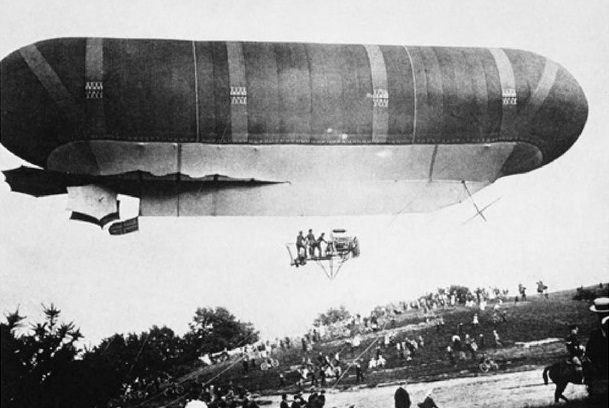
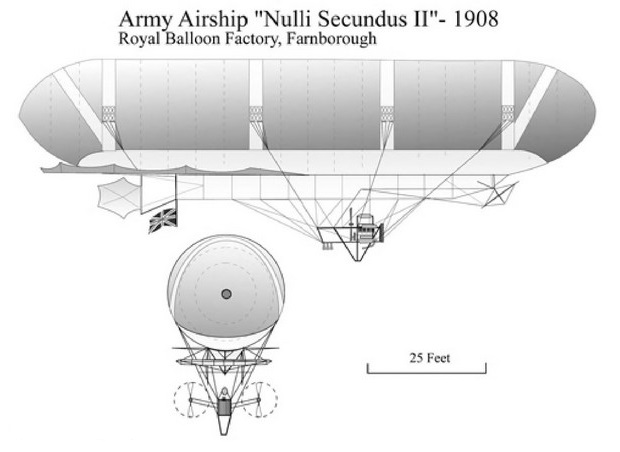
During the winter month the airship was rebuilt, emerging as Nulli Secundus II of a slightly increased capacity with a new, streamlined silk-covered deep keel that was attached directly to, and faired into, the underside of the envelope. Nulli Secundus II had made its first flight on July 24th, 1908. Several local flights were made during July and August, where a speed of 22 mph was recorded however both vertical and horizontal control was deemed to be inadequate and the airship was dismantled at the end of 1908.
In May 1909, after withdrawing its support for aeroplane experiments, the War Office reorganized the Factory for the primary task of producing airships.
Nulli Secundus II 1908 Capacity: 56,000 cu.ft Length: 120 ft Diameter: 26 ft Height: 44 ft Gross lift: 1.0 ton Disposable lift: 0.20 ton Engine: 1 x Antoinette, 50 hp Speed: 12 mph Endurance: 4 hr Crew: 3
It took George Grover some fifteen years of continual agitation before he finally persuaded the War Office to carry out trials with free and tethered observation balloons, but in 1878 such a series of tests was carried out at Woolwich Arsenal, introducing aeronautics for the first time to the British Army. These experiments resulted in the first ever Air Estimate, when the War Office voted £150 to build a balloon designed by Captain J.L.B. Templer of the 2nd Middlesex Militia. In fact, the Pioneer, as this craft was titled, cost only £71, and made its first, successful, ascent on August 23rd, 1878. Templer was promptly, though unofficially, designated as instructor to the Corps of Royal Engineers in the art of ballooning, which duty he carried out with Pioneer and another balloon of his own, the Crusader.
It took George Grover some fifteen years of continual agitation before he finally persuaded the War Office to carry out trials with free and tethered observation balloons, but in 1878 such a series of tests was carried out at Woolwich Arsenal, introducing aeronautics for the first time to the British Army. These experiments resulted in the first ever Air Estimate, when the War Office voted £150 to build a balloon designed by Captain J.L.B. Templer of the 2nd Middlesex Militia. In fact, the Pioneer, as this craft was aptly titled, cost only £71, and made its first, successful, ascent on August 23rd, 1878. Templer was promptly, though unofficially, designated as instructor to the Corps of Royal Engineers in the art of ballooning, which duty he carried out with Pioneer and another balloon of his own, the Crusader.
It was in the early 1860s that a Royal Engineer officer, Lieutenant George Edward Grover, first began to investigate the use of balloons for military purposes. It took Grover some fifteen years before he persuaded the War Office to carry out trials with free and tethered observation balloons, but in 1878 such a series of tests was carried out at Woolwich Arsenal, introducing aeronautics for the first time to the British Army. These experiments resulted in the first ever Air Estimate, when the War Office voted £150 to build a balloon designed by Captain J.L.B. Templer of the 2nd Middlesex Militia; the Pioneer. Templer was, though unofficially, designated as instructor to the Corps of Royal Engineers in the art of ballooning, which duty he carried out with Pioneer and another balloon of his own. At Woolwich, a Balloon Equipment Store was set up under Captain R. P. Lee, R.E., beginning the RAF. From these foundations there was formed, in 1890, a Balloon Section of the R.Es., now trans¬ferred to new quarters at Aldershot; the Air Estimate had risen from the initial £150 to a figure of £4,300; and Major Templer was now ‘Officer in Charge of Balloons’. In 1894, when the establishment’s title was once again changed, he became the Balloon Factory’s first superintendent. The Superintendent of the Balloon Factory at Aldershot, Lt. Col. J. L. B. Templer, went to Paris to find out all about Santos Dumont’s airships. On his return, he extracted £6,000 from the Treasury to conduct, similar experiments in Britain. This covered the cost of the envelopes for two airships, but no engines, so work came to a temporary halt in 1904. The outbreak of the Boer War in 1899 meant considerably increased production at the Factory. The Man lifting Kite Section had been formed in 1894 under Capt. B. F. S. Baden Powell, but it did not come into prominence until 1906, when “Colonel” S. F. Cody was appointed Chief Instructor in Kiting. Until his death in an aircraft accident seven years later, this colourful figure with the goatee beard, and long hair sprouting from under an enormous Stetson hat, remained a dominant figure in British aviation, combining rare skill and courage with a flair for showmanship that was displayed not only in his personal appearance but in stunts such as crossing the’ Channel in a small boat towed by several of his kites. Although unrelated, he traded on the publicity value 6f his famous namesake and fellow American, Col. “Buffalo Bill” Cody, and was to be seen astride a richly saddled white horse almost as often as on the pilot’s seat of an aircraft. In 1905 the Balloon Factory, together with the Balloon Section, R.E., was moved to South Farnborough In April 1911 the Factory changed its title again it was now the Army Aircraft Factory, a shift of emphasis reflected in the year’s Air Estimate of £85,000 for dirigibles and aeroplanes and the R.E. Balloon Section closed down. On April 11, 1912, the Army Aircraft Factory became the Royal Aircraft Factory.
Hellmuth Hirth worked for a short time as a foreman at aviation pioneer August Euler in Darmstadt. However, since Euler had difficulties with his Voisin-type flying machine, Hirth returned to Stuttgart to build himself a Blériot machine in 1909. Because of the too weak engine, this did not go beyond small aerial jumps, causing Hirth to go to Vienna to fly the Etrich Taube together with Illner.
Hellmuth Hirth (1886 – 1938) worked for a short time as a foreman at aviation pioneer August Euler in Darmstadt. However, since Euler had difficulties with his Voisin-type flying machine, Hirth returned to Stuttgart to build himself a Blériot machine. Because of the too weak engine, this did not go beyond small aerial jumps, causing Hirth to go to Vienna to fly the Etrich Taube together with Illner. He then became designer at Rumpler and Gotha, before turning to engine development.
1998: Göbler-Hirthmotoren Postfach 62 D 71726 Benningen / Neckar Germany
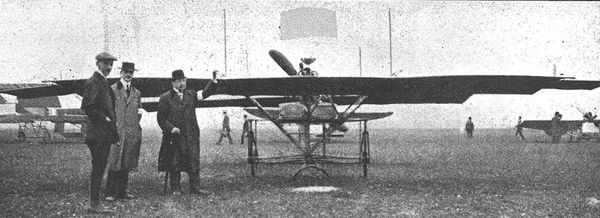
The “rekonstruierte Hipssichflieger” – sometimes identified as the Hipssich Drachenflieger II, a development of the I – photographed at the flying field at Wiener Neustadt around the beginning of October 1910. At right, wearing a bowler, is Karl Hipssich. Hippsich was a German inventor living in Vienna with an interest in aviation who invented and patented an automatically stable Flying machine, or “Drachenflieger” rather.
Construction started at the end of 1908 where the actual building was done by the Viennese firm of Karl Köhler. On the left is the pilot of the machine Erich Köhler who had no pilots’ license at the time. He acquired German No. 347 on January 10, 1913 at Breslau when flying a Rumpler Taube.
The Hino No.2 Monoplane of 1911 was designed by the Japanese captains Hino and Tokugawa. Its inline 4-cylinder pusher engine was by their own design and developed between 18 and 30 hp.
 All Aero