
The 1910 Jacquelin tractor biplane was designed and modified by E.Jacquelin and built by Voisin in France.
The 1910 Jacquelin tractor biplane was designed and modified by E.Jacquelin and built by Voisin in France.
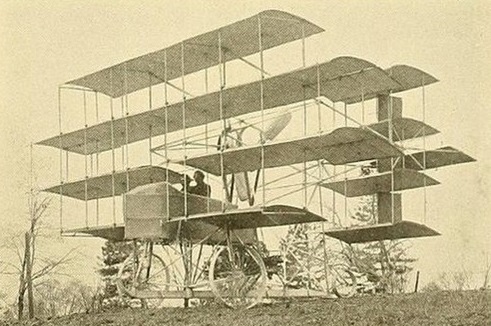
The 1910 Jacobs Multiplane [also identified as the Jacobs-Emerson multiplane] was the creation of Henry William Jacobs of Atchison, Kansas. It had quadruplane wings and tail and two engines, each driving a propeller.
Jacobs used two improved air-cooled 35hp engines he invented, to replace the two original underpowered engines [Emersons?], with which the plane flew in 1910.
It was displayed on the New York Aero Exhibition 1912. Jacobs had formed with others the firm “Multiplane Limited” in Kansas to build the machine and eventually sell it to the market and a brochure of 16 pages was produced.
Henry William Jacobs / Multiplane Ltd
Atchison KS.
USA
Built a multiplane in 1910.
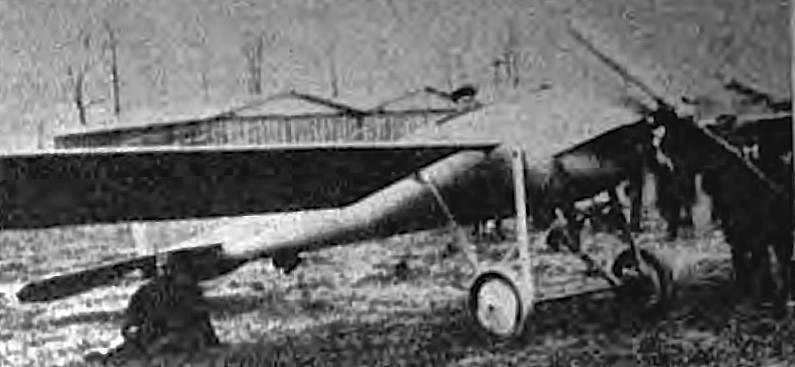
This “aero-torpedo” monoplane was destroyed when pilot Attilio Maffei crashed into some trees during a test flight on April 17th, 1913 in Italy. It was probably the “Jacchia-Wolsitt” floatplane that participated in the 1913 “Circuito delle Laghi”, modified to landplane configuration.
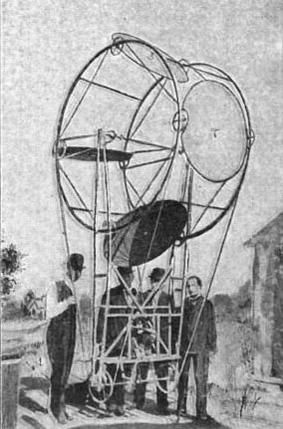
The photograph shows a quarter-size model of the Irvine Aerocycloid of 1908/1909 which was able to lift the weight of ninety pounds. The San Francisco based John C. Irvine (president of the Pacific Aero Club) had worked three years on the machine, which was driven by a 3 hp electrical engine, that could lift 30 pounds for each hp. Records do not show that the full-sized model was ever built, probably due to problems with financing of the project. The specialty of the machine was of course the two upright wheel construction, driven by cables, which carried four “propellers” which pivoted between the wheel and furnished the lifting power. With the propellers in the proper position the force would be upright, lifting the machine vertically. Pivoting the propellers at an angle would obtain a forward motion.
Denver CO.
USA
In 1911 the Imperial Airplane Society built two models of aero engine;
35-70hp various 6-cyl rotary air-cooled engines,
100hp 12-cyl air-cooled rotary.
The 1909 IAL monoplane was designed and built by Imbert and Latour in France.
The 1910 Illinschulz was designed and built by Illinschulz in France.
Span: 26’3″
Length: 22’11”
Weight: 770 lb empty
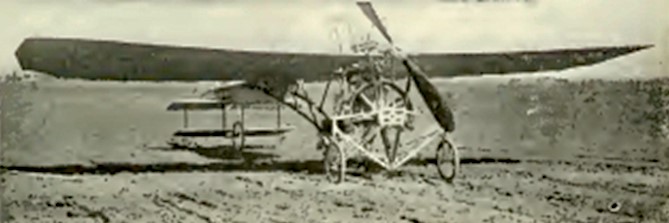
Little is known about this high-wing monoplane, a 1911 design from Woodhaven, New York. It was powered by a 50 hp Gnome, which was mounted low in the fuselage and drove the propeller via a chain. The International Aero Construction company apparently lived from building copies of other well-known designs.
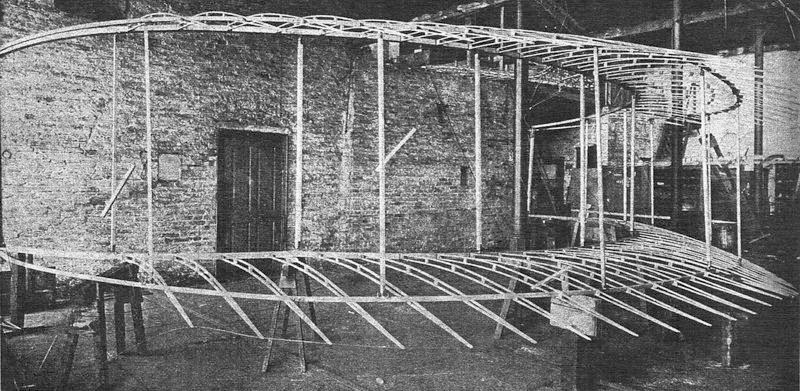
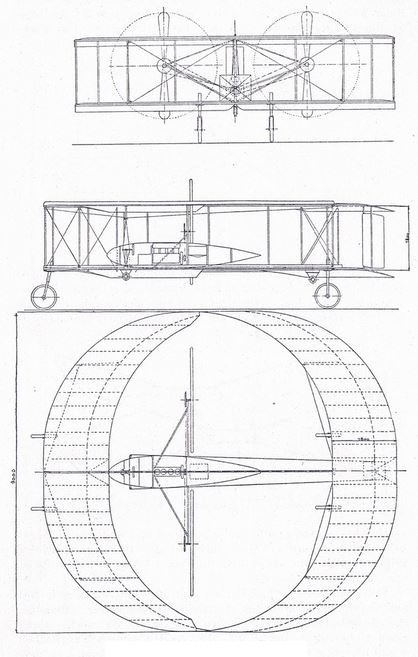
This biplane was designed by Dr. Fritz Huth and built at the Max Schüler Aeroplan-Fabrik (Berlin) in 1909. It had sickle-formed wings, the front pair with points to the rear and the rear pair with points forwards, so that almost ring-formed surfaces of 6 m diameter was formed. It’s reported that two were built, one by Huth’s Deutsche Flugwerft (Huth-Motor), another by Schüler (Aeolus-Motor).
 All Aero