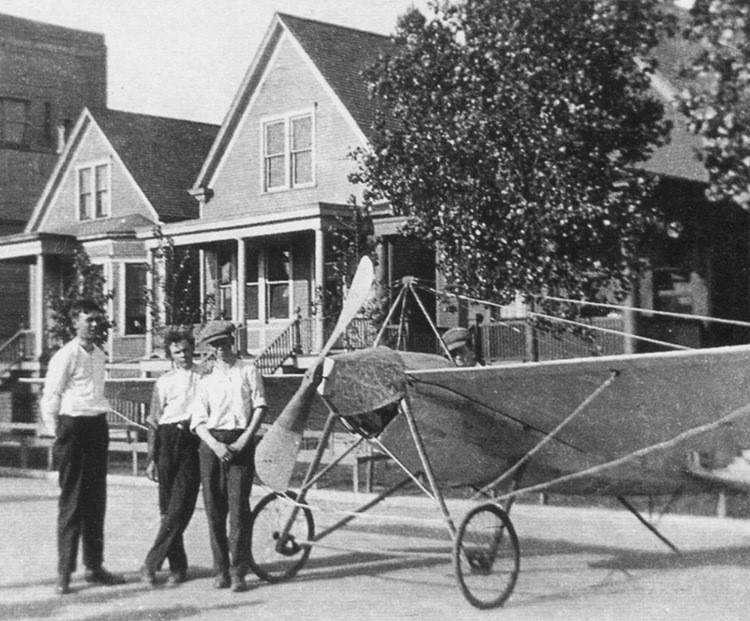
Laird No.1

Engineless at the “rollout” in Chicago in early 1913.

At age 17, Matty Laird’s first design would be a monoplane powered with an engine designed by Harry Wells. The two worked on their separate projects month after month in high school night classes. Matty’s airframe progressed, but Harry Wells was never able to devise a reliable valve mechanism for his engine. Thus Matty was left with an engineless airplane.

A Chicago machinist named Hofer offered him a 12 horsepower engine for $150. After several months of revamping his plane to accept the Hofer engine, Laird took his little single seat monoplane out to Cicero Field. To his surprise, up it came about 15 feet.

He had a very light airplane and a little too much speed, and somewhere in the series of bounces that followed, he crossed the controls and wound up on his back.
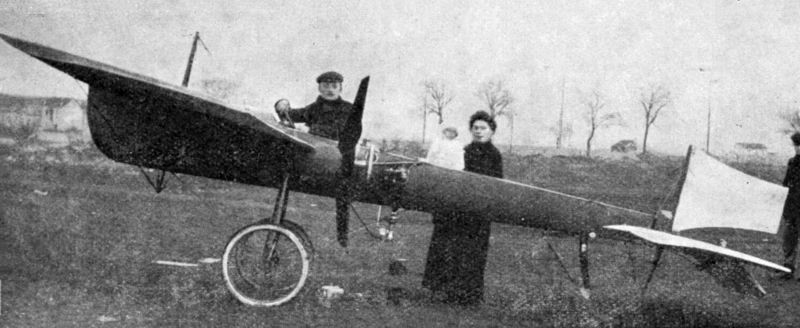
Lachassagne tandem wing monoplane

The first design of Adolphe-Étienne Lachassagne was this 1912-1913 tandem wing monoplane. The front and the tail wings could be adjusted. The two propellers were fitted at the trailing edge of the front wing, and were adjustable together with the wing. The engine was mounted in the fuselage and drove the two propellers via a rod. As Lachassagne had no funds to acquire a new and powerful engine he had to do with second hand engines. Lachassagne started to study a new aeroplane with tandem wings. The AL-2 airplane was never built in full size, only as a model. He was creative inventor and kept developing and building variable wing profile aircraft at least up to WW2. He also tried to develop a small affordable “peoples airplane”.

Lachassagne, Adolphe-Étienne

The first design of Adolphe-Étienne Lachassagne was a 1912-1913 tandem wing monoplane. As Lachassagne had no funds to acquire a new and powerful engine he had to do with second hand engines. Lachassagne started to study a new aeroplane with tandem wings. The AL-2 airplane was never built in full size, only as a model.

Lachassagne was creative inventor and kept developing and building variable wing profile aircraft at least up to WW2. He also tried to develop a small affordable “peoples airplane”.

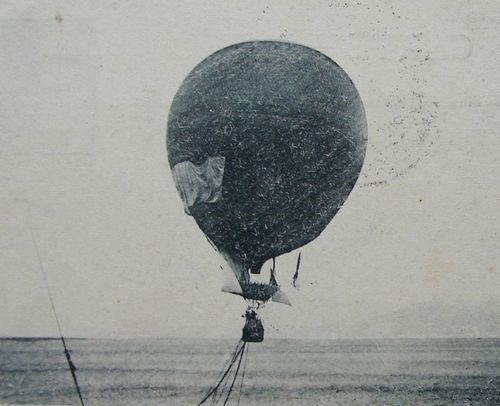
Lachambre-Andrée Örnen / Eagle

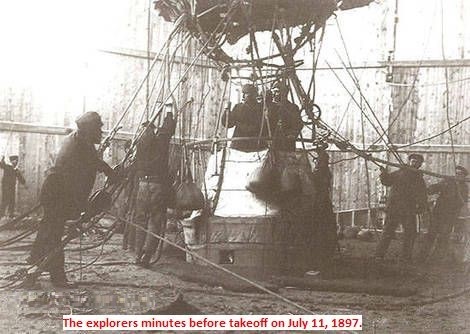
Swedish polar explorers Andrée, Fraenkel and Strindberg departing from Danes Island, Spitsbergen, in the Svalbard archipelago, on July 11, 1897, in an ill-fated attempt to reach the North Pole. The hydrogen gas balloon, 67 feet in diameter, with a capacity of 170,000 cubic feet, was built by Henri Lachambre in Paris. Three varnished layers of double Chinese silk formed the upper half of the envelope, with a single layer on the bottom half. A heavy casing of woven hempen netting shrouded the balloon, which was surmounted by a cap, or calotte, of varnished silk to keep arctic snows from lodging in the netting. Suspended from a bearing ring formed from American elm wood was a wicker car measuring 6.5 feet in diameter and 5 feet deep. The balloon was originally named “Le Pôle Nord”, but was later christened “Örnen” (Eagle). In 1930, the remains of Saloman Andrée and his two companions were discovered on White Island and repatriated to Sweden.

Kvasz II

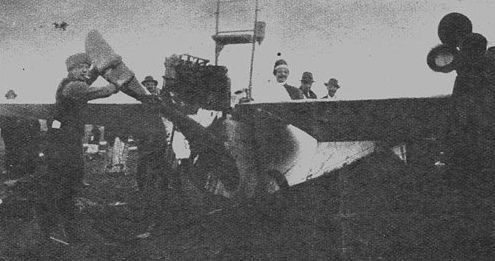
The second monoplane designed and built by Slovakian András (Andrej) Kvasz at a Budapest workshop.

First flown in August 1911 by Kvasz, powered by an Anzani 3W, 25 hp, later Anzani 3Y, 35 hp and Austro Daimler, 40 hp, 4-cyl.

On August 30, 1911, with this monoplane, Kvasz won the Sacellár prize. In November 1911 he organized public flights at Szarvas drawing 40,000 spectators. Kvasz, who worked as an engineer for Aladár Zsélyi in Wiener-Neustadt from 1909 on, started to build his own machines in 1911.

Span: 39’4″
Length: 24’7″
Weight: 750 lb

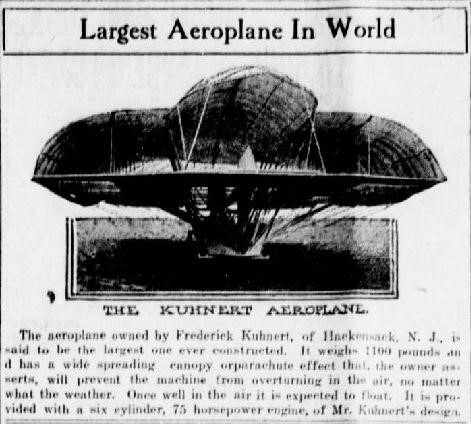
Kuhnert Ferryboat

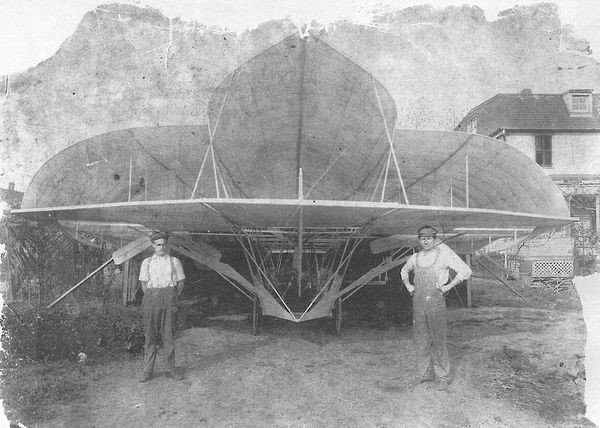
The creation of Frederick Kuhnert of New Jersey, and at the time was said to be to the largest aeroplane in the world, though no doubt it was just one of several claimants to that title. He established the Kuhnert Aerial Construction Company in order to “manufacture flying machines”. In 1910, Kuhnert bought 20 acres of land in the Hackensack Meadowlands to use as an aerodrome where he built a passenger airplane that could hold 14 people. Called Kuhnert’s Ferryboat, it, along with his aerodrome, was destroyed by a tornado in 1912 before it could make its first flight.

Engine: 75 hp

Kuhnert Aerial Construction Company

Frederick Kuhnert of New Jersey established the Kuhnert Aerial Construction Company in order to “manufacture flying machines”. The $100,000-valued company’s directors were Frederick Kuhnert, Matthew Andronico and Lester Gilbert. In 1910, Kuhnert bought 20 acres of land in the Hackensack Meadowlands to use as an aerodrome where he built a passenger airplane that could hold 14 people. Called Kuhnert’s Ferryboat, it, along with his aerodrome, was destroyed by a tornado in 1912 before it could make its first flight. Prior to the tornado, the Kuhnert Aerodrome hosted weekly aerial demonstrations.