In 1909 Lamoureux built a monoplane in France.
Span: 26’3″
Length: 24’7″
In 1909 Lamoureux built a monoplane in France.
Span: 26’3″
Length: 24’7″
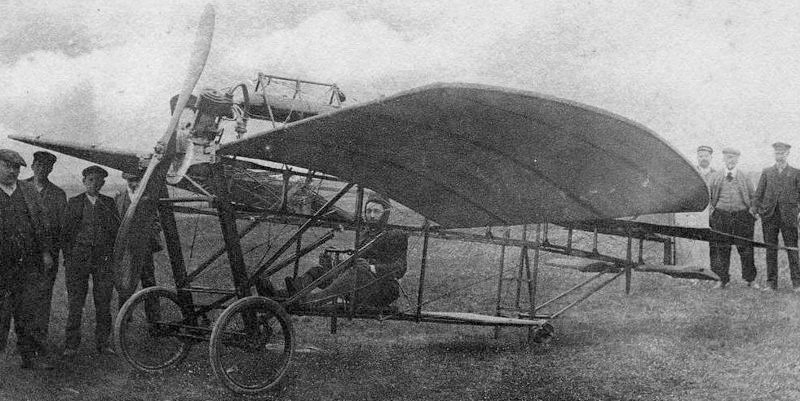
A monoplane with a two-cylinder Anzani engine, built by Victor-Thomas Lamotte of Luçon, France. A postcard gives the date as 1907.
The final design of the Lakes Flying Company was the Hydro-monoplane.
The Lakes Sea Bird was a two-seat floatplane built during 1912 by the Lakes Flying Company using the fuselage of the Avro Duigan. First flown on 28th August 1912, it gave many visitors to Windermere their first flight in the summer of 1913
After damaging his aircraft and returned to Australia the fuselage and tail unit was sold to the Lakes Flying Co. based at Windermere, who rebuilt it as a two-seat floatplane. The straight parallel-chord high aspect ratio wings of irregular three-by layout resembled those of Avro’s Avro Type D. It was originally fitted with a single central two step float, later changed to a pair of narrower floats, and demountable so that the aircraft could readily be used as a landplane. It was powered by a rotary 9-cylinder Gnome of 50 hp (37 kW),
The single Sea Bird carried many holiday makers in 1912-3. Later, it was restored for training and it was ultimately lost when a student pilot spun in in 1915.
Powerplant: 1 × Gnome 9-cylinder rotary, 50 hp (37 kW)
Wingspan: 39 ft 4 in (12.00 m)
Height: 10 ft 6 in (3.2 m)
Wing area: 350 sq.ft (32.5 sq.m)
Length: 29 ft 4 in (8.94 m)
Seats: 2
Maximum speed: 62 mph (100 km/h)
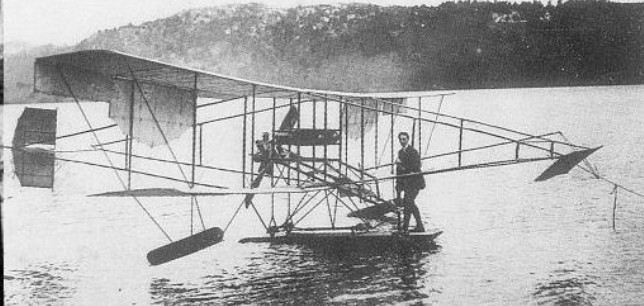
Water Bird was succeeded by the Lakes-built Water Hen, their first complete product. It was initially almost identical to its predecessor apart from straight edged ailerons. Larger, later modifications removed much of the similarity between the two aircraft, the later Water Hen having a much wider central float.
Water Bird’s successor, identical, but entirely designed and built at Windermere by Capt. Wakefield’s Lakes Flying Company later in 1912, was known as “Water Hen”. Its only Avro component was the airscrew and at first it could be distinguished from its Avro-built forerunner by the wingtip floats and straight trailing edges to the ailerons. These were mounted parallel to the chord line of the mainplanes instead of at a considerable angle to it. They were later remounted in the angled position but by that time more drastic modifications had been made and all similarity to Water Bird ceased.
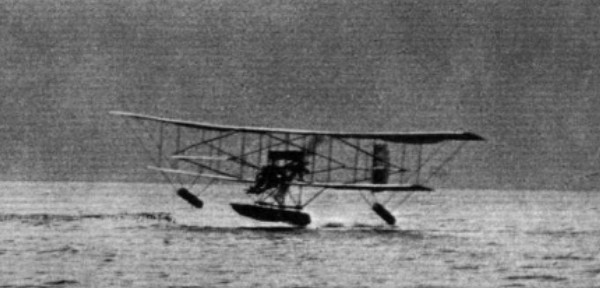
In the summer of 1910 A. V. Roe and Company declared its willingness to build aeroplanes to other people’s designs. A Curtiss-type, of the familiar outrigger-tail and front-elevator variety with 50 h.p. Gnome rotary, was built in 1911 to the order of Capt. Edward W. Wakefield of Kendal. He wanted it to follow the basic layout of the USA’s Curtiss machine – hence sometimes known as Avro-Curtis. This was never given an Avro designation.
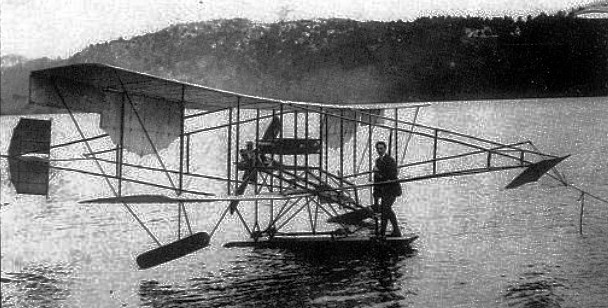
The Lakes Water Bird was built for Wakefield, of the Lakes Flying School, Windermere. It was built as a landplane with the intention of converting it to a seaplane once testing was complete. Wakefield had been interested in water-borne aircraft since 1909 and had performed experiments with different float designs towed at speed across Lake Windermere. Unsticking problems persisted until he visited Henri Fabre in France and got useful advice on float design. The 12 ft (3.66 m) long float for the Water Bird followed Glen Curtiss’ three-step float and was built by boat builders Borwick of Bowness-on-Windermere using mahogany reinforced with metal strips and canvas covered by local.
Avro built the aircraft in Manchester, transporting it to Brooklands on 25 May 1911 for its first flight on 19th June. It was a two-bay seat pusher biplane with wings of unequal span. The outer half of each upper wing carried a pair of ailerons; the larger inner one had a semicircular trailing edge extending well behind the wing trailing edge. Bamboo outriggers fore and aft of the wings supported leading elevators and tail surfaces plus rudder. Both elevator and rudder were operated by bamboo pushrods. Power was provided by a 50 hp (37 kW) Gnome 7-cylinder rotary engine driving an 8 ft 6in (2.59 m) propeller.
It was operated by the Avro School for a short period before being dismantled on July 7th 1911 and moved to Lake Windermere. At the Avro School during it was flown by F. P. Raynham, R. C. Kemp, F. Conway-Jenkins and Louis Noel. After testing as a landplane at Brooklands in May 1911, the Water Bird was brought to the Hill of Oaks on Windermere and the float fitted in place of the wheeled undercarriage. A pair of cylindrical floats was mounted below the wing-tips for lateral stability on the water. Once at Windermere it was known simply as Waterbird. It had a Gnome 50hp engine and the successful first flight was on 25 November 1911, with ex-Avro school pilot H. Stanley Adams. The floats were all made by Borwicks at Windermere. The press where invited to an exhibition flight two days later, the favourable description’s in the press seem to lead to the name ‘Lakes Water Bird’ being adopted.
Water Bird was the first consistently successful seaplane in the United Kingdom and during the next few months its fame spread quickly and a considerable waterborne joyriding business was done during December 1911 and January 1912. Sixty flights were made in the first 38 days, the best being of 20 minutes duration up to a height of 800 ft. On December 7, 1911 Stanley-Adams flew the whole length of the lake at a speed of approximately 40 m.p.h. These operations continued throughout the winter, but the night of March 29-30, 1912 brought gales which demolished the lakeside hangar at Cockshott and damaged “Water Bird” beyond repair. Its float, tailplane and rudder (the last still proudly displaying the legend “A. V. Roe and Company, Manchester”) are still in the possession of the Wakefield family at Windermere.
Engine: 1 x Gnome et Rhône 7-cylinder rotary, 50 hp (37 kW)
Length: 36 ft 5 in (11.10 m)
Wingspan (upper): 41 ft 0 in (12.50 m)
Span (lower) 32 ft. 0 in.
Wing area: 365 sq.ft (33.9 sq.m)
Empty weight: 780 lb (354 kg)
Gross weight: 1,130 lb (513 kg)
Maximum speed: 45 mph (72 km/h)
Service ceiling: 800 ft (244 m)
Maximum speed 45 m.p.h. (72 km/h)
Crew: 1
Capacity: 1
UK
Formed in 1911 by Captain E. W. Wakefield. Built the first successful British seaplane (designed by A.V. Roe) at Cockshott, Windermere. In 1912 built interesting seaplane with central float, designed by Oscar T. Gnosspelius. Renamed Northern Aircraft Company.
Northern Aircraft operated a seaplane training school at Cockshott, Lake Windermere, and built the Lakes Waterhen and Seabird aircraft.
The final design was the Hydro-monoplane. The seaplanes performed many pleasure flights from the Lake for the general public. In November 1914 the company was bought by the Northern Aircraft Company and the lakeside facility was expanded and pilot training (advertised as The Seaplane School) as well as the pleasure flights were undertaken.
One of the pilots of the Northern Aircraft Company was John Lankester Parker, who became Chief Test Pilot for the Short Brothers company in Rochester, Kent and later Belfast, Northern Ireland.

Built by the fitter Eugen Lamprecht and engine mechanic Heinrich Gerstel in Pforzheim in 1909. Lamprecht was the initiator of the project with Gerstel to install the engine. When funds ran out, the machine was exhibited at the guest house “Schwarzer Adler”, where it is told that the engine was occasionally started inside the ball room. Afterwards the monoplane was tested at the Exerzierplatz Forchheim, with only minor success.
The Lamine 1909 biplane was built in France
Length: 42’8″
Wing area: 72 sqyd
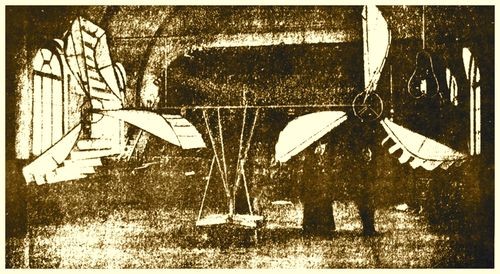
L’Auto-Volant, was a helicopter invented and built by Jean-Baptiste Laisnez and Charles Wilfart in France during 1905–06. Two rotors consisting of three arms, each of which held small moveable blades closed to form a flat surface on the downward stroke. The machine was featured in the February 1905 issue of the Parisian publication “Cosmos”. It was also the subject of the 1905 French patent #357,036.
 All Aero