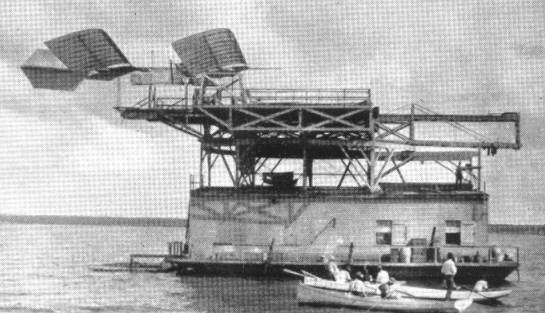
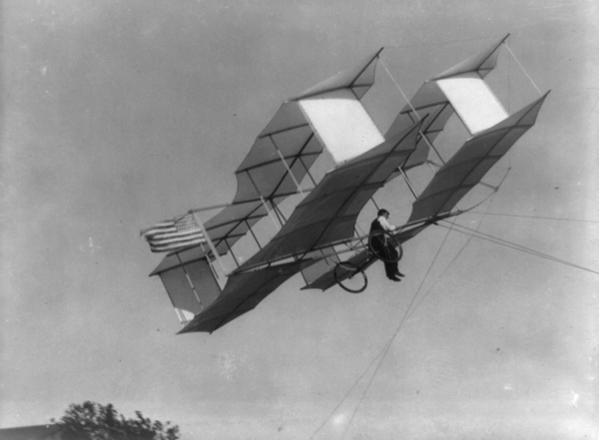
Samuel Langley’s successful flights of his model Aerodromes Number 5 and Number 6 in 1896 led to plans to build a full-sized, human-carrying airplane. Langley’s simple approach was merely to scale up the unpiloted Aerodromes to human-carrying proportions. This would prove to be a grave error, as the aerodynamics, structural design, and control system of the smaller aircraft were not adaptable to a full-sized version. Langley’s primary focus was the power plant. The completed engine, a water-cooled five-cylinder radial that generated a remarkable 52.4 horsepower, was a great achievement for the time. This machine was a scaled-up petrol-engined version of a small steam-powered model flown with great success by Langley in 1896, and had been financed to the extent of $50,000 by the US War Department.
The Aerodrome has a steel tubing fuselage and wooden wings and tail. The covering was Percaline (a light-weight cotton) with a natural fabric finish; no sealant or paint of any kind.
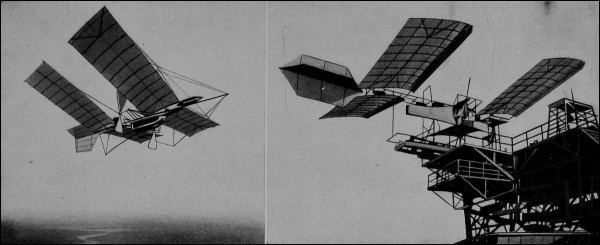
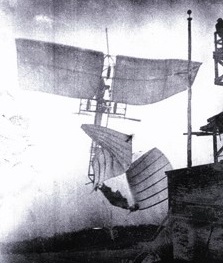
Charles Manly (designer of the engine) attempted to fly from a houseboat on the Potomac River but despite the excellent engine, the Aerodrome A, as it was called, crashed on takeoff on October 7, 1903, and again on December 8. Langley blamed the launch mechanism. While this was in some small measure true, there is no denying that the Aerodrome A was an overly complex, structurally weak, aerodynamically unsound aircraft. This second crash ended Langley’s aeronautical work entirely.
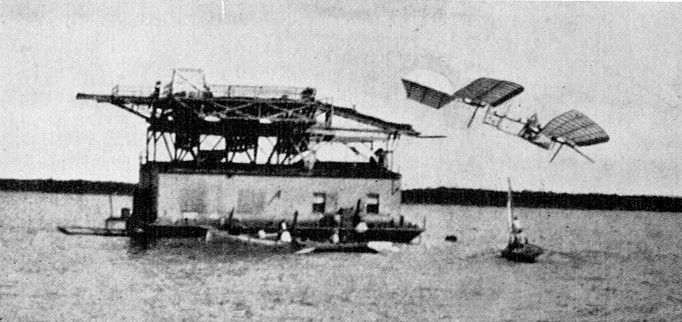
Glenn Curtiss rebuilt the Langley Aerodrome in 1914 and flew it as a seaplane. These flights were possible only because Curtiss made important changes in its design.
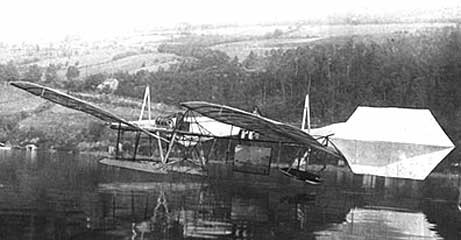
Engine: 5 cylinder radial, 52 hp.
Propellers: two pusher propellers via geared transmission system
Wingspan: 14.8 m (48 ft 5 in)
Length: 16.0 m (52 ft 5 in)
Height: 3.5 m (11 ft 4 in)
Weight: 340 kg (750 lb), including pilot
 All Aero