
A monoplane with long-span wings and up-turned wing tips, a design of Louis Lefebvre. It was entered for the 1911 Concours militaire in France, and tested by Sadi-Lecointe at Chartres, but didn’t participate.
Span: 55’9″
Length: 39’4″
A monoplane with long-span wings and up-turned wing tips, a design of Louis Lefebvre. It was entered for the 1911 Concours militaire in France, and tested by Sadi-Lecointe at Chartres, but didn’t participate.
Span: 55’9″
Length: 39’4″
Lee and Richards built another aircraft, a monoplane with a conventional fuselage and tail surfaces and a 6.7 m (22 ft) diameter annular wing. The first flight on 23 November 1913 ended abruptly when the tail heavy aircraft stalled and crashed into telegraph wires without injury to pilot E. C. Gordon England. Rebuilt, the 80 hp Gnome engined Lee Richards Annular Monoplane proved easy to fly. With pilot and passenger aboard it would take¬off at about 48 kph (30 mph) and had a maximum speed of 137 kph (85 mph). The original aircraft flew for 1028 hours during ten months of testing and was the first truly successful flying saucer. Two more Lee-¬Richards Annulars were built early in 1914 for the Gordon Bennett race, and after World War I Tilghman Richards tried to interest the Air Ministry in his unusual design, without success.
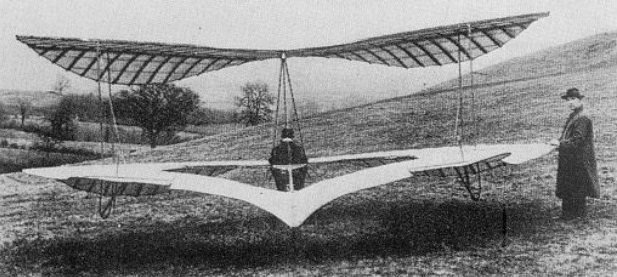
Englishman, G.J.A. Kitchen of Lancaster, patented a circular or annular wing and sold the rights to Cedric Lee, who built an annular winged biplane powered by a 50 hp Gnome rotary engine in 1911. This ‘Kitchen Doughnut’ was wrecked by a gale during tests. Lee and his engineer Tilghman Richards continued to experiment with gliders and with wind tunnel test models at the National Physical Laboratory and soon discovered that the circular wing had some very desirable properties. It continued to provide lift at extreme angles of incidence, and had a gentle stall. Furthermore, a round wing could have a span or diameter less than half that of a conventional surface of the same lifting area.
In 1912 the Lee-Richards annular wing was a circular planform with a hole diameter half span. The powered portotype was a biplane, and they tested it at Middleton Sands, Heysham in 1911. This was supposed to be a very stable configuration, and a later version flew for 128 hours, but the prototype had run into a gully, and then been destroyed when the hanger blew down in a gale. They had been changing the leading-edge camber shape, but were unable to decide which was best, so before rebuilding they tried two models, span 4.7 ft, flown indoors. Extra camber seemed to give a flatter glide angle, but the other person said that this was due to better launch technique. So they went full scale.
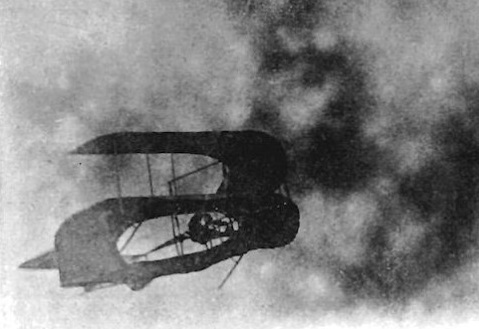
The glider was a biplane, but the upper wing was only the front half of the circle. Elevators behind the wing were also operated differentially for roll control and a fin and rudder were added later. The pilot’s seat was in the hole, and the breeze.
Launch was by catapult from a track, pulled by a rope tied to a dropping weight within a tall tripod. The site was Sellet Banks, an east-facing slope 117 feet above the River Lune near Kirby Lonsdale.
The glider made many successful glides. It was stable and controllable, was banked into turns, and even taken through the stall to 30 degrees nose up, when it pancaked steadily. They often flew in winds of 20 mph, and even 40 mph.
On the final day of flying at the end of trials in December 1912, Cedric Lee made a soaring flight in a strong wind. Cine film was taken, used in the opening clips of “Those Magnificent Men”, and stored in the Science Museum.
A non-flying replica of the powered version is at the Newark Museum.
Wingspan: 22 ft
Wing area: 400 sq.ft
Empty weight: 215 lb (later 390 lb)
Gross weight: 710 lb
Glide ratio: 1-8
The 1911 Lecoq-Monteiro-Aillaud monoplane were 1-2 or 3-4 seaters, designed and built by Lecoq, Monteiro and Aillaud in France.

The 1910 Lecoq-Monteiro-Aillaud monoplane was designed and built by Lecoq, Monteiro and Aillaud in France.
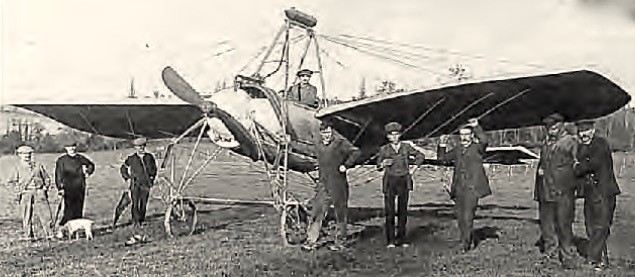
Doctor Baron William Le Clère of Mareuil in Perogord, France, was passionate about mechanics. He had experimented with model airplanes, but wanted a real one. He entrusted the construction to Bertrand Gonthier, founder of the house Gonthier and Nouhaud. The plane was completed in 1911. It was transported by rail to Ribérac on October 20, 1911 and was reassembled in the grounds near the station, where they had built a hangar near the field where the experiments were to take place. The 500-kg plane had an elongated tapered fuselage with a total length of 10 meters, At the end, a triangular canvas represented the shape of a bird’s tail in full flight. The plane only travelled some 50 metres before standing on its nose. Disappointed, Le Clère gave up his plans, but kept the engine of his airplane until his death, in Arcachon in 1927.
In 1855 French sea captain Jean-Marie LeBris built a glider based on his observation of the albatross, the seabird with huge wings.
LeBris’ monoplane had a wingspan of 49 ft and total wingarea of 215 sq.ft.
The whole thing was set on a cart and drawn downhill by a horse. It flew briefly, scaring LeBris, and then crashed, breaking his leg.
LeBris gave up aeronautics.
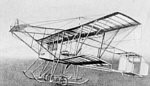
The 1911 P.T.A. folding wing biplane was designed and built by V. A. Lebedev in Russia.
Span: upper 45’11” / lower 32’10”
Weight loaded: 1100 lb
Speed: 50 mph
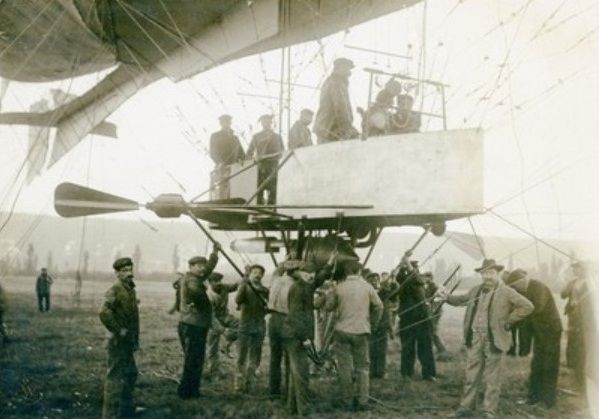
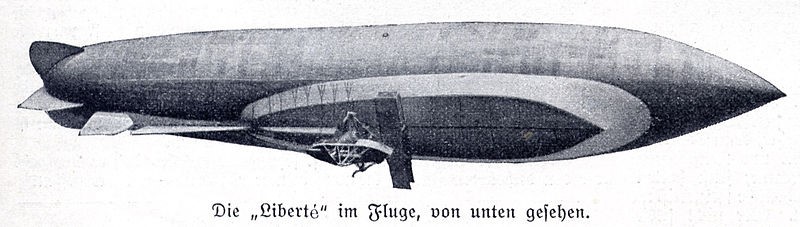
In 1909 Lebaudy produced two other vessels patterned after the République. The Russie and La Liberté, built respectively for Russia and France. The fourth designed dirigible, the Russie made her first voyage on May 29th, ascending 600 feet with eight passengers, and manoeuvring under perfect control. After her official trial, in June, she was sent to St. Petersburg, being the first dirigible furnished to a foreign government by a private concern.
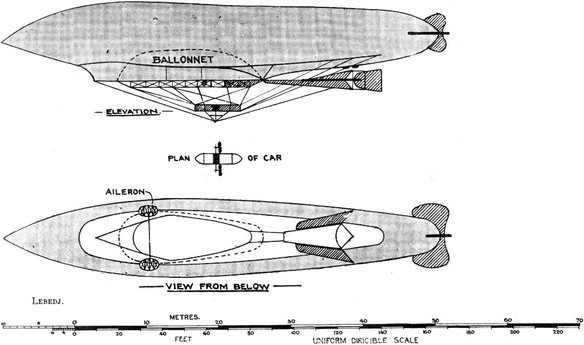
This dirigible was originally known as La Russie, and later renamed by the Russians as Lebedj, and was supposed to be an exact copy of the République.
Featuring a single Panhard-Levassor motor, twin propellers capable of 70 horsepower, the Lebedj dirigible had a volume of 3,800 cubic meters, and could achieve a speed of 49 kph.
Length: 61.2 m
Beam: 10.9 m
Volume: 3,800 m³
Engine: 1 x Panhard-Levassor, 70 hp
Props: 2
Ballonet: 900 m
Speed: 49 km/h
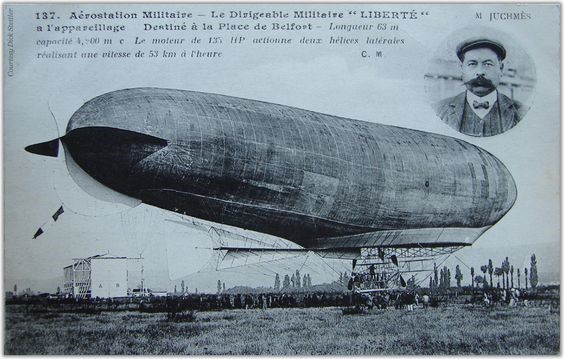
In 1909 Lebaudy produced two other vessels patterned after the République. The Russie and La Liberté, built respectively for Russia and France.

The Liberté was launched the last week in August and, after various practice and official tests, was accepted by the French government two months later. On a notable voyage, made on September 20th, she sailed ten hours with her Panhard motor constantly working.
 All Aero