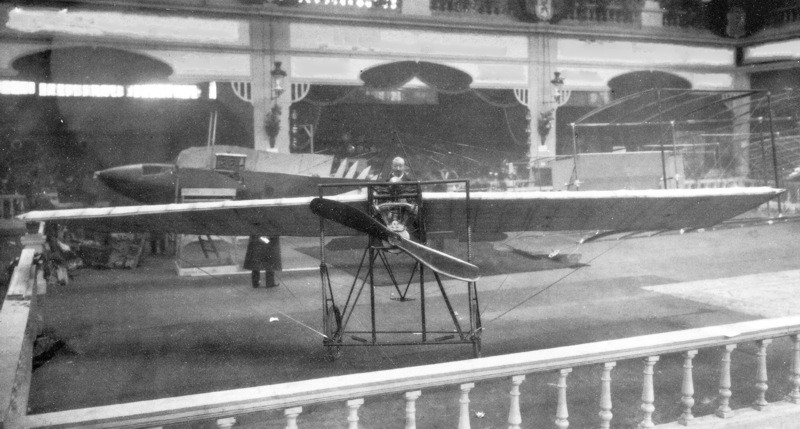
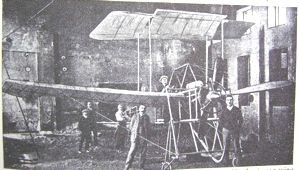
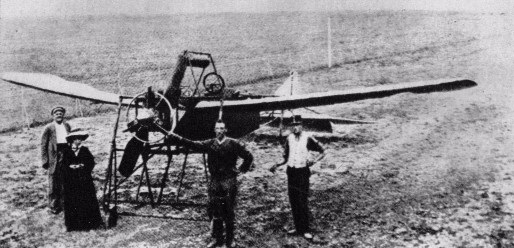
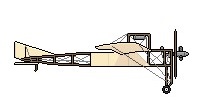
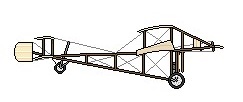
After a visit to the Grande Semaine de Reims in 1909 Linon became interesting in flying and constructed a full scale model, which was exposed on the Brussels salon in the beginning of 1910. After tests of the machine it was modified and fitted with a more powerful three-cylinder Delfosse engine. The machine was shown and flown during the “Semaine de Verviers” from 11 to 17 September 1910, likely by the Italian aviator Darioli.
The Linon brothers, André and Louis, were active in bicycle production around 1890 – 1900 in Ensival-lez-Verviers [Liège] and diversified into autocar building in the beginning of the 1900s. Their firm was named “Les Ateliers de Constructions Automobiles Linon”. The total production of cars was about 1800 before 1914.
After a visit to the Grande Semaine de Reims in 1909 Linon became interesting in flying and constructed a full scale model, which was exposed on the Brussels salon in the beginning of 1910.
The company disappeared during the German invasion.
In five years between 1891 and 1896 Otto constructed seven gliders (five monoplanes and two biplanes) and made over 2000 ever-improving flights from hill sites at Stieglitz and in the Rhinow Mountains near Stöllen. He flew distances up to 400 m (1312 ft) and reached heights of 25 m (82 ft). He dis¬covered and made use of up-currents of air for soaring flight.
His first means of launching was a spring board, but this he soon abandoned in favour of hill launching. Some of his tests were made from the Rhinower Hills, near Stollen, but he also had constructed an artificial hill near Berlin.
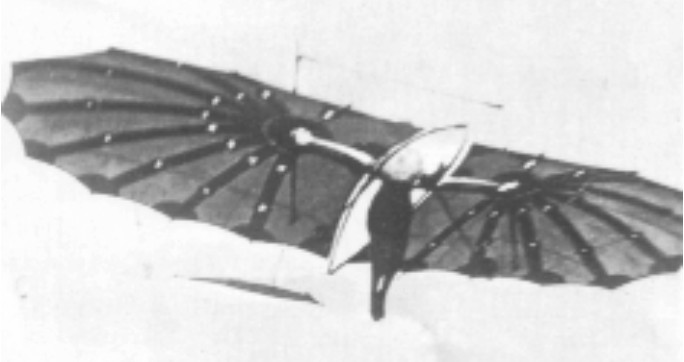
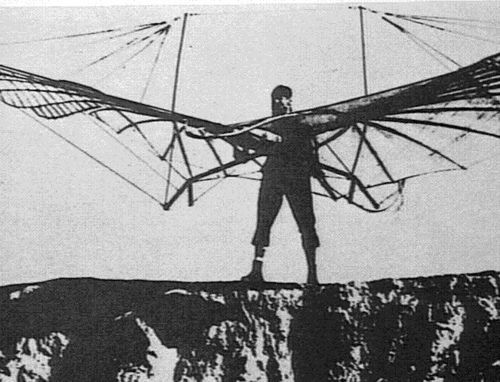
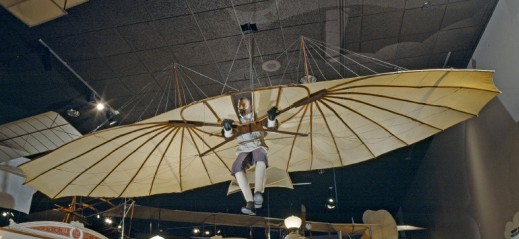
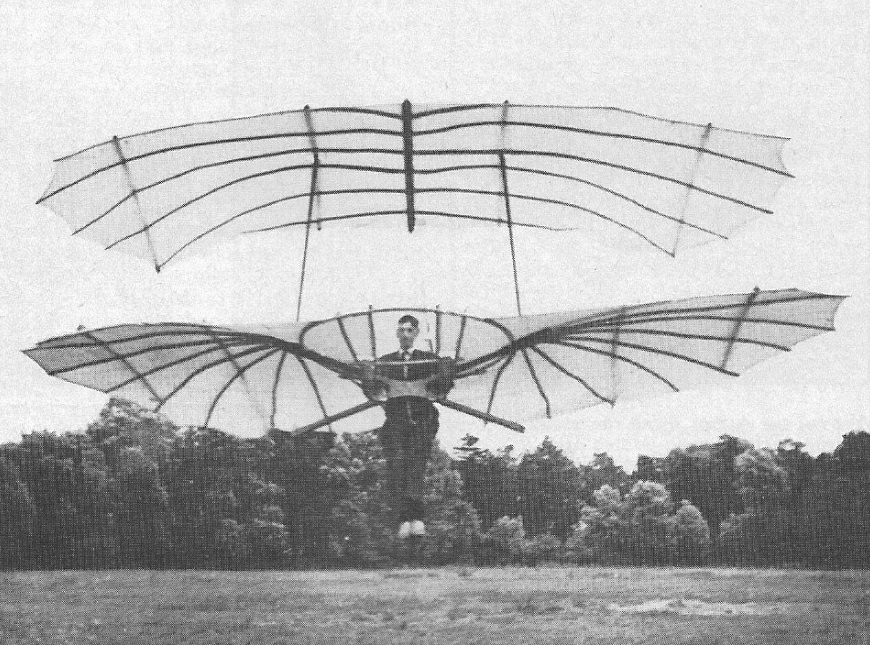
In 1891 Lilienthal completed glider no.3, a monoplane glider constructed from peeled willow wands with a covering of waxed cotton. Its wings spanned 7 m (23 ft), with Lilienthal supporting himself within its centre section on parallel bars — literally a hang-glider — and controlling his flight path by shifting his body mass and thus altering the craft’s centre of gravity.
Otto Lilienthal Segelflugzeug N°3
Lilienthal’s first tentative hops were made with the aid of a springboard launcher, but soon flew from a specially constructed 15-m (49-ft) hill on the outskirts of Berlin.
Between 1891 and 1896 Lilienthal constructed five types of monoplane glider and two biplane types (1891 and 1892).
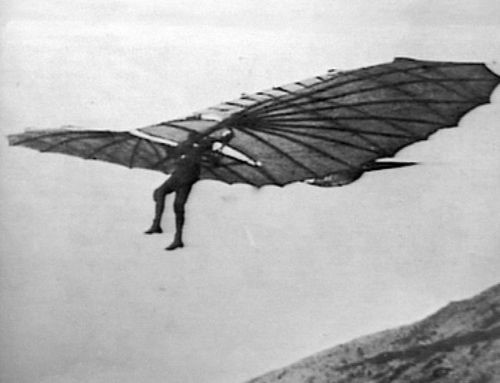
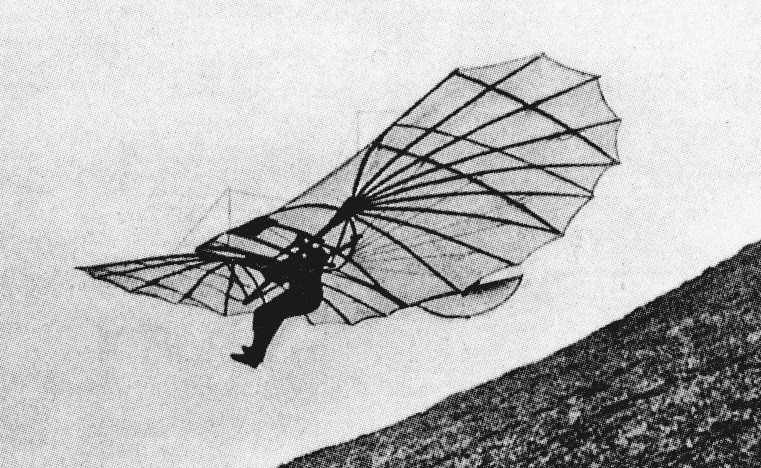
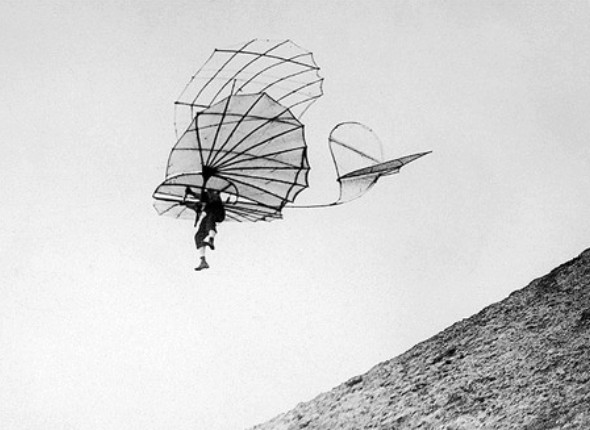
Lilienthal supported himself in his gliders by his arms, so that after a running take off his hips and legs dangled below the aircraft, allowing him to swing his body in any desired direction to achieve stability and control. After 1893 he was achieving glides of 300-750 ft (90-230 m), with remarkable ease of control.
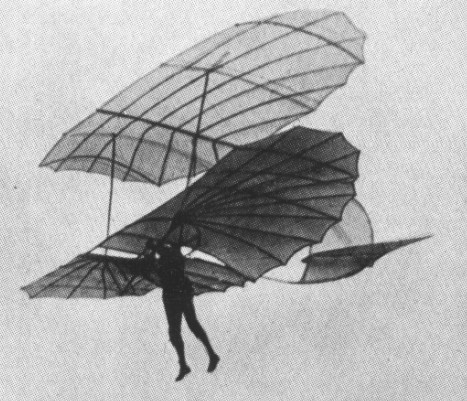
Otto Lilienthal Segelflugzeug N°11 (1894)
The 1894 monoplane hang glider was a single surface fabric covering over exposed framework. Wings fold for storage. Natural fabric finish; no sealant or paint of any kind.
1894 Glider
In 1895 he was developing a type of body harness to work a rear elevator. The purpose of this was to give better control in rising or descending by increasing the effect of the occupant swinging his body forwards or backwards and thus altering the centre of gravity. Lilienthal also tested a glider which had flapping wing tips, driven by a small carbonic acid gas engine. This system could never have equalled in efficiency the new petrol engines and propellers which were soon to come into being; but the great German inventor/ pilot was never to become aware of this, for he crashed in one of his gliders in the Rhinower Hills on 9 August 1896, and died in a Berlin clinic on the following day. His last words were ‘Opfer mussen gebracht werden’ (‘Sacrifices must be made’).
In 1895 produced his thirteenth design, a biplane. On the evening of 9 August 1896, Otto was at Stöllen testing a new kind of head-movement control arrangement when a sudden gust upturned his No. 11 monoplane glider and he crashed heavily from 15 m (49 ft) breaking his spine. He died the next day.
Otto Lilienthal (1848 1896) made approximately 2,500 successful glides in 1893 96, mostly in monoplane ‘hang gliders’ types, in which he flew distances of up to 985 ft (300 m).
In 1937 Dart Aircraft built for Alexanda Korda’s film production, Conquest of the Air, two Lilienthal biplane glider replicas. They ‘flew’ suspended by piano wire. In the end the film was never completed.
1893 monoplane glider Wing span: 22 ft 11.5 in (7.00 m) Wing area: 150.7 sq ft (14.0 sq.m) Wing chord (max): 8 ft 21 in (2.50 m) Length: 16 ft 4.75 in (5.00 m) Weight without pilot: 44 lb (20 kg) Accommodation: Crew of 1.
1894 Glider Wingspan: 7.9 m (26 ft) Length: 4.2 m (13 ft 9 in) Height: 1.5 m (5 ft) Weight: 20 kg (44 lb) Materials: Airframe: Wood Fabric Covering: Cotton-twill
The most significant pre-Wright brothers aeronautical experimenter was the German glider pioneer Otto Lilienthal. In Germany, Otto Lilienthal make an intensive study of bird anatomy and flying characteristics, inspired by the storks which he and his brother Gustav watched wheel¬ing over the rooftops of Potsdam, their home town. He sought to discover precisely how birds flew, altering the dihedral angle of their wings for lateral stability, and varying the camber of the surfaces for lift or drag. Lilienthal was quick to appreciate the importance of curved wing surfaces. In 1889 he published the results of his findings in his book Der Vogelflug als Grundlage der Fliegekunst (Bird Flight as the Basis of the Flying Art), and set about testing his theories.
Between 1891 and 1896, he built and flew a series of highly successful full-size gliders. During this period, Lilienthal made close to 2,000 brief flights in 16 different designs based on aerodynamic research he conducted in the 1870s and 1880s. Most were monoplanes with stabilizing tail surfaces mounted at the rear. Control was achieved by shifting body weight fore-and-aft and from side-to-side.
Lilienthal began testing gliders in his backyard on a one metre platform and made hundreds of flights there before moving to a small hill, two and a half metres high.
By 1893 his gliders had cambred wings with radiated tip, fixed rear fin and tailplane, and could be folded to fit through an ordinary door.
On the evening of 9 August 1896, Otto was at Stöllen in the Rhinower Hills testing a new kind of head-movement control arrangement when a sudden gust upturned his No. 11 monoplane glider and he crashed heavily from 15 m (49 ft) breaking his spine. He died in a Berlin clinic the next day. His last words were ‘Opfer mussen gebracht werden’ (‘Sacrifices must be made’).
Gustav Lilienthal (1849-1933) was the younger brother of glider pioneer Otto Lilienthal. He spent the last 20 years of his life developing ornithopters, based on his studies of bird flight. The 1914 “Big Bird” spanned 17.5 metres and was tested at the research station of Altwarp, on the Stettiner Haff, but never left the ground. Lilienthal continued working at the Berlin Tempelhof and Adlershof airfields until his death.
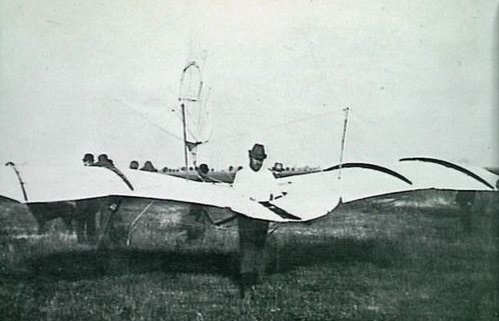
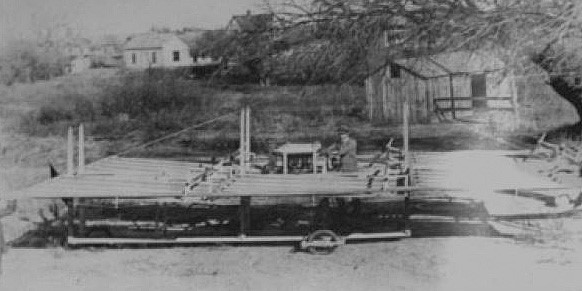
William D. Lindsley of Waynoka, Oklahoma, invented several everyday items, including fishhooks and flyswatters. In 1909 he began experimenting with aircraft designs. His first design was called the Oklahoma Monoplane; a sketch of which appeared in the Waynoka Democrat newspaper on March 5, 1909. In January 1910, he applied to the Unites States Patent Office for a patent on his flying machine, which was eventually granted on September 5, 1911.
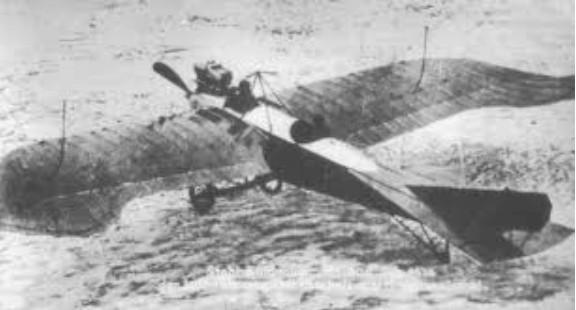
In 1910 Edmund Libański of Lwów (then under Austrian rule, presently in Ukraine) designed an aircraft that was supposed to have advantages of both mono- and biplane through use of lift areas of different size (with upper plane much smaller than the lower one). The 1911 Polish Libański Jaskółka featured a 3-cylinder Delfose rotary engine placed ahead of its propeller. During the take-off to first flight the engine exploded leading to crash. Designer dropped the idea of rebuilding the plane and instead designed a year later a much more succesful two-seat airplane named Jaskółka (Swallow). It was later transported to Vienna where it made many succesful flights. The Jaskółka (Swallow) never flew with the additional upper wing, although it did fly in August 1911 as a monoplane at Wiener Neustadt – without its proven-to-be-impractical top plane.
In 1910 Edmund Libański of Lwów (then under Austrian rule, presently in Ukraine) designed an aircraft that was supposed to have advantages of both mono- and biplane through use of lift areas of different size (with upper plane much smaller than the lower one).
The mono-biplane was built by Libansky and W. Rumbowicz.
During the take-off to first flight the engine exploded leading to crash. Designer dropped the idea of rebuilding the plane and instead designed a year later a much more successful two-seat airplane named Jaskółka (Swallow).
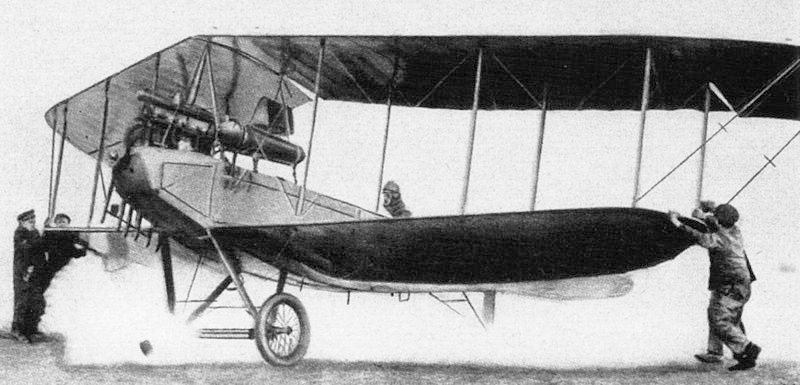
A swept wing, single engine, two seat biplane built in 1914 by the Luft-Fahrzeug-Gesellschaft in Reinickendorf (Berlin). Before the outbreak of World War I Bernard Langer flew the machine shown, equipped with a 100 hp Mercedes D.I engine and an extra tank above the fuselage in place of the passenger, on a non-stop sixteen hour flight. During WW1 at least one Pfeilflieger served with the Schutztruppe (Protection Force) in German South West Africa, now Namibia, between 1914 and 1915.
Reconnaissance and training aircraft, Germany, 1913
Engine: Argus As I, 99 hp Length: 31.791 ft / 9.69 m Height: 9.744 ft / 2.97 m Wingspan: 45.505 ft / 13.87 m Wing area: 387.504 sq.ft / 36.0 sq.m Max take off weight: 1874.3 lb / 850.0 kg Weight empty: 1323.0 lb / 600.0 kg Max. weight carried: 551.3 lb / 250.0 kg Max. speed: 62 kt / 115 km/h Cruising speed: 54 kt / 100 km/h Wing load: 4.92 lb/sq.ft / 24.0 kg/sq.m Range: 162 nm / 300 km Crew: 2
 All Aero