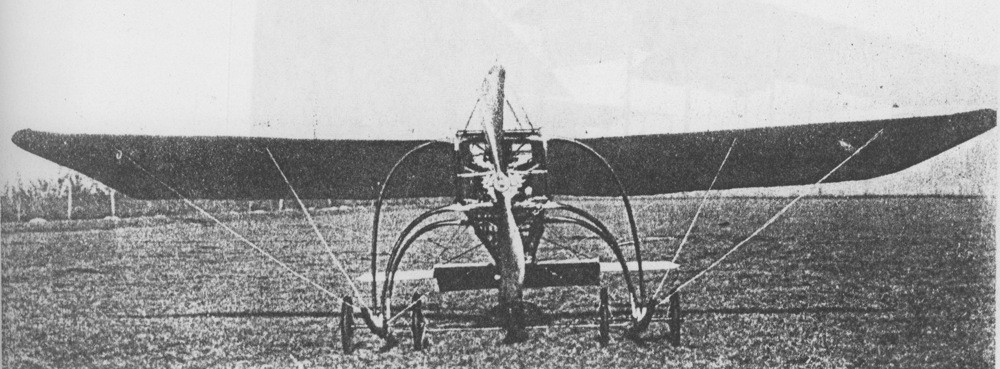
The machine was built by Italo Madrigali from Pordenone, in Northern Italy. Tested in 1910.
The machine was built by Italo Madrigali from Pordenone, in Northern Italy. Tested in 1910.
In 1911 the Macomber Rotary Engine Company of Los Angeles marketed one of the first axial internal-combustion engines, manufactured by the Avis Engine Company of Allston, Massachusetts. A four-stroke, air-cooled unit, it had seven cylinders and a variable compression ratio, altered by changing the wobble-plate angle and hence the length of piston stroke. It was called a “rotary engine” because the entire engine rotated apart from the end casings.
Ignition was supplied by a Bosch magneto directly driven from the cam gears. The high voltage current was then taken to a fixed electrode on the front bearing case, from which the sparks would jump to the spark plugs in the cylinder heads as they passed within 1/16 inch from it. According to Macomber’s literature, it was “Guaranteed not to overheat”.
The engine was claimed to be able to run at 150 to 1,500 rpm. At the normal speed of 1,000 rpm, it reportedly developed 50 hp. It weighed 230 pounds (100 kg) and it was 28 inches (710 mm) long by 19 inches (480 mm) in diameter.
Pioneer aviator Charles Francis Walsh flew an aircraft powered by a Macomber engine in May 1911, the “Walsh Silver Dart”.
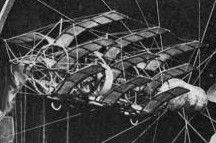
This complex 18-wing triple triplane, powered by two 125 hp engines driving four propellers and capable of carrying eight passengers, was intended for a trans-Atlantic flight. Construction was started in 1912 on Staten Island, but it was probably never completed.
The 1911 Macfie circuit biplane was designed and built by Robert F. Macfie, a US citizen in te UK.
Span: 26′
AUW: 600 lb
The 1910 Macfie “Empress” biplane was designed and built by Robert F. Macfie, US citizen and Tothill, UK.
The 1909 Macfie monoplane was designed and built by Robert F. Macfie.
Span: 28’6″
Weight: 680 lb
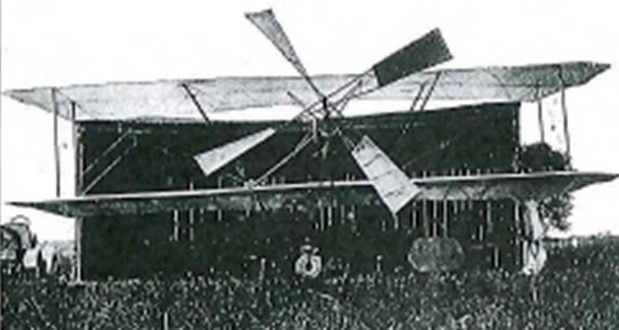
Samuel Luttrell, a local automobile enthusiast of Rockville, Maryland (or Washington DC), built this tailless tractor biplane in 1909. He tested it with a 50-horsepower engine, driving the four-bladed canvas propeller at about 650 revolutions per minute. The propeller was set on a universal joint and intended to control the vertical and lateral movement of the machine. The strong engine crumpled up the flimsy-looking propeller on the first test, after which a 30 horsepower unit was installed.

First aircraft design of Б.Г. Луцкий (transcribed as B.G. Lutskii, variously spelled in Germany, France, Austria etc.). The machine is dated as 1909 and described as a “Винтокрылый аппарат”, which can be translated as “Rotary-wing apparatus”.

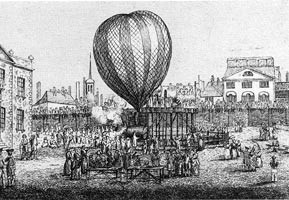
The Lunardi balloon of 1784 was the first gas balloon to make an ascension on the British Isles – September 15, 1784. Later exhibited at the London Pantheon by the flamboyant Italian aeronaut Vincenzo (Vincent) Lunardi, secretary to Prince Caramanico, the Neopolitan ambassador to the Court of St. James.
Luftverkehrs first own design was the B.1 of 1913. An efficient aircraft remaining in service for observation and training for some years, it was the forerunner of all German two-seat observation aircraft of 1914-1918.
 All Aero