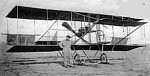
Designed and built by Michelet in 1910 in France.
Designed and built by Michelet in 1910 in France.
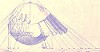
In 1784, less than a year after the first balloon flights, Jean Baptiste Marie Charles Meusnier de la Place presented a plan for a military dirigible, driven by men turning a hand crank to operate a propeller. It would have been the world’s first airship, but it was never built.
In 2002 the BBC series “Building the Impossible” set out to recreate Meusnier’s design to find out whether it would have worked. Cameron Balloons constructed the replica which was filled with helium for safety, instead of the flammable hydrogen proposed by Meusnier. A speed of about three miles per hour was achieved, although the steering sail was too small and steering was difficult.
Jean Baptiste Marie Charles Meusnier de la Place (1754 — 1793) was a French mathematician and engineer. In 1784, less than a year after the first balloon flights, he presented a plan for a military dirigible, driven by men turning a hand crank to operate a propeller. It would have been the world’s first airship, but it was never built.
In 2002 the BBC series “Building the Impossible” set out to recreate Meusnier’s design to find out whether it would have worked.
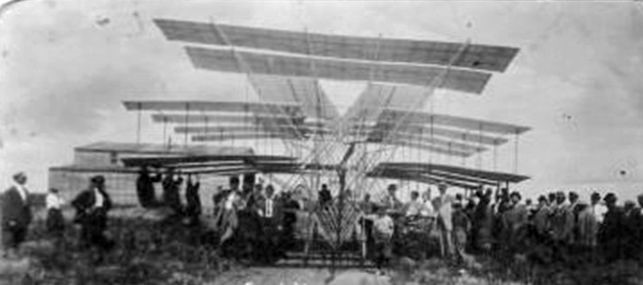
This machine was created, promoted, and built by Ralph Metcalf, a farmer and carpenter from Driscoll, Valley City, North Dakota, and founder of the Metcalf Multiplane Company. He wanted to design an airplane that could take off and land from either land or water. The main body looked like a slender fishing boat with a curved prow, ready to take off or land on a lake, yet with attached wheels for alighting on land. With about twenty wings arrayed in five layers, the machine looked like a “huge bird with wings outstretched”. It had a “double propeller system” with “two fans moving in opposite directions”, powered by a six-cylinder engine. The corporation planned to open an aircraft factory in Minneapolis once the plane had proven its flying capabilities. Much time passed from the incorporation of the company in 1910 until the full-sized aircraft was ready for a test flight in the summer of 1913. Aviator Metcalf steered his Multiplane out of his large Granger Hill workshop to the runway. Alas, it refused to leave the ground. Mr. Metcalf promised the disappointed multitude that he would revamp the aircraft for another trial. Unfortunately, his health failed him and he died in 1918 after several operations.
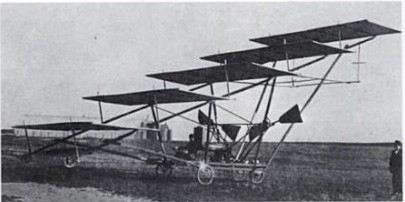
Built and demonstrated at Flugplatz Johnannisthal in 1911, but apparently did not fly. Later, the machine was modified, and it appears questionable whether the revision flew either. The secretive Merx had the “Himmelsleiter” (sky ladder) built and kept in its shed – hidden from prying eyes. When the first flight test was to take place, it turned out that the apparatus was higher than the door and could not be pulled out of the shed. Also known as the Mehrdecker-Versuchsflugzeug von J. Merx, (multiplane-experimental).
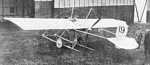
The 1911 Mersey monoplane was designed and built by Mersey Aeroplanes Co. in the UK.
Span: 35′
Length: 24′
Weight all up: 1150 lb
Speed: 55 mph
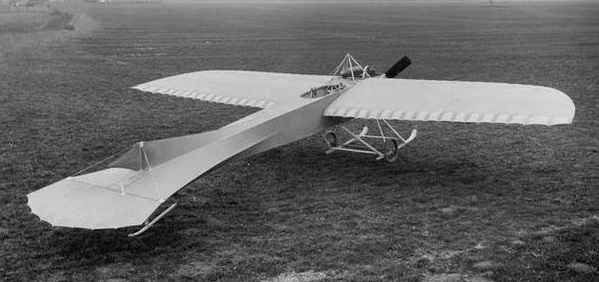
The Merćep 1912 aka Merćep-Rusjan Military-Monoplane of 1912 or Rusjan-Novak No.2, was the second design after the crash of the Slovenian aviation pioneer Eduardo Rusjan. Earlier, Eduardo Rusjan had moved with his brother to Zagreb, Croatia, where Guiseppe Rusjan and Dragutin Karlo Novak then continued to build aircraft for the “Agramer Aëroplanfabrik M. Merćep”, set up by the businessman Mihajlo Merćep in Zagreb.
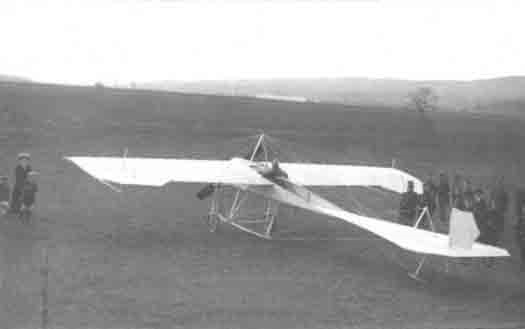
Engine: Gnome, 50 h.p.
Span: 32½ ft / 10 m
Wing area: 204 sq. ft / 19 m²
Length: 23 ft / 7 m
Weight: 617 lb / 280 kg
Useful load: 661 lb / 300 kg
Number built: 1
Mihalis Mercep
Aeroplanwerkstatte,
Agram,
Hungary.
Russjan was connected with this firm, which built 2 biplanes to his designs in 1909. Russjan was killed in the second of these.
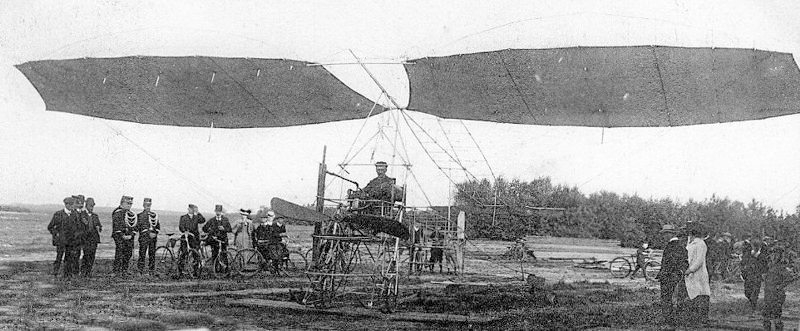
This machine was built at the Sint-Job-in-‘t-Goor airfield, Belgium, in the hangars of baron Pierre de Caters, by the Swedish inventor Janne Mellander, who lived in Antwerp at the time. In 1911 he was granted French patent No. 422954, which disclosed some details of his rather fragile-looking machine, which was equipped with an automatic stabilization device and had the wings mounted very high on a secondary fuselage.
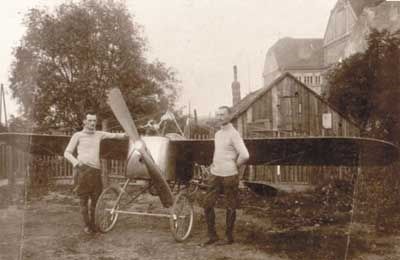
Built by Franz Meichelböck and a friend in Ober Sankt Veit, a district of Vienna, in 1913.
 All Aero