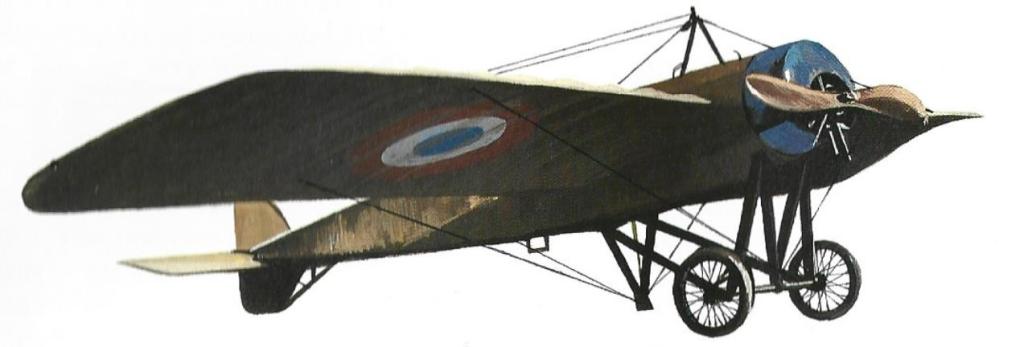
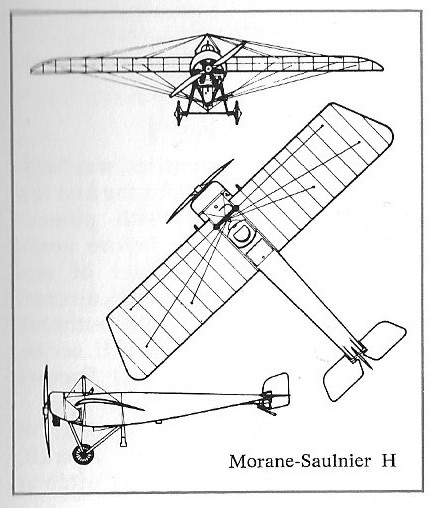
1913 reconnaissance aircraft built by Societe Anonyme des Aeroplanes Morane-Saulnier
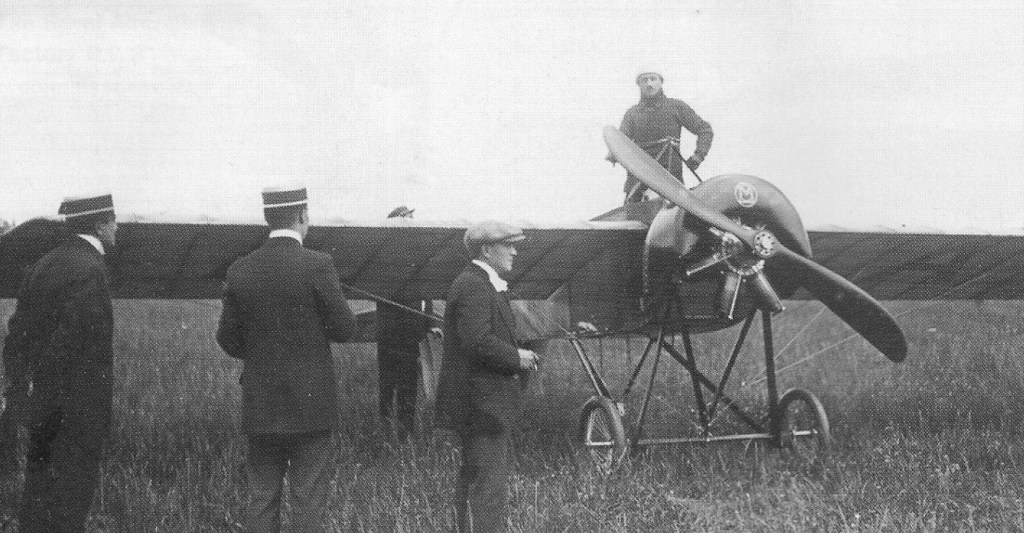
Type H of Frenchman Edmond Audemars at Juvisy in 1913
Engine: Gnome, 80 hp Wingspan: 29 ft 11 in / 9.12 m Length: 20 ft 7 in / 6.28 m Height: 7 ft 6 in / 2.30 m Weight: 1034 lb / 470 kg Max speed: 85 mph / 135 kph Ceiling: 3280 ft / 1000 m Endurance: 3 hr Armament: 1 x mg Seats: 1
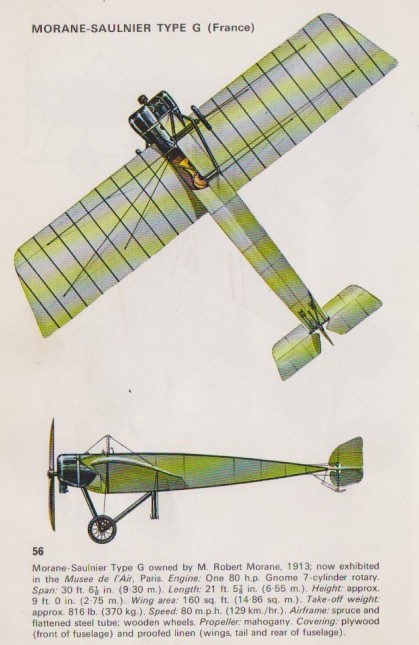
The appellation Type G was something of a generic designa¬tion in that several very different Morane-Saulnier designs were known as such, the last of these being a single-seat fighter designed in the summer of 1915 and built after the initial production batch of Type N aircraft for the Aviation Militaire. A refined development of the basic Type G of 1912, but featuring a fully-faired fuselage and powered by an 80 hp Le Rhóne 9C, the Type G fighter had a centrally-mounted 8-mm Hotchkiss machine gun with standard bullet deflectors on the propeller.
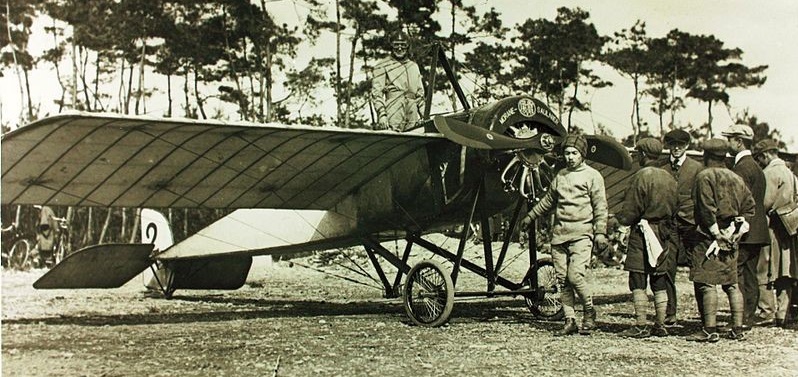
The Morane-Saulnier G was a two-seat sport and racing monoplane produced in France before the First World War. It was a development of the racing monoplanes designed by Léon Morane and Raymond Saulnier after leaving Borel and, like its predecessors, was a wire-braced, shoulder-wing monoplane. Construction was of fabric-covered wood throughout, except for the undercarriage struts which were of steel tube.
The type was a sporting success. In April 1913, Roland Garros took second place in the inaugural Schneider Cup in a floatplane version, finishing with a time of 40 minutes 40 seconds. On 26 June, Claude Grahame-White flew another float-equipped example from Paris to London via Le Havre, Boulogne-sur-Mer, and Dover, covering some 500 km (310 mi) that day. Between 21 and 28 September the same year, two float-equipped Type Gs competed at the seaplane meeting at San Sebastián, with Lord Carbery winning the short takeoff prize on one, and Edmond Audemars winning the maneuverability prize on the other. The following week, Carbery flew his Type G in the Italian Waterplane Contest from Lake Como to Pavia and back, along with two other Type Gs in the field of fifteen competitors, these flown by Garros and Morane. Garros not only won the Grand Prize in the “general class”, but also the prizes for best speed (127.7 km/h, 79.8 mph) and greatest altitude (2,100 m, 6,000 ft).
1909 – Roland Garros and Gustav Hamel
On 28 September 1913 Roland Garros became the first person to cross the Mediterranean Sea by air, flying from Fréjus in the south of France to Bizerte in Tunisia in a Morane-Saulnier G.
In 1914, Russian manufacturer Duks arranged to build the type under licence at their Moscow factory for the Russian Army, and the same year, the Turkish military ordered 40 examples. Before these could be delivered, however, war broke out, and the aircraft were impressed into the French Army. To these, the Army soon added an order of 94 aircraft, and the British Royal Flying Corps also acquired a number, these latter machines purchased from Grahame-White, who was manufacturing the type in the UK under licence. The Type XIV was the in-house designation given to Grahame-White license-built Morane-Saulnier Type G aircraft.
At the outbreak of war, the type’s military value was found to be wanting, and the French machines were quickly relegated to training duties. Despite this, a dedicated single-seat fighter version was built in 1915, armed with an 8 mm Hotchkiss machine gun that fired through the propeller arc, the propeller blades being protected by deflector plates. Only one or two prototypes were built, and the type never entered service.
Some Type Gs were modified by Morane-Saulnier to have their wings mounted above the fuselage, parasol-fashion, rather than at the fuselage sides. This arrangement was found to offer far better visibility for the pilot, and formed the basis for the Morane-Saulnier L.
A Type G is preserved at the Museo del Aire (Madrid) (Museo del Aire de Cuatrovientos).
Operators included the Argentine Air Force, one aircraft in Cuba, the Imperial Russian Air Force and with their aircraft taken over by the Soviet Air Force, the Spanish Air Force, and Royal Flying Corps.
The French Aéronautique Militaire ordered 94, plus the 40 impounded from the Turkish order.
Variants: Type GA version with 40 kW (60 hp) Le Rhône engine
Type GB version with 60 kW (80 hp) Gnome engine
Type WB version for export to Russia with glazed forward fuselage
MS.2 official French government STAe designation for the G
Grahame-White Type XIV License built by Claude Grahame-White in the United Kingdom
Specifications
Span, 29 ft 11 in (9.12 m) Length, 21 ft 8 2/3 in (6.62 m) Height, 8 ft 4 in (2.54 m)
GB Engine: 1 × Gnome, 60 kW (80 hp) Wingspan: 9.20 m (30 ft 2 in) Wing area: 16 m2 (172 ft2) Length: 6.30 m (20 ft 8 in) Empty weight: 95 kg (208 lb) Gross weight: 370 kg (815 lb) Maximum speed: 123 km/h (76 mph) Rate of climb: 1.8 m/s (345 ft/min) Crew: one pilot Capacity: one passenger
Société Anonyme des Aeroplanes Morane Saulnier Societe d’Exploitation Etablissements Morane-Saulnier
Société Anonyme des Aeroplanes Morane Saulnier was established in 1911, by brothers Robert and Leon Morane and Raymond Saulnier at Puteaux, Seine, France.
Developed series of parasol-winged fighters and training aircraft, beginning with 1913 Type L or MS.3; principal production aircraft throughout 1920s and 1930s included MS.130, MS.230, and MS.315 two-seat trainers. Series of single-seat monoplane fighters introduced from 1935, including MS.406s built for French Air Force up to Occupation; development of basic design continued by Morane-Saulnier design bureau and derived MS.450 built by Dornier Werke AG in Switzerland as D-3802A.
Also built Fieseler Storch for Germans as MS.500 Criquet. After liberation developed MS.470 series of advanced trainers, several light aircraft and then MS.733 Alcyon basic trainer. MS.760 Paris introduced into French Air Force service in 1958. MS.880 Rallye touring aircraft first flown June 10,1959.
Societe D’exploitation Des Etablissements Morane-Saulnier was the provisional name for the Morane-Saulnier company after it had been acquired in 1963 by the Potez Group. MS760 Paris jet-propelled communications aircraft was developed further into 6-seat Paris III of 1964. Production also included Rallye-Club, Super-Rallye and Rallye Commodore, the latter first flown in February 1964 after formation of SEEMS.
Reorganized as Gerance des Etablissements Morane-Saulnier in May 20, 1965, subsidiary of Sud Aviation.
Edwin Rowland Moon, possibly inspired by the 1903 Wright brothers flight, took a corner of the workshop of the Moon family owned a boat-building business to realise his dream of constructing and flying an aircraft of his own design.
He tested his first plane, Moonbeam I, in the Fawley area, near the home of his future bride. His first short “hop” took place on Websters Field at Ower Farm, near Calshot and at Moulands Field, Regents Park. Following these test flights on the prototype plane, he built a second plane, Moonbeam II.
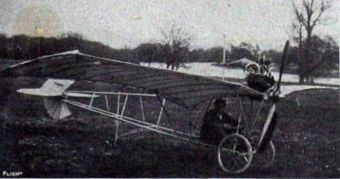
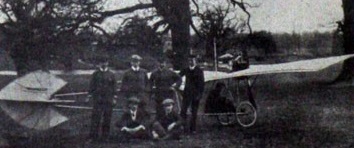
1910 ‘Moonbeam’
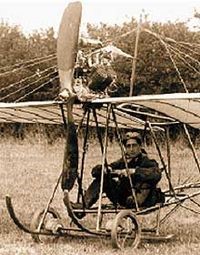
Moonbeam II was a monoplane, weighing 260 lbs, of which 160 lbs was engine and propeller. A V-4 cylinder, 20 h.p. J.A.P engine was fitted, and it had a 6 ft wooden propeller. In 1910, the plane was conveyed by horse-drawn cart to the meadows belonging to North Stoneham farm from where he made the first successful flight; the precise date of the first flight is not known, although researchers believe that it was between 12 April 1910 and 11 June 1910.
Moon later regularly flew his plane from Stoneham, as well as from Beaulieu Heath (near the site of the later World War II airfield) and Paultons Park. He gained his aviator’s certificate in 1914.
Edwin Rowland Moon (8 June 1886 – 29 April 1920), possibly inspired by the 1903 Wright brothers flight, took a corner of the workshop of the Moon family owned a boat-building business to realise his dream of constructing and flying an aircraft of his own design.
He tested his first plane, Moonbeam I, in the Fawley area, near the home of his future bride. His first short “hop” took place on Websters Field at Ower Farm, near Calshot and at Moulands Field, Regents Park. Following these test flights on the prototype plane, he built a second plane, Moonbeam II.
He made the first successful flight; the precise date of the first flight is not known, although researchers believe that it was between 12 April 1910 and 11 June 1910.
Following the start of World War I, Moon soon enlisted in the Royal Naval Air Service. On 29 April 1920, Moon was at the controls of a flying boat on an instructional cruise when it crashed into the sea. Moon and three other crew members were killed.
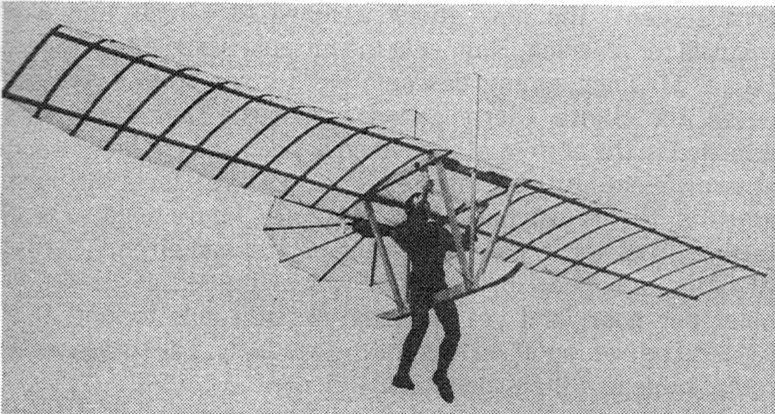
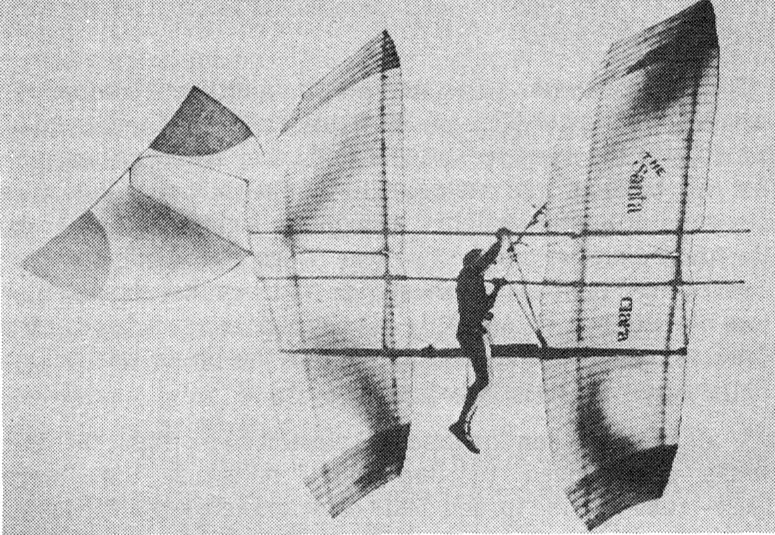
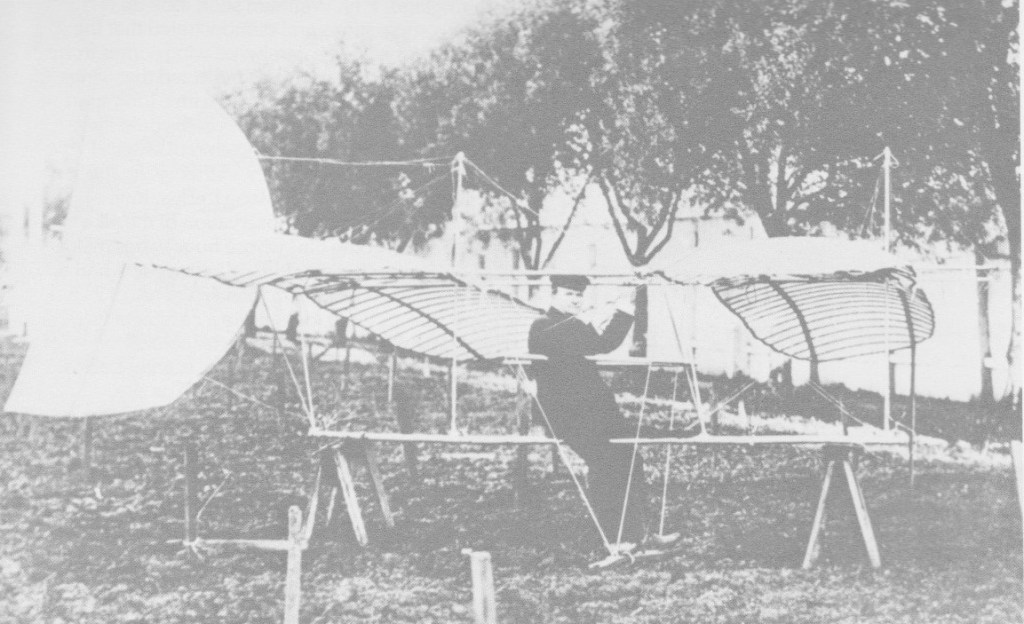
John J Montgomery, a science teacher at Santa Clara College, in California, experimented with gliders as early as 1883. Montgomery’s 1883 glider had a short, 23 foot wing span with a moveable horizontal tail. A keel-like bar (longeron) was suspended three feet below the wing longerons. The pilot ran to launch the ship by holding the upper bars, and once in flight he straddled the centre bar. He could then swing his body from side to side for lateral control and manipulate the horizontal elevator plane for lift. The craft is reported to have flown consistently well.
The first glider proved the value of the cured wing which he copied from a seagull and with it he flew 600 ft.
His second hang glider used flat wing surfaces, and proved to be totally useless. In 1905, Montgomery added a second, tandem wing to his basic design, and Daniel Maloney, a parachute jumper, made numerous exhibition flights with his plane, performing sharp turns and even barrel rolls.
His third hang glider incorporated wing warping for lateral control.
1883 hang glider
Montgomery’s first models were tested from aa cable suspended between two hill tops in California, and the gliders were dropped from them. He was able to give them such stability that they could even even themselves after being launched upside down, and glider smoothly to the ground.
Montgomery made a number of flights himself but stopped when he put his foot in a squirrel hole on one landing and hurt his leg.
He also dropped from a balloon at 4000 feet and glided gently back to a stand-up landing at his take-off point.
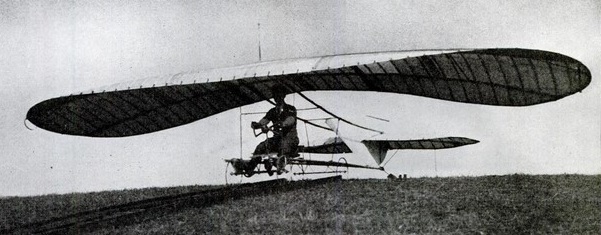
In 1905 Montgomery returned with an improved hang glider with two main wings: one placed behind the other in a tandem arrangement.
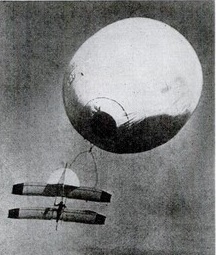
His new glider weighed 45 lb and had controls for steering. Engaging parachute jumper Daniel Maloney, many descents were made from 4000 ft above the Santa Clara college grounds. The glider was attached to the bottom of a manned balloon cut loose when at sufficient altitude. Montgomery was able to perform figure eights, dives and stalls, spiral and circling turns. At times the speed of the glider was estimated at almost 70 mph, and yet Montgomery was still able to land at a predetermined spot on his own two feet. Montgomery also employed two other glider pilots, Wilkie and Defolco. Maloney was killed in an accident and the act was discontinued. Montgomery describes the fatal accident as follows; “The ascension was given to entertain a military company in which were many of Maloney’s friends, and he told them he would give the most sensational flight they had ever heard of. As the balloon was rising with the aeroplane, a guy-rope dropping switched around the right wing and broke the tower that braced the rear wings and which also gave control over the tail. We shouted to Maloney that the machine was broken, but he probably did not hear us, as at the time he was saying ‘Harrah airship’ and as the break was behind him, he may not have detected it. When the machine started on its flight, the rear wings commenced to flap – indicating they were loose – the machine turned on its back and settled faster than a parachute. When we reached Maloney he was unconscious and lived only 30 minutes. The only mark of any kind on him was a scratch from a wire on the side of his neck, the six attending physicians were puzzled at the cause of his death”.
Montgomery and his double-winged glider. Note both foot and hand operated controls
Montgomery did quite a bit of research in the use of curved lifting surfaces and the movement of air around them. He had intended to carry out more experimentation, but the great San Francisco Earthquake prevented it. It wasn’t until 1911 that he again started gliding, but unfortunately h was soon killed in a fall in one of his gliders. In October, while in the air, he was struck by an unexpectedly violent gust of wind which sent his glider crashing to the ground. He hit fairly hard and injured his head and hip. At the time he did not think he was severely hurt, but later on complained of severe pains. These continued to get worse, and stayed with him until death.
A hot air balloon hauled Carnival Parachutist Dan Maloney in a Montgomery glider to 400 feet. Maloney flew eight-mile course during the glider’s descent.
John Joseph Montgomery was born in Yuba City, California, USA, on 15 February 1858. After graduating from St.Ignatius College (now the University of San Francisco) as a lawyer he entered the law profession but failed. He tried storekeeping but failed.
Montgomery graduated from St. Ignatius College in San Francisco in 1879. He is often referred to as a Professor, though it is believed he didn’t have a Ph.D. He was the son of a former assistant attorney-general of the US. Two of his college classmates were James D. Phelar, mayor of San Francisco (1896-1902) and Rev. R.H. Bell, well known for his work in wireless telegraphy.
At his family ranch near San Diego he studied the flight of birds. He tried building three ornithopters with flapping wings, which failed.
At 25, he built a fixed wing glider with his sisters and younger brother assisting with the fabric. With this glider, on 20 August 1883, he soared 602 feet.
Rozier took part in a further flight on 23 June 1784, in a modified version of the Montgolfiers’ first balloon christened La Marie-Antoinette after the Queen, which took off in front of the King of France and King Gustav III of Sweden. Together with Joseph Proust, the balloon flew north at an altitude of approximately 3,000 metres, above the clouds. They travelled 52 km in 45 minutes before cold and turbulence forced them to descend past Luzarches, between Coye et Orry-la-Ville, near the Chantilly forest. They set records for speed, altitude and distance travelled.
Along with Joseph Montgolfier, he was one of six passengers on a second flight on 19 January 1784, with a huge Montgolfier balloon Le Flesselles launched from Lyon. Four French nobles paid for the trip, including a prince. Several difficulties had to be overcome. The wallpaper used to cover the balloon’s envelope became wet because of extreme weather conditions. The top of the balloon was made of sheep- or buckskin. The air was heated by wood in an iron stove: to start, the straw was set on fire with brandy. (In other tests charcoal or potatoes were used). The balloon had a volume of approximately 23,000 m³, over 10 times that of the first flight, but it only flew a short distance. The spectators kneeled down when the balloon came down too quickly. That evening the aeronauts were celebrated after listening to Gluck’s opera, Iphigénie en Tauride.



 All Aero