Two English enthusiasts named Mortimer and Vaughan built a biplane with two pairs of semicircular wings which gave it the appearance of a double decker ring doughnut. They called it ‘The Safety’, but the machine crashed and burned during its first trial at Edgware, Middlesex, in 1910. A second version proved safer, if no more successful, for it never flew at all, though Morton and Vaughan did have it photographed suspended on thin wires to give the impression of flight.
Pioneers
Morrow 1912 biplane
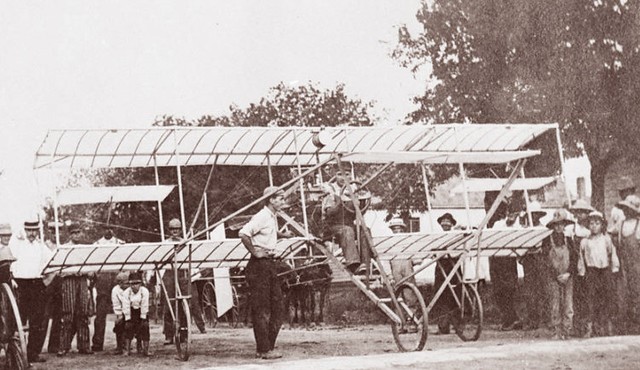
In the summer of 1911 J. A. Morrow and his sons, Everett and Edward, began building an airplane in their Carleton, Nebraska, blacksmith shop. Before it was finished, the Morrows moved to Burwell to ply their trade. It was there that the plane first took flight in the fall of 1912. It was a pusher biplane patterned after the 1909 Curtiss. It proved to be less than successful, though they persevered and built a second machine, used to make exhibition flights throughout Nebraska.
Morok 1910 monoplane
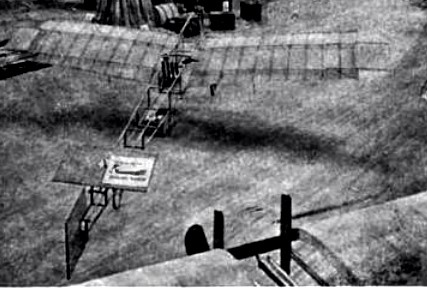
A monoplane with sliding wing-tips, which allowed it to bypass the lateral control patent wars of the time. It was built by Charles F. Morok of the Morok Aeroplane Co. of New York. His most noted flight was when he flew across the Green Mountains at Rutland, Vermont, but he also gained some notoriety by crashing into the window of a young woman during an attempt to fly across the Hudson River in December 1910.
Morok 1911 biplane
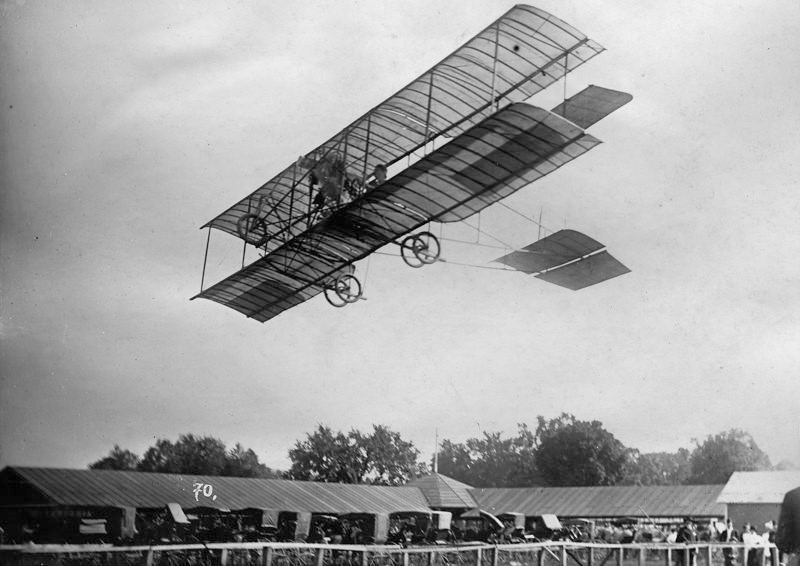
Belgian aviator Charles Frank van der Merrsche, alias Charles F. Morok (the name he used in the USA), flying his biplane over the Sandusky County Fairground at Fremont, Ohio in September 1911. Following the Boston Aero Show in February 1910, Morok was flying for Fred Shneider on Shneider biplanes. He then settled on the Nassau Boulevard Aerodrome of Garden City, formed a flying school and built a biplane of his own in Summer 1911. The machine had a span of 32 feet (9,75 m) and a weight of 500 pounds (227 kg). The engine was a 45 hp Anzani, probably American-built. It has been stated that two of these machines were built for exhibition and training duties.
Morok, Charles F. / van der Merrsche, Charles Frank
Morok Aeroplane Co. of New York; “Charles F. Morok” was a Belgian and his actual name was Charles Frank Van der Merrsche, but he was also known by the stage name “Diavolo”. He was famous as a daredevil, the inventor of the automobile-somersault-in-the-air and the loop-the-loop-on-a-bicycle feats, before starting flying.
Following the Boston Aero Show in February 1910, Belgian aviator Charles Frank van der Merrsche, alias Charles F. Morok was flying for Fred Shneider on Shneider biplanes. He then settled on the Nassau Boulevard Aerodrome of Garden City, formed a flying school and built a biplane of his own in Summer 1911. It has been stated that two of these machines were built for exhibition and training duties.
Morok’s flying career ended abruptly in the summer of 1912, when he died of typhoid fever.
Morita 1911 monoplane
The 1911 Morita monoplane was designed and built by the Morita Company in Japan.
Span: 30’6″
Length: 24’3″
Moreau Aérostable No.2
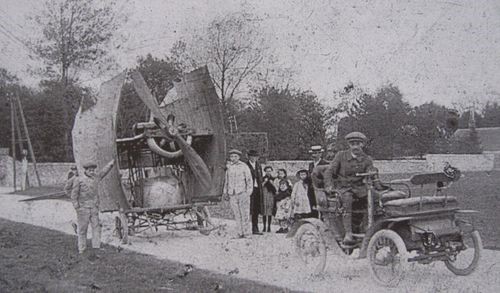
A De Dion-Bouton “Vis-à-vis” automobile towing a “Frères Moreau Aéroplane a stabilisation automatique” in 1911 at Combs-la-Ville. Different than other machines built by brothers Jules Albert & André Moreau, the No.2 was equipped with a Gnôme engine and the wings do not seem to be covered of silk, but with emaillit.
Moreau Aérostable No.1

Designed and built by Albert Moreau in France in 1909.
Span: 39’4″
Length: 29’6″
Weight empty: 1100 lb
Moreau, Jules Albert & André
Circa 1908-1909 the Moreau brothers’ (Albert and André) built a relatively large model, with a wing area of two square metres, made flights of up to 1500 metres when tested in the Jura mountains. It was intended for verifying the Moreau brothers’ (Albert and André) theories about control systems, which were later put to practice in their “Aérostable” machines of 1912-1914.
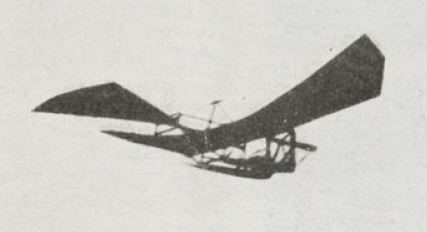
The machine had automatic pitch control by the weight of the pilot and his nacelle, which were pendulum suspended and operated the elevators via levers and rods.
Morel 1910 Canard Biplane
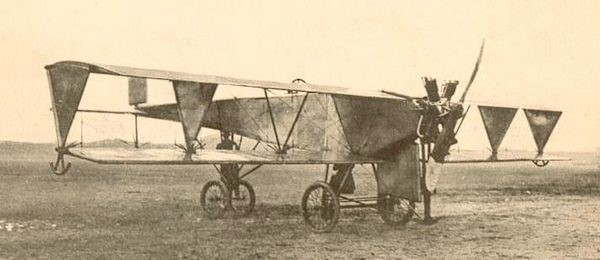
Designed by capitaine Morel de l’infanterie coloniale and built by Pierre Pons – who had formed the SAFA (Société Anonyme Français d’Aviation). Entered in the 1911 Grand Concours Militaire de Reims, as evidenced by the Liste officielle des concurrents du concours militaire 1er janvier 1911; named in the list as Pons (Adresse – Paris). As no further mention of the machine can be found in this concours it is likely that it was not ready in time for the competition.
The Morel (Pons) Canard was evaluated in a French official military report dated March 6, 1912, and, as quoted by Opdycke, did some flying in April 1912 at Issy-les-Moulineux. Constructed of aluminium and steel in its entirety, the design made it possible for it to be disassembled completely by loosening only nine bolts.
Constructed of aluminium and steel in its entirety, this aeroplane was designed and built by Capitaine Morel to carry two passengers in addition to its pilot, was powered with an Anzani 60 hp, 6-cylinder radial.
Engine: Anzani 60 hp
Length: 7 m
Span: 9 m
Wing area: 23 m sq.
Weight: 380 kgs
 All Aero