Murrell Ornithopter

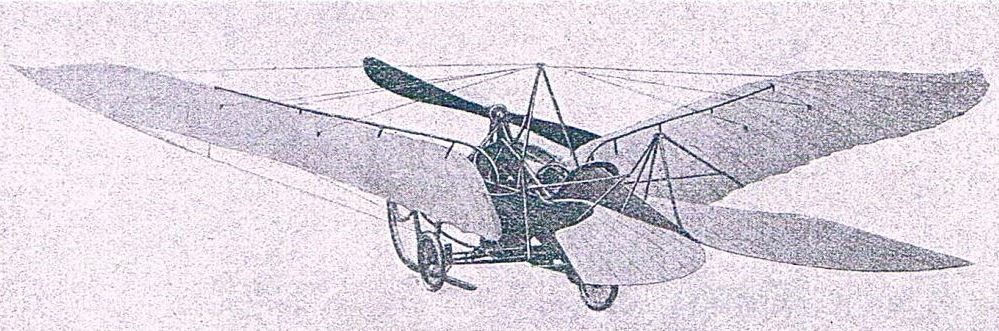
An ornithopter, circa 1910, that was built by Melville M. Murrell of Morrinsville, Tennessee. He’d previously patented a human-powered ornithopter in 1877, then was bitten by the aviation bug again when powered flying machines were being developed. For reasons of his own, 35 years after applying for his flying-machine patent, Murrell pulled his old drawings out, made some alterations, and built a new flyer. Though Murrell’s new model bore some resemblance to his original ornithopter, he’d apparently been doing some reading. This time, he gave his plane a fixed wing; his louvered flapping wings were still a part of the design, but now supplied forward thrust. Murrell rigged the machine to a cable along a hillside and harnessed it to a mule to launch it into the air. The cable having some sort of a trip such that, when the plane had gotten to a certain speed, it was hurled into the air.
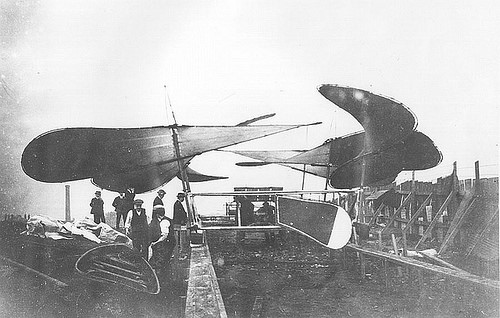
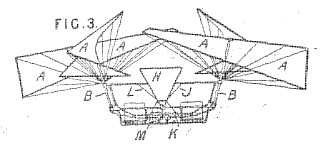
Mumford 1913 Aerodrome

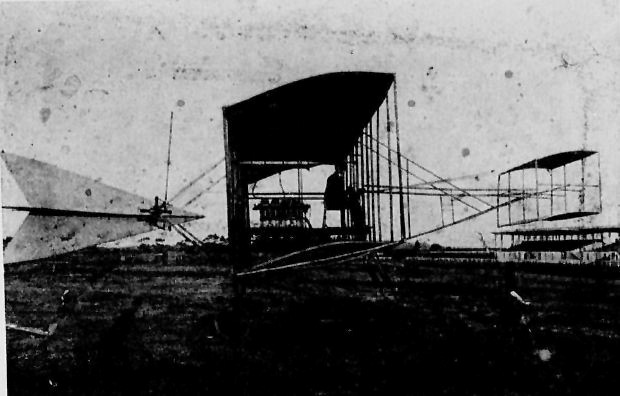
In Glasgow, construction on Mumford’s second helicopter was started in 1913.

The patented Mumford machine was originally identified as the Mumford Aerodrome in a 1909 article published in “The Aero”, Vol. 1, No. 1.

The crew consisted of one pilot, no passengers.

The invention of Mumford was patented in Great Britain as improvements in or connected with Aerodromes or Flying Machines. In the USA a patent was also acquired by Mumford; Improvements in or connected with Aerodromes or Flying Machines.in France there were equivalent patents Aéroplanes ou machines volantes and Machines volantes.

Mumford 1908 Helicopter

In Glasgow, Mumford’s first machine was started in 1908, and after a rather long and active life for an early flying machine, was wrecked in 1912. In that time, it went through a number of improvements and alterations, as various flaws with the design were attended to. Construction on the second helicopter was started in 1913.

Müller, Jacques V.

Jacques V. Müller was born in Luxembourg in 1881 and emigrated to the USA in 1900 to join his sister, who ran a farm there. He settled in Salina, Kansas, where he experimented with balloons and from 1909 reportedly built four airplanes. In 1914 he returned to Luxembourg, where he started a mine and a pigment factory.

Moy Aerial Steamer

The Moy Aerial Steamer was an experimental 15-foot span tandem-wing monoplane, powered by a 3 hp steam engine driving two, 6-foot diameter pusher- propelling paddle wheels. Built by Englishman Thomas Moy, the unmanned flying machine was tested in the Spring of 1875, tethered to a pole, running on a circular track, at the gardens of the Hotel DeLuxe in south London. Spuriously reported to have left the ground and “flown” at a height of six inches, the Aerial Steamer may sometimes be claimed to be the first unmanned airplane to fly from level ground.

Mouraret 1910 Hydro-aeroplane

In October of 1910 at the Boufarik Racecourse, Algeria, Leon Mouraret flew his biplane for a distance of 200 meters on his first attempt. On his second attempted at flight the aircraft crashed and was damaged. Boufarik’s flying machine was distinguished by its unusual arrowhead-like tail and by the very high setting of the pilot and frame above the ground. The biplane was powered by a French 60 hp Mutel engine. Mouraret’s biplane was called a “Hydro-aeroplane” and could be fitted with two long floats.

Mouillard Glider No.4

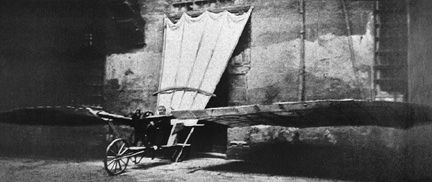
In 1881, Louis Mouillard wrote L’Empire de l’Air (Empire of the Air), in which he proposed fixed-wing gliders with cambered bird-like wings. He had been experimenting with gliders since 1856, and although his own gliders were unsuccessful, he realized the importance of gliding to the future of aviation – a perspective that was later shared by Otto Lilienthal. Photographed in Cairo, Egypt.

Mosment 1806 balloon

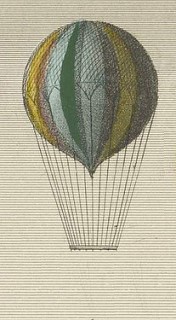
Frenchman M. Mosment did not use the customary basket on his balloon, but stood on a flat platform. He made his last ascent at Lille on 7th April, 1806. About ten minutes after takeoff a small parachute, containing some animal, was observed to be launched from the car; immediately afterwards an object which was soon ascertained to be the flag of the adventurer, slowly followed it through the sky. A rumour began to spread about that the aeronaut himself had fallen from his balloon. This was shortly after confirmed by the discovery of his body almost buried under the sand in one of the fosses (ditches) of the ramparts that surrounded the town. It was supposed that the oscillations communicated to the balloon in the act of delivering the parachute had thrown him off his balance. Some persons pretended at the time to have heard him declare the event before-hand, and from thence argue that the affair was not unpremeditated.