Némethy Flugrad / Flying wheel

Flying wheel no.2

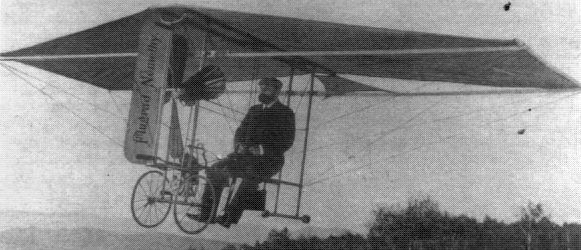
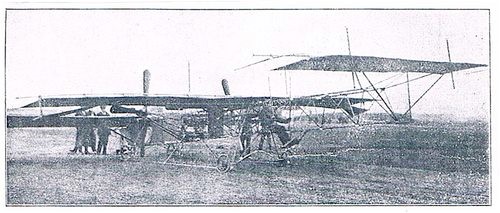
Designed and built by Emil von Némethy at his factory in Arad, Hungary (now in Romania). The construction of his Flugrad (“flying wheel”) started sometime in 1899 yet wasn’t completed until 1901. A second machine appeared in 1903 – pictured in a 1907 Scientific American article – and in 1910 produced a third and final original design. Némethy soon after however, gave up his experiments once his Anzani motor was damaged and he’d run out of money.

Némethy, Emil von

Emil Némethy, 1867 – 1943, was a pioneer aviator of Hungary (listed in Jane’s as Austria, as in the Austro-Hungarian Empire of the time). He is credited with early use of steel tubular structures for aircraft. Also, the Némethy Equation is one of the first mathematical means of calculating with precision the mass-lifting capability of aeroplanes.

Nelson No. 4 float biplane

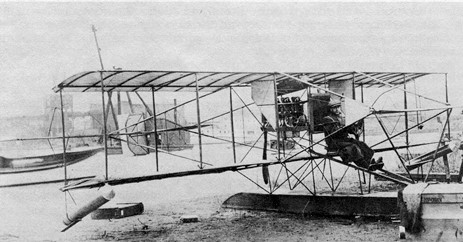
The Nels Nelson No. 4 was built in the winter of 1911-12 as a Kirkham engined landplane and fitted with the float in the summer of 1912 – first flight as a floatplane in August. It was flown in both forms but later in 1912 Nelson made further changes and converted it to a permanent wheeled configuration. It was in this form that it was sold to Prof. Charles Swartz, Mgr. of the Aeroplane Exhibition Co. Humboldt, Tenn., who promptly wrecked it.

Nelson Biplane

Nels J. Nelson, a 22-year-old Swedish immigrant working as an automobile mechanic in his shop on Elm Street in New Britain, began building and flying his own aircraft. On May 1, 1911, young Nelson made his first flight from the new field in Plainville, now known as Robertson Airport and the oldest in Connecticut.

That summer he flew some 40 miles to the ball field that also served as an airfield in Saybrook. Located at the end of Dudley and Coulter Streets, the area remained open fields until housing was built there in the 1940s. After arriving, he tested his biplane but it did not rise more than a few feet from the ground.

That evening a crowd of about 2,000 people gathered to see his flying machine and to watch the Saybrook and Deep River baseball game. When the time came, he took his machine to one end of the field, got good speed on the ground and, it was reported, “glided upward like a bird.”

He skillfully circled around while ascending to the magnificent height of two or three hundred feet. While circling, the engine’s radiator cap flew back and broke the wooden propeller. With the loss of thrust the aircraft came down rapidly and struck a fence as it landed. He was in the air for about five minutes.

Nelson continued to fly and build airplanes but, unable to get government contracts, ultimately lost out to other manufacturers. He died at his home in Yonkers, New York, in 1964.
Nau 1910 Monoplane

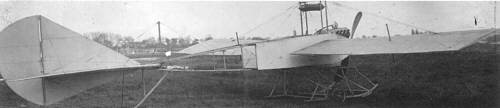
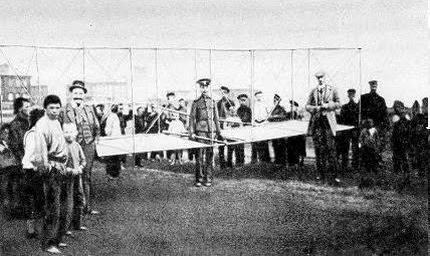
Robert Nau, a French sculptor, had constructed an earlier monoplane in 1909. The photo was taken by French press photographer Louis Branger on May 13th, 1910 on the flying field Port-Aviation at Juvisy-sur-Orge. The Nau Monoplane (1910) was a big machine, with a span of 13 meters and a length of 17 meters, wing area was 24 square meters. The fuselage was half covered. Engine was a 60 hp Renault V-8. After the photo session, which delivered at least two photos, flying was started by Mr. Nau. On May 18th flying ended when the machine with Nau as pilot crashed (it is reported as “falling down”) from a height of 4 meters. Nau was lightly innjured. The machine did not fly after this event.