France, circa 1909 airplane builder
France, circa 1909 airplane builder
Motorenfabrik Oberursel
Motorenfabrik Oberursel A.G. was a German manufacturer of automobile, locomotive and aircraft engines situated in Oberursel (Taunus), near Frankfurt (Main), Germany. The company had its origins in 1891, when Willy Seck invented a new gasoline fuel injection system and produced a small one-cylinder stationary engine of about 4 hp, which he called the Gnom. The following year he founded Willy Seck & Co. to sell the design, which became famous around the world. The engine was improved to achieve more power, but in 1897 the shareholders refused to allow Seck to develop a Gnom-powered car and he left the company. The company was reorganized as Motorenfabrik Oberursel the next year, and by 1900 had built 2,000 engines.
The same year the company granted a license to the Seguin brothers in Lyon to produce the Gnom in France. Sold under the French name Gnome, the engine became so successful that they renamed their company to the same name. In 1908 they developed a rotary version of the basic Gnome system as the Gnome Omega aircraft engine, and from there a series of larger versions of the same basic design. The new Gnome engines were wildly successful, powering many of the early record breaking aircraft.
In 1913 Motorenfabrik Oberursel took out a license on the French Gnome engine design and the similar Le Rhône 9C. They produced both, the Gnomes as the U-series, and the Le Rhônes as the UR-series. During World War I it supplied a major 100 hp-class rotary engine that was used in a number of early-war fighter aircraft designs.
The Gnome Lambda seven-cylinder 80 hp rotary engine was also produced by the Oberursel firm as the Oberursel U.0 Umlaufmotor (the generic German term for a rotary engine) as their first-ever powerplant for German military aircraft, and was used on the initial versions of the Fokker Eindecker fighter, the Fokker E.I.
When World War I started the following year the Oberursel U.I of 100 hp, a clone of the Gnome Delta 100 hp rotary, had the best power-to-weight ratio of any German engine. It went on to power most of the early German fighters, such as the Fokker and Pfalz E-series monoplanes
.
Oberursel also built a copy of Gnome’s 14-cylinder Double Lambda two-row rotary. This 160 hp (120 kW) engine, designated U.III in Germany, was difficult to build and quickly wore out in service. It was used on the Fokker E.IV and D.III designs.
The 110 hp Oberursel UR.II, the clone of the Le Rhône 9J of the same power output, was the next major success. Fokker bought the company in 1916 in order to guarantee supplies of the UR.II. This acquisition proved advantageous because Fokker was partial to rotary powered designs, and because supplies of the Mercedes D.III engine were limited. The UR.II was used in the Fokker Dr.I and Fokker D.VI.
By 1917, the UR.II had been rendered obsolete by its relatively low power and poor performance at altitude. An 11-cylinder development, the UR.III, was not used operationally. Indeed, by 1918, rotary engines had largely fallen from favor with the Idflieg and with pilots. The lack of castor oil and the poor quality of the mineral oil substitute “Voltol” severely reduced engine life and reliability.
Nevertheless, in the summer of 1918, the UR.II was installed in the Fokker D.VIII. The light weight and aerodynamic cleanliness of the D.VIII allowed it to achieve excellent performance even with the outdated UR.II.
After the war the company was purchased in 1921 by Gasmotorenfabrik Deutz, another gasoline engine manufacturer, who moved their two-stroke diesel manufacturing to the Oberursel factories. In 1930 they merged with Humboldt-Deutz, but with only one product line. The factory was eventually closed in 1932 during the Great Depression, reopening in 1934 for small-scale production.
In 1938 the company merged Klöcknerwerke AG. From this point on they were known as the Klöckner-Humboldt-Deutz Oberursel factory, known primarily for their locomotive engines.
In 1940 during World War II all diesel research was relocated to Oberursel, where Dr. Ing. Adolf Schnürle led the development of much larger and more advanced engines for aircraft use. This led to the Klöckner-Humboldt-Deutz DZ 700 8-cylinder radial engine, the DZ 710 16-cylinder boxer engine, and the DZ 720 32-cylinder H-block made from twinned 710’s. None of these designs reached operational use by the end of the war, when the factory was occupied by US troops.
For a short period in 1946 the factories were used as a tanks and trucks repair depot by the US army.
In 1956 the factories were returned to Klöckner-Humboldt-Deutz, and from then on have been used primarily for gas turbine development and production. For the next twenty years they produced a variety of designs, typically under license from other companies. In 1980 they were renamed KHD Luftfahrttechnik GmbH.
In 1990 the company was sold to what was then BMW Rolls-Royce. The new owners decided to use the Oberursel plants to produce an entirely modern engine for the “small end” of the aviation market, and started development of the Rolls-Royce BR700 family in 1991. The engines have since gone on to power a number of aircraft including Bombardier, Gulfstream V and the Boeing 717.
The factory in Oberursel is claimed to be the oldest surviving aircraft engine factory in the world.
Engines:
Gnome designs:
Oberursel U.0
licensed Gnome 7 Lambda, 68 hp (51 kW) seven cylinder rotary.
Oberursel U.I
100 hp (75 kW), nine cylinder.
Oberursel U.II
110 hp (82 kW)
Oberursel U.III
Gnome Lambda-Lambda 14-cylinder, two-row rotary engine copy. 160 hp (120 kW).
Le Rhône designs:
Oberursel Ur.II
Le Rhone 9J 110 hp (82 kW) nine cylinder rotary.
Oberursel Ur.III
11-cylinder development of the Ur.II. 145 hp (108 kW).
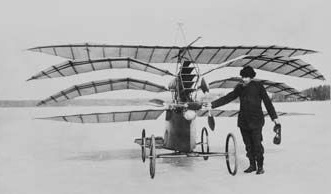
Carl Richard Nyberg (1858-1939) was a Swedish industrialist and the inventor of a successful blowtorch. He began work on this flying test-bed in 1897, with tests and alterations to the design of Flugan (The Fly) going on until around 1910. It had a wingspan of 5 meters, and the surface area of the wings was 13 m². It was powered by a steam engine heated by four of his blowtorches, producing 10 hp at 2000 rpm. The weight of the engine was 18 kg, giving a very good power-to-weight ratio for its time. The total weight of the plane was 80 kg, so the failure to fly was more related to poor propeller and wing technology. The challenge photo was probably taken in 1903 or later, when he started testing on the ice of the Baltic at his home on Lidingö outside Stockholm, rather than tethered around a circular board track in his garden.
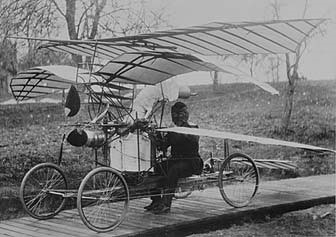
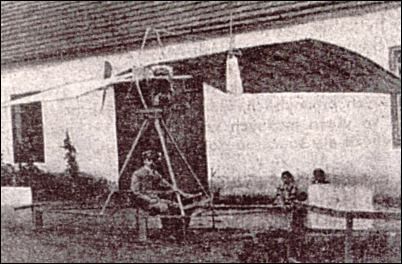
The second helicopter made by Frantisek Novak in 1914.

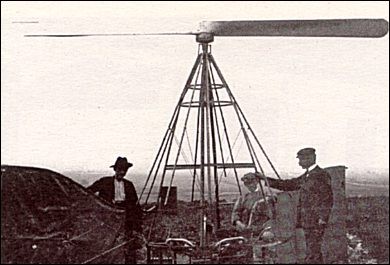
Novák started his pioneering work on helicopters already in 1909 with a model helicopter and in June 1910 he started building his first full size helicopter which used a motorcycle engine for power. In this first version it turned out that the 3 meter diameter rotor was too heavy and that the motorcycle engine was too weak. Later Novák was able to obtain a more powerful engine, a 3-cylinder Trojan and Nagl of 25 hp; and developed a lighter rotor of the same 3 meter diameter. This helicopter did lift into the air unloaded – however, as there was no compensation for the reaction movement, the machine counter-rotated in the air and even the fitting of large vertical panels did not stop the helicopter from spinning. Coinciding with the start of his more advanced second helicopter, development of Novák’s first ended in the fall of 1911.
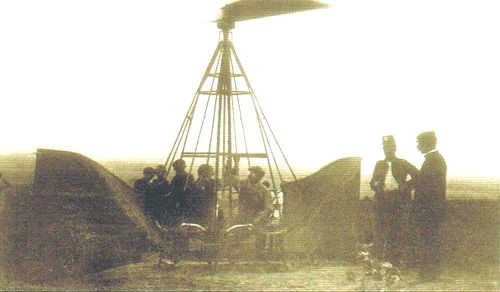
In 1909, Norman Arthur Thompson, an Electrical Engineer born in 1874 at Streatham, London, became interested in the science and practice of Aeronautics after reading two books on by the pioneer aerodynamacist Frederick W. Lanchester. Thompson, after securing finance from Dr Douglas White, a wealthy friend, approached Lanchester and persuaded him to collaborate on designing an aircraft. Lanchester designed a two-seat pusher configuration biplane powered by two 50 hp (37 kW) rotary engines, the Thompson-Lanchester No. 1 Biplane or Gray Angel. This was completed during 1910, but proved incapable of any more than brief hops, and was eventually scrapped.
Despite these setbacks, which used up most of White’s initial capital, Thompson and White set up a limited company, “White and Thompson” on 8 June 1912 to continue their aviation business at Bognor Regis. In early 1913 Thompson, working on his own without the involvement of Lanchester designed a second aircraft, the Norman Thompson No. 1 Biplane, another pusher, this time powered by a single 100 hp (75 kW) water-cooled ABC engine, which successfully flew. This was not progressed further, however, as White and Thompson was hired to maintain a Curtiss Model F flying boat, and was appointed the exclusive European agents for Curtiss in February 1914.
In the summer of 1914, White and Thompson designed and built two flying boats to compete in the Daily Mail £5,000 Circuit of Britain race for seaplanes, a single-engined flying boat, and a larger twin-engined aircraft. Although the race was cancelled owing to the outbreak of the First World War, the single-engined aircraft was successful, and a further eight were built for the RNAS as the White and Thompson No. 3, being delivered in 1915, as were 10 examples of the “Bognor Bloater”, a single-engined landplane.
White left White and Thompson in 1915 to join the Royal Army Medical Corps, the company being re-organised as the Norman Thompson Flight Company, and expanding its factories to cope with increased demand for its aircraft, orders being placed for the N.T.4, a twin-engined patrol flying boat of similar size to the Curtiss H.4 Small America, and the N.T.2B, a single-engined flying boat trainer. One N.T.2B was shipped to Canada to make forestry patrols from Lake St John, Quebec. A change in RNAS requirements lead to the sudden cancellation of orders for the N.T.4, however, while engine problems caused delays to the delivery of N.T.2Bs.
These problems caused Norman Thompson to go into receivership on 19 April 1918, an attempt to sue Curtiss over breaking the 1914 agreement for White and Thompson to have exclusive sales rights in Europe getting nowhere. The Norman Thompson Flight Company went into Voluntary liquidation on 12 July 1919, the company’s factory and stock being purchased by Handley Page.
Aircraft
Thompson-Lanchester No. 1 Biplane / Gray Angel
White & Thompson No. 1 Seaplane
White and Thompson No. 3
White & Thompson Bognor Bloater
Norman Thompson N.1B
Norman Thompson N.T.2B
Norman Thompson N.T.4
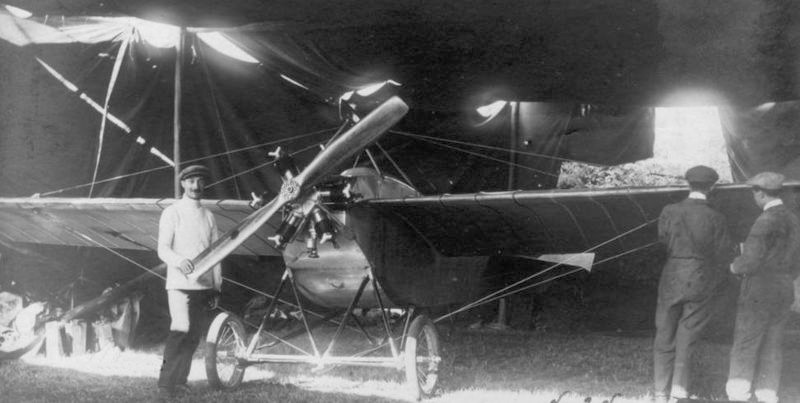
A Nieuport copy, built by Ch. Perron (Norrep backwards) and, probably, two Leau brothers in 1913, in France. It was powered by a five-cylinder Anzani and by the unusual Edelweiss engine, a radial with fixed pistons and moving cylinders.
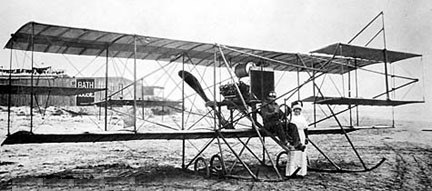
1911 (Petaluma) = A second Hall-Scott-powered aircraft was built in 1911, practically a duplicate of the first, for use by “Wiseman the Fearless” in exhibition flights throughout the West, as well as for the first Post Office-sanctioned air mail flight, on 17 February 1911, from Petaluma to Santa Rosa.
The names Wiseman-Cooke and Noonan-Wiseman often appear in conjunctive reports—Ben Noonan, a Santa Rosa butcher, supplied finances for Wiseman’s projects; Weldon B Cooke (an aircraft builder in his own right) purchased Wiseman’s 1911 machine, thought to have been repowered with 75hp Roberts, to fly in exhibitions after his Black Diamond was retired.
Restored in 1985 for the Smithsonian’s Postal Museum.

The first aeroplane designed by Louis Noel (sometimes mistakenly called Paul Noel) appeared in 1911. It was completed in April in France and flew in June. It was an unequal-span biplane with an all-tubing airframe for disassembly. The box fuselage was uncovered with a rudder hinged at the tail and a huge tail plane set ahead of it. After brief testing at the end of June, the Anzani was replaced with a Viale, itself an Anzani copy, and the balance was changed. Later a Gnome was installed.
Span: upper 39’4″ lower 26’3″
Length: 31’2″
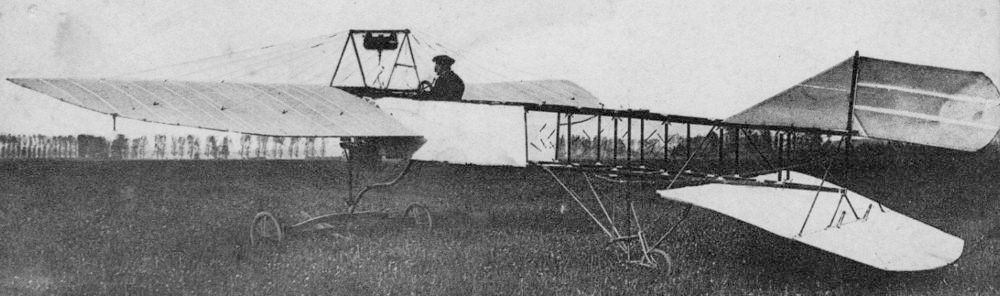
Jules Noël qualified for French license No. 322 on a Sommer and was then employed by Sommer. Before, he had built at least three aeroplanes of his home town Carignan, in the northeast of France. The third was a monoplane with an uncovered rear fuselage and Bleriot-style kingposts. Its empty weight was 210 kg and the machine was powered by a 25 hp Anzani. Noël and an Italian passenger were killed in a testing accident at the Sommer airfield in Douzy on 9 February 1911.
 All Aero