The 1911 Pelliat monoplane was designed and built by Pelliat in France.
Span: 28’7″
Length: 28’3″
Weight empty: 507 lbs
The 1911 Pelliat monoplane was designed and built by Pelliat in France.
Span: 28’7″
Length: 28’3″
Weight empty: 507 lbs
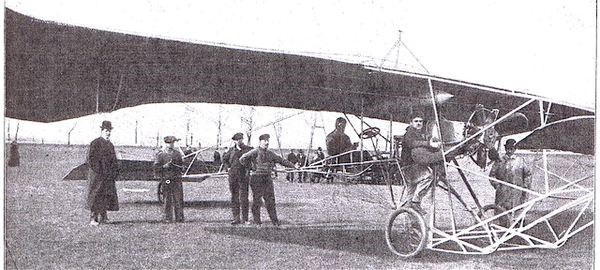
A tractor monoplane designed and recorded as a Deutsche Sommer aircraft, in respect to Pega & Emich (Griesheim am Main) being sold to the Deutsche Sommer-Flugzeugwerke early in 1911. Unsuccessfully powered by a 60 hp Hoffmann-Rotor engine, sporting an uncovered fuselage and elevator section in front.
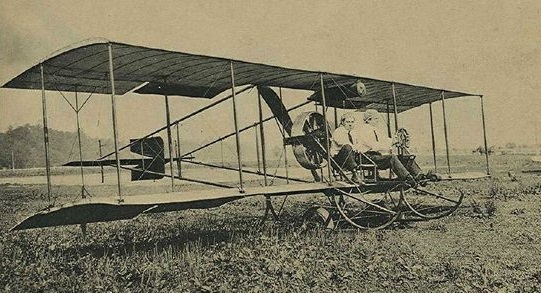
The Columbia Biplane designed by Colonel Paul Peck was fitted with a seven-cylinder, air-cooled rotary rated at 50 hp at 1500 rpm, built by the Gyro Motor Company (Washington), sponsored by, and designed under the direction of Emile Berliner.
A Gordon Bennett Cup entry did not compete.
In American Air Mail Catalogue, Vol 1, 6th Edition, Entry 3: Sep 23-Oct 1, 1911, Garden City-Mineola, NY, International Aviation Tournament. The first official US airmail was flown during the (event) at the Aerodrome on Nassau Boulevard in Garden City. Postmaster General Frank H Hitchcock authorized mail to be flown and Earle L Ovington was sworn in as the first official airmail pilot. T O M Sopwith and Capt Paul W Peck also flew mail during the meet. Ovington flew mail on the first day, and most covers and cards received a circular “Aeroplane Station #1” postmark and a 3-word (“Aerial Special Despatch”) cachet. Covers were postmarked during each day of the meet, but no mail was flown on Sep 29 or Oct 1 due to poor weather conditions. A total of 43,247 pieces of mail was serviced during the meet.
[ibid.] Entry 41: July 19-21, 1912, Coney Island [an amusement park clone in Cincinnati; note roller coaster in background on postcard], Ohio. Paul Beck [spelling error] flew mail each of three days from Coney Island to California, Ohio [the town’s Post Office existed 1865-1935 on the outskirts of Cincinnati, about 1.5 miles from the park]. A Columbia biplane was used and the service was designated as Route 631,003.
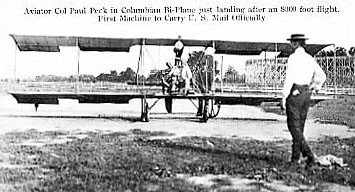
The heavy Gyro motor was fatal to Peck (and passenger) in his crash on Cicero Field, Chicago on September 11, 1912. Peck held American pilot licence No.57 and had set the American duration record at 4 hours 23 minutes, 15 seconds set on May 24, 1912.
Engine: 50hp Gyro rotary pusher
Wingspan 30’0″
Seats: 1

New Zealander Richard Pearse, sometime in March 1902 on a remote South Canterbury, New Zealand, farm, got his aircraft into the air powered by an internal combustion engine of his own design. He took off along the road running near his family’s farms at Waitohi, flew about 50 metres before crashing into a tall gorse hedge.
The precise date is not known because the event was not recorded in any official sense, but it was carried out in front of a small group of mainly children.
Pearce’s achievements were not really known about outside his family and the immediate Waitohi area of South Canterbury until his death in 1953 and the discovery of a partly completed aircraft behind the house where he had last lived in Christchurch, NZ.
Pearse had died in Christchurch’s Sunnyside mental hospital and when it came to tidy up his affairs and clear out his house someone realised that there was something significant here.
The discovery of this aircraft led to interest in this unknown, loner of a man and the subsequent revelations of his achievements.
The argument against Richard Pearse is based on the definition of “flight” and the claim that while Pearse may well have designed and built his own aircraft and got it into the air 17 or 18 months before Orville and Wilbur, he had no real control over it – witness the crash into the hedge – and thus he did not have “controlled” flight.
He flew his aircraft many more times – on one occasion flying up the bed of the nearby Opihi River for almost a kilometre and demonstrating real control. He crashed into the river on this occasion after the engine overheated and ran out of power.
Pearse took off from a paddock, aimed at a cliff that dropped off sheer into the riverbed – a drop of 25 metres that would almost certainly have killed or badly injured him if the aircraft hadn’t flown.
Witnesses say they saw the plane flying from the moment it got up enough speed and they saw Pearse turn the plane to fly up the river.
Waitohi (pronounced Wai-tui locally) at the dawn of the 20th century was still remote and really was on the edge of civilisation. And Pearse worked by himself, for himself. One of the other reasons that so little of Pearse’s exploits were known outside the Waitohi area is that many of the farming families in the region were Plymouth Brethren and regarded his attempts at flight as ungodly and ignored them.
When it became obvious that the history of Richard Pearse needed exploring George Bolt went straight to the tip that every farmer has on his farm. Several small parts of what’s understood to have been the first plane were found.
At least two replicas of what’s understood to be Pearse’s first aircraft have been built. Pearse may have worked alone, but he did file his designs with the patent office and it’s from these drawings that both replicas have been built. The first was the work of long-time Pearse investigator and supporter, Aucklander Geoff Rodliffe and it was powered by a modern, conventional microlight engine. Attempts to fly it were thwarted by bad weather and this machine now lies in a dark and dusty corner, out of sight and out of mind at MOTAT in Auckland.
The second was built in Timaru by a team of four people – two working on the aircraft and two building a replica of the original Pearse engine.

By the time the Wright brothers flew their powered aircraft, Richard Pearce had apparently made four flights in total, the later flight covering a distance of some 1000 yards and only ending when his engine began to overheat requiring a precautionary landing.
Pearce remained modest about his achievements, and while he patented his aileron control system, he did not seek notoriety, later stating that he was quite happy for the Wright brothers to claim the glory for that first flight as he did not claim ‘controlled flight’.
Pearce was so intelligent and forward thinking that in some people eyed it put him firmly out side what was considered ‘normal’ at that time, and he spent the last two years of his life committed to Sunnyside Mental Hospital.
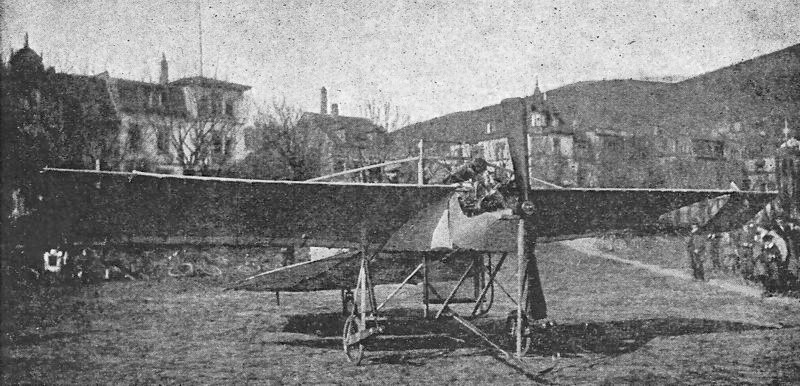
This monoplane was built by Firma Max Pause in Heidelberg, Germany, probably in 1909 and probably powered by an Antoinette engine.
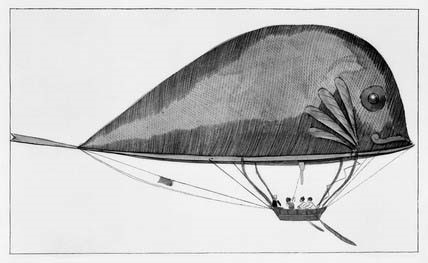
The creation of two Swiss-borne gunsmiths; eccentric engineer and inventor of the cartridge breech-loader (patented 1812), Jean Pauly, and Durs Egg, gun-maker to King George III – its construction was begun during June 1816 in Knightsbridge, London, and continued into the following year. The rigid craft, Pauly’s second dirigible flying fish – his first being a smaller one that he first flew in 1804 near Paris with little success – had an envelope 90 feet long and was notable for its intended use of trimmable ballast. The device, to have been either a sand-filled box or a water-filled barrel (accounts differ), was to be slung on ropes laid out between the airship’s tail and the rear of the gondola, and by using these ropes the ballast could then be hauled back and forth, thus moving the centre of gravity of the aerostat. For this, and its other innovations in aeronautic navigability, a patent, No.3909 dated April 15, 1815, was granted by the Great Britain Patent Office to Jean Samuel Pauly and Durs Egg. This patent became entangled in a lawsuit between the two gunsmiths, which was ostensibly about pistols. The lawsuit, Egg v. Pauly, lasted from 1817 until 1820 – the year previous to Pauly’s death. During the lawsuit Pauly claimed that Egg had failed to assist with the production of certain firearms in contravention of an agreement dated March 15, 1815, which dealt with the building of the airship. In the end, the venture, aptly named “Egg’s Folly” by those following its lack of progress, failed miserably, proving to be both too complex and too costly, resulting in the financial ruin of its inventors. A decade later, Durs Egg, having gone blind and insane, died in 1831. In January 1844, P. T. Barnum and General Tom Thumb (1838-1883) sailed for England to begin a European tour where at the Surrey Zoological Gardens a captive balloon ascent exhibition was made by the famous dwarf using the Dolphin’s still-existing goldbeater’s skin air bladder, or ballonet rather, capable of lifting fifty or sixty pounds when filled with gas.
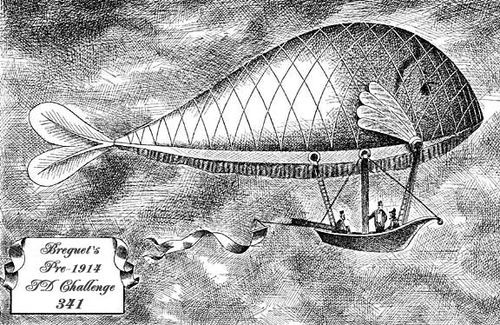
In 1789, Baron Scott, of Paris, proposed an aeronautic fish. Jean Samuel Pauly revived the plan with modifications. Marshal Michel Ney patronised it, and gave nearly 100,000 francs for the construction of an aerostat 50 feet long, and for experiments. Its first trial was made on August 22, 1804 at Sceaux, south of Paris; the success anticipated did not follow.
Albert Paulson, of Northwood ND., USA, built the single-place Aeronef, or Gold Bug, in 1910.
Built on the box-kite principle, with the forward box used for changing the angle of flight, while the rear box was adjusted for the direction of flight. Made its public appearance at the June 1910 Indianapolis Air Meet, but not known if it flew.
As Paulat did not succeed in obtaining the required second Hilz engine for his seaplane, he designed the light 1912 Hydro-Aero Monoplane – suited for one Hilz engine – and completed in June 1912 as a landplane. This machine crashed on June 6, 1912.
Paulat was called under arms during the Balkan War (1912-1913), but once returning, decided to end his aeronautical work due to his financial difficulties.
 All Aero