A 1922 single-engined transport/COIN
Era
Latécoère Laté 11
A 1922 3-engined transport/COIN
Latécoère Late 8
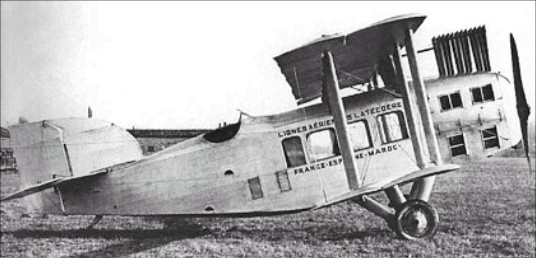
In 1922 the Late 8 prototype was flown. A six-passenger biplane with a single 300 hp / 224kW Renault 12Fe engine, the Late 8 transport was based on the Breguet 14, with a rear cockpit and of steel-tube fuselage construction.
It is believed that the Late 8 was used on Lignes Aeriennes Latecoere’s France-Spain-Moroccan services.
Engine: 223kW Renault
Max take-off weight: 2270 kg / 5005 lb
Empty weight: 1500 kg / 3307 lb
Wingspan: 12.60 m / 41 ft 4 in
Length: 8.60 m / 28 ft 3 in
Height: 3.40 m / 11 ft 2 in
Wing area: 46.25 sq.m / 497.83 sq ft
Max. speed: 160 km/h / 99 mph
Cruise speed: 122 km/h / 76 mph
Ceiling: 3500 m / 11500 ft
Range: 500 km / 311 miles
Passengers: 6
Latécoère Late 6 / LAT.6 / Laté 6 Jupiter
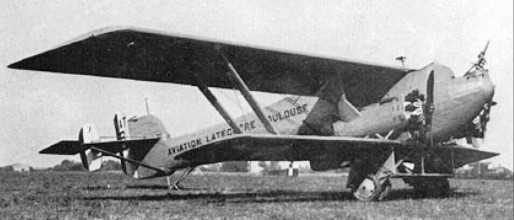
1921 saw the test flight of the Late 6 (or LAT.6), an advanced bomber escort fighter in the multiplace de combat category.
Initially flown with 4 x 260 hp Salmson Z9s in push-pull pairs, later, as the Laté 6 Jupiter, flew with 4 x 400 hp Bristol Jupiters.
An all-metal sesquiplane with considerable sweepback, it failed to gain a production contract and the Laté 6 was abandoned due to the high cost of all-metal geodesic construction.
Engine: 4 x 400hp Bristol Jupiter / 4 x 194kW Salmson Z-9
Max take-off weight: 7050 kg / 15543 lb
Empty weight: 5000 kg / 11023 lb
Wingspan: 27.70 m / 90 ft 11 in
Length: 15.74 m / 51 ft 8 in
Wing area: 124.00 sq.m / 1334.72 sq ft
Max. speed: 215 km/h / 134 mph
Cruise speed: 166 km/h / 103 mph
Ceiling: 6000 m / 19700 ft
Crew: 4-5
Armament: 3 x 7.7mm machine-guns, 2000kg of bombs
Latécoère Late 5

The Laté 4 was unstable and on 14 October 1922 the aircraft was caught by a gust and crashed. At this point the civil aircraft was abandoned. In early 1921 a decision had already been made to submit the second Latécoère 4 as a four-man bomber (to BPR 3 spec); it became the Latécoère 5 powered by three 375 hp / 280kW Lorraine 12Da W12 engines.
The Late 5 was unsuccessful.
Engine: 3 x 370hp / 280kW Lorraine 12Da
Max take-off weight: 8400 kg / 18519 lb
Empty weight: 5230 kg / 11530 lb
Wingspan: 26.80 m / 87 ft 11 in
Length: 18.10 m / 59 ft 5 in
Height: 4.12 m / 13 ft 6 in
Wing area: 195.00 sq.m / 2098.96 sq ft
Max. speed: 160 km/h / 99 mph
Cruise speed: 122 km/h / 76 mph
Ceiling: 4000 m / 13100 ft
Range: 700 km / 435 miles
Crew: 2
Passengers: 24
Latécoère Late 4
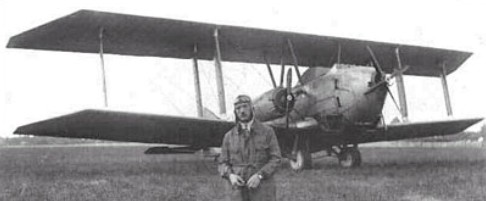
Designed by Marcel Moine and P.G.Latécoère, the Latécoère 4 (referred to in the initial contract as the Latécoère IV) was the company’s first multi-engined aircraft, the result of a decision that passenger aircraft needed to be designed form scratch rather than modified from military machines. It was a three-engined, two bay biplane with accommodation for 16 passengers. Its wings had neither stagger nor sweep, but had an unusually large interplane gap. The lower wing, which carried dihedral was fixed to the lower fuselage with a thick wing root, but the upper one was high above the fuselage at its centre, supported by pairs of N form cabane struts. The interplane struts were streamlined and broad in chord, made from duralumin; there was a pair of these struts marking the inner bay but a single strut outboard. The wings, made of wood and fabric covered were of constant chord over most of the span, but final sections where the leading edges swept back produced triangular tips. There were balanced ailerons on both upper and lower planes.
The fuselage in contrast was made of metal. The central Salmson water-cooled radial was mounted in the nose with rectangular radiators mounted on the fuselage forward of and just above the lower wing. The outer engines were also fuselage mounted, each having pairs of struts to the upper fuselage longeron and to the lower ones via the wing roots. Thus they were positioned a little above the lower wing, near to the centre of the inner bay in neatly faired nacelles with circular radiators at the front. The underlying fuselage structure was rectangular in cross-section aft of the leading edge, but faired at its sides and top into a rounder shape. It was deepest between the wings and gave the aircraft a somewhat short, fat look. The pilot sat just forward of the wings, high up and well above the central motor line, with a god view. Below and forward of him were positions for a radio operator and an engineer. The passenger cabin, entered via a port side door had tables, armchairs and sliding windows for thirteen, with another three places accessed forward via a 500 mm wide corridor.
The tail unit was quite complicated with a biplane arrangement of tailplanes and elevators. One of the tailplanes could be adjusted in incidence in flight to trim the aircraft. There was a central fin and rudder rising above the upper tailplane, which had a cut-out to allow the rudder to move, and there were two outboard vertical surfaces, again moving in cut-outs, to assist stability. These latter could be turned in flight to offset asymmetric engine-out forces. The undercarriage was narrow track, with pairs of mainwheels on both sides mounted vertically to the wing and cross braced, with a tailwheel at the rear.
The first flight was made in May 1920, when the aircraft was powered by three identical Salmson 9 Z engines of about 255 hp (190 kW), piloted by Pierre Beauté. The Laté 4 proved hard to control and it crashed on landing at Francazal, injuring its crew. It was rebuilt, though without its passenger cabin windows. It also gained a two-row Salmson 18 Z central engine of double the power of the 9 Zs retained outboard. The central engine drove a four-bladed wooden propeller and the outer pair two-bladed ones. The open cockpit was turned into an enclosed cabin with a corridor aft. It appeared in this form at the Salon d’Aéronautique in December 1921, but did not fly again until some major changes had been made. These included the replacement of the single outboard interplane struts by double ones, an exchange of the rectangular central engine radiators for tubular Lamblin ones and the addition of a substantial additional pair of wheels placed vertically below the engine bulkhead to prevent nose-overs. All engines now drove four-bladed propellers. In this form the Laté 4 flew, piloted by Gronin on 6 September 1922. The aircraft was still unstable and unready to try the intended Toulouse-Casablanca route. On 14 October the aircraft was caught by a gust and crashed, seriously injuring Gronin and his engineer Franck. At this point the civil aircraft was abandoned. In early 1921 a decision had already been made to submit the second Latécoère 4 as a bomber; it became the Latécoère 5.
Initial specifications
Engine: 3 × Salmson 9 Z, 190 kW / 255 hp
Wingspan: 24.65 m (80 ft 10½ in)
Length: 14.54 m (47 ft 8 in)
Height: 6.25 m (20 ft 6 in)
Wing area: 158 sq.m
Empty weight: 3,615 kg (7,970 lb)
Gross weight: 8,340 kg (18,387 lb)
Maximum speed: 200 km/h (125 mph)
Range: 1,100 km (688 miles)
Crew: 3
Passengers: 15
Engine: 1 x 550hp Salmson 18CM + 2 x 260hp Salmson 9Z
Max take-off weight: 8340 kg / 18387 lb
Empty weight: 3615 kg / 7970 lb
Wingspan: 24.80 m / 81 ft 4 in
Length: 14.80 m / 48 ft 7 in
Height: 6.25 m / 20 ft 6 in
Wing area: 158.00 sq.m / 1700.70 sq ft
Max. speed: 180 km/h / 112 mph
Cruise speed: 148 km/h / 92 mph
Range: 1100 km / 684 miles
Crew: 2
Passengers: 10
Latécoère Late 3
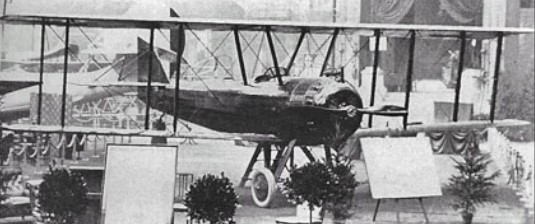
In 1919 there appeared the Late 3 biplane postal aircraft, shown at the 1919 Paris Salon.
A revised Salmsom 2 by Marcel Moine, with redesigned shorter metal fuselage.
One was built for Aéropostale, went to Ligne France Espagne Maroc.
Engine: 1 x Salmson 8Z, 260hp
Max take-off weight: 1670 kg / 3682 lb
Empty weight: 930 kg / 2050 lb
Wingspan: 12.85 m / 42 ft 2 in
Length: 8.25 m / 27 ft 1 in
Height: 3.40 m / 11 ft 2 in
Wing area: 46.25 sq.m / 497.83 sq ft
Max. speed: 170 km/h / 106 mph
Cruise speed: 159 km/h / 99 mph
Range: 600 km / 373 miles
Crew: 2
Latécoère 1
The experimental Latecoere 1 two-seat fighter of 1918 was unsuccessful and the company concentrated for a period on licence manufacture of the Salmson 2 reconnaissance biplane.
Latécoère / Ateliers Aeronautiques de Toulouse
La societé industrielle d’aviation Latécoère
Forges et Ateliers de Construction Latecoere
Ateliers Aeronautiques de Toulouse
The Forges et Ateliers de Construction Latecoere began its interest in aviation in 1917 with an aircraft works at Toulouse-Montaudron. In 1917 P-G Latécoère turned from making munitions to licence-building aircraft for the Aviation Militaire Française. Total wartime production amounted to 800 licenced Breguet XIV and Salmson 2A.2 2-seat reconaissance bomber biplanes.
The experimental Latecoere 1 two-seat fighter of 1918 was unsuccessful and the company concentrated for a period on licence manufacture of the Salmson 2 reconnaissance biplane, over 800 of which were built. Latecoere showed an aircraft at the 1919 Paris Salon, and another two, the LAT 4 airliner and LAT 6 bomber, in 1921. The Societe Industries d’Aviation was formed in 1922. From 1925 Latecoere developed an airline to South America and built a series of commercial aircraft for this route. Part of the Toulouse factory went to SNCAM in 1936. Developed a series of bomber aircraft (L.28, L.29) and torpedo-carrying floatplanes, the L.290 and L.298, the latter in service in 1939-1940. Some LeO flying-boats also built. In the 1930s developed a number of two- and four-engined commercial flying-boats, culminating in the six-engined L.521 Lieutenant de Vaisseau Paris of 1938 and L.631 of 1939.
Construction of the latter was interrupted by the war, but four were eventually completed by Breguet and used on commercial routes in the Mediterranean until 1948. The firm was sequestered in 1945 under the name of Ateliers Aeronautiques de Toulouse, but returned to the original owners and name in 1947.
The Compagnie Latécoère had numerous aviation related divisions located around Toulouse including: the Lignes Aeriennes Latécoère and CGEA (Cie Generale d’Entreprises Aeronautiques). The Lignes Aeriennes Latécoère may explain why earlier designations are often shown as LAT-xx rather than Laté-xx (as well as the SILAT acronym).
- 1918: Société des lignes Latécoère or Lignes Aeriennes Latécoère (LAT)
- 1918: Compagnie Espagne Maroc Algerie (CEMA) P-G Latécoère & Beppo de Massimi
- 1919: CEMA renamed Lignes Aériennes Latécoère (LAT)
- 1921: LAT renamed Compagnie Générale d’Entreprises Aéronautiques (CGEA)
- 1927: Marcel Latécoère sells CGEA majority shares to Marcel Bouilloux-Lafont
- 1927: Marcel Bouilloux-Lafont founds Compagnie Générale Aéropostale (CGA)
— NB: Aéropostale assoc. with Latécoère but not owned by Compagnie Latécoère - March 1931: Compagnie Générale Aéropostale declared bankrupt
- 1932: Aéropostale dissolved by French government and merged with SCELA
— SCELA: Société Centrale pour l’Exploitation de Lignes Aériennes - Aug 1933: Aéropostale officially merged with SCELA to become Air France
The Latécoère corporate identity went through three major changes between 1917 and the beginning of WWII.
- 1917: Forges et Ateliers de Construction Latécoère building aircraft
- 1922: name changed to Société Industrielle d’Aviation Latécoère (SIDAL)
— Acronym later SILAT for clipped-form Société Industrielle LATécoère - End 1936: Latécoère nationalized (to be combined with Dewoitine as SCNAM)
- 1937: Société Nationale de Constructions Aéronautiques du Midi (SCNAM)
Pierre-Georges Latécoère died on 23 Aug 1943.
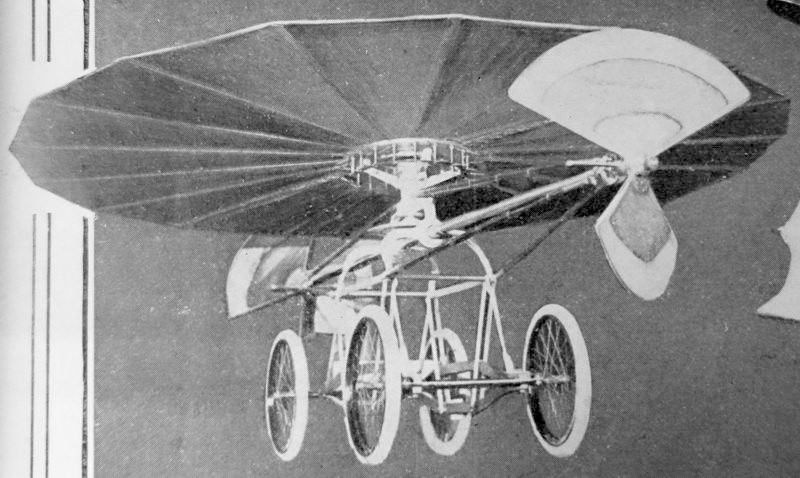
Lataste Gyroscopique
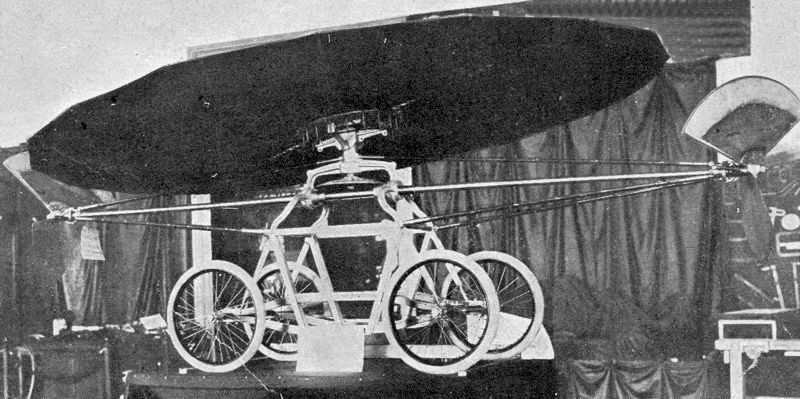
The 1909 French Lataste Aeroplane Gyroscopique was constructed of metal and the circular top wing was covered with fabric. It featured a long, uncovered, tapered frame with a propeller at each end; each propeller had two semicircular blades like sections of Archimedean screws, and turned the same way. Above the frame was the flat rotating, circular wing surface, probably mounted on a swivel joint. This surface and the propellers were driven through a long horizontal propeller shaft and planetary gears; the shaft ran through a cylindrical fuel tank inside the fuselage. The machine was mounted on four wheels, with the pilot sitting between them holding on to a steering wheel, which probably controlled the rotating winged surface high above him.
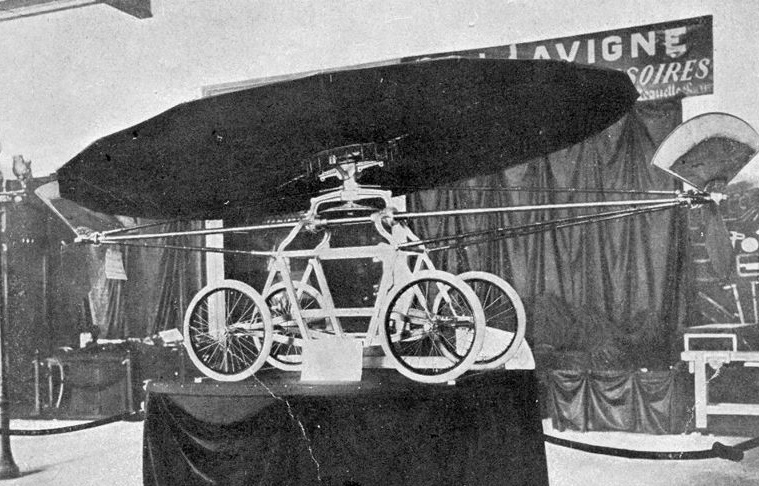
The photo shows a model of machine, which was displayed at the first Paris Salon Aéronautique in December 1908.