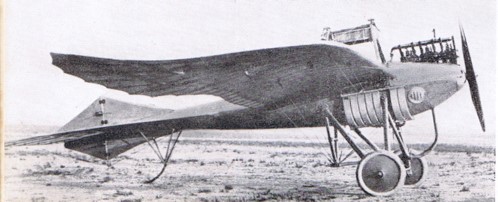
Powered by a 100 hp Argus; second of two aeroplanes built by Theodor Lawrenz, pilot brevet nr. 638 (Feb. 1, 1914), at Johannisthal.
Powered by a 100 hp Argus; second of two aeroplanes built by Theodor Lawrenz, pilot brevet nr. 638 (Feb. 1, 1914), at Johannisthal.
During World War I the Lawrance Aero Engine Company of New York City produced the crude opposed twins that powered the Penguin trainers, and the Lawrance L-1 60 hp Y-type radial.
After the end of World War I, the Lawrance engineers worked with both the Army and the Navy in developing their L-1 onto a nine-cylinder radial engine, which became the 200 hp Model J-1. It was the best American air-cooled engine at the time and passed its 50-hour test in 1922.
The U.S. Navy badly needed light, reliable engines for its carrierborne aircraft. As a means of pressuring Wright and other companies into developing radial engines, it gave a contract to Lawrance for 200 of the J-1 radial and ceased buying the liquid-cooled Wright-Hispano engines. At the urging of the Army and Navy the Wright Aeronautical Corporation bought the Lawrance Company, and subsequent engines were known as Wright radials. The Wright Whirlwind had essentially the same lower end (crankcase, cam, and crankshaft) as the J-1.
Applications:
Dayton-Wright XPS-1
Naval Aircraft Factory N2N
Naval Aircraft Factory TS-1
Huff-Daland TA-2 trainer prototype – one example only re-engined
Huff-Daland TA-5 trainer prototype
Huff-Daland TA-6 trainer prototype
Huff-Daland HN-2 naval trainer
J-1
Type: 9-cylinder air-cooled radial engine
Bore: 4.5 in (114 mm)
Stroke: 5.5 in (144 mm)
Displacement: 787 cu.in (12.9 lt)
Dry weight: 476 lb (216 kg)
Cooling system: Air-cooled
Power output: 200 hp (150 kW)
Power-to-weight ratio: 1:2.38
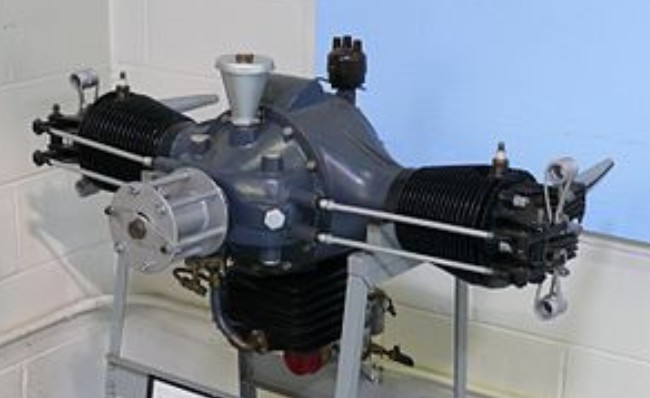
The Lawrance A-3 or Lawrance Model A was an American twin-cylinder aircraft piston engine. Designed by Charles Lawrance in the mid-1910s the engine was produced by the Lawrance Aero Engine Company and under license by Excelsior. Weighing 200 lb (90 kg) the engine produced 28 horsepower (21 kW). A feature of this engine was the shared use of a single crankpin for both cylinders, this caused vibration as the pistons moved in the same direction.
First run circa 1916, around 450 were built.
Applications:
Breese Penguin (flightless ground training aircraft)
Driggs Dart
Waco Cootie
Shinnecock lightplane
Specifications:
Type: Two-cylinder, air-cooled horizontally opposed piston aircraft engine
Dry weight: 200 lb (91 kg)
Cooling system: Air-cooled
Power output: 28 hp (21 kW)
The Lawrance Aero Engine Company was founded in 1917 by Charles Lawrance. After the end of World War I, the Lawrance engineers worked with both the Army and the Navy in developing their L-1 into a nine-cylinder radial engine, which became the 200 hp Lawrance J-1. It was the best American air-cooled engine at the time, and passed its 50-hour test in 1922.
The United States Navy was very enthusiastic about air-cooled radials, but was concerned that Lawrance couldn’t produce enough engines for its needs. The Navy suggested to Wright that it purchase the Lawrance company and build the J-1 itself. In May 1923, Lawrance was purchased by Wright Aeronautical, with the J-1 being further developed by Wright into the J-5, J-6, and R-795.
Products:
Lawrance A-3
Lawrance C-2 1917
Lawrance J-1
Lawrance J-2
Lawrance L-1
Lawrance L-2
Lawrance L-3
Lawrance L-4 aka Wright Gale
Lawrance L-5
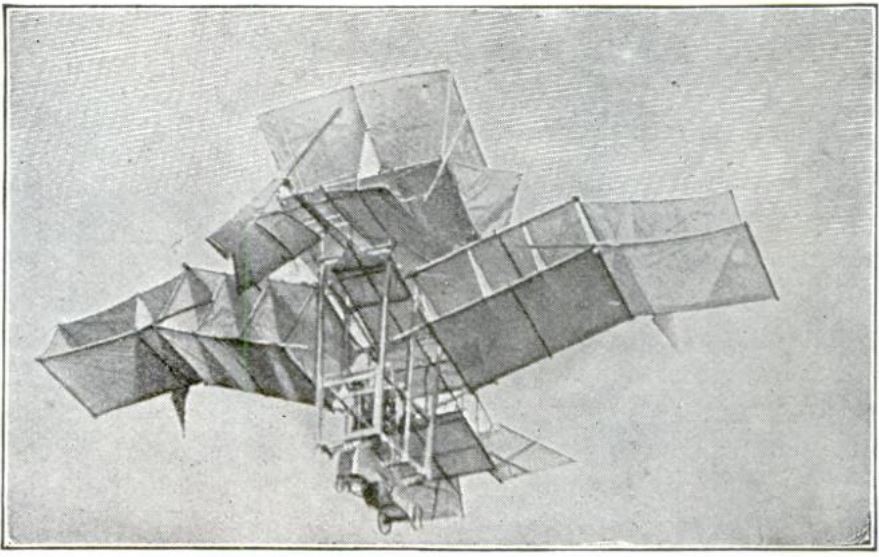
Little is known about this complicated machine, which was designed by George A. Lawrence of Sayre, Pennsylvania. It was claimed to have flown during secret tests, first on 1 October 1907, and then on 11 October. It’s not clear if it was crewed or not, however the inventor said he had plans to build a larger machine, which would be powered by a 60 hp engine and capable of carrying three people. In 1908, Lawrence entered into a business relationship with Gustave Whitehead and formed the Whitehead Motor Works.
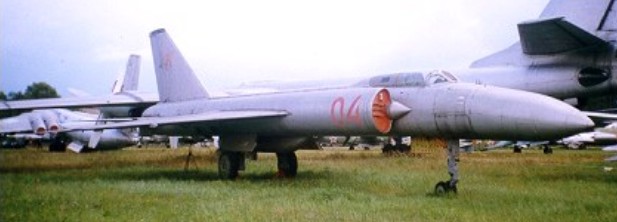
Planned in response to a January 1954 requirement for a super-interceptor able to cruise long distances at high altitudes with missiles able to provide a ‘snap-down’ attack capability against targets at lower altitudes, the La-250 was known unofficially as the Anaconda.
Featuring a 57 degree delta wing, slab delta tailplane, and a fuselage of near-constant cross section, the La-250 was powered by two Lyulka AL-7F turbojets each rated at 6500kg which were later to be fitted with afterburners boosting thrust to 9000kg. All control surfaces were fully powered with duplex systems and without manual reversion.
Intended armament was a pair of K-15 missiles that rode the beam of the Uragan (Hurricane) radar, which had a range of 30km. The missiles were cancelled and the radar never made it into an aircraft before the development was cut short.
Although the La-250 was intended as a single-seater in operational form, prototypes were completed as two-seaters to provide accommodation for a test observer, and the first of three flying examples was completed in July 1956.
The first flight was attempted on 16 July, but the test pilot, A G Kochetkov, encountered an unexpectedly rapid roll moment and lost control. Extensive testing of a systems rig followed before acceptable characteristics were attained and flight testing could be resumed. Investigation revealed a severe roll-coupling problem derived from the combination of a long heavy fuselage and small wings. Enormous effort went into the creation of a new electronic flight-control system, and a successful first flight was recorded in spring 1957.
The third La-250 had its nose lowered by six degrees to give better visibility on landing, the poor view forward having been determined as a factor in the second crash.
The second aircraft was lost in a landing accident on 28 November 1957, and the third aircraft also suffered a landing accident on 8 September 1958.
The flight test programme suffered continual delays as a result of poor engine reliability and the full testing had not been completed when the programme was cancelled just before Semyon Lavochkin’s death in 1960.
Max take-off weight: 30000 kg / 66139 lb
Empty weight: 15000 kg / 33070 lb
Wingspan: 13.90 m / 45 ft 7 in
Length: 25.60 m / 83 ft 12 in
Wing area: 80.0 sq.m / 861.11 sq ft
Max. speed: 2000 km/h / 1243 mph
Ceiling: 18000 m / 59050 ft
Range: 2000 km / 1243 miles
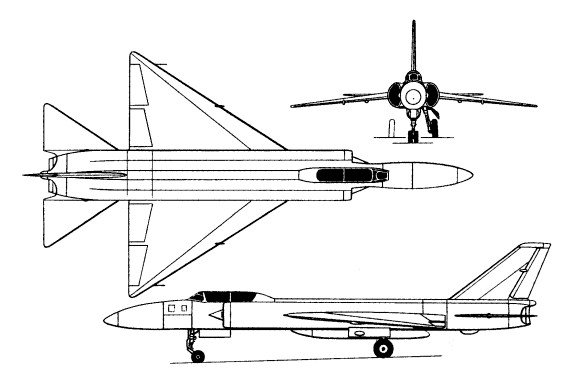
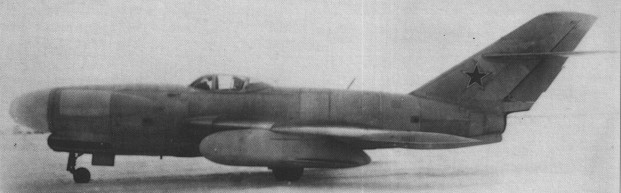
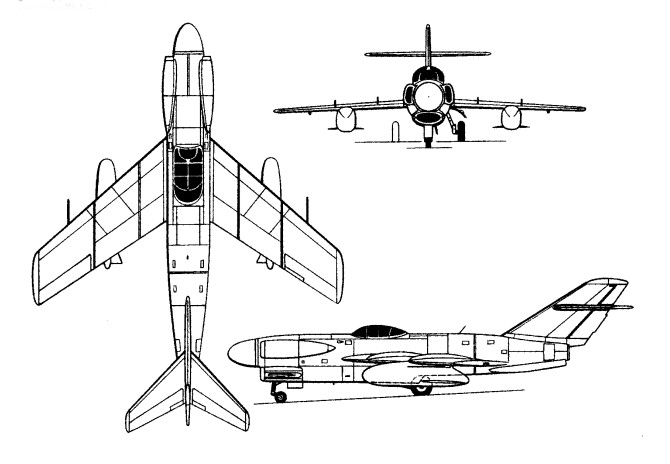
In January 1948 a requirement was formulated for a two-seat twin-engined all-weather interceptor.
The La-200 was powered by two examples of an engine derived from the RD-45, the 5004-lb (2270-kg) thrust Klimov VK-1. These were located in a tandem arrangement, with the forward engine exhausting from the bottom of the central fuselage via an S-shaped jetpipe and the aft engine trough a nozzle at the tail, and were aspirated via an annular nose inlet round the centre body that accommodated the antenna of the search radar. The flying surfaces were swept at 40 degrees, and the crew of two was accommodated side-by-side under a large canopy.
Two were built, each powered by two 2700kg Klimov VK-1 turbojets mounted in tandem with the exhaust of the foremost engine ducted beneath the fuselage. The side-by-side seating for the two crew members was retained, and the centre and aft fuselage were comparatively unchanged, but the forward fuselage was entirely redesigned. The prototypes differed one from the other primarily in the location of the Torii (Thorium) AI radar, the first prototype having a conical intake centrebody and the second prototype having a radome underslung on the upper intake lip. Armament consisted of three 37mm N-37 cannon, one to port and two to starboard. The wing, sweptback 40 degrees at the leading edge, was largely occupied by integral tankage and two large underwing slipper-type auxiliary tanks could boost maximum range from 1165 to 2000km.
The first of two prototypes was flown on 9 September 1949, and the first and second flight test phases were completed by February and October 1950 respectively, Mach 0.946 being attained in level flight and Mach1.01 in a dive.
The range was 1243 miles (2000 km), but in November 1950 a range of 2175 miles (3500 km) was demanded, together with longer-range radar. The design was recast as the La¬200B with greater fuel capacity and a larger antenna for the more powerful radar. This led to a redesign of the nose. The extreme nose was formed by a large dielectric radome of more than 1.0m diameter. The early single-antenna Torii-A radar was replaced by a large RP-6 Sokol (Falcon) radar with three different scan modes, and twin ventral strakes supplanted the single strake of the second La-200. The additional fuel required to achieve the specified endurance was provided by increasing the capacity of each underwing tank from 1120 l to 2650 l. Two 3100kg Klimov VK-1 turbojets were installed, the forward engine’s air being supplied through a chin intake and that for the aft engine being provided by “elephant ear” type intakes on the sides of the extended nose. Armament remained three 37mm cannon.
The La-200B first flew on 3 July 1952, and while range was improved considerably, overall performance was reduced. A mock-up of the Sokol radar initially being fitted, tests with the radar installed commencing on 10 September.
The second prototype joined the flight programme early 1951, the repositioned radar being of the improved Torii-A type, ammunition capacity being increased, a ventral keel being introduced and normal loaded weight rising to 10580kg. With the final NII VVS test phase completed in April 1952, a recommendation was made that series production of the La-200 should be initiated.
An extensive test programme was conducted, but, in the event, the competitive Yak-120 was selected to fulfil the requirement. The La-200B was beaten to a production order by the Yak-25.
La-200 (1st prototype)
Max take-off weight: 10375 kg / 22873 lb
Empty weight: 7090 kg / 15631 lb
Wingspan: 12.92 m / 42 ft 5 in
Length: 16.59 m / 54 ft 5 in
Wing area: 40.18 sq.m / 432.49 sq ft
Max. speed: 1090 km/h / 677 mph
Range: 1165 km / 724 miles
La-200B
Max take-off weight: 12700 kg / 27999 lb
Empty weight: 8810 kg / 19423 lb
Wing area: 40.00 sq.m / 430.56 sq ft
Max. speed: 1030 km/h / 640 mph
Range: 2800 km / 1740 miles
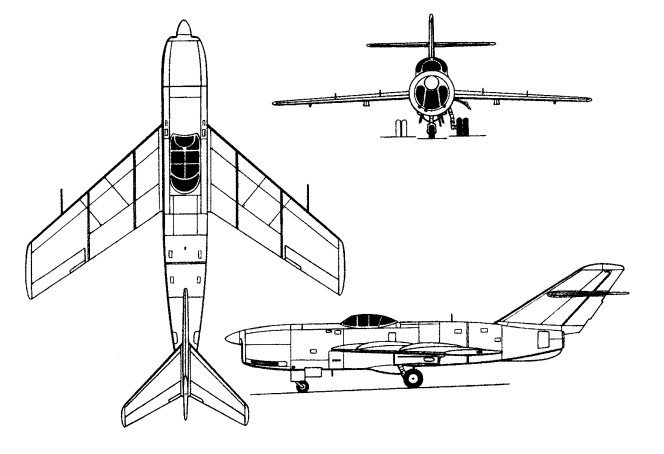
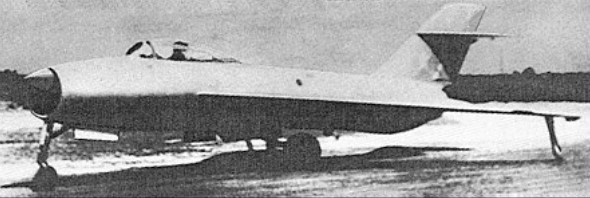
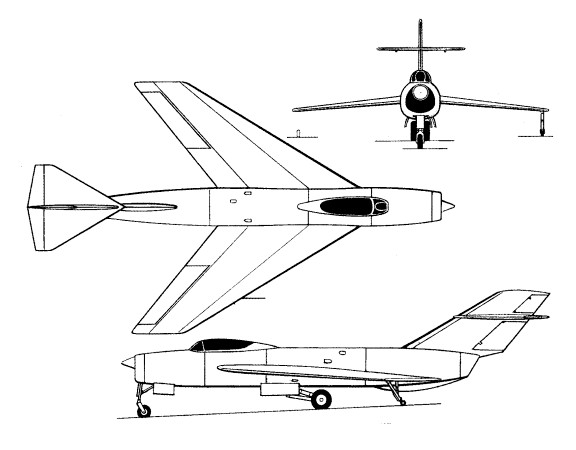
The La-190 was conceived to meet the October 1948 demand of Yosif Stalin for the “fastest fighter in the world”. Other contenders were the I-350, progenitor of the MiG-19, and the Yak-1000, which, in the event, was to be abandoned before flight testing. The requirement called for use of the new Lyulka AL-5 turbojet which had an initial rating of 4600kg.
The La-190 featured wings swept at 55 degrees and a delta tailplane located about three-fifths of the way up the broad-chord vertical tail. Equipped with a bicycle-type main undercarriage members with wingtip outrigger stabilising wheels, and an armament of two 37mm N-37 cannon. Integral fuel tankage occupying virtually the entire interspar box of the 6.1% thickness wing which featured machined upper and lower skins. All control surfaces were powered by irreversible actuators.
Although planned originally as a day fighter, the prototype was completed in limited all-weather form with a radar radome in the upper portion of the nose inlet.
The sole prototype La-190 was completed in February 1951. The AL-5 engine offered less thrust than predicted and its unreliability led to cancellation of the development programme after only eight flights.
A speed of 1190km/h at 5000m, or Mach1.03, was attained in level flight during one test in March 1951.
Engine: Lyulka AL-5 turbojet, 4600kg
Max take-off weight: 9257 kg / 20408 lb
Empty weight: 7315 kg / 16127 lb
Wingspan: 9.90 m / 32 ft 6 in
Length: 16.35 m / 53 ft 8 in
Wing area: 38.93 sq.m / 419.04 sq ft
Max. speed: 1190 km/h / 739 mph
Range: 1150 km / 715 miles
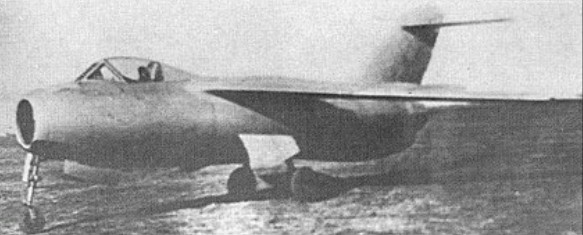
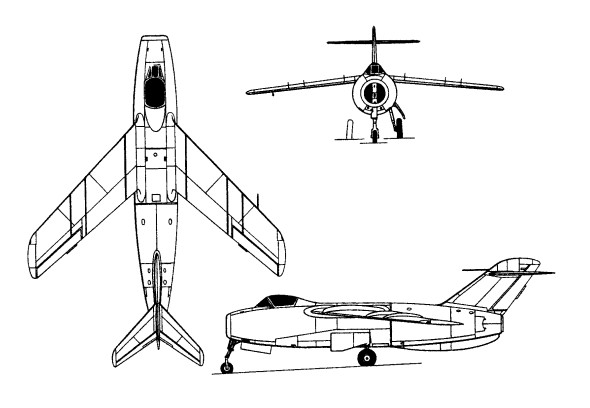
Combining a fuselage essentially similar to that of the Lavochkin La-168 with wings sweptback 45° at quarter-chord and several other aerodynamic refinements, the La-176 was flown in September 1948 with a 5004-lb / 2270kg RD-45F turbojet, and armament comprising one 37mm N-37 and two 23mm NS-23 cannon.
Re-engined with a Klimov VK-1 turbojet of 2700kg, the La-176 was claimed to have exceeded Mach=1.0 in a dive from 9050m to 6000m on 26 December 1948, test pilot of No.301 Factory, Captain Sokolovsky OV. It was initially believed that an ASI error had been involved, but the process was repeated six times during January 1949, 1105km/h being recorded at 7500m, this being equivalent to Mach=1.02. The La-176 thus became the first Soviet aircraft to achieve supersonic flight. Further development was abandoned shortly afterwards when the canopy locks failed at high speed, resulting in test pilot Î V Sokolovsky losing his life.
Max take-off weight: 4631 kg / 10210 lb
Empty weight: 3111 kg / 6859 lb
Wingspan: 8.59 m / 28 ft 2 in
Length: 10.97 m / 35 ft 12 in
Wing area: 18.25 sq.m / 196.44 sq ft
Max. speed: 1043 km/h / 648 mph
Range: 1000 km / 621 miles