
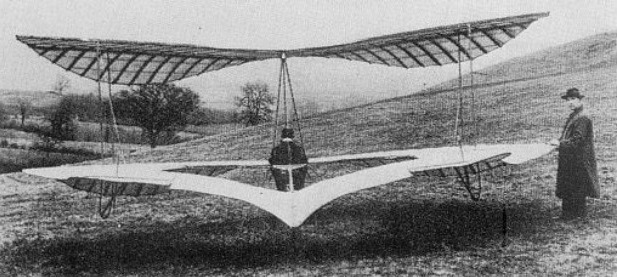
A monoplane with long-span wings and up-turned wing tips, a design of Louis Lefebvre. It was entered for the 1911 Concours militaire in France, and tested by Sadi-Lecointe at Chartres, but didn’t participate.
Span: 55’9″
Length: 39’4″
A monoplane with long-span wings and up-turned wing tips, a design of Louis Lefebvre. It was entered for the 1911 Concours militaire in France, and tested by Sadi-Lecointe at Chartres, but didn’t participate.
Span: 55’9″
Length: 39’4″
Lee and Richards built another aircraft, a monoplane with a conventional fuselage and tail surfaces and a 6.7 m (22 ft) diameter annular wing. The first flight on 23 November 1913 ended abruptly when the tail heavy aircraft stalled and crashed into telegraph wires without injury to pilot E. C. Gordon England. Rebuilt, the 80 hp Gnome engined Lee Richards Annular Monoplane proved easy to fly. With pilot and passenger aboard it would take¬off at about 48 kph (30 mph) and had a maximum speed of 137 kph (85 mph). The original aircraft flew for 1028 hours during ten months of testing and was the first truly successful flying saucer. Two more Lee-¬Richards Annulars were built early in 1914 for the Gordon Bennett race, and after World War I Tilghman Richards tried to interest the Air Ministry in his unusual design, without success.
Englishman, G.J.A. Kitchen of Lancaster, patented a circular or annular wing and sold the rights to Cedric Lee, who built an annular winged biplane powered by a 50 hp Gnome rotary engine in 1911. This ‘Kitchen Doughnut’ was wrecked by a gale during tests. Lee and his engineer Tilghman Richards continued to experiment with gliders and with wind tunnel test models at the National Physical Laboratory and soon discovered that the circular wing had some very desirable properties. It continued to provide lift at extreme angles of incidence, and had a gentle stall. Furthermore, a round wing could have a span or diameter less than half that of a conventional surface of the same lifting area.
In 1912 the Lee-Richards annular wing was a circular planform with a hole diameter half span. The powered portotype was a biplane, and they tested it at Middleton Sands, Heysham in 1911. This was supposed to be a very stable configuration, and a later version flew for 128 hours, but the prototype had run into a gully, and then been destroyed when the hanger blew down in a gale. They had been changing the leading-edge camber shape, but were unable to decide which was best, so before rebuilding they tried two models, span 4.7 ft, flown indoors. Extra camber seemed to give a flatter glide angle, but the other person said that this was due to better launch technique. So they went full scale.
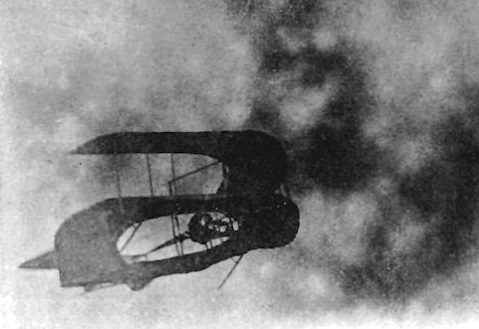
The glider was a biplane, but the upper wing was only the front half of the circle. Elevators behind the wing were also operated differentially for roll control and a fin and rudder were added later. The pilot’s seat was in the hole, and the breeze.
Launch was by catapult from a track, pulled by a rope tied to a dropping weight within a tall tripod. The site was Sellet Banks, an east-facing slope 117 feet above the River Lune near Kirby Lonsdale.
The glider made many successful glides. It was stable and controllable, was banked into turns, and even taken through the stall to 30 degrees nose up, when it pancaked steadily. They often flew in winds of 20 mph, and even 40 mph.
On the final day of flying at the end of trials in December 1912, Cedric Lee made a soaring flight in a strong wind. Cine film was taken, used in the opening clips of “Those Magnificent Men”, and stored in the Science Museum.
A non-flying replica of the powered version is at the Newark Museum.
Wingspan: 22 ft
Wing area: 400 sq.ft
Empty weight: 215 lb (later 390 lb)
Gross weight: 710 lb
Glide ratio: 1-8
The Lee L-2P-T N353V was a two-place, open cockpit monoplane, powered by a 60hp LeBlond 5D.
Lee Inman sold the Lee L-2P-T in 1930 and it was renamed the Springfield JM2P of the Springfield School of Aviation, Springfield OR., USA.
A second, biplane Continental-powered version, was built in 1931 as the MacManaman Baby Fleet.

Development of the Leduc 0.10 continued with the larger Leduc 0.21, then the Leduc 0.22 Mach 2 interceptor which incorporated a SNECMA Atar D3 turbojet within the athodyd to allow the aircraft to take off under its own power and then accelerate it to a speed at which the ramjet would ignite.

This was not achieved with the 0.22, for although flown on turbojet power for the first time on 26 December 1956, and later making more than 30 test flights with the turbine engine, the ramjet was not tested. This resulted from withdrawal of government financial support, because of economic stringencies, and the project was abandoned in 1957.
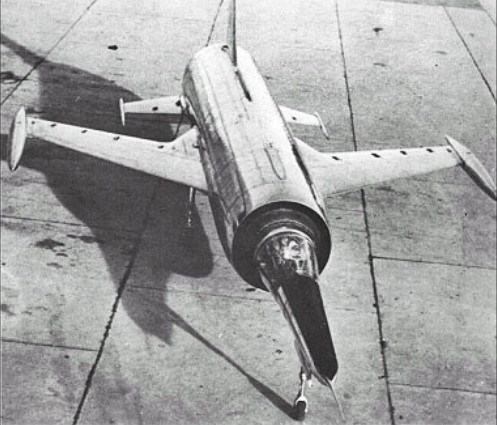

Development of a aero-thermo-dynamic-duct or athodyd ramjet engine continued with two examples of the larger Leduc 0.21 of improved design (L.021 -01 and –02), the first making its initial flight on 16 May 1953.
These proved to be successful, demonstrating a maximum speed of Mach 0.87 and attaining an altitude of 20,000m. Development then began of the Leduc 0.22 Mach 2 interceptor.
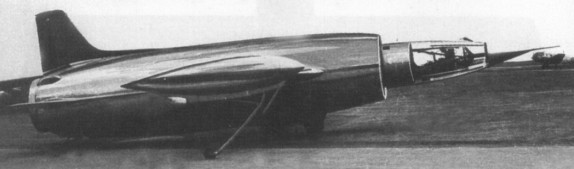
The Leduc 0.21 was larger than the 0.10, and with a ramjet delivering 14,330-1b (6500kg) thrust at a speed of 621 mph (1000 km/h).
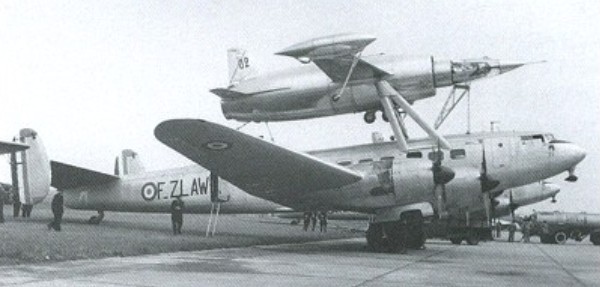


Two more examples of the Leduc 0.10 were built, the first an identical 0.10, the other differing only by having two wingtip-mounted turbojet engines to accelerate the aircraft to the ignition speed of the ramjets. This last aircraft, designated 0.16, was first flown on 8 February 1951, but the turbojet engines were later removed.
The Leduc 016 was developed with wingtip mounted Marbore I.
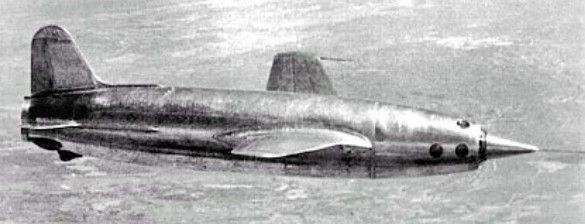
Rene Leduc in France had worked for many years on the development of a ramjet engine for aircraft propulsion. Known technically as an aero-thermo-dynamic-duct or athodyd, which has no major rotating components, a ramjet relies upon air being forced into an intake which is designed to ensure that the air loses kinetic energy but gains pressure energy as it passes through a diverging duct en route to a combustion chamber. There, burning fuel increases the total energy, causing the expanding gases to accelerate to atmosphere via an outlet venturi. Leduc’s first success had come in 1935 with a small but practical engine developing 4kg of thrust. It was not until after the end of World War II that Leduc was able to continue his experiments, building first the Leduc 0.10 with a tubular double-skinned fuselage in which the inner shell contained the pilot’s cockpit, surrounded by an outer shell which formed the inlet duct to the ramjet engine at the rear of the pilot’s position. First tested as a glider in October 1947, the Leduc 0.10 was carried on struts above a Sud-Est SE.161 Languedoc ‘motherplane’ which released it at appropriate altitude. The first powered flight was made on 21 April 1949, the SE.161 accelerating the Leduc 0.10 to a speed of approximately 322km/h to achieve the right pressure conditions for the ramjet to ignite and sustain power. During the first flight, of 12 minutes duration, a speed of 680km/h was attained on half power. The aircraft was flown subsequently on half power at a speed of 805km/h. The ramjet delivering 4409-lb (2000-kg) thrust, reached Mach 0.84.
Two more examples were built, the first an identical 0.10, the other differing only by having two wingtip-mounted turbojet engines to accelerate the aircraft to the ignition speed of the ramjets. This last aircraft was designated 0.16.
France
Leduc began designing athodyds (ramjets) in 1929 at Argenteuil, as well as experimental aircraft in which to test them. The L.010-1, started 1937 and completed 1945, was first purely athodyd-powered manned aircraft to fly. Followed by L.010-2 and similar L.016-1 in 1951. All air launched from Languedoc mother plane. In 1953-1954 appeared the L.021 -01 and -02, and plans existed for a swept-wing aircraft with Atar 101 turbojet engine for independent take-off and an 0.22 supersonic fighter.
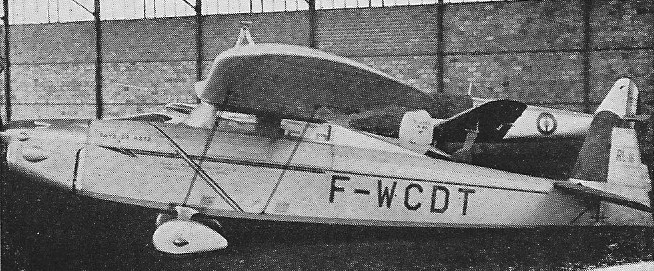
The RL-16 two-seat monoplane, designed by R. Leduc for high altitude flight, gained the light plane altitude record on 13 June 1949 at 25,551 ft.
For long distance, the RL-16 can supplement its fou wing fuel tanks with four fuselage tanks, raising the total the 132 Imp.Gal.
Engine: Zundapp, 50 hp
Wingspan: 41 ft 11.75 in
Wing area: 172.223 sq.ft
Length: 42 ft
Empty weight: 562 lb
Loaded weight: 1764 lb
Max speed: 110 mph
Cruise: 90 mph
Max range: 4163 mi
Endurance: 47 hr 30 min
Ceiling: 28,871 ft

