Renato Levi did produce a microlight called the Levi RL10 Magpie.
Its registration G-MBYW was cancelled on 17 May 1990 as permanently withdrawn from use.
Renato Levi did produce a microlight called the Levi RL10 Magpie.
Its registration G-MBYW was cancelled on 17 May 1990 as permanently withdrawn from use.
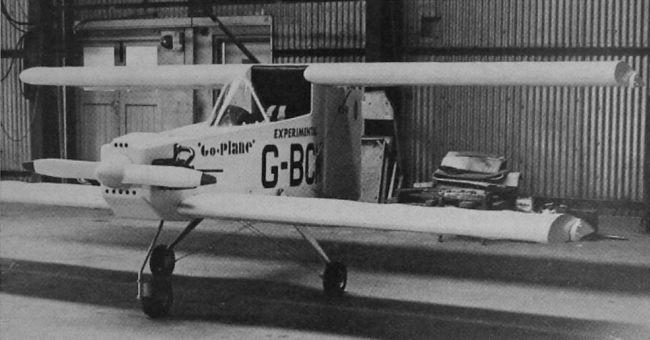
The Levi RL-6 Go-Plane is a single-seat tandem wing design with tricycle undercarriage. Either a double monoplane or a staggered biplane, with its rudder integrated into the fuselage but no tail, in the traditional sense, or tailplanes.
By the end of 1974 Renato Levi of Newport, Isle of Wight was conducting test on the RL-6 Go-Plane G-BCMF c/n EAA3678, at Bembridge. It was a Bembridge Airfield on 16 November 1974 for the purpose of its maiden flight. It was damaged beyond repair in the course of that on 16 November 1974.
The CAA cancelled the registration of G-BCMF on 5 December 1983.
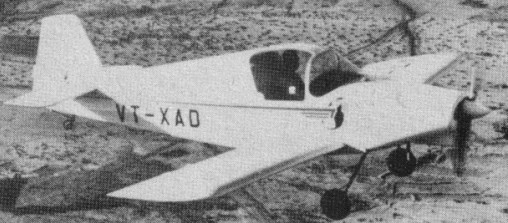
This two-place, low-wing taildragger was first built in India by an Italian engineer who studied in England and France and was available to American homebuilders through Canadian company Aie-Craft Supplies. It is of conventional all-wood construction and covered with fabric. The prototype, VT-XAD, was powered by a Continental 85-hp engine. Some are also built to house a 125-hp Lycoming.
Gross Wt. 1500 lb
Empty Wt. 870 lb
Fuel capacity 28 USG
Wingspan 25’l0”
Length 20’3”
Top speed 130 mph
Cruise 115 mph
Stall 45 mph
Climb rate 800 fpm
Takeoff run 500 ft
Landing roll 700 ft
Range 600 miles

Born to Italian parents in British India, Karachi in 1926, educated there and in France, Renato ‘Sonny’ Levi flew Spitfires in the RAF near the end of WWII, and studied aeronautical engineering in England after the war.
Joining his father’s boatyard in Bombay, it was his victory in the Daily Express Cowes-Torquay offshore powerboat race in 1963 that brought his name to prominence as a successful designer.
Sonny Levi was a man who developed a huge range of ideas which in his early including light aircraft, inflatable boats, cars and sailing yachts. More recently he turned his hand to pure art, creating over 100 canvases.
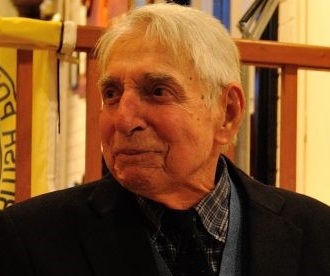
Renato ‘Sonny’ Levi, died peacefully at the age of 90 at his home on the Isle of Wight on November 12, 2016.
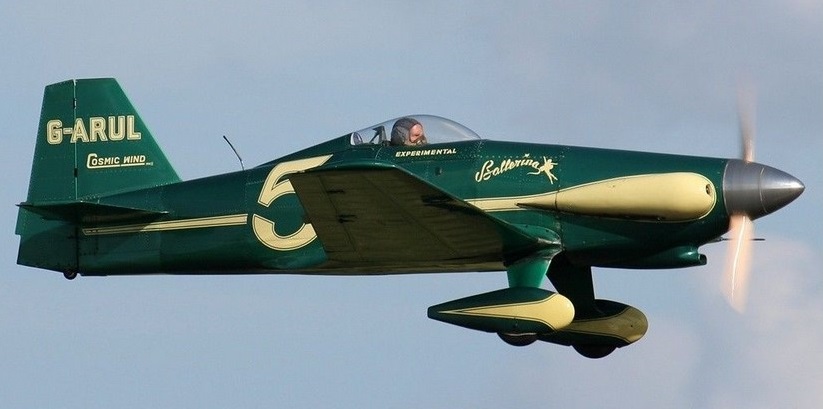
The Le Vier Cosmic Wind is an all-metal Formula One racing aircraft designed by Toni Le Vier and built by a consortium of Lockheed employees at Burbank.
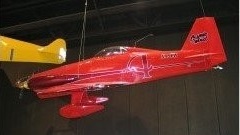
Three were imported to the UK;
c/n 101
‘Little Toni’ first flown as NX67888, later re-registered N20C. Sold to Pacific Air Racers, then to M.Blair.
Sold to R.McCowen in 1971 and moved to the UK as G-AYRJ. Modified and fitted with a Rolls-Royce/Continental O-200-A and first flown as such on 28 January 1971 at Blackbushe.
c/n 103
‘Ballerina’ Registered N22C and sold to Pacific Air Racers, then to M.Blair.
Sold to the Tiger Club in 1961 and moved to the UK as G-ARUL. Sold to P.G.Bannister but badly damaged in a crash at Halfpenny Green on 17 April 1968. Rebuilt from 1969 onwards as PFA.1511. It flew again in 1973 as ‘Ballerina II’.
c/n 1067
A fifth airframe built under Lockheed supervision to meet the USAF ‘Mighty Mouse’ specification for an ultra-small counter-insurgency aircraft. It was not finished.
The hulk was bought by Robin Voice and moved to the UK in 1973 as G-BAER. It was completed as PFA.1571. First flew at Redhill in 1973 with a Continental C90, named ‘Filly’ after Robin’s wife.
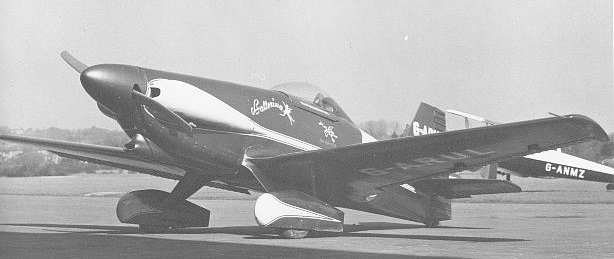
Engine: Continental C85
Wingspan: 18.11 ft
Length: 16.08 ft
Final product of the company was the PL 400, built to an Armee de I’Air requirement, inspired by the German Fieseler Fi 156 Storch, for a STOL observation machine. A high-wing cabin monoplane powered by a Potez 9C radial of 164kW, the PL 400 flew for the first time on 19 December 1939, but German occupation put an end to construction of the PL 401 development with a Renault 6Q-09 engine of similar power.
The PL 200 monoplane was intended as an advanced reconnaissance seaplane, with a shoulder-wing mounted on a short nacelle for the three crew members, at the front of which was the 537kW Hispano-Suiza 9Vbrs radial engine.
Test-flown in February 1935, the PL 200 achieved a maximum speed of 225km/h by comparison with the 208km/h of the production PL 15. It was re-engined with a 552kW Gnome-Rhone 9Kfr engine in October 1935 as the PL 201, but development was abandoned soon afterwards
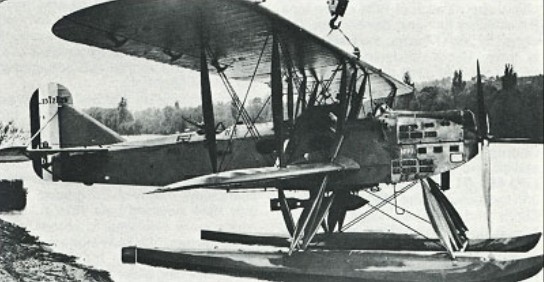
The prototype Levasseur PL 15 twin-float biplane flew for the first time with temporary wheel landing gear in October 1932. A production order for 16 aircraft as PL 15 T2B2b followed, these entering service from 1934 onwards with navy Escadrille 7B2 aboard the seaplane-carrier Commandant Teste. By comparison with the earlier PL 14, the PL 15 had a redesigned slender fuselage without the ‘avion marin’ type hull. Power was provided by a 485kW Hispano-Suiza 12Nbr engine, and the wings folded for storage aboard ship.
Surviving PL 15s, taken out of service at the end of 1938, formed Escadrille 3S6 for anti-submarine patrol along the Atlantic coast from September 1939 onwards. The PL 15 was armed with two 7.5mm machine-guns, and a torpedo or up to 450kg of bombs.
The PL 15 was developed into the PL 151, a mid-wing monoplane with a small stabilising plane mounted over the fuselage. A full-scale mock-up was built, but no further development was undertaken. The PL 154, converted from the fourth PL 15, was a three-seat landplane torpedo-carrier which was abandoned after limited test flying.
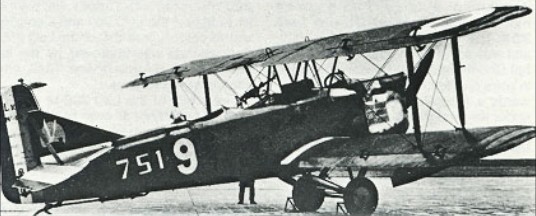
The PL 10 had equal-span folding wings, and the deep slab-sided fuselage had a hull-shaped undersurface. Armament comprised a single 7.5mm machine-gun operated by the pilot, plus twin 7.5mm guns operated by a gunner, whose cockpit was immediately behind that of the pilot. The observer, in the rear cockpit, had a Cayere-Montagne bomb-sight, and six 10kg bombs could be carried on underwing racks.
The prototype of the Levasseur PL 10 three-seat carrier reconnaissance (R.3b) biplane flew for the first time in the spring of 1929. Production of the PL 10 totalled 30 aircraft, and these began to enter service with carrier Escadrille 7S1 in 1931.
The PL 101.01 made its first flight in March 1933 differing from, the PL 10 in having wide-track landing gear and limited sweepback on the wings. Thirty production aircraft followed, these weighing 270kg more than the PL 10s in overload condition, but being credited with a maximum speed of 220km/h. PL 101s replaced the PL 10s on the Beam during 1935, and five were still in service at the outbreak of World War II.
Several projects were developed from the PL 101, the only ones built being the PL 107 (two prototypes) and the PL 108. They introduced a fuselage of improved aerodynamic shape, had wheel fairings for the fixed landing gear and a glazed crew canopy. Powered by a 552kW Gnome-Rhone 9Kfr, the PL 107 had a maximum speed of 235km/h, and the PL 108 with a 537kW Hispano-Suiza 9Vbrs radial could attain 266km/h.
Engine: 1 x Hispano-Suiza 12Lb, 447kW
Max take-off weight: 2880 kg / 6349 lb
Wingspan: 14.20 m / 46 ft 7 in
Max. speed: 198 km/h / 123 mph
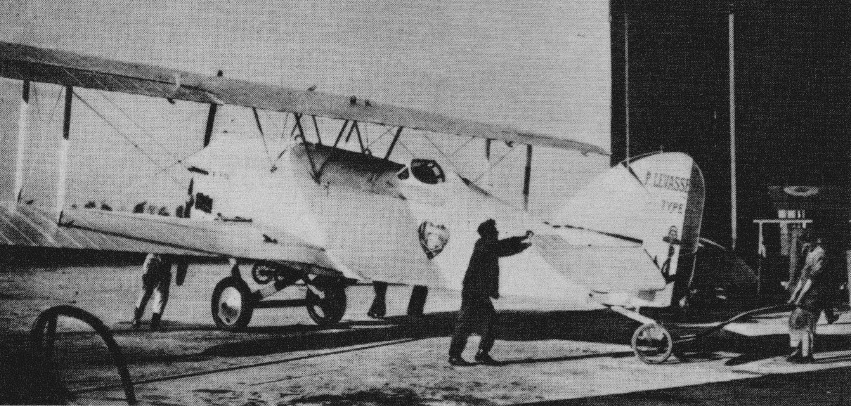
Upon his return to France Nungesser became interested in the possibility of being the first to fly between Paris and New York non-stop. Raymond Orteig had offered $25,000 to the first to accomplish this feat. Nungesser engaged Captain Francis Coli to act as navigator and approached the Levasseur Airplane Company to build a craft capable of the voyage.
By the spring of 1927 the plane was ready. It was a re-designed version of a three-place torpedo carrier plane powered by a single Lorraine-Detriech engine of 450 hp.
The large biplane contained many watertight compartments to ensure its safety if forced down en-route. In fact, Nungesser planned to land in the waters of New York harbour since the plane’s gear was to be jettisoned immediately after takeoff to save weight.
The machine was painted pure white and sported Nungesser’s wartime insigbia on its fuselage sides. Named “L;Oiseau-Blanc: (The White Bird) it took off from Le Bourget airfield at dawn on 8 May 1927. The craft with its two man crew was last seen at 6:48am over Le Harve heading westward across the Atlantic Ocean. Nothing more was ever heard of men or machine.

