Page acquired the rights to the New Swallow and redesigned this as the three-seater Lincoln-Page LP-3 in 1928, an attempt to catch up with developments in light aircraft design.
Era
Lincoln Sport
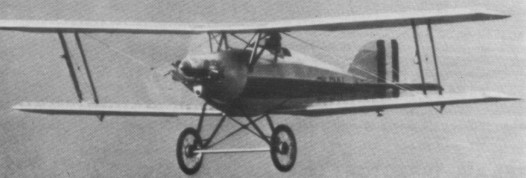
The first sport single-seater of note in the early 1920s was the Lincoln “Sport,” which was a biplane originall~ developed as a homebuilt by S.S. Swanson in 1923. It was put into limited production by the Lincoln Aircraft Co., of Lincoln, Nebraska, when Swanson became chief engineer there. The production model died for lack of a market because there were still plenty of cheap World War 1 surplus single seaters around for the sporting types. The Lincoln design was perpetuated as a homebuilt, however, when the plans were published in Modern Mechanics magazine in the early 1930s.
Capable of 100 mph and fully aerobatic.
Engine: Bristol Cherub III.
Max speed: 100 mph.
Lincoln-Standard Tourabout
Between 1923 and 1925 offered the Lincoln-Standard Tourabout, a three-seat rework of the Standard J.1 of 1916.
Lincoln Air Coach
Lincoln began construction, in 1922, of the five-seat Air Coach.
Lincoln Standard
Ray A. Page established Nebraska Aircraft Corporation at Lincoln, Nebraska, during the First World War, and was a builder of the Lincoln Standard, a two-bay biplane circa 1920.
Replica
Mexicana Lincoln Standard Replica
Lincoln Aircraft Company Inc / Lincoln-Page Aircraft Co / Nebraska Aircraft Co
Ray A. Page established Nebraska Aircraft Corporation at Lincoln, Nebraska, during the First World War, and was a builder of the Lincoln Standard biplane, and also built aircraft under subcontract to the U.S. government.
Began construction, in 1922, of the five-seat Air Coach. Between 1923 and 1925 offered the Lincoln-Standard Tourabout, a three-seat rework of the Standard J.1 of 1916. Also produced the Sport Lightweight biplane. Page acquired the rights to the New Swallow and redesigned this as the three-seater Lincoln-Page LP-3 in 1928, an attempt to catch up with developments in light aircraft design. In 1929 produced a two-seat trainer known as the Lincoln-Page Trainer.
Lincoln Aircraft Company Inc was the official name of Lincoln-Page from 1929, but both names used indiscriminately.
The last design was the parasolwing Lincoln Playboy of 1931. Firm was by then the Lincoln Airplane and Flying School.
Limbach L-2400
Four cylinder, single & double ignition, four stroke engines for light & ultralight aircraft & motorgliders.
L-2400 DA3BX
Four cylinder, four stroke engines for light & experimental aircraft with double magneto ignition, with 92hp; produce 2400 EFI engine with liquid cooled cylinder heads, dual electronic ignition, 100hp take off power at 2900rpm; type certification per JAR-22 sub-part H; dev. turbocharged version of C-2400 EFI
L-2400 DE3 X
Cycle: 4 stroke
No cylinders: 4
Bore: 97 mm
Stroke: 82 mm
Compression: 8.5
Displacement: 2424 cc
Cooling: air/liquid
Ignition: Double magneto
Weight: 87.5 kg
Max pwr: 90 hp at 3200 rpm
Price 1998: 20 700 DM
Limbach L2000
The Limbach L2000 is a series of German piston aero-engines designed and built by Limbach Flugmotoren. First run circa 1980, they are four-cylinder, four-stroke, air-cooled horizontally opposed, piston engines with a power output of 75 to 80 hp (56 to 60 kW).
Variants:
L2000 DA
Certified in 1989 as a double-ignition tractor engine with carburettor in the back, top location, alternator in the front, starter in the front. 75 hp (56 kW)
L2000 E0
Certified in 1980 as a single-ignition tractor engine with carburettor in the back, bottom location, alternator in the back, starter in the back. 80 hp (60 kW)
L2000 EA
Certified in 1980 as a single-ignition tractor engine with carburettor in the back, top location, alternator in the front, starter in the front. 80 hp (60 kW)
L2000 EB
Certified in 1980 as a single-ignition tractor engine with two carburettors in the back, bottom location, alternator in the back, starter in the back. 80 hp (60 kW)
L2000 EC
Certified in 1980 as a single-ignition pusher engine with carburettor in the back, bottom location, alternator in the back, starter in the back. 80 hp (60 kW)
Applications:
Aeromot AMT-100 Ximango
AV Leichtflugzeuge Vagabund
Grob G 109
Hoffmann HK 36 Super Dimona
ICA IS-28
JPM 01 Médoc
Lucas L-6A
Scheibe SF 36A (EA)
Valentin Taifun
Weller UW-9 Sprint
Whisper Aircraft Whisper
Specifications:
L200 E0
Type: Four-cylinder, four-stroke air-cooled flat piston engine
Bore: 90 mm
Stroke: 78.4 mm
Displacement: 1.994 cc
Length: 627 mm
Width: 775 mm
Height: 415 mm
Dry weight: 70 kg
Fuel type: Mogas and 100LL Octane petrol
Cooling system: Air-cooled
Power output: 51 kW at 3,000 rpm (max continuous)
Compression ratio: 8:5 – 8:9:1
L-200 EA
Cycle: 4 stroke
No cylinders: 4
Bore: 90 mm
Stroke: 78.4 mm
Compression: 8.6
Displacement: 1994 cc
Cooling: air
Ignition: magneto
Weight: 69 kg
Max pwr: 80 hp at 3400 rpm
Price 1998: 16 400 DM
Limbach Flugmotoren
Limbach Flugmotoren (Limbach Flightmotors) is a German company that produces aircraft engines. The company is named after Peter Limbach who expanded his father’s engine repair business in the 1970s in Königswinter.
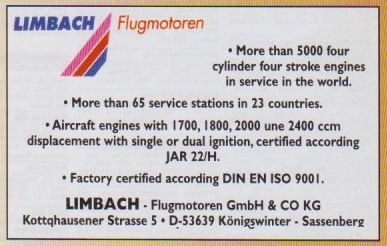
By May 2006, Limbach had produced more than 6000 engines for light aircraft, ultralight aircraft and airships. Many Limbach engines are based on the Volkswagen flat-4 boxer unit with displacement of up to 2.4 litres, and up to 160 BHP in the turbocharged model.
In a letter dated 25th August 2011, the company announced that it would be closing by late 2011, saying “Years of ever increasing regulations and requirements have been choking us. Our efforts to operate in that environment were not successful because we cannot provide the necessary resources. Additionally there are government activities that hinder our current business and we cannot make plans for the future.”
In late 2012 it was announced that the Limbach assets had been sold to Mr. Chen Shuide.
1998-2012: Kotthausener Str. 5, Konigswinter, Germany, D-53639
Limbach produce 2-stroke and 4-stroke engines from 15 to 125 kW for paragliders to cruising aircraft.
The engines have electronic engine management with electronic fuel injection, no mixture control, no choke, and no carburettor preheating. With an electrically adjustable propeller, you only need to preselect the speed and accelerate.
Lilium Jet
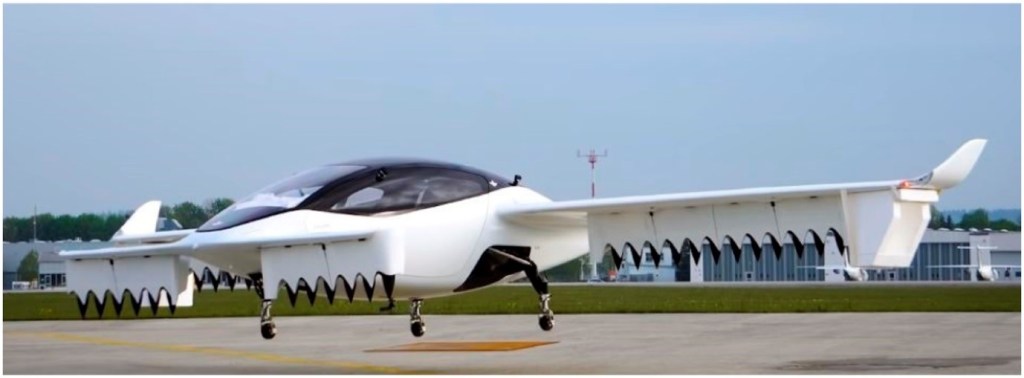
On 4 May 2019, Lilium flew its first flight of an untethered and unmanned five seat Lilium Jet at the Special Airport Oberpfaffenhofen in Munich, Germany. The full-scale prototype was powered by 36 electric ducted fans in configuration inspired by the Eagle prototype aircraft. After the first flight, which consisted primarily of hover, the Lilium Jet has expanded its flight envelope to include conversion to forward flight using the wing for lift, and several safety tests.

