Xian J-7 / JJ-7 / F-7 Airguard / Skybolt / Chengdu J-7

The Xian factory reverse-engineered the MiG-21 and the resulting J-7 made its first flight in December 1964. Two years later, manufacture halted because of unexplained technical problems after only 70 had been built.

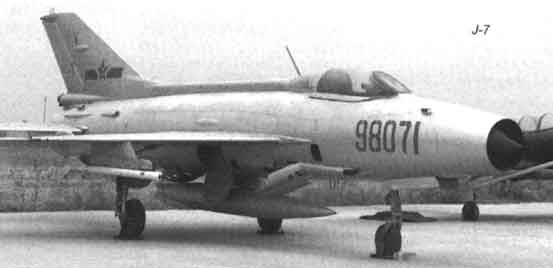
The early model J7I can be seen as the first variant of the type of full production standard. One difference with the MiG-21F-13 is the drag chute housing at the base of the tail.
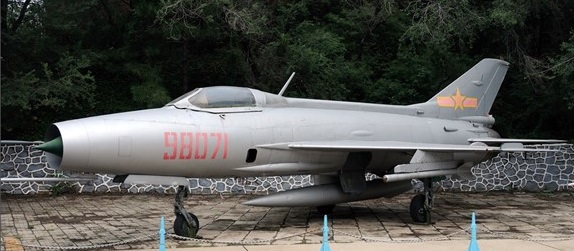
J7I 98071

Meanwhile, in the common cause of communism, China was allowing Soviet supplies to pass through its territory bound for Vietnam, where the USA was embroiled in conflict. One day, several railway wagons containing dismantled MiG-21s went astray, and subsequently the J-7 re-entered production in modified form at Chengdu. The new J-7 II, a considerably upgraded Chinese development, entered production in the early 1980s, and by 1982 was being exported as the F-7B. China (Giuzhou) also produces the JJ-7 two-seat operational trainer, designated FT-7 for export (first flown in 1981). The JJ-7 dual seat version was originally built by Guizhou Aviation Industry Group (GAIG).

Despite Chinese denials, a number of F-7s have been confirmed in Iranian service, while Iraq has also received the type via assembly (by Chinese technicians) in Egypt.

Details of the latest export version of the Chinese-built MiG-21 were released in 1984. Known as the F-7M Airguard and (as offered to Pakistan) F-7P Skybolt, this variant of the earlier F-7B is extensively modernised with Western avionics including ranging radar, a weapons aiming computer, a headup display, multimode radios, and IFF. Two additional wing hardpoints are fitted, and two fuselage cannon are carried, rather than the one carried by earlier models. Other changes include a revised canopy, an updated ejection seat, and a relocated brake-parachute housing.

With development of a successor to the J-7 (MiG-21) that formed the backbone of the PLAAF taking far longer than hoped, Chengdu began efforts to modernize the design. Work began in 1987, resulting in a major design overhaul. The wings were redesigned to have a double-delta planform, and the engine was replaced with a WP-13F engine. The primitive radar of the J-7 was replaced with the British Super Skyranger radar, and fuel capacity was increased. The modifications improved turn performance, and the takeoff roll was reduced from 1km to 600m. Upgrades to the cockpit included HOTAS controls, as well as the later addition of a helmet-mounted sight. Development proceeded quickly, with the first J-7E, as the new model was known, flying in 1990.

By the time the J-7E came about, most J-7 operators had since moved on to more capable designs. However, Pakistan, the largest non-Chinese J-7 operator, ordered significant numbers of the type. A special variant was developed to meet Pakistani requirements, integrating new western radars and the capability to mount AIM-9 AAMs.
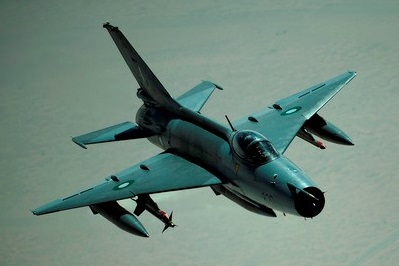
Ever eager to develop anti-shipping platforms, the PLANAF also ordered a special J-7 variant with the ability to deploy AShMs (J-7EH). The J-7EH features the ability to carry antiship missiles, but, due to limitations with the radar, must receive targeting data from other aircraft.

The derivative of the F-7M supplied to Pakistan as the F-7P Skybolt featured 20 PAF specified changes, including for four, rather than two, PL-5B or AKM-9 Sidewinders on pylons outboard of the main undercarriage attachment points. The Skybolt retains the two wing root-mounted Type 30-1 cannon ND MOST OF TE Western systems of the basic F-7M, although some equipment (eg. IFF) is installed in Pakistan.
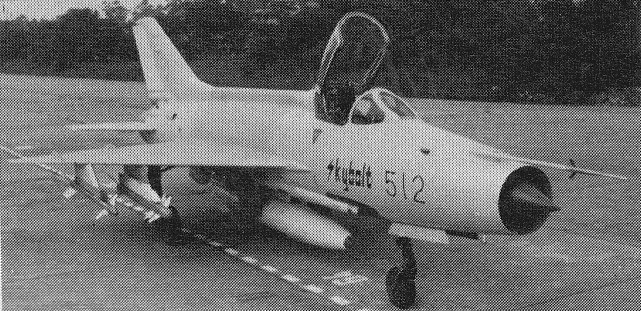
F-7P Skybolt

The initial Pakistan Air Force order for 20 F-7P was fulfilled in August 1988 when the aircraft were ferried from Chengdu, but the Chengdu Aircraft Corporation was by then responsible for F-7 production.

After the final deliveries to Bangladesh, Chengdu shut down J-7 production in May 2013, marking the end of a 2,400 aircraft production run.

F-7M Airguard
Engine: 1 x Wopen-7B (BM)
Installed thrust (dry / reheat): 43 / 60 kN
Span: 7.2 m
Length: 13.9 m
Wing area: 23 sq.m
Empty wt: 5275 kg
MTOW: 7531 kg
Warload: 1800 kg
Max speed: 2.05 Mach
Initial ROC: 9000 m / min
Ceiling: 18,700 m
TO run: 700-950 m
Ldg run: 600-900 m
Combat radius lo-lo-lo: 370 km
Air refuel: No
Armament: 2 x 30 mm, 2 x AAM
Hard points: 5

Xian H-6

H-6

A 1961 split ending Soviet assistance, left the Chinese with the task of getting the Tu-16 into production as the Hongzhaji-6 (bomber aircraft no. 6). The Chinese spent two years in reverse-engineering the Tu-16 and its Mikulin AM-3 turbojets, and started production in 1962 for first deliveries in 1968. Since that time the Air Force of the People’s Liberation Army has received more than 100 H-6s for the strategic free-fall bomber and anti-ship roles, the latter with two missiles carried under the wings. Principal version – H-6 (sole production model in several variants up to at least the H-6D, or H-6 IV, which is believed to be the anti-ship type). Low-rate production of the Tu-16 Badger continues at Xian in 1987, and the H-6 is still the mainstay of China’s strategic nuclear bomber force. Local developments of the design include an anti-shipping version carrying C601 missiles and equipped with an under-nose search radar. A four-engined variant of the H-6 has also been reported. Customer: China 120+

Xian H-6 Article

H-6K

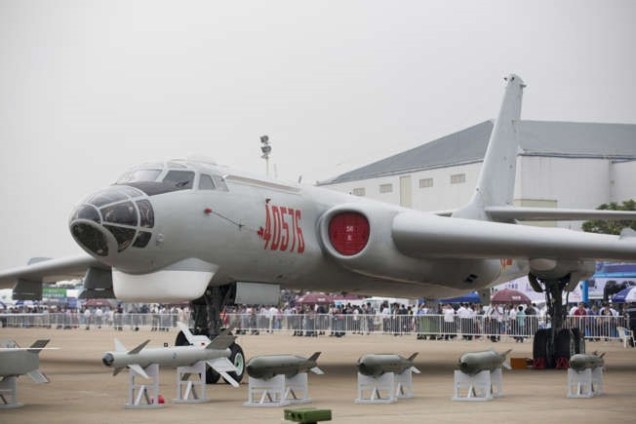
After decades of service, Xian finally performed a major overhaul of their H-6 (Tu-16) around the turn of the century. While previous modifications merely upgraded avionics of the design, the new variant developed, the H-6K, redesigned the airframe to extensively use composites, and replaced the old Chinese engines with Russian-made Saturn D-30KP turbofans. As Chinese bomber doctrine has long since shifted to the use of bombers as cruise-missile carriers, the bomb bay was replaced with larger fuel tanks, and the obsolete tailgun armament was replaced with an extensive ECM suite. Similarly, the glazed navigator position was replaced with a more powerful targeting radar. The H-6K first flew in January 2007, and after two years of testing, the bomber entered service with a combat radius nearly double that of the original H-6.

China International Aviation & Aerospace Exhibition in Zhuhai, China, 2014

About 150 of its bombers have been built, and about 120 were still operational in 2025. The H-6 has been upgraded to carry modern weapons, including hypersonic and nuclear-capable missiles.

China sold H-6s to both Egypt and Iraq, but those countries no longer have their bombers operational. According to the Center for Strategic and International Studies, Iraq’s four H-6s were destroyed while in service.

The H-6 has four crew and is powered by two Soloviev D-30KP-2 turbofan engines, each with 27,000 pounds of thrust. Its top speed is 670 mph, and its cruising speed is 477 mph. Its combat range is 2,200 miles.
It can also carry 26,500 pounds of bombs, both guided and unguided (dumb bombs), but no longer carries free-fall nuclear bombs, as the H-6 could not be relied upon to penetrate an enemy’s air space.

Xian H-6
Type: six-seat strategic medium bomber and anti-ship missile carrier
Engines: 2 x 20,944-lb (9,500-kg) thrust Xian WP-8 turbojets
Maximum speed 616 mph (991 km/h) at 19,685 ft (6,000 m)
Initial climb rate 4,100 ft (1,250 m) per minute
Service ceiling 40,355 ft (12,300 m)
Range 2,983 miles (4,800 km) with an 8,157-lb (3,700-kg) warload
Empty weight about 82,010 lb (37,200 kg)
Maximum take-off weight 158,733+ lb (72,000+ kg)
Wing span 108 ft 1.2 in (32.95 m)
Length 114 ft 2.1 in (34.80 m)
Height 35 ft 5.2 in (10.80 m)
Wing area 1,772.87 sq ft (164.70 sq.m)
Armament: four 23-mm cannon in twin-gun dorsal and tail turrets, and up to 19,842 lb (9,000 kg) of bombs

Xian

This major aircraft company was established in 1958. In 1961 it took over from Harbin production of the H-6, a Chinese version of the Soviet Tupolev Tu-16 Badger bomber, and also developed the H-6D as a cruise missile carrier. Produced the Y7 short/medium-range transport based on the Soviet An-24, the first flying in December 1970, and improved versions continue in production. Y7H and Y7H-500 are military and civil versions of the An-26. A supersonic strike aircraft first flew in 1989 as the JH-7, which might have entered service in small numbers with the PLA Naval Aviation for maritime strike duties from 1994. An export version of JH-7 was revealed in November 1998 as the FBC-1 Flying Leopard.

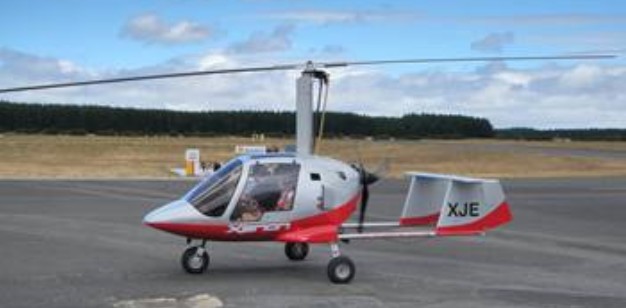
Xenon Gyroplanes Xenon / ABS Aerolight Xenon / Future Flight Xenon / Celier Xenon

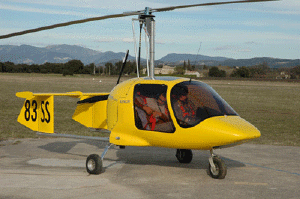
Xenon was designed by French aircraft designer Raphael Celier and was manufactured in Poland to the French Ultralight category standards.

Celier Aviation established its reputation with the two-seat side-by-side configuration Celier Xenon 2 series of autogyros. By 2011 over 100 of these were flying.

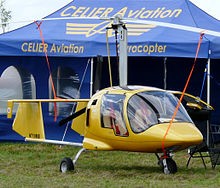
A Celier Xenon 2 on display at Sun ‘n Fun in Lakeland, Florida, United States, 2008.

This high performance ultralight autogyro was available as a kit or ready to fly. Registered as an LSA.
Delivered fully factory built starting at $61,000 in 2009.
The composite structure is the airframe, providing lightness and incorporating a full roll cage to protect the occupants. The cabin is 10″ wider than a Cessna 172 and the two pilots are separated by a 10″ console and arm rest. Behind the seats is a very large luggage compartment. The Aircopter rotor blades are aluminum yet use titanium for strength and tip weighting for higher inertia. The DUC R propeller features a spoon blade with a wider tip and built in feathering. It is carbon forged under high pressure and a carbon fiber spinner is fitted.
The box tail section is directly in the propeller slipstream and is on a long lever arm for effectiveness with or without engine power. The 28″ high cabin is soundproofed, with interior carpeting and heated leather bucket seats, and the Xenon meets European noise standards.
The Xenon is available with a choice of 3 different engines. The standard model comes with a Rotax 912S Engine that delivers 100 horsepower. The 914 Model features a Rotax turbo that delivers 115 horsepower for up to 5 minutes after which the engine delivers a continuous 100 horsepower. The high altitude or extra climb ability model is the 912 RST version which has a Rotax 912 sporting a custom designed Mitsubishi turbo delivering 122 horsepower for take-off followed by a continuous 110 horsepower with full time turbo boost.
The doors are removable for flight, leaving a full wrap around optical windshield with overhead windows and foot well windows, allowing near unobstructed viewing. The instrument panel is shock mounted to be vibration free and includes full instrumentation for flight performance and engine monitoring. Flight instruments include: altimeter, airspeed indicator and vertical speed indicator. Rotor tach and fuel are separate gauges while graphic digital engine monitor uses colored LEDs to keep track of engine tach, CHT and EGT gauges, volt/amp meter, oil pressure and temperature, fuel flow, turbine temperature and manifold pressure. There is a 12 volt power plug for the portable GPS or MP3 player. Options include intercoms, VHF radio and transponder with altitude encoder.
The console arm rest puts the throttle and 280 rpm pre-rotator under one hand. Circuit breakers control the panel and landing lights and overhead heat vents are fitted.
Options vary depending on the model but your Xenon is available with propeller spinner, special metallic paint, cabin and blade covers, larger rotors, removable joystick, adjustable pedals, heated leather seats or a ballistic parachute.

Engine: Rotax 912S, 100 hp
Propeller: 3 Blade DUC Windspoon 68.5 in
Max TO weight: 1,155 lbs.
Empty Weight: 583 lbs
Payload: 462 lbs
Rotor blades: Type 8H12 Aircopter Extruded Aluminum
Rotor Diameter: 27.55 ft
Dics Area: 596.1 sq. ft
Total Width: 86.6 in
Total Length: 192.9 in
Total Height: 110.23 in
Cabin Width: 49.2 in
Pre-rotator: Mechanical 280 RRPM
Wheel Diameter: 400×4
Vne: 108 kt / 124 mph / 200 kph
Minimum Speed: 19 mph
Cruise 75%: 75 mph
Max speed: 105 mph
Climb Rate: 600-1200 fpm
Glide Ratio: 3:1
Service Ceiling: 15,000 ft
Endurance: 4 hr + res
Take off Dist: 100-300 ft
Landing Dist: 15 ft
Fuel Capacity: 22 USG
Fuel Burn @ 65% pwr: 4.8 USGPH
Endurance: 4 hrs + res

Engine: Rotax 914, 115 hp
Empty Weight: 616 lbs
Propeller: 3 Blade DUC Windspoon 68.5 in
Max TO weight: 1,155 lbs.
Rotor blades: Type 8H12 Aircopter Extruded Aluminum
Payload: 484 lbs
Rotor Diameter: 27.55 ft
Dics Area: 596.1 sq. ft
Total Width: 86.6 in
Total Length: 192.9 in
Total Height: 110.23 in
Cabin Width: 49.2 in
Pre-rotator: Mechanical 280
Wheel Diameter: 400×4
Vne: 108 kt / 124 mph / 200 kph
Minimum Speed: 19 mph
Cruise 75%: 87 mph
Max speed: 115 mph
Climb Rate: 600-1200 fpm
Glide Ratio: 3:1
Service Ceiling: 15,000 ft
Endurance: 4 hr + res
Take off Dist: 100-300 ft
Landing Dist: 15 ft
Fuel Capacity: 22 USG
Fuel Burn @ 65% pwr: 4.8 USGPH
Endurance: 4 hrs + res

Engine: Rotax 912 RST, 122 hp
Empty Weight: 605 lbs
Propeller: 3 Blade DUC Windspoon 68.5 in
Max TO weight: 1,155 lbs.
Rotor blades: Type 8H12 Aircopter Extruded Aluminum
Payload: 550 lbs
Rotor Diameter: 27.55 ft
Dics Area: 596.1 sq. ft
Total Width: 86.6 in
Total Length: 192.9 in
Total Height: 110.23 in
Cabin Width: 49.2 in
Pre-rotator: Mechanical 280 RRPM
Wheel Diameter: 400×4
Vne: 108 kt / 124 mph / 200 kph
Minimum Speed: 19 mph
Cruise 75%: 99 mph
Max speed: 121 mph
Climb Rate: 600-1200 fpm
Glide Ratio: 3:1
Service Ceiling: 15,000 ft
Endurance: 4 hr + res
Take off Dist: 100-300 ft
Landing Dist: 15 ft
Fuel Capacity: 22 USG
Fuel Burn @ 65% pwr: 4.8 USGPH
Endurance: 4 hrs + res

Xenon Gyrocopter
Engine: Rotax 912RST (turbo)
Height: 2.8m
Fuselage width: 2.2m
Length: L4.9m
Empty weight: 294kg
Max take off weight: 544kgs
Payload: 240kgs
Fuel capacity: 87 litres
VNE: 113 knots
Cruise speed: 86 knots
Min speed: 16 knots
Rate of climb: 800-1200 fpm
Take off Distance: 35-100 meters
Landing distance: 0-5 metres
Range: 4hours plus
Seats: 2

Xenoah C72C-C

C72C-C

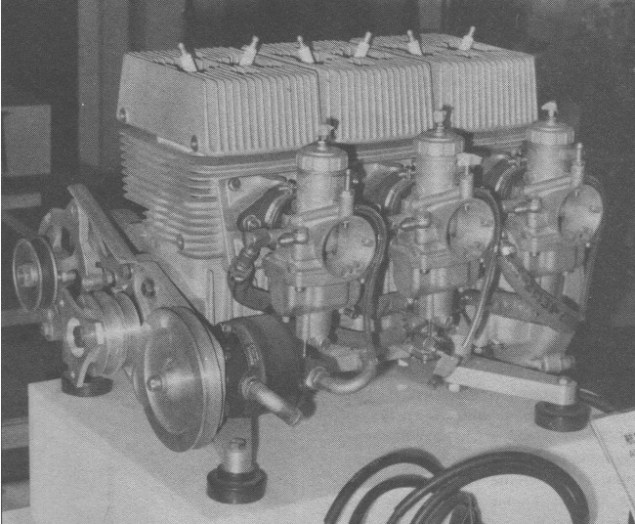
Affected by an Arabian oil embargo, like many other countries Japan has felt the squeeze in private flying. One result was Xenoah’s takeover by Komatsu, which decided to go ahead with the development program of the G72C-C engine, since there was a growing homebuilt market developing in Japan itself.

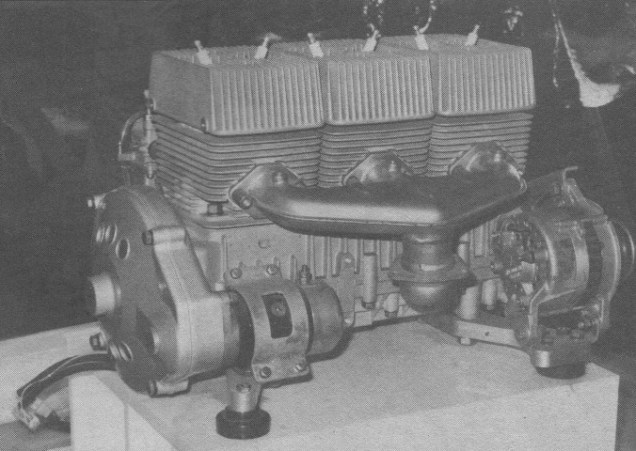
The Xenoah C72C-C is a two-cycle, three-cylinder, in-line, air-cooled powerplant with three carburetors; it burns 100/130 octane av gas. Of 44.34 CID and a compression ratio of 71, the engine measures 22.2 inches long, 17.4 inches wide and 15.35 inches high. It comes with dual ignition, oil injection, starter, and engine mount.

The G72C-C weighs 157 pounds and is rated at maximum continuous 54 hp at 6080 rpm SL. The cruise rpm of 6080 requires a reduction unit for the propeller.
The G72C-C aircraft engine has been certified by both the FAA and Japan’s JCAB for use in homebuilts.

Xenoah

The Xenoah firm has been around since 1910 and early on manufactured various engines for lightplanes. Their airframe department built a plane for the Aeronautical Research Institute of Tokyo University in 1937, and with it they established a world record for nonstop closed-course max distance flight. After World War II Xenoah produced many piston engines for trainers and engine parts for Japan’s Self Defense Forces. They have been involved in overhauling piston engines for civil and military planes.
The Xenoah Company is now called Komatsu Xenoah, since the firm was taken over by Komatsu Co., Ltd., Japan’s leading manufacturer of bulldozers and other earthmoving equipment.