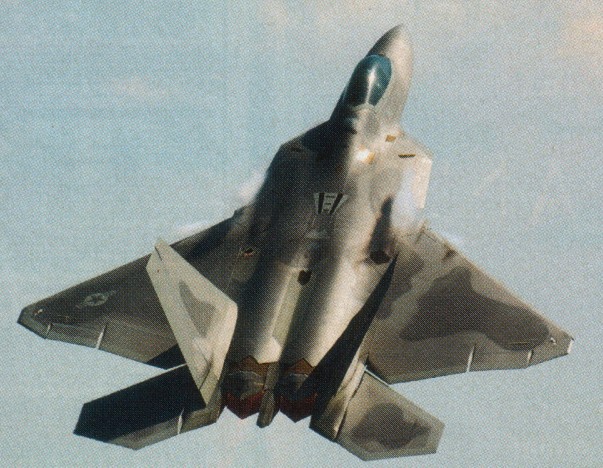
Lockheed Martin F-22 Raptor

In the late 1970s, the US Air Force identified a requirement for 750 examples of an Advanced Tactical Fighter (ATF) to replace the F-15 Eagle. Flown by a single pilot, it must be able to survive in an environment filled with people, both in the air and on the ground, whose sole purpose is to destroy it. To test the concepts that would eventually be combined in the ATF, the US AF initiated a series of parallel research programmes. The first was the YF-16 control-configured vehicle (CCV) which flew in 1976-77 and demonstrated the decoupled control of aircraft flight path and attitude; in other words, the machine could skid sideways, turn without banking, climb or descend without changing its attitude, and point its nose left or right, or up or down, without changing its flight path. Other test vehicles involved in the ATF programme included the Grumman X-29, which flew for the first time in December 1984 and which was designed to investigate forward-sweep technology, and an F-111 fitted with a mission adaptive wing (MAW) – in other words, a wing capable of reconfiguring itself automatically to mission requirements.
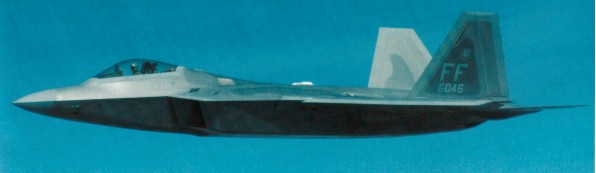
Flight testing of all these experimental aircraft came under the umbrella of the USAF’s Advanced Fighter Technology Integration (AFTI) programme. In September 1983, while the AFTI programme was well under way, the USAF awarded ATF concept definition study contracts to six American aerospace companies and, of these, two – Lockheed and Northrop – were selected to build demonstrator prototypes of their respective proposals. Each company produced two prototypes, the Lockheed YF-22 and the Northrop YF-23, and all four aircraft flew in 1990. Two different powerplants, the Pratt & Whitney YF119 and the General Electric YF120, were evaluated, and in April 1991 it was announced that the F-22 and F119 were the winning combination. The F119 advanced technology engine, two of which power the F-22, develops 155kN and is fitted with two-dimensional convergent/ divergent exhaust nozzles with thrust vectoring for enhanced performance and manoeuvrability.

Lockheed Martin F-22 Raptor Article

The Raptor is designed and built by Boeing, Lockheed Martin and Pratt & Whitney. Boeing supplies the F-22s 2,000-lb titanium and composite wings and aft fuselage, integrates and tests the advanced avionics and is responsible for the training and life-support systems.

Previously the designation for the Raptor was changed to F/A-22 to indicate the possible air-to-ground role of the aircraft. JDAM bombs can be carried in the internal weapon bay, while the optional external pylons offer a more flexible station for air-to-ground armament. However the U.S. Air Force changed the designation back to F-22 in December 2005, although it will still posses the secondary air-to-ground role.

The F-22 combines many stealth features. Its air-to-air weapons, for example, are stored internally; three internal bays house advanced short-range, medium-range and beyond-visual-range air-to-air missiles. Following an assessment of the aircraft’s combat role in 1993, it was decided to add a ground-attack capability, and the internal weapons bay is also capable of accommodating 454kg GBU-32 precision-guided missiles.
The F-22 is the first production aircraft with the ability to super cruise – flying at supersonic speeds without the use of afterburners. The F-22 is designed for a high sortie rate, with a turnaround time of less than 20 minutes, and its avionics are highly integrated to provide rapid reaction in air combat, much of its survivability depending on the pilot’s ability to locate a target very early and take it out with a first shot. The F-22 was designed to meet a specific threat, which at that time was presented by large numbers of highly agile Soviet combat aircraft, its task being to engage them in their own airspace with beyond-visual-range weaponry. It will be a key component in the Global Strike Task Force, formed in 2001 to counter any threat worldwide. The USAF requirement is for 438 aircraft.

The first definitive F-22 prototype was rolled out at the Lockheed Martin plant at Marietta, Georgia, on 9 April 1997.

The planned first flight of the F-22A, scheduled for 29 May 1997, was delayed by a small fuel leak in the F-1A tank just aft of the cockpit, together with an oil problem in the APU/auxiliary generator system area and software troubles.

The first flight was delayed to 7 September 1997. The second prototype first flew on 29 June 1998. The first two Raptor fighters, Nos. 4001 and 4002, have only 80% of the required strength, partly the result of an aggressive weight-cutting program, and the No. 4003 airframe has been strengthened to make it 100% capable. The third F-22 was delivered to Edwards AFB in March 2000. The aircraft was about eight months behind schedule. The empty weight is still low enough to beat the operational requirements.
Raptor 4001 has been doing high speed tests such as loads and flutter but could not fully clear the envelope because of the lower strength, although it and ship No. 4002 have both exceeded 7g loads. The Air Force will only say that the required F-22 limit exceeds 7g. Raptor 4003 will provide full high speed clearance for subsequent aircraft, but will first spend several months on the ground at Edwards AFB because the reworked structure requires new ground vibration tests and other evaluations.
The nonstop delivery from Marietta, Ga., was the fourth flight of 4003 and lasted 4 hr. 50 min., including four aerial refuelings. By late 2001, there were eight F-22s flying.

A YF-22 being tested at Edwards reacted unexpectedly when a go round initiated a changed in its fly-by-wire control laws. After a few cycles of PIO, the aircraft belly-flopped onto the runway.
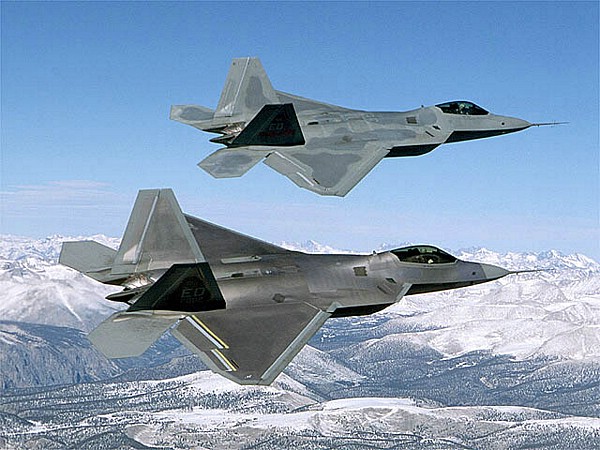
In January 2003, the Air Warfare Center at Nellis Air Force Base near Las Vegas, Nevada, received its first Raptor. It was the twelfth F-22 produced. The 422nd Test & Evaluation Squadron took on seven more F-22s for testing and training of the initial cadre of instructor pilots.
The 43rd Fighter Squadron became the first F-22 squadron when it received its first F-22 (then designated F/A-22) in the end of September in 2003. The unit of the 325th Fighter Wing carries out the training at Tyndall Air Force Base, Florida. In January 2004, the first pilot qualified at Tyndall AFB.

The 27th Fighter Squadron of the 1st Fighter Wing at Langley AFB became the first operational F-22 squadron when it received its first Raptor in January 2005. The squadron was declared operational (initial operational capability) in December 2005 with 12 F-22A Raptors. Also based at Langley AFB, the 94th Fighter Squadron received its first two Raptors in March 2006. On January 19, 2007, the last of 40 F-22A Raptor for the 1st Fighter Wing was delivered to the 94th FS, equipping both fighter squadrons with 20 Raptors each.

First prototype:
N22YF (GE YF120 engines) rolled out at Palmdale 29 August 1990; first flight/ferry to Edwards AFB 29 September 1990; first air refuelling (11th sortie) 26 October 1990; Mach 1.58 supercruise’ (later exceeded) on 3 November 1990; first thrust-vectoring 15 November 1990; anti-spin parachute fitted for high AoA tests with thrust-vectoring; last flight 28 December 1990 — total 43 sorties/52.8hr.

Second prototype: N22YX (P&W F119 engine) first flight Palmdale-Edwards 30 October 1990; launched first AIM-9M Sidewinder on 28 November 1990 and AIM-120 AMRAAM on 20 December 1990; achieved Mach 1.8 26 December 1990; last flight 28 December 1990 — total 31 sorties/38.8 hrs.
Summary demonstrated thrust vectoring, including 100deg/sec roll rate at 120kt (222km/h; 138mph); Mach 2 speed with afterburning. Aircraft in storage at Edwards AFB from January 1991.

Despite its $150 million unit cost and production run of only 195 aircraft, terminated early due to post-Cold
Its capabilities were partially demonstrated during deployments to Syria, where Raptors operated with impunity even in airspace covered by advanced Russian air defence systems.

The F-22’s main limitation is its age—designed before modern networked warfare concepts were fully developed, it lacks some of the connectivity features of newer aircraft.
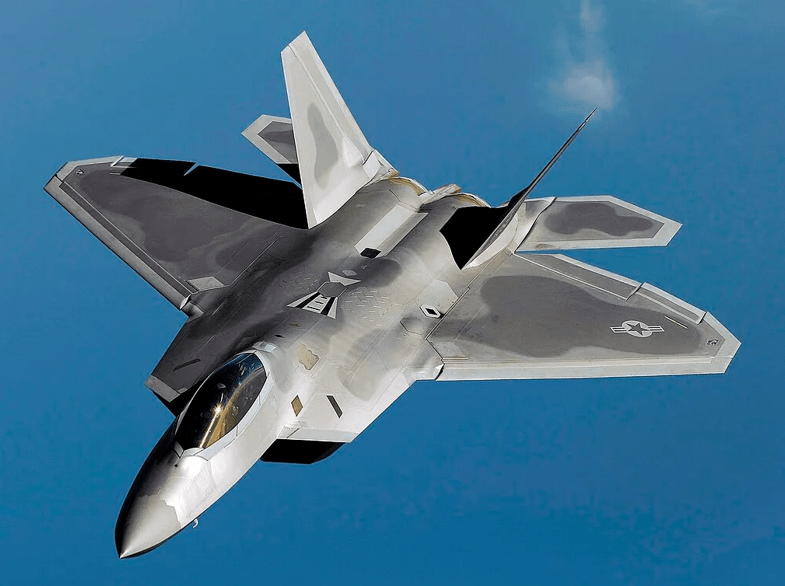
Lockheed Martin F-22 Raptor

However, ongoing modernisation programs including upgraded processors, new datalinks, and integration with the latest AIM-260 long-range missiles will keep the Raptor at the forefront of air combat capability until its planned replacement by the sixth-generation NGAD (Next Generation Air Dominance) fighter.

Gallery

YF-22
Wing span 43ft 0in (13.11m)
Length overall 64ft 2in (19.56m)
Height overall 17ft 8.875in (5.41m)

F-22A
Engines: two Pratt & Whitney F119-P-100 turbofan, 155.69 kN (35,000 lb st) with afterburning
Length 18.92m (62 ft 1 in)
Height 5.00m (16 ft 5 in)
Wing span 13.56m (44ft 6 in)
Empty weight: 13.608+ kg (30,000+ lb)
Max Take-Off Weight: 26.308 kg (58,000 lb)
Max level speed at optimum altitude: Mach 1.58 in supercruise
Max level speed at 30,000 ft (9145m) Mach 1.7 in afterburning mode
Service ceiling: 15,240+m (50,000+ ft)
G limit: +7.9
Armament: one 20mm M61A2 Vulcan six-barrel gun with 480 rounds; 2 AIM-9X Sidewinder IR-guided missiles in internal side bays. Up to 6 AIM-120C or 4 AIM-120A AMRAAM missiles in internal fuselage weapon bays or 2 AIM-120C AMRAAMs and 2 GBU-32 JDAM bombs or 2 GBU-30 JDAM bombs. Up to four fuel tanks and up to 8 missiles on optional external hardpoints.
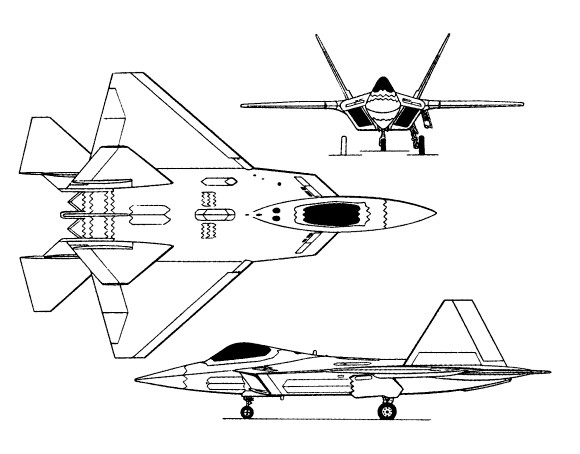
Lockheed F-22 Raptor

Lockheed Brothers Uni-twin / Olympic Duo-4

Lockheed Alcorc 6 1

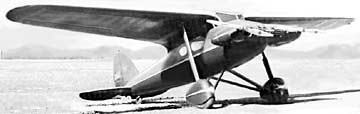
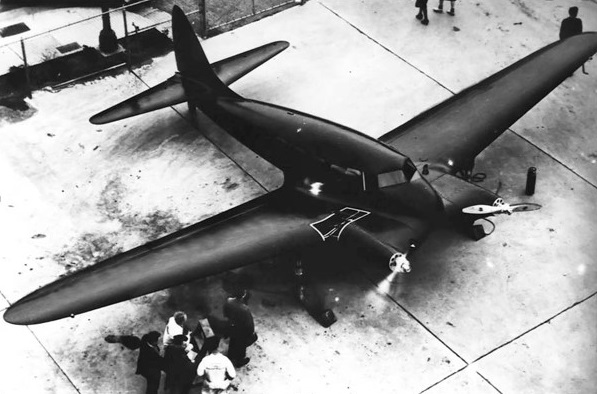
The Lockheed Brothers left the Company after the Detroit merger and set up the Airover Company, later called Alcor, to build the Uni-twin. With two Menasco engines side-by-side in the nose, driving two propellers. The name of the company was changed to Lockheed Vega when it became a subsidiary of the revived parent organization.

With Allan H. Lockheed as president, built a new version of his Duo twin-engined monoplane. Type was called Alcor Duo-6 and was distinctive in having two Menasco engines placed horizontally.

A demonstration flight was made in May 1934 at Mines Field with one propeller removed—it took off in 1200′, attained 130mph, and reportedly handled much like a single-engine plane.

Alcor Duo-6 NX962Y

The Alcor Olympic Duo-4 of 1930 designed by Allan Loughead, featured two engines mounted side-by-side in a nose nacelle. Powered by two 160hp Menasco B-6 (reportedly first with 125hp C-5s), it was originally planned for one Wright J-6-7c in the nose. The unbraced cantilever wing had two full-length box spars.

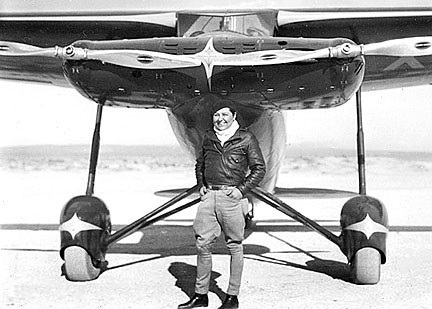
Alcor Duo-4 with Pancho Barnes

The one five-place Alcor Duo-4 built, NX962Y, nosed over in a wind gust during a landing on Mar 18, 1931; although damage was slight, nervous financial backers withdrew their support.

Though Alcor conformed with Lockheed “star names” system and development was pursued in 1930s, no production resulted. Alcor was not a Lockheed Aircraft Corporation product.

Olympic Duo-6
Engines: two 230hp Menasco B-6S
Wingspan: 42’0″
Length: 28’6″
Useful load: 2045 lb
Max speed: 183 mph
Cruise: 157 mph
Stall: 57 mph
Range: 700 mi

Lockheed Brothers Aircraft Corp / Alcor

1929: Allan Loughead resigned from Lockheed Co after its acquisition by Detroit Aircraft Corp to establish Loughead Bros Aircraft Corp Ltd
737 S San Fernando Rd,
Glendale CA.
USA

The Lockheed Brothers left the Company after the Detroit merger and set up the Airover Company, later called Alcor, to build the Uni-twin, with two Menasco engines side-by-side in the nose, driving two propellers.

1934: Legally changed name to Lockheed.

1934: Alhambra Airport & Air Transport Co, Alhambra CA.

1937: Alcor (Allan Lockheed Corp) Aircraft Corp formed, San Francisco CA.

The name of the company was changed to Lockheed Vega when it became a subsidiary of the revived parent organization. The Lockheed Vega Twin then named Olympic Duo-4, crashed 1938. Firm also built low-wing Starliner and NA-35 trainer. With Boeing and Douglas during Second World War, as the BVD pool, built B-17s. Allan Lockheed, during Alcor period, was associated with Alhambra Airport and Air Transport Company.

Gave up aircraft production for parts manufacturing and, after WW2, retired from aviation to focus on his real estate business.

Lockheed-Azcarate sa

Mexico
Formed by Juan F. Azcarate in 1957 with Lockheed, to design an aircraft specifically to suit Central American conditions. Built the LASA-60 4/6-seat utility aircraft in 1959. Construction undertaken by Lockheed-Azcarate, Macchi and Aviones Lockheed-Kaiser. Lockheed acquired a substantial holding in Aermacchi 1959.

Lockheed 44 Excalibur

Around this time, the late 1930s Lockheed Aircraft Corporation was studying different airliner projects. The first was the Model 27, which had a canard configuration. The other two were the L-104 and L-105. The L-105 was smaller, with 1200 hp engines, and was more conventional than the L-104. These studies led Lockheed’s Burbank facility to settle on a design dubbed Model 44, a four-engined airliner that was announced to the public in April 1939. Soon afterwards, the new airliner was dubbed Excalibur. The Excalibur resembled an enlarged Model 10 Electra. It would be powered by four Wright GR-1820 Cyclone 9 radial engines, rated at 1000 hp (746 kW), or four Pratt & Whitney R-1830 Twin Wasp radials. Its wingspan was 95 ft 9 in (29.18 m), its length was 82 ft 6 in (25.15 m), and its projected maximum speed was in the 250-280 mph range (402–451 km/h). Several variants were proposed, to accommodate different passenger loads.

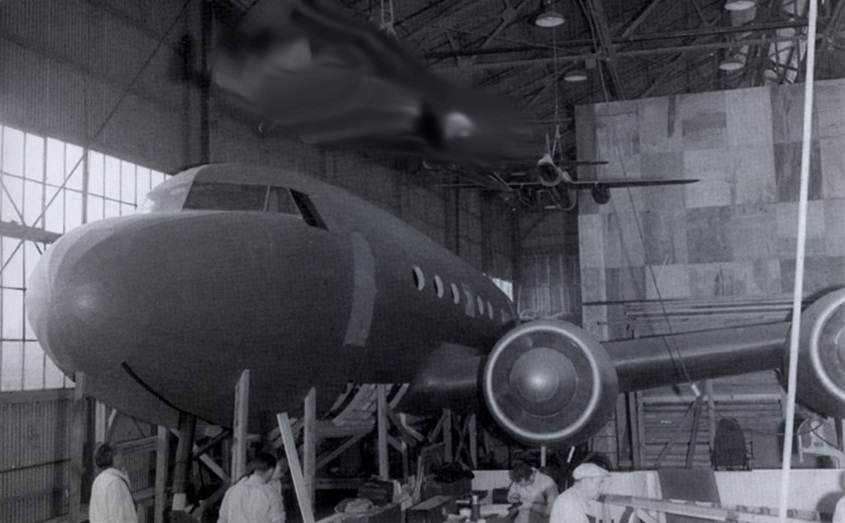
The original Excalibur design envisioned a 21-passenger payload, with a 240 mph (386 km/h) cruising speed. This was revised to 36 passengers at 268 mph (431 km/h) cruise at 12,000 feet (3,660m) altitude. This change included increasing the fuselage diameter, making it comparable to the Model 18 Lodestar, and increasing the wingspan to 95 ft 9 in (25.19 m) with an area of 1,000 ft² (92.9 m²). A tricycle landing gear with steerable nosewheel was envisioned. With the revised specifications, the Excalibur could now effectively compete with the near monopoly Douglas had on the airliner market. Its projected performance was better (except in range) than the Boeing 307. The revision of specifications was partially due to a request from Pan American Airlines; their influence also caused the addition of the third tailfin. A variant designated the L-144, able to carry 40 passengers was planned, but was ultimately cancelled even though South African Airways had placed a potential order for two examples. Lockheed proceeded with a full-scale mockup of the proposed Excalibur, including most of the airliner except the right wing.

The billionaire Howard Hughes, who had recently gained ownership of Transcontinental & Western Air (TWA), decided to provide funding for the new Excalibur. He had a plan in mind to vastly improve the characteristics of the Excalibur by increasing comfort, speed and profit of the aircraft. It was thus that Hughes invited three workers from Lockheed and Jack Frye (president of TWA) to a meeting at his Hancock Park residence. The Lockheed employees included Clarence “Kelly” Johnson and Robert E. Gross. Hughes expressed his requirements for the “airliner of the future”: a payload of 36 passengers (or 20 sleeping berths), a six-person crew, a 3,600 mile (5,800 km) range, a 300 mph (483 km/h) cruise speed, and a weight of 23.5-25 metric tonnes. This meant that the Excalibur would have to get a 100 mph (161 km/h) increase in speed and be able to fly 1,000 ft (305 m) higher. It would need to cross the United States nonstop. The first decision was to re-engine the Excalibur with Wright R-2600 radials, which had not been tested yet. The next decision was to start from scratch while saving the overall shape and triple tail configuration of the original Excalibur.

The new design differed so much from the original Excalibur, that a different model designation was needed. It was first given the temporary designation L-104, then it was later officially designated the Model 49 or “Excalibur A”. In time, the Model 49 would become a completely different aircraft from the original Model 44. Lockheed later dropped the name “Excalibur” as the new airliner had little to do with its predecessor. The end result was the Lockheed L-049 Constellation.

Powerplant: 4 × Pratt & Whitney Twin Wasp S4C-4-G, 1200 hp (895 kW) each
Wingspan: 95 ft 0 in (28.96 m)
Wing area: 1000 sq.ft (92.90 sq.m)
Aspect ratio: 9.025
Length: 74 ft 11½ in (22.85 m)
Empty weight: 26,424 lb (11,986 kg)
Gross weight: 40,000 lb (18,144 kg)
Crew: two
Capacity: 32 passengers

Lockheed CL-595 / Model 186 Aerogyro / Model 286 / XH 51A Aerogyro

Lockheed began developing its rigid rotor concept with the CL-475 helicopter design in 1959 and the performance of the CL-475 encouraged Lockheed to continue development. Lockheed submitted the CL-475 to the Army as a candidate to replace the Bell OH-13 Sioux and Hiller OH-23 Raven observation helicopters. Lockheed also tested the commercial market waters without success. However, in February 1962, Lockheed’s Model 186, a new design based on the CL-475 rigid rotor, was selected as the winner for a joint Army-Navy program to evaluate the rigid rotor for high-speed flight capability.

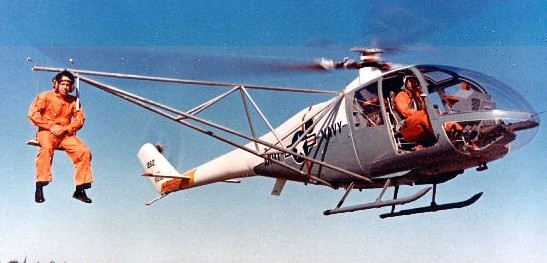
Two four-seat, three-bladed XH-51As were ordered and built for the program. Powered by the 550 shp (410 kW) Pratt & Whitney Canada PT6B-9 turboshaft engine, XH-51A (serial number 61-51262) first flew on 2 November 1962. As flight testing progressed, the original three-bladed, rigid rotor system demonstrated instability at higher speed ranges. Lockheed engineers solved the problem by modifying the aircraft with a four-bladed rotor system. In 1963, the Army’s Technology Research and Evaluation Command (TRECOM) contracted with Lockheed to modify one of the XH-51 aircraft into a compound helicopter.

The second XH-51A (serial number 61-51263) was subsequently converted by adding wings with a span of 16.1 ft (4.9 m), and a 2,500 hp (1,864 kW) Pratt & Whitney J60-2 turbojet engine mounted on the left wing to increase performance. The XH-51A Compound first flew without powering up the turbojet on 21 September 1964, while tests were conducted for balance and handling. The aircraft’s first flight as a true compound helicopter took place on 10 April 1965, and on 29 November 1967 achieved a speed of 263 knots (302.6 mph, 486.9 km/h).

In June 1964, NASA ordered a five-seat, three-bladed variant, the XH-51N (NASA 531) as a helicopter test vehicle.

Lockheed built two demonstrator aircraft, designated the Lockheed Model 286, to market to the public (registration numbers N286L and N265LC). These aircraft had the five-seat configuration of the XH-51N with the four-bladed rotor system of the XH-51A. The Model 286 was certificated for civil operation by the FAA on 30 June 1966, but Lockheed never sold any aircraft. Lockheed used the aircraft for several years as executive transports, eventually sold them to a collector where they were destroyed by fire in 1988.

The two XH-51A examples (Serial Numbers 61-51262 and 61-51263) are stored at the United States Army Aviation Museum at Fort Rucker.

Variants:

186
Civil version of 286/XH-51
Rotor dia: 35 ft
Length: 32 ft

286 / XH-51A
four place, three-bladed rotor
Engine: 1 × Pratt & Whitney Canada PT6B-9 turboshaft, 550 hp (410 kW)
Length: 40 ft 9 in (12.40 m)
Rotor diameter: 35 ft 0 in (10.67 m)
Height: 8 ft 2½ in (2.50 m)
Disc area: 962 ft² (89.4 m²)
Empty weight: 2,790 lb (1,265 kg)
Max takeoff weight: 4,100 lb (1,864 kg)
Maximum speed: 151 knots (174 mph, 280 km/h)
Cruise speed: 139 knots (160mph, 257 km/h)
Range: 226 NM (260 mi, 418 km)
Service ceiling: 16,000 ft (4,876 m) (hover ceiling (in ground effect))
Rate of climb: 2,000 ft/min (10 m/s)
Disc loading: 4.26 lb/sq.ft (20.9 kg/sq.m)
Power/mass: 0.27 hp/lb (0.44 kW/kg)

XH-51A Compound
modified with a four-bladed rotor and stub wings and an auxiliary 2,900 hp Pratt & Whitney J60-2 engine.
Rotor diameter: 31 ft 7 in
Length: 31 ft 7 in

Model 286
five place civilian or military light helicopter offered for sale, none were sold.

Model 286 / XH-51N
five place, three-bladed rotor modified for NASA test purposes.

Lockheed CL-475

The concept of the rigid rotor coupled to a gyroscope system was developed by an Advanced Concepts Group led by Irven Culver to seek significant improvements in performance, cost, reliability, and handling characteristics of helicopters. Following testing of a small radio-controlled vehicle – with a 1.52m diameter, two blade, hingeless rotor driven by a McCoy 60 model aeroplane engine – the small design team undertook in July 1959 to design and build an experimental two-seat helicopter for full-scale demonstration of the new concept.

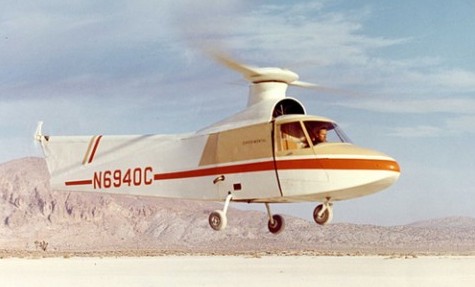
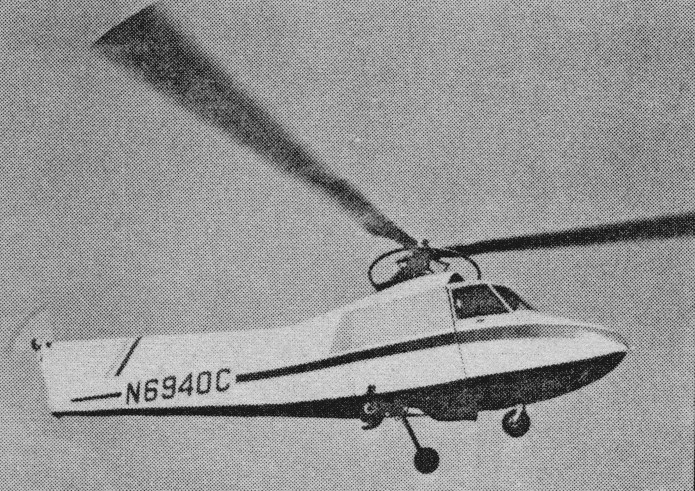
Designated CL-475, this research helicopter had a steel and aluminium tubing covered frame with fabric and a Plexiglass cabin with side-by-side seats. Its 140hp Lycoming VO-360-AIA four-cylinder air-cooled engine initially drove a two-blade wooden rotor, with gyroscopic control being provided by a double metal ‘lollipop’ attached to the blades and connected to the swashplate by springs. In this form the CL-475, which was registered N6940C, was completed in autumn 1959 and was trucked to Rosamond Lake in the Mojave Desert where initial trials could be made without attracting undue attention.

Excessive vibration was encountered during the first flight on 2 November, 1959, and forced Irv Culver’s team to experiment during the next six months with a variety of three- and four-blade wooden rotor designs. The vibration problem, however, was brought within reasonable limits only after the adoption of a three-blade metal rotor and the installation of a new gyroscopic ring attached directly to the swashplate. The CL-475, which in mid-1960 had been moved to the Lockheed facility at Rye Canyon, was then evaluated by FAA, NASA and military pilots and proved to be easy to fly. In fact, a pilot without previous helicopter experience was once able to ferry it alone. Pleased with the results, Lockheed incorporated the rigid-rotor concept in its entry for the US Army light observation helicopter (LOH) competition in 1961. Although the Army did not select this Lockheed design, it had sufficient confidence in the new concept to order jointly with the Navy two Lockheed XH-51 research helicopters.

At the end of its trial programme, the CL-475 was put in storage until 1975, when it was donated by Lockheed to the National Air and Space Museum, Smithsonian Institution. It has now been loaned to the US Army Aviation Museum at Fort Rucker, Alabama.

Lockheed began developing its rigid rotor concept with the CL-475 helicopter design in 1959 and the performance of the CL-475 encouraged Lockheed to continue development. Lockheed submitted the CL-475 to the Army as a candidate to replace the Bell OH-13 Sioux and Hiller OH-23 Raven observation helicopters. Lockheed also tested the commercial market waters without success. However, in February 1962, Lockheed’s Model 186, a new design based on the CL-475 rigid rotor, was selected as the winner for a joint Army-Navy program to evaluate the rigid rotor for high-speed flight capability.

Lockheed CL-475 prototype
Registration: N6940C
Engine: 1 x 140 hp Lycoming VO-360-AIA
Main rotor: three-blade
Main rotor diameter: 32 ft
Weight: approx 2,000 lb
Seats: two side-by-side

Lockheed Vega Starliner

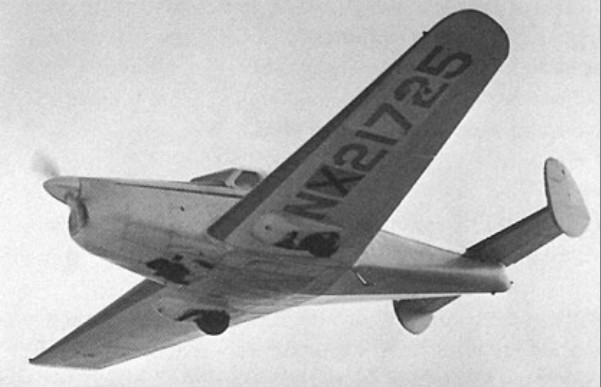
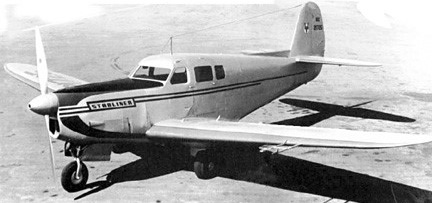
The Vega Starliner NX21725 was a five/six-seat low-wing cabin monoplane with retractable landing gear and an unusual powerplant. The model 22 was a modification with 640hp Menasco Unitwin 2-544 and a single tail. This comprised two 194kW Menasco C6S-4 inline engines, mounted side-by-side, and coupled to drive together, or independently in emergency, a single propeller.

First flown on 22 April 1939 (piloted by B A Martin), the Starliner was abandoned after some 85 flight test hours as there was no demand for an aircraft in this category.

Vega Starliner NX21725

The aircraft was sold to a film studio and its track faded.

Engines: two 194kW Menasco C6S-4 Unitwin
Wingspan: 12.50 m / 41 ft 0 in
Length: 31’6″
Max take-off weight: 2722 kg / 6001 lb
Useful load: 1660 lb
Max. speed: 338 km/h / 210 mph
Cruise speed: 180 mph
Stall: 60 mph
Range: 600 mi
Seats: 6