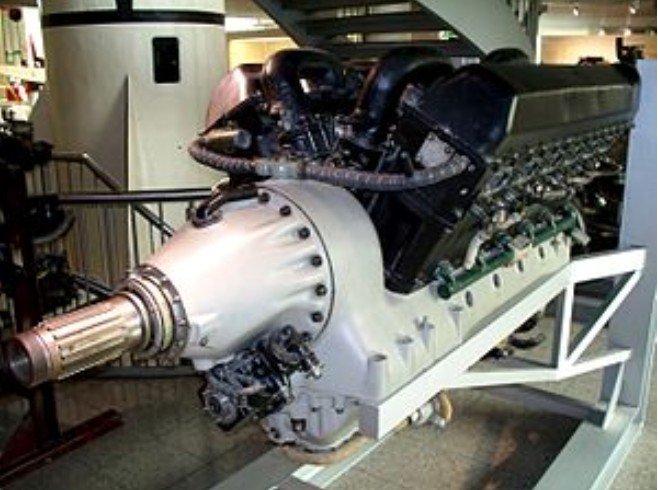
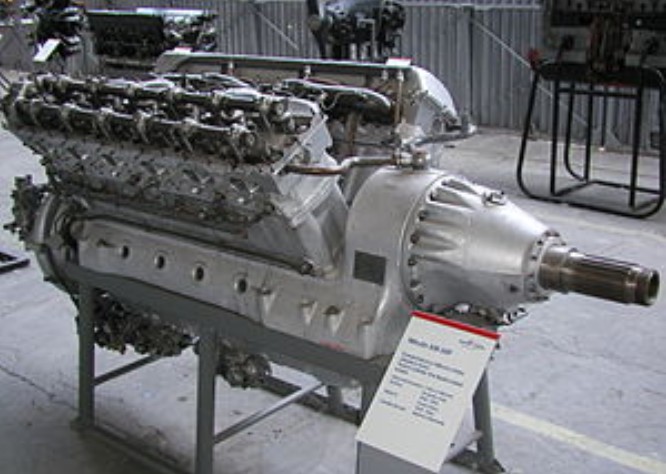
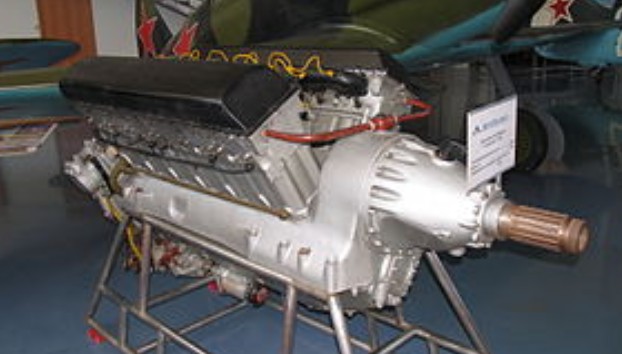
The Mikulin AM-38 was a Soviet liquid-cooled V-12 aircraft engine first run in 1941. It was a further development of the Mikulin AM-35 design. The AM-38 was used on the Il-2 Shturmovik and Il-10 ground attack aircraft. The engine may also have been installed in MiG-3 aircraft, as a field modification, to improve the speed and performance
Approximately 36,163 were built.
Variants: AM-38F Low-altitude version with greater takeoff power and a 10 minute forsazh (war emergency power) mode.
Applications: Ilyushin Il-2 Ilyushin Il-10
Specifications: AM-38F Type: 12-cylinder 60 deg Vee aircraft piston engine Bore: 160mm (6.30 in) Stroke: 190mm/196.7mm (7.48 in/7.744 in) Displacement: 46.66 L (2,847 cu.in) Dry weight: 880 kg (1,940 lb) Supercharger: Single speed centrifugal Cooling system: Liquid-cooled Power output: 1,270 kW (1,700 hp) at 2,350 rpm Specific power: 27.2 kW/L (0.60 hp/in³) Compression ratio: 6.0:1 Power-to-weight ratio: 1.53 kW/kg (0.93 hp/lb)
Design work on a development of the liquid-cooled, V12 AM-35 with boosted supercharging and an intercooler positioned behind the supercharger began on the factory’s initiative in December 1939. A batch of ten prototypes was completed in 1940 and bench-testing began on 5 January 1941. It passed its State acceptance trials the following April and was approved for production. It was tested in a variety of aircraft, but proved to be unreliable and prone to overheating. Factory No. 24 in Moscow built only twenty-nine AM-37s, as the new engine was designated, in 1941 before the German advance forced the factory to evacuate in October. Mikulin had been unable to resolve the issues with the AM-37 in the meantime and production was not resumed.
Variants:
AM-37A Planned version to be tested in February 1940, but no information if it was tested or it was even completed. 1,600 hp (1,200 kW) and a weight of 850 kg (1,870 lb).
AM-37TK TK for toorbokompressor. Planned version with a turbocharger.
AM-37P P for Pushechnyy or cannon. A 1940 project for a model with an autocannon mounted in the space between the cylinders, firing through a hollow reduction-gear shaft.
Am-37u/v or AM-37UV UV for udlinyonniy val or lengthened shaft. An engine with a lengthened shaft and remote gearing for use in the Gudkov G-1 fighter that carried the engine behind the pilot. Ordered developed in 1940 and design work started in 1941, but it was not completed.
The Mikulin AM-35 was a liquid-cooled V-12 piston aircraft engine. Derived from the AM-34FRN, the AM-35 first ran in October 1939, entered production in 1940 and was used on the MiG-1 and MiG-3 World War II fighters as well as the Petlyakov Pe-8 heavy bomber. The engine was very similar to the AM-38F of the Ilyushin Il-2, and built in the same plant (Kuybyshev, in late 1941). It was for this fact that Mikulin was forced to focus production on the AM-38F, thus discontinuing construction of the AM-35.
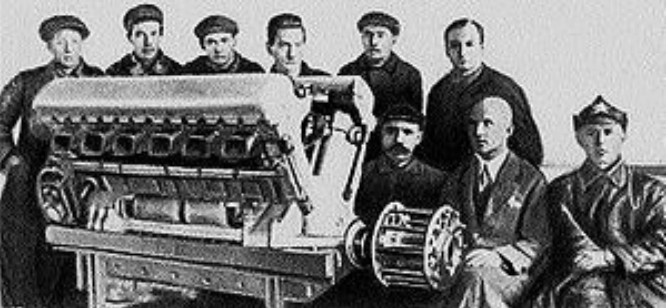
The M-34 began development in 1928 as a replacement for the Mikulin M-17, a license-built copy of the BMW VI. It had similar dimensions and attachment points, but was otherwise an entirely new design. It was a direct-drive, block-type engine with the cylinder block connected by long internal studs with centrally-coupled connecting rods. The development process was prolonged with the engineering drawings not completed until April 1931. The Soviet Union’s first indigenous, mass-produced, liquid-cooled, aircraft engine, the first engine was delivered to TsIAM (Tsentralniy Institut Aviatsionnogo Motorostroeniya, Russian: Центральный Институт Авиационного Моторостроения) on 21 September 1931 for bench testing with imported carburetors and magnetos. It began State testing in November 1931, but failed. It was submitted again a year later with Soviet-designed K-34 carburetors, but was again rejected. It was resubmitted in January 1933, but again failed. It was flight-tested in a Tupolev TB-3 in October 1933.
Despite these failures it began production in 1932 at Factory No. 24 in Moscow and 64 engines had been delivered by the end of the year. 790 were built the following year and it was exhibited in Paris as an achievement of the Soviet aviation industry. The M-34 was redesignated with Alexsander Mikulin’s initials as the AM-34 on 9 August 1936 in honor of his achievement.
The M-34 was used in an unusual system, first tried by Imperial Germany in 1918 with a Zeppelin-Staaken R.VI, that used an external supercharger to supply pressurized air to the aircraft’s M-34FRN engines. The first installation, designated ATsN-1 (Agregat tsentral’novo nadduva – central boosting unit), used an auxiliary M-34 fitted inside the fuselage to drive a central supercharger with ducts leading to the engines in the wings. This was flight-tested in a Tupolev TB-3 in 1935. It was adapted for use in a Petlyakov Pe-8 bomber prototype with a smaller Klimov M-100 engine substituted for the M-34 as the ATsN-2. It was flight-tested during 1938–39, but was not approved for production. The same idea was revived in 1943 by Nazi Germany with the Henschel Hs 130E bomber prototype series, with the Höhen-Zentrale Anlage unit.
The AM-34FRN and subsequent models used articulated connecting rods which increased the stroke to 196.7 mm (7.74 in) and increased the displacement to 46.66 L (2,847 cu.in). Combined with a number of other changes power significantly increased in most models to 1,200 horsepower (890 kW).
Development of a version for motor torpedo boats began in 1932 as the GM-34, but it did not pass its State tests until December 1934, although it was put into production that same year. It was given a reversing gear, a free-wheel sleeve and its cooling and exhaust systems were modified. Production continued through 1943 with the GM-34s adapting features from the aviation models. With the exception of the GAM-34BP and the original GM-34 all maritime engines used a benzene-alcohol fuel mixture.
A version of the GM-34 was adapted for use in heavy tanks in 1939 as the GAM-34BT, although only small numbers were built. It was mounted in the prototypes of the T-100 and SMK heavy tanks and the SU-100y self-propelled gun, none of which were put into production. The cooling system was modified with an external fan and it was given new gearing. An electric starter was used rather than the original pneumatic one. It was rated at 850 hp (630 kW).
Produced between 1934–43, 10,538 were built.
Aviation Variants: M-34 First production version. Direct drive. Early engines used imported Zenith 90R carburetors, although later ones used indigenous K-34 carburetors. In production until the end of 1939. Rated at 800 hp (600 kW) with a weight of 680 kg (1,500 lb).
Coupled M-34 Two engines driving one propeller, project for the Kalinin K-7, no production.
M-34F small batch built in 1933 with a rating at 830 hp (620 kW).
M-34R R for Reduktor or reduction gear. Rated at 800 hp (600 kW) with a weight of 670 kg (1,480 lb). Passed its State trials in May 1933 and in production from the end of that year to the end of 1939.
M-34RD D for Dal’niy or long-range. Ten engines built with special attention to quality, smaller tolerances and K-34RD carburetors to equip the Tupolev ANT-25 record-breaking aircraft. RPMs were boosted to give a power of 830 hp. Later fifty more were built to power Tupolev TB-3 bombers converted to VIP transports.
M-34N N for Nagnetatel’ or supercharged. Development began in 1931 of this direct-drive model, but the first two-stage supercharger design proved to be quite unreliable. A single-speed replacement was developed at TsIAM and tested in November 1933 and production began in September 1934. The centrifugal type supercharger was designed as a removable module and could be installed on other versions of the M-34. Rated at 820 hp (610 kW). A PTK steam-powered supercharger was developed and tested from 1938 to 1940, but was not accepted for production.
M-34RN This geared model used the same geared centrifugal supercharger (GCS) as the M-34N and had the same rating. It failed State testing in September 1934 when the pistons burned through.
M-34NA A version of the M-34N with minor changes to some components to extend service life. It had the same power as the original model.
M-34RA A version of the M-34R with the same changes and power as the M-34NA.
M-34RNA A version of the M-34RN with all the changes introduced on the NA and RA models. Same power as before, but weighed 748 kg (1,649 lb). Flight-tested on a TB-3 in May 1935 and production began at the end of the year.
M-34NB The NA fitted with a strengthened crankcase, a lightened crankshaft with a modified nose and a refined supercharger. The power remained the same, but the weight dropped to 638 kg (1,407 lb). A TK-1 turbocharger was tested with the prototype on a Polikarpov R-Z in 1936.
M-34RNB A geared equivalent of the NB model with a lightened reduction gear. The power remained the same, but the weight dropped to 725 kg (1,598 lb). In production from October 1935 until the end of 1939.
M-34P P for Pushechniy or cannon. A version of the M-34RN adapted to mount an autocannon in the V between the cylinder banks that fired through a hollow gear shaft. The specification was issued in August 1934.
M-34NV NV for Neposredstvenniy Vprysk or fuel-injected. It passed its bench tests in 1935 and was flight-tested in 1937, but was not accepted for production. Rated at 985 hp (735 kW).
M-34RNV Geared version similar to the NV.
AM-34RNV-TK Prototype built in 1938, similar to the RNV with the addition of a TK-1 turbocharger. Rated at 850 hp (630 kW) and an estimated weight of 810 kg (1,790 lb).
AM-34RS Prototype built in 1938 with mixed cooling; air-cooled sleeves and ethylene glycol-cooled cylinder heads. Rated at 1,200 hp (890 kW).
AM-34NF Prototype with a geared centrifugal supercharger and a TK-1 supercharger. Flight-tested in a TB-3. Compression ratio of 6.6:1 and rated at 985 hp (735 kW).
M-34N2B A prototype with a supercharger, two turbochargers and four K-4 carburetors. Rated at 1,030 hp (770 kW).
AM-34FRN F for Forsirovanniy or boosted. Development began in 1934, but development was not completed until 1938. The crankshaft, crank case, gearing and the side joints of the connecting rods were reinforced. The lubrication system was modified, the supercharger improved and a new gas-distribution system was fitted. The carburetors were moved to behind the supercharger. Rated at 1,200 hp (890 kW) and the weight dropped to 690 kg (1,520 lb). It was exhibited in the 1937 Paris Air Show.
AM-34FRNA First main production version of the FRN model. Equipped with four carburetors.
AM-34FRNB Next production model of the FRN. Equipped with six carburetors. A small batch was adapted for the ATsN-2 system with pressurized air provided by an external supercharger and flight-tested in a Pe-8 in 1938–39.
AM-34FRNV The last main production variant of the AM-34. Built during 1938–39. The crankcase was modified and bronze bushings were used for the main supports. It had a longer crankshaft nose, four K-4 carburetors, and a modified lubrication system. The valve castings were made of magnesium alloy. The power remained the same, but the weight increased to 763.5 kg (1,683 lb). Variants with fuel injection and two TK-1 turbochargers were tested, but not put into production.
AM-34RB Superchargers were removed from AM-34RNB engines during 1938–39 to create this model.
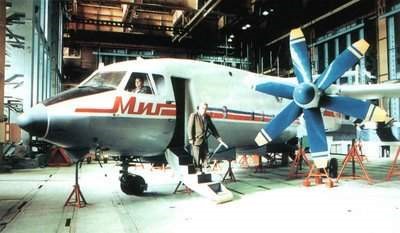
The Mikoyan MiG-110 designed by the Russian company Mikoyan-Gurevich is a multipurpose transport aircraft for cargo and passenger transport developed in 1995. It is powered by two turboprop engines.
The aircraft is capable of carrying up to 15 passengers and a cargo of 3500 kg (passenger version – 35 people). In the 1990s Russian Prime Minister Yevgeniy Primakov signed the agreement in Austria on cooperation between the MiG and Austria in the production. It can carry up to 3.5 tons of cargo or 24-48 passengers up to a distance of 1,600 km.
The aircraft would possess STOL and tailgate features. The aircraft components were produced in Russia and final assembly was done in Austria. Austria also invested in the testing and certification of the aircraft.
Engines: 2 x 2,500 HP TV7-117SV or Pratt & Whitney Canada PW127C turboprops, 1,846 kW (2,475 hp) each Wingspan: 25.0 m Length: 18.9m Height: 5.4m Maximum takeoff weight: 18,000 kg Load: 5,500 kg Top speed: 500km/h Range: 3,710 km Crew: 2 Capacity: Passengers: 49
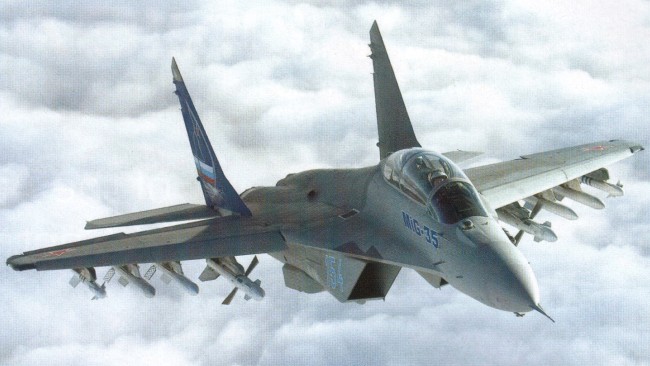
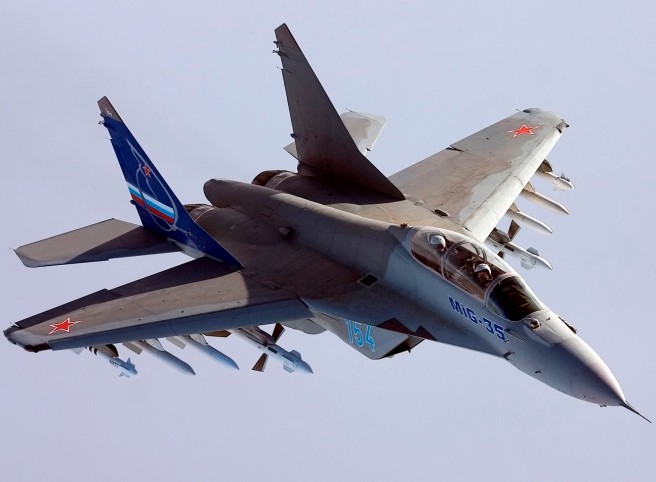
The Mikoyan MiG-35 (Russian: Микоян МиГ-35; NATO reporting name: Fulcrum-F) is a Russian multirole fighter that is designed by Mikoyan, a division of the United Aircraft Corporation (UAC). Marketed as a 4++ generation jet fighter, it is a further development of the MiG-29M/M2 and MiG-29K/KUB fighters.
The MiG-35 is powered by two FADEC RD-33MK Morskaya Osa (Russian: Морская Оса, literally: “Sea Wasp” or Chironex fleckeri) turbofans. The RD-33MK a highly improved variant of the Klimov RD-33 turbofan and was intended to power the MiG-29K and MiG-29KUB. It has 7% more power compared to the baseline model due to the use of modern materials in the cooled blades, providing a higher thrust of 9,000 kgf. In response to earlier criticism, the new engines are smokeless and include systems that reduce infrared and optical visibility. The engines may be fitted with thrust vectoring nozzles, which would result in an increase in combat efficiency by 12% to 15%, according to manufacturer claims.
The RD-33OVT engine variant comes with thrust vectoring nozzles, and can direct thrust in two axis.
The MiG-35 has a glass cockpit equipped with night-vision goggles, an additional display for the optical locator system, and a 3-equal-size color LCD multi-function display. The second-seat version of the MiG-35, the MiG-35D, has 4 LCD displays in its rear cockpit. The MiG-35D uses a tandem cockpit while single-seat versions of the MiG-35 uses the rear cockpit to store extra fuel, while retaining a two-seat canopy.
The MiG-35 is to be equipped with the new Phazotron Zhuk-A/AE active electronically scanned array (AESA) radar, the first radar of this kind installed on a Russian fighter aircraft. The Phazotron Zhuk-A/AE AESA radar offers a wider range of operating frequencies, providing better resistance to electronic countermeasures (ECMs), extended detection range and more air and ground targets detected. The FGA-35 radar type, featured 688 mm antenna and 1016 T/R modules (originally planned 1064) with initial stage performance of a 200 km detection range for 3m2 RCS target. Later detection range was raised up to 250 km. It can track up to 30 targets at any time, engaging up to 6 air targets at once, or 4 ground targets at once.
For detection of targets in the infrared spectrum, the MiG-35 is equipped with the OLS-UEM (13SM-1) electro-optical targeting station with lookdown capability against ground, sea and air targets. Its forward-looking infrared (FLIR) sensor is capable to detect airborne threats up to 55 km and provides coverage in azimuth of +/- 90-degree and +60-degree to −15-degree in elevation. There is also the OLS-K/OLS-KE podded electro-optical targeting system mounted under the right engine nacelle. It is designed to search, detect and track ground and sea targets. The system consists of infrared sensor and TV camera and is capable to detect ground targets up to 20 km and sea targets up to 40 km.
To protect the aircraft against current and future surface-to-air (SAM) missiles, the MSP-418KE compact active jammer pod can be mounted on any of the aircraft nine hardpoints.
The first prototype was a modification of the aircraft that previously served as a MiG-29M2 model demonstrator.
The single-seat version is designated MiG-35S and the two-seat version MiG-35UB. The fighter has vastly improved avionics and weapon systems, notably new precision-guided targeting capability and the uniquely designed optical locator system, which relieves the aircraft from relying on ground-controlled interception systems and enables it to conduct independent multirole missions. There is also an option for AESA radar.
First flying on 7 February 2007, Russia unveiled the MiG-35 at the 2007 Aero India air show in Bangalore, amid Moscow’s keenness to sell these planes to India. The MiG-35 was ousted from the contest in April 2011.
In May 2013, it was reported that Russia intended to order 37 aircraft. However, in August 2013, the Russian Defense Ministry reported that the purchase worth 37 billion rubles ($1.1 billion) will be delayed until 2016 due to the spending cuts in the state arms program for 2014–2016. The state tests of the MiG-35 was to begin in 2017 with completion in mid-2018 after the serial production of the aircraft would started.
During 2016, first two pre-production aircraft were in active phase of construction at the Production Center No.1 in Lukhovitsy. Both aircraft were delivered at the end of the year.
In July 2017, during the MAKS 2017 International Aviation and Space Salon, the Russian Defence Ministry agreed it will buy 24 MiG-35s as a part of the new state armament program for 2018–2027, although 37 aircraft were previously planned. Six out of the 24 MiG-35s will replace the aging MiG-29s of the Russian aerobatic team Swifts.
On 22 August 2018, during the International Military-Technical Forum «ARMY-2018», the first contract for six MiG-35s was signed.
By April 2010, pictures and additional information surfaced of two new MiG-35 demonstrators, the single-seat MiG-35 “961” and the two-seat MiG-35D “967”. According to Russian media, they first flew in autumn of 2009, and subsequently took part in MMRCA trials in India in October 2009. Both have a very high commonality with the previous MiG-29K/KUB airframes, an immediate visible difference being the braking parachute installed in place of the hook, present on the naval aircraft. Subsequently, the MiG-35D “967” appears to have been equipped with a similar AESA radar as fitted to the older MiG-35 demonstrator “154”, identifiable by the dark grey short nose radome.
On 6 September 2016, according to the general designer of the United Aircraft Corporation Sergei Korotkov, first MiG-35s were to be delivered in November 2016 to the Russian Air Force for flight testing to confirm the technical characteristics of the aircraft. First of the two aircraft, single-seat MiG-35 “702” made its first flight on 24 November 2016, followed by double-seater MiG-35UB “712” in December 2016.
On 28 January 2017, MiG officially demonstrated one of the two pre-production aircraft, MiG-35UB “712”, to the Russian government, followed by subsequent demonstration for export customers on the next day. The newly presented MiG-35 showed to be a bit different with the one unveiled in 2007, the aircraft allegedly lacked the AESA radar as well as thrust vectoring control, supposedly to keep procurement cost low to attract foreign customer.
In February 2017, it was announced a contract was signed to build another two aircraft that would join the testing.
In February 2018, MiG Aircraft Corporation announced that it had completed factory trials of the MiG-35, the certificate of the trials completion having been signed in December 2017. In May 2018, head of the United Aircraft Corporation Yuri Slyusar reported, state trials of the MiG-35 had begun. In April 2019, another MiG-35UB “11”, first took off to join the testing. This is first of the two additional pre-production aircraft for which contract was signed in February 2017.
On 17 June 2019, Russian Aerospace Forces has received first two serial MiG-35S fighters, marking the introduction of the variant into service.
The MiG-35/MiG-35D incorporate advancements of the MiG-29K/KUB and MiG-29M/M2 fighters in combat efficiency enhancement, universality and operational characteristics improvement. The main features of the new design are the fifth-generation information-sighting systems, compatibility with Russian and foreign weapons applications and an integrated variety of defensive systems to increase combat survivability. The new overall design overtakes the design concepts of the baseline model and enables the new aircraft to conduct full-scale multirole missions as their western counterparts.
New avionics includes the Phazotron Zhuk-AE active electronically scanned array (AESA) radar, the RD-33MK engines and the newly designed optical locator system, OLS-35. The number of weapon stations has increased to 10, flight range has increased by 50%, and radar visibility has been reduced.
The final configuration of the MiG-35’s onboard equipment has been left open intentionally using the MIL-STD-1553 bus. Weight load 7 tons (twice the weight load of the MiG-29).
United Aircraft Corporation subsidiary Russian Aircraft Corporation (RAC) MiG developed an export-oriented variant of its Mikoyan-Gurevich MiG-35 multirole combat aircraft (MCA), which was unveiled at the MAKS 2019 aerospace show held in Zhukovskiy close to Moscow from 27 August to 1 September.
The MiG-35 export version is a 4++ generation MCA “made using some fifth-generation aircraft technologies”. The platform has been fitted with a nose-mounted radar with an active electronically scanned array (AESA), as well as an electro-optical search-and-track system installed under the fuselage for employment against land targets.
The upgraded MiG-35 has a maximum take-off weight of 24,500 kg and is powered by two 9,000 hp RD-33MK afterburning jet engines, producing a top speed of 2,100 km/h and a service ceiling of 16,000 m. “The platform also features a modular design, allowing integration of new electronic subsystems, including of foreign origin,”. Installation of a PAZ-MK refueling pod allows the platform to be employed as a tactical aerial tanker.
The MiG-35 export version has received a Russian-designed helmet-mounted target designation system and head-up display. Its armament suite comprises RVV-AE air-to-air, Kh-35UE anti-ship, and Kh-38MLE air-to-surface missiles, KAB-500 guided bombs, and various free-fall bombs.
According to the General Director of Mikoyan, Ilya Tarasenko, a carrier-based version of the MiG-35 was under development. The Radioelectronic Technologies Concern (KRET) has already adapted a new landing system to the BINS-SP-2 deck for the MiG-35.
MiG-35 Single-seat variant Engines: 2 × Klimov RD-33MK afterburning turbofan engines, 53 kN (12,000 lbf) thrust each dry, 88.3 kN (19,900 lbf) with afterburner Wingspan: 12 m (39 ft 4 in) Length: 17.3 m (56 ft 9 in) Height: 4.73 m (15 ft 6 in) Wing area: 38 m2 (410 sq ft) Empty weight: 11,000 kg (24,251 lb) Gross weight: 17,500 kg (38,581 lb) Max takeoff weight: 29,700 kg (65,477 lb) Maximum speed at altitude: 2,400 km/h (1,500 mph, 1,300 kn) Maximum speed at sea level: 1,450 km/h (900 mph; 780 kn) / M1.7 Maximum speed: Mach 2.2 Range: 2,400 km (1,500 mi, 1,300 nmi) Combat range: 1,000 km (620 mi, 540 nmi) Ferry range 3 external fuel tanks: 3,100 km (1,900 mi, 1,700 nmi) Ferry range with aerial refuelling: 6,000 km (3,700 mi; 3,200 nmi) Service ceiling: 19,000 m (62,000 ft) g limits: +10 Armament: 1 × 30 mm Gryazev-Shipunov GSh-30-1 autocannon with 150 rounds Hardpoints: 9 with up to 6,500 kg Crew: 1
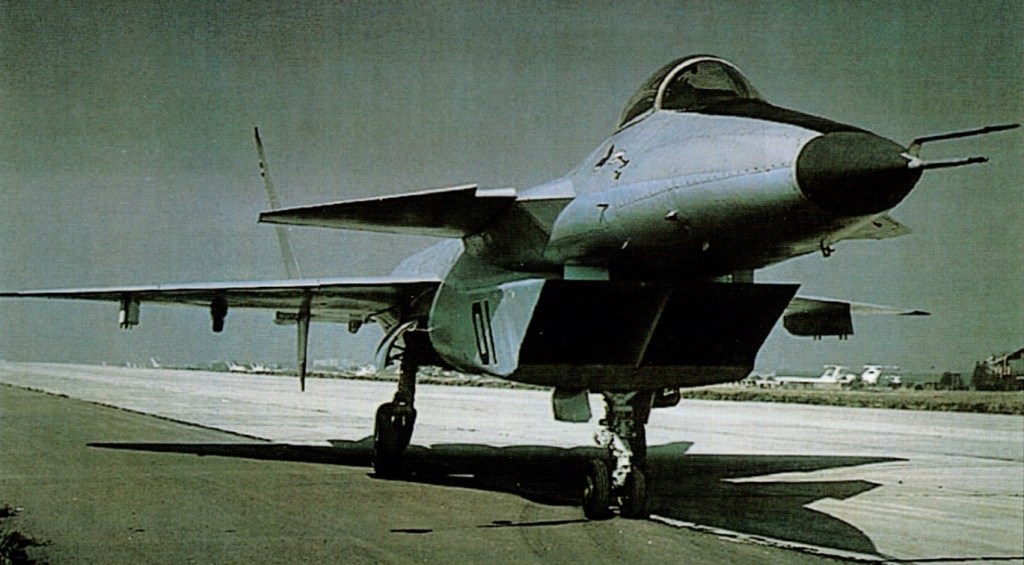
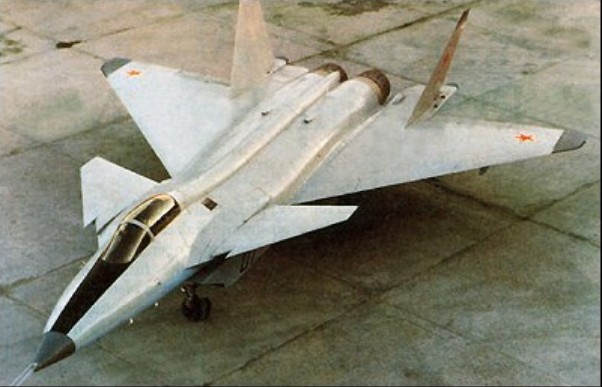
Designed as a replacement for the Su-27, the MiG 1.42 MFI (Mnogo-Funktsionalniy Istrebitel – Multi-Role Fighter) was publicly rolled out in January 1997.
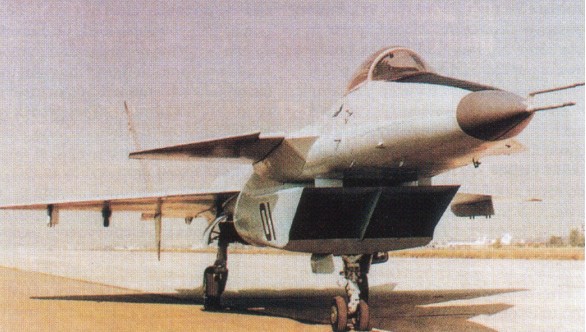
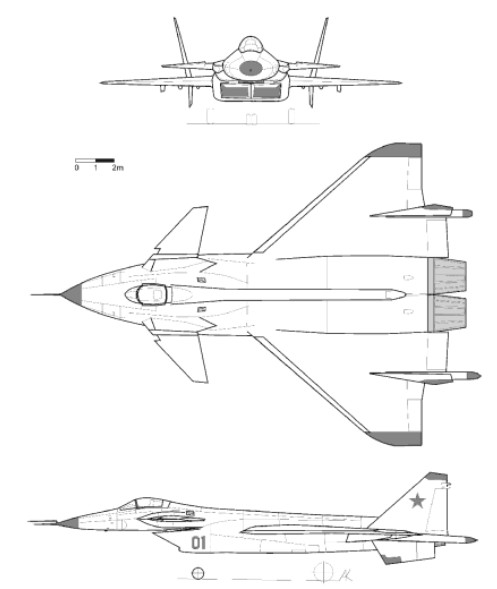
The MiG 1.42 Mnogofunktsionalny Frontovoi Istrebitel (Multifunctional Frontline Fighter), or MFI, was designed as a response to the American F-22. Its makers, MAPO-MiG, say it will be able to outperform the most advanced US fighter, the F-22 Raptor. Like the F-22, the MiG 1.42 has a “thrust vectoring” system that gives it greater manueverability than current fighters. It also has similar stealth capabilities, employing composite materials, a special shape, S-shaped compressor channels, internal weapon storage, and perhaps an active radar cancellation system or a plasma cloud stealth system to avoid detection. Considering previous Russian fighters, such as the super-manoeuvrable Su-37, the MiG 1.42 will definitely enjoy greater manoeuvrability. Additionally, MAPO-MiG also claims that it would be stealthier than the F-22. And, since it is bigger, the MiG 1.42 will have a greater range. The MiG 1.42 is a twin-engine aircraft with a cranked delta wing, canards, twin tail fins, jet intakes under the nose, and 3D vectoring nozzles. It features the new Phazotron N-014 phased array fire control radar as well as a rear-facing N-012 radar.
The delta canard has a wing sweep of between 40 and 45 degrees, with a vortex generating dogtooth on the canard. The large wing of slender section, three sets of trailing edge control surfaces, and pronounced actuator fairings. External pylons are visible.
The stated intent of the delta canard configuration was to provide for excellent high AoA performance, and low supersonic energy bleed, by avoiding the trim drag associated with a conventional configuration.
The paired, outwardly canted vertical stabilisers are attached to a pair of large tailbooms, which house aft looking avionics and enclose the innermost trailing edge surfaces. Two ventral keels protrude beneath the vertical stabilisers, mounted on the tailbooms.
The aft fuselage is dominated by the paired and closely spaced Lyulka/Saturn AL-41F afterburning turbofans. These were to be fitted with circular thrust vectoring nozzles, which would be limited to 2D vertical vectoring should the tailboom arrangement be retained for production aircraft. The large single mainwhhels retract forward into the fuselage, close to the wing roots. The fuselage geometry provides for a modest inlet tunnel S-bend, which will reduce the inlet tunnel and compressor face RCS.
The inlets are variable, ventrally mounted, and feature a stepped multiple shock design. Two supporting struts, angled outward to reduce RCS, are employed to stiffen the inlet and nose structure. The clearance between the upper inlet lip and lower nose is intended to provide for good boundary layer separation at high AoA.
The structure is reported to comprise 30% composite materials, 35% aluminium lithium alloys, and 30% steel alloys.
MiG 1.42 Crew: 1 Engine: 2 x Lyulka AL-41F turbofans, ~200kN Max take-off weight: 25000-30000 kg / 55116 – 66139 lb
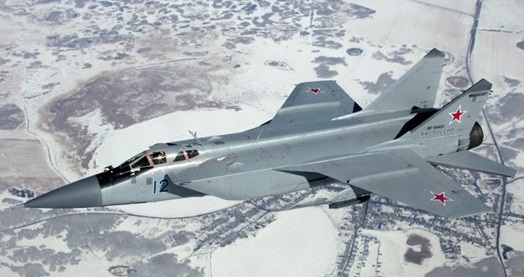
The MiG-25 was designed to counter high-flying threats. The MiG-31 was the result of the demand to counter low-level threats, such as the B-1B and cruise missiles. Development began in 1967 and the S-155MP avionics complex was ordered for the Ye-155MP interceptor in 1968. The Ye-155MP ‘831’ was a converted Type 83 MiG-25MP, serving as the prototype of the design, and first flew on 16 September 1975. The second prototype (‘832’), with radar, first flew 22 April 1976.
Designed as a long-range, extended-endurance PVO interceptor to replace the Tu-128 and MiG-25 based on the MiG-25 many changes were necessary to improve range and flight performance at low altitude. The fuselage was strengthened to make it suitable for supersonic flight at low level. The ‘Foxhound’ is powered by two D-30F6 turbofans which improved range drastically over the MiG-25 engines. The D-30F6 needed larger air intakes and larger exhaust nozzles. The key to success of the MiG-31 as an interceptor is the Zaslon SBI-16 phased array radar. This fire control radar is capable of tracking 10 targets at ranges up to 120 kilometers (75 miles) and engage four targets at once. Tracking and engagement is the task of the WSO which is seated behind the pilot. It is armed with four long-range R-33 (AA-9 Amos) air-to-air missiles carried under the fuselage. Two preproduction aircraft (011 and 012) built by Sokol and flown 13 July and 30 June 1977, followed by six development aircraft (201 to 203 and 301 to 303).
Full production (of about 450) started 1979 and in 1982 the NATO reporting name ‘Foxhound’ was made public. The first of 11 regiments were operational by 1983, replacing MiG-23 and Su-15 in the air defence role.
By 1987 over 150 MiG-31s were deployed across the Soviet Union, especially in the west and far east.
The MiG-31B incorporated an improved Zaslon-A fire control radar, superior long-range missiles (R-33S), additional missiles (the R-40TD medium-range missiles and R-60 short-range missiles), modernised navigation computer and new data exchange modes. The MiG-31B was also equipped with in-flight refuelling system, whereas the MiG-31BS designation was used for MiG-31B upgrades lacking this ability.
The MiG-31D was a specialised variant for the Russian equivalent of the ASAT program, carrying a single anti-satellite missile. It can be recognized by the big vertical fins at the wing tips.
In 1992 the MiG-31E (export) was first presented on the Berlin Air Show ILA. Only one aircraft was built. The MiG-31FE was a proposed multipurpose variant of the MiG-31 with improved weapons systems and avionics. It is able to operate the majority of the Russian air-to-surface missiles. Laser and TV equipment for missile guidance would have been accommodated in an external pod. Intended for export, it did not receive any orders.
The MiG-31M is a highly improved version of the original MiG-31. It has new IRST and phased-array radar to engage six targets at the same time. It is capable of carrying the R-37, which is an improved version of the R-33 AAM. And it is also capable of carrying the R-77 (AA-12 Adder), instead of the R-40TD, which was used on the MiG-31B. The cockpit was redesigned and features three colour multi function displays. Other changes include larger fuel capacity, no gun, uprated engines, aerodynamic improvements, larger brake chute housing, redesigned nosewheel. Six prototypes were built but none were ordered.
The MiG-31BM is an upgraded MiG-31B which adds an air-to-surface capability. New onboard computer systems and a new fire control radar capable of tracking up to 24 targets simultaneously.
In 2003 a MiG-31 claimed a 100 km closed circuit speed world record of 840 kts, a time to climb to 66,550 ft world record of 8 min 23 sec and an absolute altitude world record of 72,175 ft.
Kazakhstan inherited around 30 MiG-31 Foxhounds after the break up of the Soviet Union. Some of these aircraft remained in operational service.
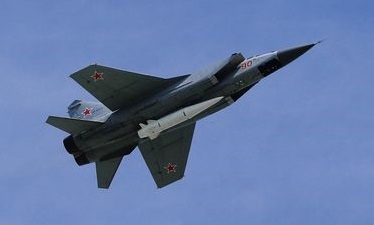
The Kinzhal hypersonic weapon, as carried by a MiG31K fighter.
Reportedly a contract with China was signed in 1992 for 24 MiG-31 interceptors. The plan included a newly set-up factory in Shenyang and were expected to enter service in 2000. At some point it was expected that at least 200 MiG-31s would be deployed by 2010. The contract was either cancelled or was never signed. Instead China opted for the Su-27/30 Flanker (J-11) as their long range interceptor.
MiG-31 Engines: 2 x D-30F6, 151.9kN Max take-off weight: 41000-46000 kg / 90390 – 101413 lb Empty weight: 29120 kg / 64199 lb Wingspan: 13.5 m / 44 ft 3 in Length: 22.7 m / 74 ft 6 in Height: 6.2 m / 20 ft 4 in Wing area: 61.6 sq.m / 663.06 sq ft Max. speed: 3000 km/h / 1864 mph Cruise speed: 2500 km/h / 1553 mph Ceiling: 20000 m / 65600 ft Range w/max.fuel: 3000 km / 1864 miles Range w/max.payload: 1200 km / 746 miles Armament: 1 x 23mm cannon, 8 missiles Crew: 2
Mikoyan Gurevich MiG 31 Fighter Interceptor and Reconnaissance, Russia, 1976 Engine : 2 Klimov R 31 F, 134691 N / 13730 kp Length : 68.898 ft / 21.0 m Height : 18.373 ft / 5.6 m Wingspan : 45.604 ft / 13.9 m Wing area : 602.784 sqft / 56.0 sq.m Max take off weight : 77175.0 lb / 35000.0 kg Weight empty : 46812.2 lb / 21230.0 kg Max. payload weight : 30362.9 lb / 13770.0 kg Max. speed : 1320 kts / 2445 km/h Service ceiling : 80052 ft / 24400 m Wing load : 128.13 lb/sq.ft / 625.0 kg/sq.m Range : 1026 nm / 1900 km Crew : 2 Hardpoints: 4 under fuselage, 4 under wing.
MiG-31B ‘Foxhound-A’ Powerplant: two 151.9 kN (34,170 lb st) Aviadvigatel D-30F6 afterburning turbofans Length 22.69m (74 ft 5¼ in) Height 6.15m (20 ft 2¼ in) Wing span 13.46m (44ft 2 in) Empty weight 21.825 kg (48,115 lb) Max Take-Off Weight 46.200 kg (101,850 lb) Max level speed at 17,500 m (57,400 ft) more than Mach 2.8 or 3.000 km/h (1,865 mph) Service ceiling 20,600m (67,600 ft) Armament: one 23mm GSh-6-23 six-barrel gun / 260 rounds; eight air-to-air missiles (4 R-33 and 4 R-60 AAMs, or 3 R-33 and 2 R-40TD AAMs)