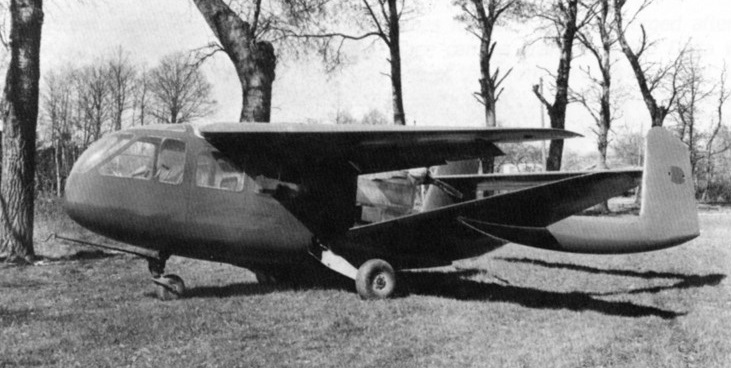
A twin-boom, heavily-staggered biplane four-seater, powered by 180 hp Regnier engine and first flown 1949.
A twin-boom, heavily-staggered biplane four-seater, powered by 180 hp Regnier engine and first flown 1949.
France
Formed by Mm. Millet and Lagarde to exploit Lagarde ‘s ML-10 twin-boom, heavily-staggered biplane four-seater, powered by 180 hp Regnier engine and first flown 1949.
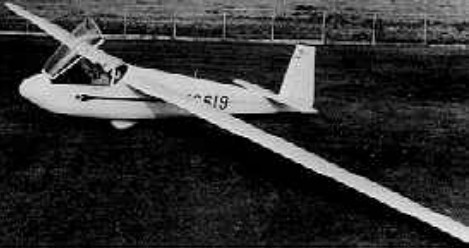
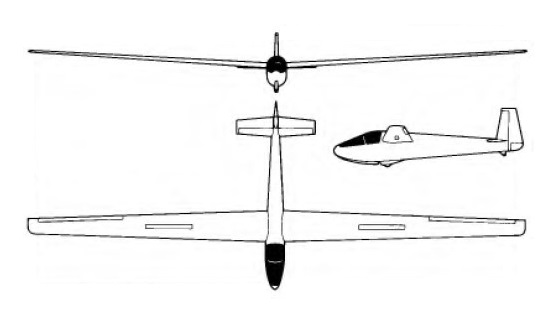
The Tern high perfomance single-seater was designed by Mr W. Terry Miller of Furlong, Pennsylvania, for amateur construction and the prototype, which was built in a total of 1,180 working hours, made its first flight in September 1965.
An improved version, known as the Tern II, made its first flight in August 1968; this featured a wing span increased by 4 ft 6 in to 55 ft 6 in, increasing the aspect ratio from 20 to 22, and giving an improved best glide ratio and minimum sinking speed. During 1968 brake parachutes were fitted to the prototype Tern, and two types of these were later made available for installation in both versions of the Tern in the base of the rudder, namely a 6 ft diameter cross parachute or a 5 ft diameter guide surface parachute.
By May 1970 nearly 100 Terns and 12 Tern IIs were under construction not only in the USA, but by amateurs in Africa, Australia, South America and Canada.
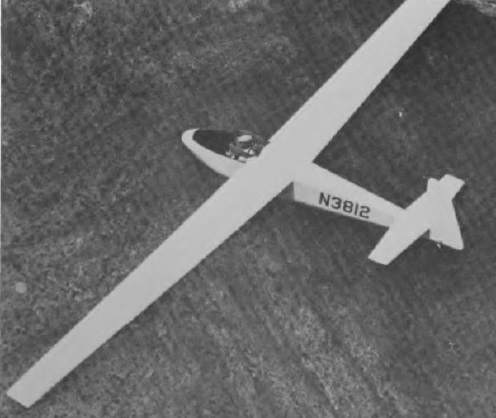
Of conventional all-wood construction, the Tern has unswept cantilever shoulder wings which are two piece two-spar spruce structures, entirely plywood covered. There are no flaps and the plain ailerons are also all wood; there are wooden spoilers in the wing lower surface used for approach and glide slope control. The semi-monocoque wooden fuselage has a plastic-reinforced glassfibre nose and plywood skinning aft of the cockpit. The cantilever all-wood tail unit has modified NACA laminar flow sections and special hinge-line contours to reduce drag and increase control effectiveness at large angles of deflection; there are no elevator or rudder tabs. Landing gear consists of a non-retractable monowheel forward of the eg housed in a streamlined pod, and skids under the nose and tail; there is a brake lever for applying pressure directly to the tyre. The pilot sits in a semi-reclining seat under a three piece canopy, the centre portion of which hinges sideways for entrance and exit, and radio can be fitted.
One Tern belongs to the National Soaring Museum.
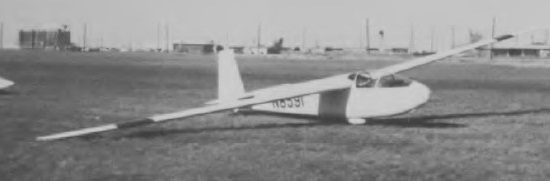
Tern
Wing span: 15.54 m / 51 ft
Wing area: 12.08 sq.m / 130 sq.ft
Empty Weight: 215 kg / 475 lb
Payload: 102 kg / 225 lb
Gross Weight: 317 kg / 700 lb
Wing Load: 26.24 kg/sq.m / 5.4 lb/sq.ft
L/DMax: 34 93 kph / 50 kt / 58 mph
MinSink: 0.64 m/s / 2.1 fps / 1.24 kt
Aspect ratio: 20
Airfoil: Wortmann 61 Series
Seats: 1
Tern II
Span: 15.56 m / 55 ft 6 in
Length: 6.49 m / 21 ft 3.5 in
Height: 1.52 m / 5 ft 0 in
Wing area 13.01 sq.m / 140 sq ft
Aspect ratio: 22.0
Wing section: Wortmann 61 Series
Empty weight: 249 kg / 550 lb
Max weight: 363 kg / 800 1b
Water ballast: None
Max speed: 120 mph / 104 kt / 193 km/h (smooth air)
Stalling speed: 34.5 kt / 64 km/h
Max aero-tow speed: 88 mph
Max rough air speed: 76.5 kt / 142 km/h
Min sinking speed: 1.95 ft/sec / 0.59 m/sec at 48 mph / 41.5 kt / 77 km/h
Best glide ratio: 38:1 at 60 mph / 52 kt / 97 km/h
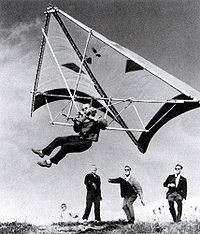
Barry Hill Palmer had a good paying aerospace job and was flying on a minimalist and inexpensive glider purely for curiosity and fun. He did not attempt to modernize or market the flexible wing hang glider; there was no attempt to publicize on the media, except for an ‘accidental’ report made by a small local newspaper. Palmer freely gave information about the wing to any person interested, including Francis Rogallo and Richard Miller, who develop the famous Bamboo Butterfly Rogallo wing hang glider, the plans of which circulated in some American magazines in the mid 1960s.
In 1964, after building some small Rogallo models, Miller used bamboo and polyethelene to construct the ‘Bamboo Butterfly’.
Over the next few years Miller and a growing number of friends slowly mastered the techniques of Rogallo flight.
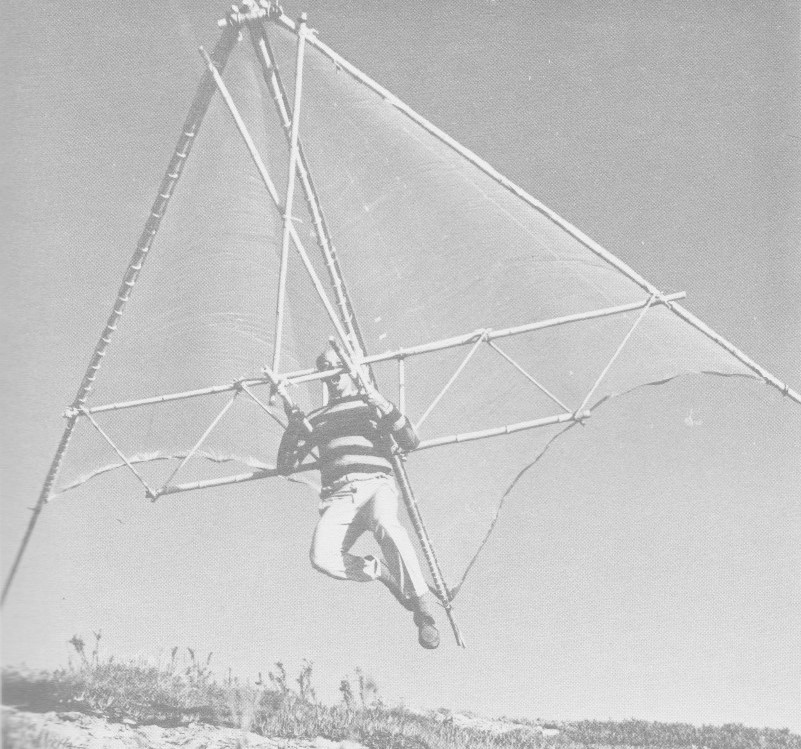
Before the Butterfly was retired they had launched more than a hundred successful flights over Los Angeles beaches.
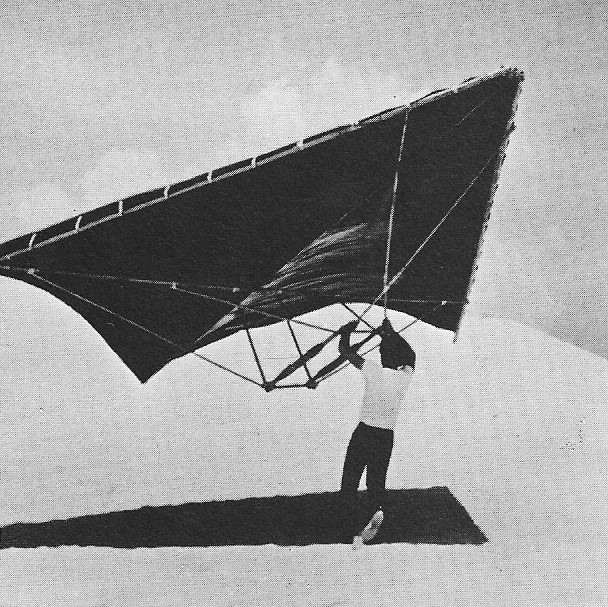
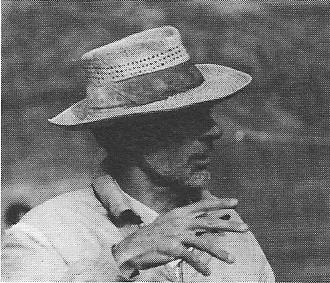
In 1964 Richard Miller was building his Bamboo Butterfly hang glider.
Later, Miller went on to be editor of ‘Soaring’ magazine.
The “Lil’ Rascal” by Merle B. Miller began flight testing in early 1978. This biplane makes use of a steel-tube fuselage and tail section covered with Stits Poly-Fibre Dacron. The wings are constructed of spruce and plywood and are covered with same fabric. The landing gear is the nonretractable tailwheel type, and seating is for two persons in a side-by-side open cockpit. The standard 85-hp engine turns a fixed-pitch prop.
Gross Wt. 1100 lb
Empty Wt. 600 lb
Fuel capacity 12 USG
Wingspan 20 ft 8 in
Length 15 ft 3 in
Engine 85-hp Continental
Top speed est: 110 mph
Cruise est: 90 mph
Stall est: 58 mph
Aeroneering Inc., Box 22064, Savannah, GA 31403, USA.
Built the 1978 Miller Lil’ Rascal
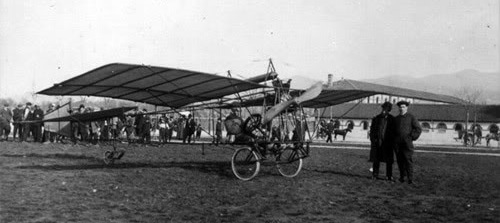
The third and final aeroplane designed and constructed by Franz Miller of Turin, Italy.
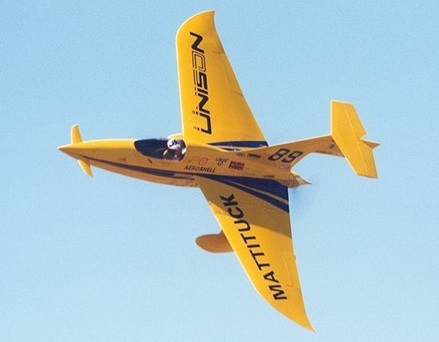
The Miller-Bohannon JM-2 Special, named Pushy Galore, is a one-of-a-kind American homebuilt Formula One racing and record-setting aircraft, based on Jim W Miller’s Miller JM-2 design, but highly modified by Bruce Bohannon.
Bohannon began construction of Pushy Galore in 1988 and first flew it in the early part of 1989, first entering it in a race in June 1989.
The aircraft features a cantilever mid-wing, a single-seat enclosed cockpit under a bubble canopy, fixed main tricycle landing gear with a retractable nose wheel, a t-tail, nose mounted canard and a single engine in pusher configuration.
The aircraft is made from welded steel tubing covered in molded carbon fiber. As required by the Formula One rules, its engine is a 100 hp (75 kW) Continental O-200A.
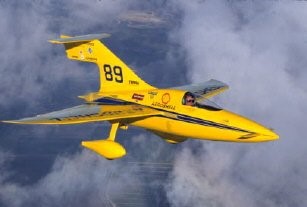
Only one example was ever built, N189BB.
Bohannan entered the aircraft in the Reno Air Races in 1994, qualifying in third place in the Formula One class, with a speed of 236.153 mph (380.051 km/h).
In 1995 Bohannan flew the aircraft to second place in the Formula One Gold championship race at Reno, Nevada.
Bohannan also used the aircraft to set world time-to-climb records in the Fédération Aéronautique Internationale (FAI) C-1.A class. At AirVenture 1994 Bohannan set a new world time-to-climb record, climbing to 6,000 m (19,685 ft) in 12 minutes and 50 seconds. In January 1996, Bohannan climbed the aircraft to 9,000 m (29,528 ft) in 41 minutes and 35 seconds, setting class world time-to-climb, absolute altitude and altitude in horizontal flight records. In July 1996 at AirVenture in Oshkosh, Bohannan set a third FAI class time-to-climb record of 3,000 m (9,843 ft) in three minutes and eight seconds.
After the climb records were set in 1996 Bohannan retired the aircraft and in 1998 donated it to the AirVenture Museum.
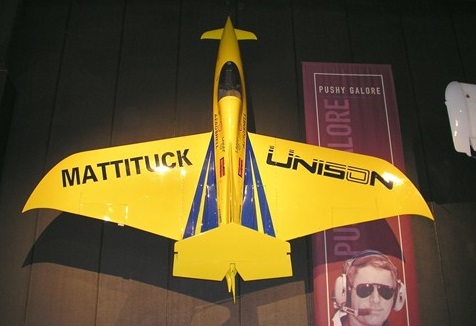
JM-2 Special Pushy Galore
Engine: 1 × Continental O-200A, 100 hp (75 kW)
Wingspan: 18 ft 5 in (5.61 m)
Length: 17 ft 2 in (5.23 m)
Height: 6 ft 3 in (1.91 m)
Maximum speed: 250 mph (402 km/h; 217 kn)
Crew: one
A two-seat light aircraft with 150 hp Menasco C-4S

