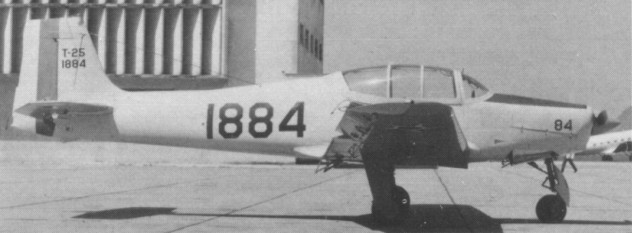
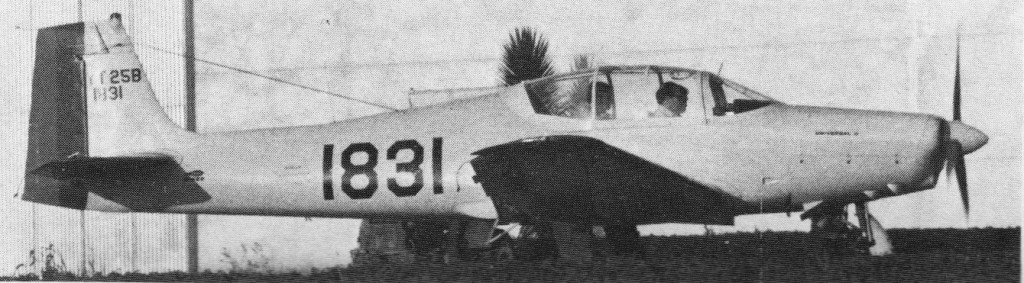
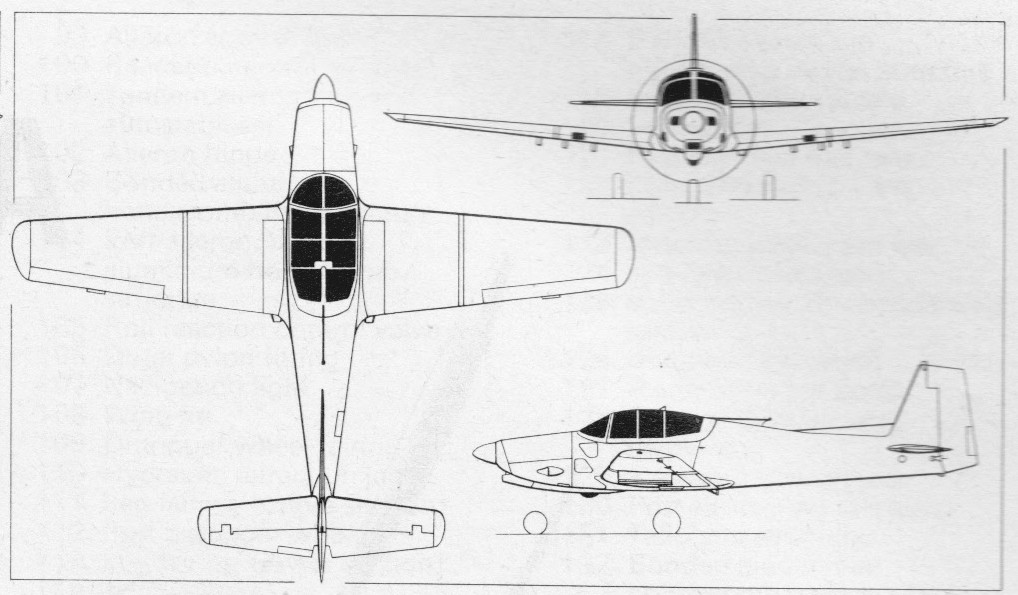
Designed to replace Fokker S-11 and Harvards with the Brazilian Air Force. The Universal is designated T-25 in Brazilian service and operates as a 2/3 seat basic trainer. About 140 were delivered plus 10 to the Chilian Air Force. An armed version with underwing pylons is designated AT-25.
Sociedade Construtora Aeronautica Neiva Ltda Industria Aeronautica Neiva Sa
Neiva has produced over 3,200 aircraft since 1956, many under license from Piper and including Ipanemas, Urupema gliders, Cariocas, Coriscos, Tupis, Minuanos, Sertanejos, Senecas/Cuestas, Navajos, and Carajas.
Neiva produced Model N621/T-25 Universal trainers for the Brazilian Air Force and a series of lightplanes.
In March 1980 it was renamed Industria Aeronautica Neiva S.A, as a subsidiary of EMBRAER. All work on the EMBRAER/Piper series of light aircraft and production of the EMB-202 Ipanema agricultural aircraft were transferred (over 780 built).
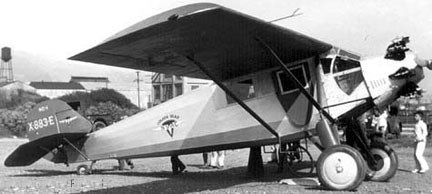
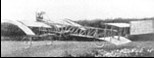
Designed by Richard Korman, the three-place cabin Neilsen Steel Aircraft Co NC-1 Golden Bear, or Coach, was a fabric-covered Ryan B-3 type. Subsequent models were planned to be metal-clad.
Priced at $7,500 in 1928, it was destroyed by an angry crowd at a “thrill show” at Oakland Speedway in Aug 1939 after its performance failed to meet their expectations.
A second one, with 300hp Wright J-6, was reportedly under construction at the time, but its history is unknown.
Engine: 130hp Comet Wingspan: 37’6″ Length: 29’0″ or 28’6″ Useful load: 800 lb Max speed: 130 mph Cruise speed: 110 mph Stall: 40 mph Range: 800 mi Seats: 3
In 1982 Martin Hollmann held one of his aircraft design classes in Santa Monica, CA. Six people attended including Lance Neibuaer. He asked Martin if there was a future in bringing to market a new, two place sport aircraft. Martin of course said “yes.” Two years later, Lance sent Martin a request to perform a stress analysis on his two place design and a check for $200. Richard Trickel offered to build the moulds for Lance’s aircraft at no cost. Richard had formed a composite fabrication company called High Tech Composites in Oxnard, CA. Lance moved to Santa Paula, CA based on Martin’s recommendations and rented a shop space that had been occupied by Jim Kern of Task Research. The new aircraft was powered by a Continental O-200 and Lance called his aircraft the Lancair 200. It had a cruise speed of 200 mph. Although the prototype was made of urethane and hot wire cut styrofoam and covered with wet layed up fiberglass, the production Lancair 200 kit parts were made of temperature cured, prepreg fiberglass and graphite parts. They were lighter and stronger than the epoxy, wet layed up, fiberglass parts used on most kits at that time.
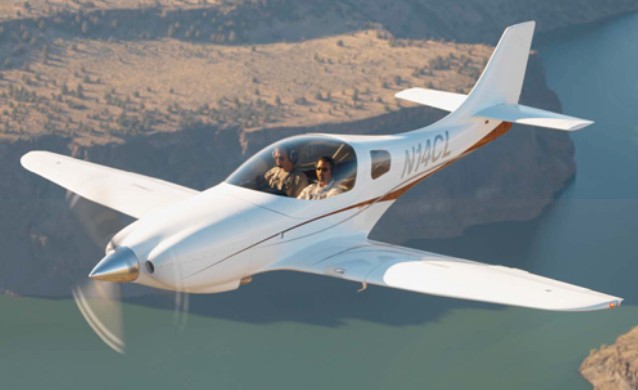
Lance Neibauer sold his family home to pursue his dream of producing the perfect kit. At the time, only the prototype had flown but its performance on an O 235 engine was good. The Lancair 200 is a sleek two-place retractable with maximum level flight speed of 213 mph and 625 pound useful load, and 193 mph cruise. Comprising 27 premoulded, oven cured components, it can be put together in around 600 hours.
Lancair 235 ZK-PDS
The structural integrity of the Lancair wing is said to be +9G and 4.5G ultimate at maximum all up weight (MAUW). This is achieved with an airframe in excess of 25 per cent lighter than similar aircraft built using different construction methods.
At Oshkosh 87 Lancair unveiled its new 320 model, powered by a 150 hp Lycoming O-320. This increased the cruise to 230 mph from the 235 models 210 mph. Kit prices in 1987 were $16,900 for the 235, and $18,500 for the 320.
When the NEICO “fast build kit” became available early 1990, popularity resulted in a one year waiting list. Two years in the development, the kit provides all major sub assemblies including the fuselage ex factory with a resultant saving of up to 700 hours by the builder.
In twelve years 400 kits had been sold using 108-180 hp.
Lancair 360
Two models were available in 1990; the 118hp version with a fixed pitch propeller returns a 180 knot cruise on 75 per cent power while the Lancair 320, sporting a 160 hp Lycoming and constant speed unit, has a 210 knot cruise. The kit price was $18,950 (1987), and $23,200-28,900 in 1998. A kit was also available in carbon for $34,400 in 1998. The 320 is approved for aerobatics. The 320 replaced the 235.
The Lancair 360 has optional wingtip extensions that take the wing from its usual 7.2 m out to 8.3 m. The empty aircraft weighs in at 543 kg and is powered by a Lycoming IO-360-B1F engine behind an MTV-12-B/175-59d three-bladed propeller.
The Australasian market is provided for by licence built 235 and 320 kits manu¬factured by Avtex at Ballina on the NSW coast. The Australian company takes prospective builders step by step through the construction manual. Deposits for twenty eight Lancairs were held by the NSW company in 1990 which has the capacity to turn out one kit every ten days. Standard kits can be constructed in around 800 900 hours while the “fast build” comes together in as little as 200 300 hours.
Aviation Composite Technology / ACT in the Philippines was formed in 1990 to develop the Apache I military trainer from the Lancair 320. 1988 saw the first flight of a Lancair 320 assembled in the Philippines by Aviation Composite Technology (ACT) in a venture with Aerotech S.A. of Switzerland.
In 1991 in the Philippines, Pacific Aeronautical, the new name of ACT relocated to Cebu City started producing airframes for Lancair 320 and Lancair IV, the new higher-powered, four-seat version.
With a family background in aviation (Meyers Aircraft), Lance Niebauer, a Californian graphics artist, sold his family home and chattels in order to pursue the dream of producing the perfect kitset aircraft, founding the company in 1984. The original Lancair 200 composites monoplane, designed by Lance Niebaur, first flew in 1984.
The first model Lancair 200 was developed in 1984 and today, that prototype resides in the Experimental Aircraft Association (EAA) Museum in Oshkosh, WI.
1988: Neico Aviation Inc 403 S. Ojai St Santa Paula California 93060 USA
From the subsequent Lancair 320 evolved the Lancair 320 Mk II two-seat monoplane that was available in kit form. In July of 1999 The Legacy 2000 was introduced as the successor to the Lancair 320/360. The Legacy provides additional passenger and luggage space as well as increased performance over the previous Lancair 360. Using a 310 hp Continental IO-550-N, the Legacy achieves cruise speeds in excess of 276 mph at 8000 ft.
In Sept of 2001 Lancair International flew their turbine engine powered Lancair IV-P. The Lancair Sentry is a Walter turbine powered Lancair IV is a military-style tandem seat aircraft with left-side throttle controls, and a rear hinge canopy. “The airplane performs very similar to the existing Propjet model, achieving a cruise speed of almost 400 mph! ”Not only does this new Lancair kit yield blood-boiling speeds similar to the IV-P Propjet model, it also offers increased yaw stability and excellent visibility out of a newly designed rear hinge canopy.
There are kits for the four-seat Lancair IV, IVP with pressurized cabin and Tigress as a two-seat variant of IV. Four-seat Lancair Super ES has also given rise to the Columbia 300 for certification, the latter being a joint venture program with a Malaysian organization.
1995: Marketed by Lancair International from 2244 Airport Way, Redmond, OR 97756, USA. Lancair International Inc. manufactures advanced composite structures at its Redmond, Oregon facility.
In February 2003, founder and president, Lance Neibauer announced the sale of his kit company to Joseph C. Bartels, a previous Lancair IV-P customer. Joseph C. Bartels, an attorney from New Orleans, first became involved with Lancair in December 1992 when he took delivery of a Lancair IV-P kit. Since then he and a partner formed Aero Cool, LLC, a company that provides air-conditioning units for the Lancair IV’s, now sold exclusively through Kit Components Inc., a division of Lancair International Inc. Joe holds a private pilot certificate with instrument rating as well as an A & P rating.
2009: Lancair International, 2244 Airport Way, Redmond, OR 97756, USA.
Lancair, in 2009, had a market segment that outsold the production market fleet by more than 3 to 1.
The Lancair family of aircraft covers the range of private pilot aircraft from the solid two-seat aerobatic Lancair Legacy, the economical two-seat Legacy fixed-gear to the four-seat, fixed-gear Lancair ES, the 330 mph Lancair IV speedster to the fourth-ever pressurized piston single in the history of aviation, the Lancair IV-P. In 2000 Lancair was proud to announce a turbine engine option to the Lancair IV-P. This high-powered turbine will propel the Lancair IV-P to incredible speeds of up to 370 mph.
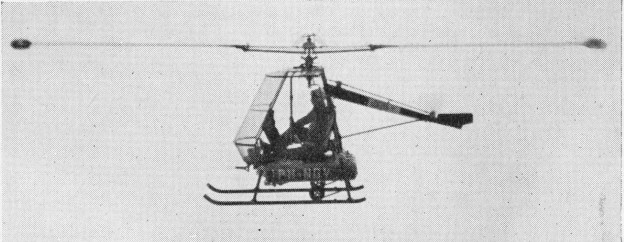
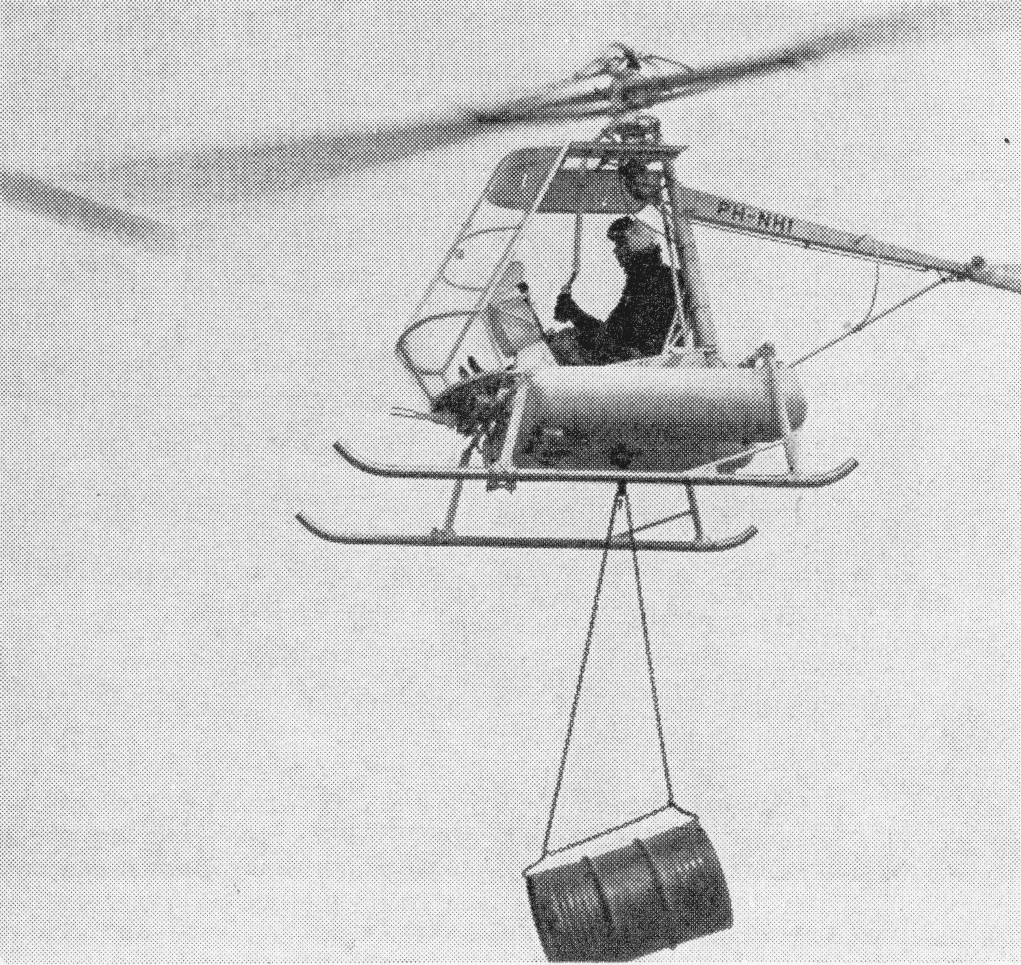
A light helicopter which first flew in May 1956. For propulsion the Kolibrie employed ramjets mounted at the tips of its rotor blades. Ten helicopters were built before production rights were handed over to Aviolanda Maatschappij voor Vliegtuigbouw, which subsequently abandoned it.
The Kolibrie could lift more than is own empty weight.
Netherlands This company designed and built the N-3 Kolibrie light helicopter which first flew in May 1956. For propulsion the Kolibrie employed ramjets mounted at the tips of its rotor blades. Ten helicopters were built before production rights were handed over to Aviolanda Maatschappij voor Vliegtuigbouw, which subsequently abandoned it.
Apparently brought in as the 1929 Engle T-1 and renamed in 1930, the F-2 N11028 c/n 27 was sold (as forfeiture of mortgage) to Richard D Savage of Brighton MA for $4,000 on 15 November 1930, then to Nina L Armitage of Manville RI on 4 April 1934, who reported to CAA on 16 March 1936, “Aircraft now being dismantled.” The sole example of the F-2 open cockpit biplanes registration was cancelled by CAA 15 April 1936.
The F2-WG of 1929, NX117M c/n 26, was powered by an 85hp Wright-Gypsy. The registration of the one built was cancelled on 26 January 1931.