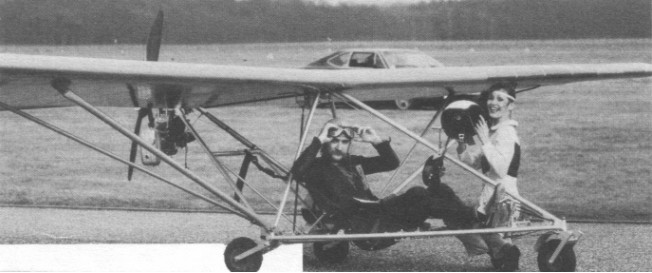
Newbauer Vertical Airplane Co

(Valentine) Newbauer Vertical Airplane Co
Monterey Park CA.
USA

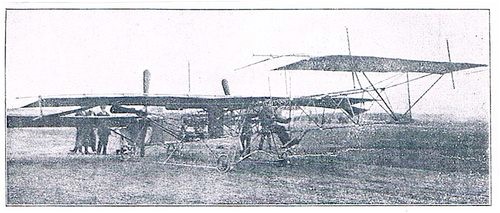
In 1927 Valentine Newbauer built a single-place open helicopter with two propeller-type (coaxial?) rotors and a tractor prop. A model was built, powered by a 1.5hp engine. Newbauer claimed it lifted 60 pounds, which is judged by experts to be highly improbable.

He was engaged in helicopter experiments from 1917-27 and held several patents. One project was entered in the 1924 British helicopter competition.

Neumann/Reich ULF-1

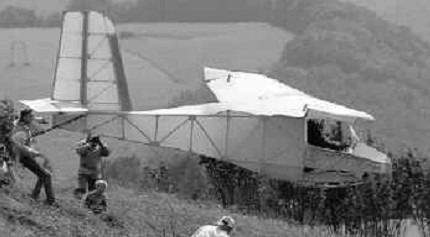
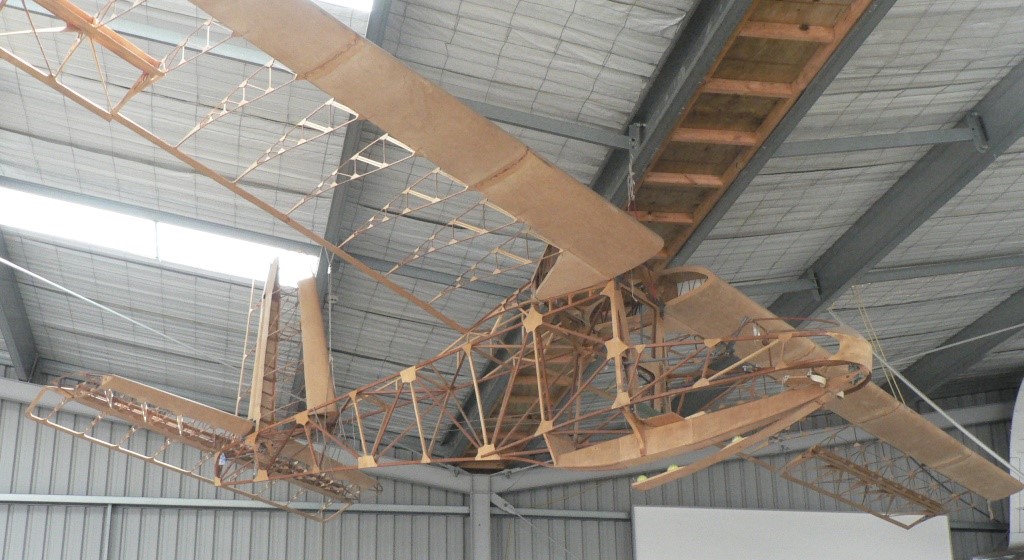
The ULF-l is a German design of classic wood and fabric by Dieter Reich and Heiner Neumann. It resembles some of the old designs like the Grunau Baby, but has an empty weight of only 100 pounds. It first flew in November 1977 and has made many excellent flights. Approximately 140 plan sets have been sold and about 40 aircraft are under construction. Plans are available from Dieter Reich. Cost of the plans is DM460.00 (about $266 US as of June 22, 1997). The plans are very detailed and have received an airworthiness certificate from the German authorities. The best L/D is 16-18:1 and the minimum sink rate is about 160 fpm. The ULF-1 climbs well and handles well. The structure is every bit as complicated as the Carbon Dragon, but results in a good foot launcher when complete.

Wing span: 10.4m
Wing area: 13.4sq.m
Empty Weight: 45kg
Gross Weight: 120kg
Wing Load: 8.96kg/sq.m
Aspect ratio: 8.07
Airfoil: FX 63-137
L/DMax: 15 50 kph
MinSink: 0.80m/s 40kph
Loading: +6g / -4g
Flying speed: 32 – 70 kph
Seats: 1

Neukom AN-66 Super-Elfe

Neukom AN-66C Super EIfe

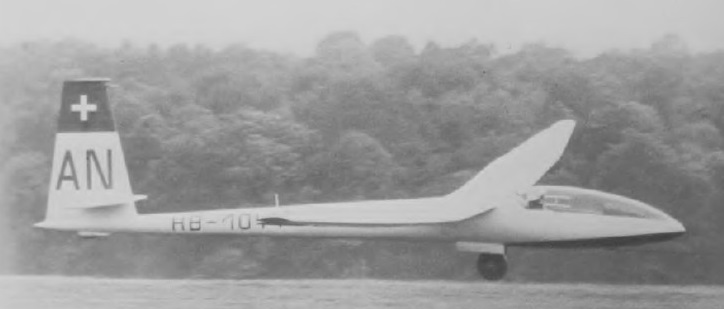
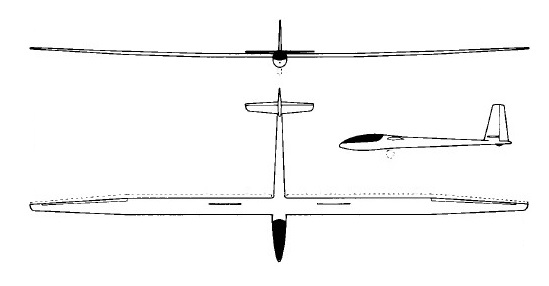
The Neukom AIM-66 high performance single-seater first flew in prototype form in 1966, and was followed by two others, designated AN-66-2, which featured a modified fuselage. These versions have cantilever shoulder-mounted wings of 18m (59ft 0.5in) span and of Eppler 441 aerofoil section, which are of sandwich construction with a metal spar and have plain flaps. The forward fuselage is a glassfibre sandwich structure, while the rear portion is a wooden plywood and balsa sandwich semimonocoque, and a ‘butterfly’-type V-tail is fitted. The landing gear is a rectractable monowheel and the pilot sits under a long flush-fitting transparent canopy.

The AN-66C Super Elfe is a development of the AN-66-2 with the same fuselage but with an entirely new variable-geometry wing with a special aerofoil flap that can be extended to increase the wing area by about 20%; a conventional tail unit with a low-set tailplane, similar to that of the Standard Elfe S-3, replaces the AIM-66-2’s V-tail.

Flight tests of the prototype AN-66C began at Butzweilerhof in Germany on 11 September 1973. The new wing has a longer span of 23m (75 ft 5.5 in) and the aerofoil flaps are chain-operated by a crank in the cockpit and can either be fully extended or fully retracted, no intermediate position being possible; when fully extended or retracted the wing profile is changed so as to result in a continuous Eppler aerofoil section. A tank to contain 132 lb of water ballast is situated in the leading edge of each wing centre section, the latter being 21 ft 4 in in length and the two outer panels 27 ft 0.75 in each. The single-spar wings have riveted duralumin double-T spars, and plywood/balsa/plywood sandwich outer skins formed by vacuum pressing; Schempp-Hirth air brakes are fitted. Landing gear consists, as it did on the AN-66-2, of a retractable monowheel and tailskid. The wing area is increased from 172.2sq ft with the flaps in, to 206.7sq ft with flaps extended, when the aspect ratio is 27.6 compared to 33.1 with the flaps in.

The AN-66D prototype, produced in 1974, has a four-piece wing of 21m (68 ft 11 in) span.

AN-66C Super-EIfe
Span: 75 ft 5.5 in / 23.0 m
Length: 26 ft 6.25 in / 8.1 m
Height: 6 ft 0.75 in / 1.85 m
Wing area: 172.2 sq ft / 16.0 sq.m (flaps in)
Wing section: Eppler 562/569
Aspect ratio: 33.1 (flaps in)
Empty weight: 926 lb / 420 kg
Max weight: 1,433 lb / 650 kg
Water ballast: 60 kg / 132 lb
Max wing loading: 33.1 kg/sq.m / 6.8 lb/sq ft
Max speed: 168 mph / 146 kt / 270 km/h (in smooth air)
Stalling speed: 32.5 kt / 60 km/h
Min sinking speed: 1.64 ft/sec / 0.5 m/sec at 46.5 mph / 40.5 kt / 75 km/h (flaps out)
Best glide ratio: 48:1 at 56 mph / 48.5 kt / 90 km/h (flaps in)

Neukom S-4A EIfe 15 / S-4A EIfe 17

Neukom S-4A EIfe

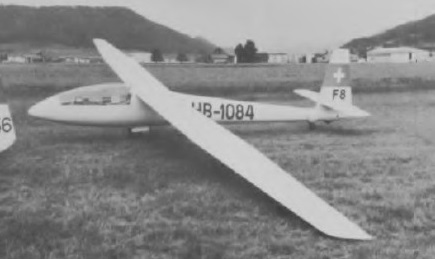
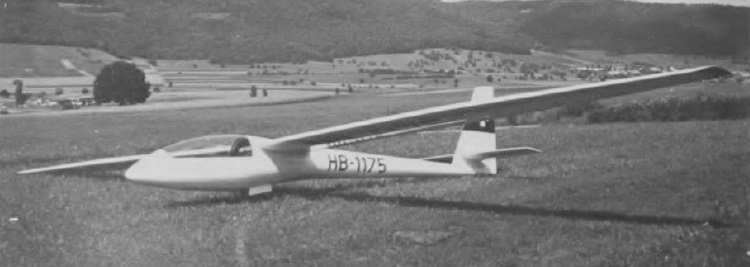
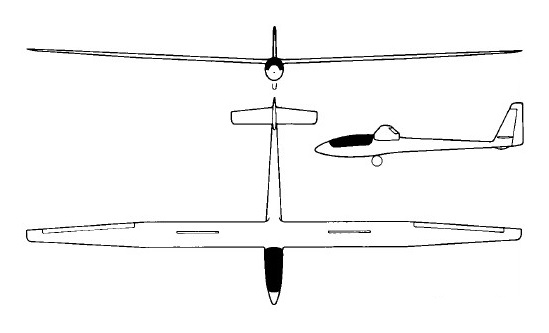
A developed version of the Standard EIfe S-3, the S-4A EIfe 15 differs from it principally in having a new two-piece wing of the same 15m span, strengthened and fitted with Schempp-Hirth air brakes; the single spar is of aluminium alloy and the wing skin of plywood/foam sandwich. A roomier forward fuselage of improved aerodynamic shape is featured, with the slight step forward of the canopy on the Standard EIfe S-3 completely eliminated. The fuselage and tail unit are of glassfibre and plywood/foam sandwich construction, and the landing gear consists of a retractable rubber-sprung monowheel with brake. The prototype EIfe 15 made its first flight in 1970 and 10 had been built by early 1973; production continues, although at a rather slow rate.

Both the EIfe 15 and EIfe 17 were available in kit form for amateur construction, the latter being a 17m span Open Class version of the S-4A EIfe 15, with the same fuselage but with a wider span two-piece wing, with provision for a tank in each leading edge to house a total of 132lb of water ballast. The EIfe 17 also has a braking parachute fitted, and a total of 10 of this version had been built by the spring of 1973, with production continuing at a relatively slow rate.

The EIfe M17 is a single-seat motor glider version of the Open Class EIfe 17 and first flew in prototype form in mid-March 1978. It is powered by a 45hp Parodi HP 45 four-cylinder four-stroke engine driving a Hoffmann two-bladed propeller; this is pylon-mounted aft of the cockpit and retracts into the fuselage when not in use. Electric starting is provided and the fuel tank capacity is 10 Imp gallons (45 litres). Apart from the engine and its related modifications the EIfe M 17 is the same as the unpowered EIfe 17.

EIfe 17
Span: 55 ft 9.25 in / 17.0 m
Length: 23 ft 3.5 in / 7.1 m
Height: 4 ft 11 in / 1.50 m
Wing area: 142.1 sqft 13.2 sq.m
Wing section: Wortmann FX-61 -163/60-126
Aspect ratio: 21.8
Empty weight: 562 lb / 255 kg
Max weight: 837 lb / 380 kg
Water ballast: 60 kg / 132 lb
Max speed: 130 mph / 113 kt / 210 km/h
Max aero-tow speed: 87 mph
Max rough air speed: 113 kt / 210 km/h
Stalling speed: 35 kt / 65 km/h
Min sinking speed: 1.84 ft/sec / 0.56 m/sec at 46.5 mph / 40.5 kt / 75 km/h
Best glide ratio: 39:1 at 56 mph / 48.5 kt / 90 km/h

Neukom AN-22

Single seat single engined high wing mono¬plane with conventional three axis control. Wing has unswept leading edge, swept for¬ward trailing edge on outboard half of span, and tapering chord; conventional tail. Pitch control by elevator on tail; yaw control by fin mounted rudder; roll control by half span ailerons; control inputs through stick for pitch/roll and pedals for yaw. Wing braced from below by struts; wing profile NACA 4415; double surface. Undercarriage has three wheels in tricycle formation with addi¬tional tailskid; no suspension on nosewheel and rubber suspension on main wheels. Push right go right nosewheel steering con¬nected to yaw control. Brakes on main wheels. Aluminium tube framework with optional pod. Engine mounted below wing driving pusher propeller.

The AN 22 was designed by the Swiss Albert Neukom who also built the first two examples to obtain certification in West Germany. The AN 22 made its first flights in March 1983 and was shown in the same month at the Aero 83 exhibition at Friedrichshafen. Point Aviation acquired the licence to build and sell this machine throughout the world, the first production machines being built in spring 1983. The model makes use of the original formula tried by Albert Neukorn in 1982 on the prototype AN 20, whereby the three¬cylinder Konig 430 cc engine is carried behind the wing on a mount coming from the large diameter spar which carries the tail. This spar also acts as the axis of the propeller which is driven through a triple V belt reduction drive. The two blades can fold backward parallel to the spar.

Production versions were factory built and sold by Point Aviation in West Germany.

Neukom completed the construction (May 1983) of the AN 22 Twin, a two seater version of the AN 22.

AN-22
Length overall 18.4 ft, 5.60 m
Height overall 4.3ft, 1.30m
Wing span 33.511, 10.20m
Chord at root 3.9ft, 1.20m
Chord at tip 3.3ft, 1.00m
Dihedral 4 degrees
Sweepback 0 degrees
Tailplane span 8.5 ft, 2.60 m
Fin height 3.1 ft, 0.95 m
Total wing area 126 sq.ft,11.8 sq.m
Total aileron area 12.1 sq.ft, 1.12 sq.m
Fin area 6.6 sq.ft, 0.61 sq.m
Tailplane area 11.7sq.ft, 1.09sq.m
Total elevator area 6.5 sq.ft, 0.60sq.m
Wing aspect ratio 8.9/1
Wheel track 6.2 ft, 1.90 m
Nosewheel diameter overall 10 inch, 26cm
Main wheels diameter overall 12 inch, 30 cm
Engine: Konig SC430, 22hp at 4200rpm
Propeller diameter 52 inch, 1.32 m
Belt reduction, ratio 1.8/1
Max static thrust 143 lb, 65 kg
Power per unit area 0.17 hp/sq.ft, 1.9 hp/sq.m
Fuel capacity 5.3 US gal, 4.4 Imp gal, 20.0 litre
Empty weight 232 lb, 105 kg
Max take off weight 464 lb, 210kg
Payload 232 lb, 105kg
Max wing loading 3.68 lb/sq.ft, 17.9 kg/sq.m
Max power loading 21.1 lb/hp, 9.5kg/hp
Load factors +6.0, 3.0 ultimate
Max level speed 75 mph, 120 kph
Never exceed speed 81 mph, 130 kph
Max cruising speed 56 mph, 90 kph
Economic cruising speed 44 mph, 70 kph
Stalling speed 24 mph, 40 kph
Max climb rate at sea level 600 ft/min, 3.1 m/s
Min sink rate 200 ft/min at 32 mph, 1.0 m/s at 52 kph
Best glide ratio with power off 14/1 at 34 mph, 55 kph
Take off distance 330 ft, 100 m
Land¬ing distance 260 ft, 80 m
Range at average cruising speed 124 mile, 200 km

AN-22 Twin