
Zeppelin-Staaken R.V
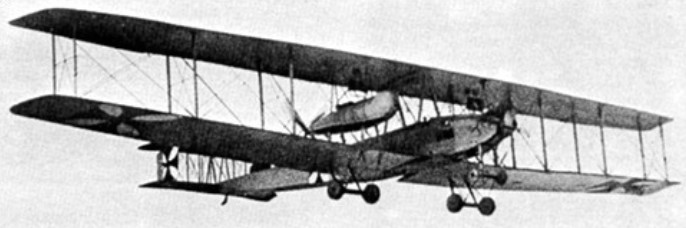
The company’s first product, the Rs I multi-engined flying-boat, was wrecked before its first flight, but three differing examples were developed progressively, the Rs IV prototype flying in 1917.
The R.VI which was built by Automobil and Aviatik, Ostdeutsche Albatros Werke and Luftfahrzeugbau Schütte-Lanz and carried out successful raids against Allied territory, dropping bombs as large as 1,000kg.
The R.VI had four engines, 4-7 machine-guns, eighteen wheel landing gear, and the capability of carrying eighteen 220 lb bombs internally. With a maximum take-off weight of just over 11.25 tons, it was used to make attacks on both France and Britain.
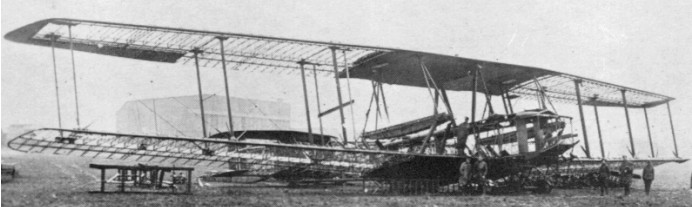
R.IV
Engine: 4 x Benz Bz.IV, 164kW + 2 x Mercedes D.III, 119kW
Max take-off weight: 13035 kg / 28737 lb
Wingspan: 42.2 m / 138 ft 5 in
Max. speed: 125 kmh / 78 mph
Armament: 6-7 x 7.92mm machine-guns

The giant seaplane Rs III was a high-wing monoplane of all-metal design with fabric covering of the wing and empennage.
The intrinsically stable hull was a monocoque design made of duraluminium with traverse and longitudinal steps. The hull housed the gun station, the flight deck for two pilots, the engineer’s station and the fuel system.
The four Maybach engines were arranged in tandem in two nacelles and installed between the hull and the wing. The tail boom was mounted on the wing and had a box-type horizontal tail assembly with split elevator without compensating surfaces; the rudders and tail fins were divided into halves by the fuselage.
First flight took place on November 4, 1917. On 19 February 1918, a 7-hour non stop flight was made from Friedrichshafen to Norderney for further testing by the Seaplane Test Command Warnemonde.
Rs III
Engine: 4 x Maybach HS, 180kW
Take-off weight: 10670 kg / 23523 lb
Empty weight: 7865 kg / 17339 lb
Wingspan: 37 m / 121 ft 5 in
Length: 22.70 m / 74 ft 6 in
Height: 8.10 m / 26 ft 7 in
Wing area: 238 sq.m / 2561.81 sq ft
Max. speed: 136 km/h / 85 mph
Ceiling: 2700 m / 8850 ft
Range: 1380 km / 858 miles
The company’s first product, the Rs I multi-engined flying-boat, was wrecked before its first flight.
Zeppelin-Werke Staaken GmbH
Zeppelin-Werke Lindau GmbH
This company was established under the patronage of Graf von Zeppelin, located formerly at Gotha, to design and construct aircraft with Claudius Dornier as chief designer, the Riesenflugzeug (giant aeroplane) “R” series bombers. The company’s first product, the Rs I multi-engined flying-boat, was wrecked before its first flight, but three differing examples were developed progressively, designated Rs II, Rs III, and Rs IV.
The Staaken design team evolved four-, five- and six-engined bombers, leading to the four-engined R.VI which was built by Automobil and Aviatik, Ostdeutsche Albatros Werke and Luftfahrzeugbau Schütte-Lanz and carried out successful raids against Allied territory, dropping bombs as large as 1,000kg. A floatplane version of the R.VI, the Staaken L, was wrecked during trials in 1918.
Other aircraft built by Zeppelin-Lindau included the C.I, C.II, D.I and VI biplanes, and Cs.I two-seat monoplane seaplane. Developed the Gs.I commercial flying-boat after the Armistice, which was broken up on the instructions of the Allied Control Commission. An advanced four-engined all-metal monoplane airliner, the E.4/20, flew successfully in 1920 but was then destroyed by order of the Allied Control Commission under the terms of the Armistice.
In 1922 the company was renamed Dornier GmbH.

Commissioned in September 1938, more than a year after the Hindenburg disaster, LZ-130 never entered the transcontinental passenger service. Instead, she was used for propaganda flights over Germany and recently annexed Sudetenland. In summer of 1939, the Graf Zeppelin II was sent on an espionage flight which wasn’t a success.
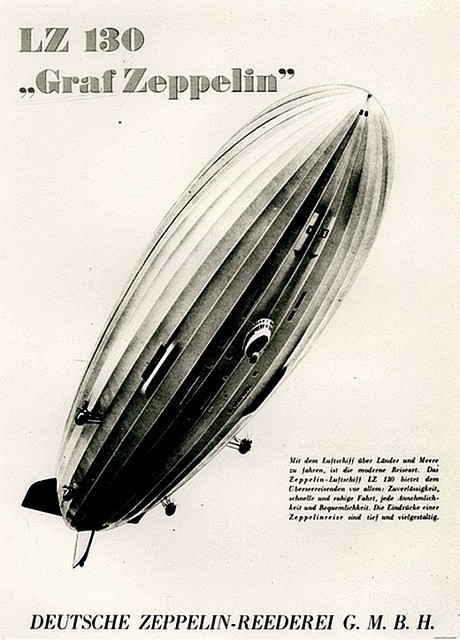
The last giant rigid airship Graf Zeppelin II flew for the final time on 20 August 1939, 12 days before World War Two started, and was scrapped the following year.
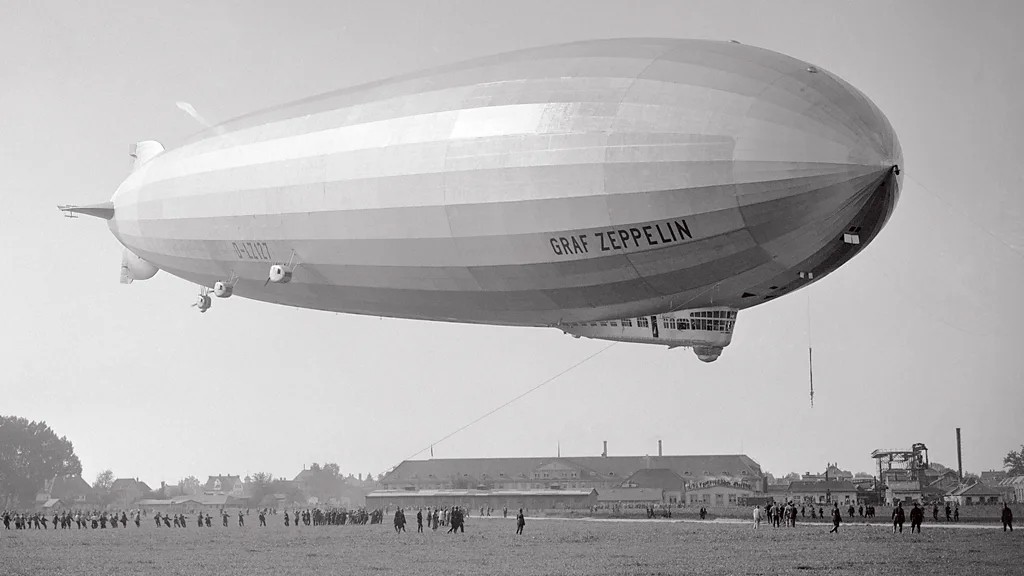
In April 1940 Hermann Goering, a renowned zeppelin-hater, ordered to dismantle the LZ130 together with her namesake, the retired LZ127. Zeppelin hangars in Frankfurt were destroyed by explosives on May 6 the same year, exactly three years after the Hindenburg was lost.
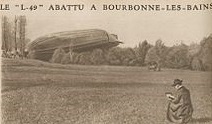
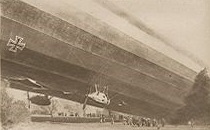
The L-49 was one of the lightened Type U “height climbers” designed by the Germans late in World War I, when improvements in Allied fighter aircraft and anti-aircraft artillery made it necessary for Zeppelins to climb to great altitudes to avoid being shot down. For the Zepeplins to rise to greater heights on a fixed volume of lifting gas, however, the weight and strength of their structures were dramatically reduced. This decrease in strength was accepted as a wartime necessity, since a structurally weaker Zeppelin flying above the reach of enemy aircraft and artillery was safer than a stronger Zeppelin that could be easily attacked.
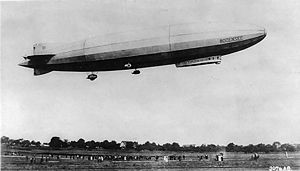
LZ 120 Bodensee was a passenger-carrying airship built by Zeppelin Luftschiffbau in 1919 to operate a passenger service between Berlin and Friedrichshafen. It was later handed over to the Italian Navy as war reparations in place of airships that had been sabotaged by their crews and renamed Esperia. A sister-ship, LZ 121 Nordstern, was built in 1920: it was handed over to France and renamed Méditerranée.
The Bodensee, designed by Paul Jaray, had an innovative hull shape of relatively low fineness ratio, (ratio of length to diameter). This was arrived at after wind-tunnel tests conducted at the University of Göttingen had shown that this would significantly reduce drag.

The framework consisted of eleven 17-sided main transverse frames with a secondary ring frame in each bay, connected by longitudinal girders with a stiffening keel. The forward-mounted control car was combined with the passenger accommodation and was constructed as an integral part of the hull structure rather than being suspended beneath it. Passenger accommodation consisted of five compartments seating four people and a VIP cabin for one. An additional six passengers could be carried on wicker chairs in the gangway between the compartments. A galley and toilets were also fitted.
It was powered by four 190 kW (260 hp) Maybach Mb.IVa engines, two in a centrally mounted aft gondola driving a single 5.2 m (17 ft 1 in) diameter two-bladed pusher propeller, the other two in a pair of amidships engine cars mounted either side of the hull. These drove 3.2 m (10 ft 6 in) two-bladed propellers via a reversing gearbox to enable reverse thrust for manoeuvering when landing.
A sister-ship LZ 121 Nordstern, similar to the lengthened Bodensee but with modified passenger accommodation, was completed in 1920.
Bodensee was first flown on 20 August 1919 piloted by Captain Bernhard Lau. The first passenger-carrying flight was made on 24 August, with Hugo Eckener in command. It made over 100 flights for DELAG, carrying 2,322 passengers over a total distance of 50,000 km (31,000 mi) These flights included a 17-hour voyage between Berlin and Stockholm.
On 3 November 1919 Bodensee suffered a partial engine failure, leading to an accident at Staaken when attempting to land. One of the ground handling crew was killed and several injured, and the airship, lightened after five passengers had jumped out, was then carried off by the wind and eventually brought down near Magdeburg.
Bodensee had suffered some damage in the accident, and while being repaired was also modified: the controls had proved oversensitive, so the control surfaces were cut down and it was lengthened by 10 m (32 ft 10 in).
In July 1921 Bodensee was handed over to the Italian government as compensation for the Zeppelins which were to have been handed over as war reparations but had been sabotaged by their crews. Two stowaways accompanied the flight to Rome: a German bank clerk and an American cinematographer. In Italian service, renamed Esperia it made at least one long flight in Italian service, a 2,400 km (1,500 mi) voyage lasting 25 hours from Rome to Barcelona and Toulon before being broken up for scrap in July 1928.
The Bodensees sister-ship, LZ 121 Nordstern, was also covered by the reparations decided as part of the peace treaty of June 1919 and was confiscated by the Allies, Nordstern was delivered to France as a war reparation on 13 June 1921 and renamed Méditerranée.
LZ 120 Bodensee / Esperia (after enlarging)
Engines: 4 × Maybach Mb.IVa
Length: 120.8 m (396 ft 4 in)
Diameter: 18.71 m (61 ft 5 in)
Volume: 20,000 m3 (710,000 cu ft)
Empty weight: 13,646 kg (30,084 lb)
Useful lift: 9,593 kg (21,149 lb)
Maximum speed: 132.5 km/h (82 mph; 72 kn)
Range: 1,700 km (1,056 mi; 918 nmi)
Crew: 12
Passengers: 27
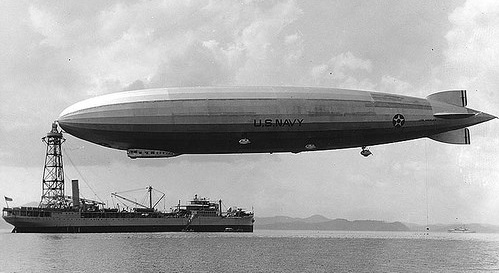
Built by Luftschiffbau Zeppelin GmbH as LZ 126 in 1923-1924 and handed over to the United States as a part of war reparations as the US Navy rigid airship ZR-3 USS Los Angeles. LZ126 has a distinction of being the first German-built dirigible to cross the Atlantic.


The Los Angeles (ZR-3) served with the U.S. Navy until decommissioned in 1932, and dismantled in 1939. The longest-serving US military airship.
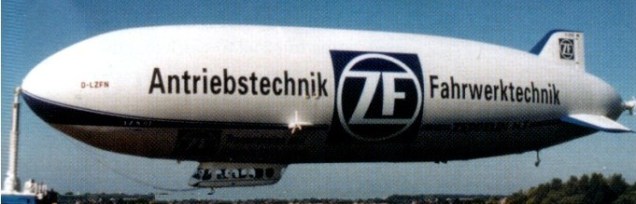
The 75m prototype Zeppelin NT LZ07 first flew in 1997. A semi-rigid airship, the LZ07 received type certification in the commuter category for up to 19 passengers.
In May 2011, Goodyear announced it will be replacing its fleet of three blimps with three semi-rigid airships built by Luftschiffbau Zeppelin.
The new airships are faster, quieter, larger, easier to fly and more manoeuvrable than the blimps it introduced more than 90 years ago. Still, the company plans to keep calling the new models blimps “Because a Goodyear Semi-rigid Dirigible doesn’t roll off the tongue”.
The switch to dirigibles offers a similar-looking, cigar-shaped flying machine but one that’s nearly the length of a football field and about 15 metres longer than the old blimps. With room for three engines instead of two, it will be able to hit speeds of over 110 kilometres per hour.
The quieter engines also will provide an advantage in covering golf tournaments. The ability to hover will allow a pilot to better position the aircraft to capture NASCAR race finishes and key moments in a baseball game.
Construction began in 2012 on the first of three new semi-rigid airships; the first completed in March 2014.
Assembly of Wingfoot One began in March 2013 at Goodyear’s Wingfoot Lake hangar. An international team of engineers and technicians from Goodyear and Germany’s ZLT Zeppelin Luftschifftechnik worked side by side to complete the build project. Parts such as the tail fins and gondola were built in Germany and shipped to the U.S. for assembly. The balloon-like body of the airship – the “envelope” – is made of polyester with an innovative film from DuPont™ called Tedlar®, surrounding a semi-rigid internal structure, which differentiates this airship from previous Goodyear blimps.
Spirit of Innovation, a model GZ-20A blimp (non-rigid airship), was retired on March 14, 2017, and Wingfoot One (N1A), the first such model in Goodyear’s U.S. fleet, was christened on August 23, 2014, by Good Morning America anchor Robin Roberts, near the company’s world headquarters in Akron, Ohio. Wingfoot Two, the name of Goodyear’s second semi-rigid airship, was unveiled in April 2016.
Wingfoot One (N1A (model LZ N07-101), based in Pompano Beach, Florida

Wingfoot Two (N2A) (model LZ N07-101), based in Suffield Township, Ohio

All three craft will be outfitted with LED sign technology Goodyear calls “Eaglevision.” This allows the aircraft to display bright, multi-colored, animated words and images. Goodyear also has blimps operating in other parts of the world. These airships are built and operated by Van Wagner of Orlando, Florida.
The new airships are 246 feet long, 52 feet longer than Goodyear’s old model, the GZ-20. The Zeppelin NT model is also slimmer, has a top speed of 70 miles per hour (versus 50 for the blimp), and has a passenger gondola that seats 12 (compared to seven in the blimp). The gondola even has a bathroom.
The blimps are filled with helium. The helium is maintained under low pressure, so small punctures do not pose serious consequences for the blimp. One inspection element of the blimps is to look into the envelope for pinpoints of light which are indicative of small holes.
Goodyear decided a celebration for its centennial year the main event was giving the iconic airship a retro makeover with a black-and-silver color scheme, complete with a vintage Goodyear logo and a reappearance of the blue-and-yellow Goodyear “house flag” that donned the side of the company’s earliest blimps. The retro design is intended to replicate the look of the first Goodyear blimp, dubbed “Pilgrim,” that appeared 100 years ago. It’s important to know that only one Goodyear blimp, Wingfoot One, gets the special treatment. There were currently four Goodyear blimps wafting overhead in 2025: Wingfoot One, Wingfoot Two, Wingfoot Three, and a fourth airship based in Germany, Europe Blimp. It is operated by noted blimp company Zeppelin. These three blimps will maintain their current blue-and-yellow design.

LZ N07
Overall Length: 246.4 ft
Maximum Width: 64.79 ft
Maximum Envelope Width: 46.45 ft
Overall Height: 57.57 ft
Internal Framework: Aluminum and Carbon Fiber Trusses
Envelope Material: Polyurethane, Polyester and Tedlar film
Envelope Volume: 297,527 cu.ft
Envelope Life: 10 years+
Maximum Weight (without Helium): 19,780 lb
Maximum Speed: 73 mph
Gondola Seating: Up to 14
Gondola Weight Empty: 2,626 lb
Number of LED Lights: 82,656
Static Lift: 2,940 lb
Maximum Dynamic Lift: 1,102 lb
Total Usable Lift: 4,042 lb
Engines: 3 Vectored, 200 hp
Endurance: 24-40 hr
Inside Gondola Noise Level: 64 decibels
Outside Gondola Noise Level: 69.43 decibels
 All Aero