Garland & Associates built the model A in 1948 as midget racer ‘Miss Nashville’. A single place low wing monoplane, registered NX66311 and piloted by Al Bennyworth, the fastest race was at 139.53 mph in 1948. Power was from an 85hp Continental C-85.
The craft was dismantled circa 1949 and parts were used in subsequent racers.
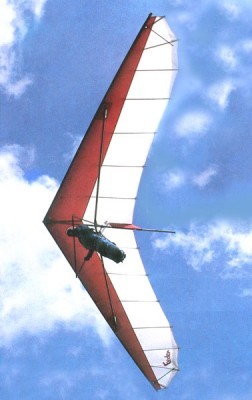
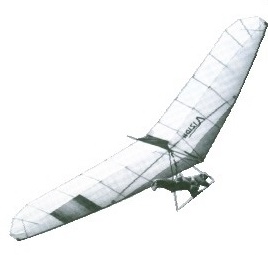
The 1981 Vampire (for advanced pilots) drawing were from plans made by the manufacturer Pacific Kites in New Zealand. In England it was named Vampyre, while in France it was the Vampire.
The 1982 Vampire II had an 80% double surface. It was fast but not so good at slow speed.
Vampire / Vampyre Wing area: 14.7 m² Wing span: 10 m Aspect ratio: 6.8 Hang glider weight: 27 kg Minimum pilot weight: 60 kg Maximum pilot weight: 90 kg Minimum speed: 28 km/h Max glide ratio (L/H): 9 Max glide ratio speed: 31 km/h Minimum sink rate: 0.9 m/s Number of battens: 22 Nose angle: 126°
Vampire 2 / Vampyre 2 Wing area: 13.2 m² Wing span: 9.4 m Aspect ratio: 6.7 Hang glider weight: 25 kg
Vampire 2 / Vampyre 2 Wing area: 14.2 m² Wing span: 10 m Aspect ratio: 7 Hang glider weight: 29 kg
Vampire 2 / Vampyre 2 Wing area: 15.7 m² Wing span: 10.6 m Aspect ratio: 7.15 Hang glider weight: 32 kg
The Feder one-surface wing was created in 1985, just after Mr. Andre Chayrou had left the Oderen site.
Produced by Aérotec for novice pilots, it has had no succes in France.
The German name “Feder” means “plume” in French.
Aérotech who made the Feder (in fact it was the “schuss” of Andre Chayrou with a new name) and then for some commercial reasons, the Feder was re-branded “Contact” shortly after its launch, in 1986.
These are the same 100% identical wings.
Aerotec Contact
This wing had at the level of the transverse a piece of removable nylon, as useless as it was ineffective: which served to bridle the floating transverse. According to the manufacturer, it was for a better grip for the first flights.
Aerotec Contact Wing area: 15.6 m² Wing span: 9.9 m Aspect ratio: 6.3 Hang glider weight: 24 kg Minimum speed: 25 km/h Maximum speed: 75 km/h Max glide ratio (L/H): 7 Max glide ratio speed: 35 km/h Minimum sink rate: 1.8 m/s Packed length short: 4.2 m Nose angle: 120°
André Chayrou, starting from plans made by the manufacturer Pacific Kites, was the owner of Pacific Wings until 1985 (purchased by Aérotec).
Pacific Wings produced, the Royal, the Schuss, the Vampire, and the Express.
Pacifics Wings was bought by Germans in 1985 and was named Aérotec who made the Feder (in fact it was the “Schuss” of Andre Chayrou with a new name) and then the Feder was renamed “Contact”. These are the same 100% identical wings. He also made a double-surface: the Raptor.
On his departure from Oderen, Andre Chayrou created in 1985 “Pacific Diffusion” and moved to Kembs Loechle, near Mulhouse to make the “Select”, which was none other than the Express.
Pacific Windcraft (USA) became part of Airwave circa 1983, from Pacific Airwave to PacAir.
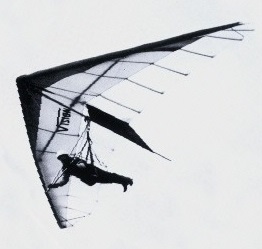
The Pacific Airwave Vision, an intermediate DSTI, was built also by Airwave from 1983 for advanced pilots.
Airwave Vision
The 1987 Hiway Hang Gliders (1983) Vision 5 was been designed in such away that it can be tuned by way of a variable geometry facility so as to be suitable for the beginner to develop his or her flying skills right from initial downhill glides, through first soaring flights to cross country performance all on the same machine. Adjustments are quick and easy.
1987 Hiway Hang Gliders (1983) Vision 5
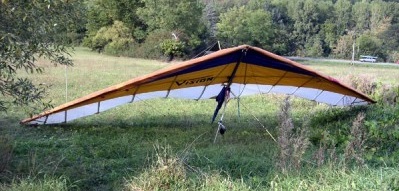
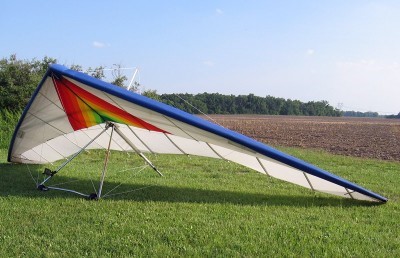
The Airwave Vision 4 1988 Intermediate glider was an excellent all round recreational glider, very maneuverable, with performance somewhat better than single surface models. Its only failing is lack of glide ratio at high speeds, although this can be an advantage when landing in tight fields. Its maneuverability allows it to take advantage of small areas of lift that higher performance “stiffer” wings cannot. It was easy to set up, launch, thermal, and land. It had an elevated king post hang-point for easy roll control. It had great static balance and was a light glider.
Airwave Vision 4
The Vision MkIV has no keel pocket.
There was also a Vision biplace (“Double Vision”).
Hiway Hang Gliders (1983) Ltd has offered the Vision 18, designed by Pacific Windcraft, along with the Excalibur and Explorer2.
Hiway Hang Gliders (1983) Vision
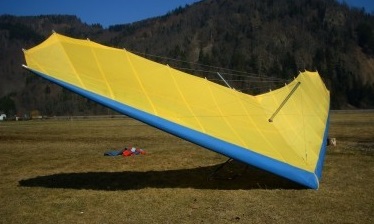
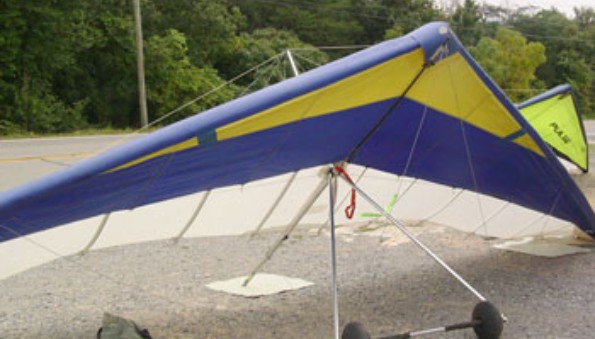
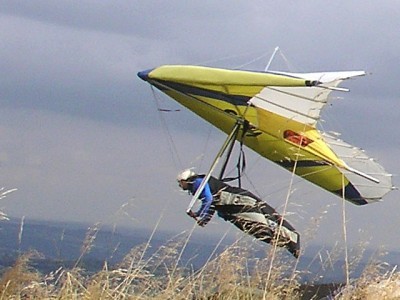
The 1983 Hiway Hang Gliders (1983) Vision was a new Concept to meet the demands of the novice pilot. Designed by Pacific Windcraft in the States and manufactured by Hiway in Europe, the Vision takes the pilot from beginner to expert all on the same glider. In its loosest setting this new design is as docile and predictable as a Super Scorpion. Tighten it up, to get the performance of thoroughbred CFX machine. This glider may be identified by having rigging adjusters on the flying wires (not on the Vision V). The Hiway Vision was priced at £897.00.
Hiway Vision
The great feature of the Hiway Vision 18 wing was the variable geometry which would allow the flight, according to the adjustement, for novice pilots as well as the confirmed ones.
The 1989 Hiway Vision 5 intermediate glider was a well balanced glider having floater style handling and easy take off and landing characteristics.Only downside is that it weighs more than a lot of more modern intermediates and the sink rate goes up as the bar is pulled in more than a modest amount however this characteristic is useful for getting into a small field. A great glider for relaxed flying.
Airwave Vision 4 17 Wing area: 15.33 m² Wing span: 9.3 m Aspect ratio: 5.74 Hang glider weight: 27 kg Minimum pilot weight: 52 kg Maximum pilot weight: 88 kg Number of battens: 18 Nose angle: 122° USHGA rating: 2-4 Stall: 25 mph VNE: 46 mph Load limits: positive 53 mph@ 30 degrees / -negitive 36 mph@ -30 degrees
Airwave Vision 4 19 Wing area: 16.9 m² Wing span: 9.9 m Aspect ratio: 5.83 Hang glider weight: 29 kg Minimum pilot weight: 70 kg Maximum pilot weight: 120 kg Number of battens: 20 Nose angle: 122° USHGA rating: 2-4 Stall: 25 mph VNE: 46 mph Load limits: positive 53 mph@ 30 degrees / -negitive 36 mph@ -30 degrees
Airwave Vision 4 Wing area: 20 m² Wing span: 10.9 m Hang glider weight: 28 kg Minimum pilot weight: 75 kg Maximum pilot weight: 190 kg Packed length: 6.2 m Packed length short: 4 m Number of battens: 19 Nose angle: 127°
Hiway Vision 18 Wing area: 15.8 m² Wing span: 9.4 m Aspect ratio: 5.7 Hang glider weight: 25 kg Minimum pilot weight: 55 kg Maximum pilot weight: 88 kg Packed length short: 3.65 m Nose angle: 122°
Hiway Vision 5 145 Packed length: 5.50 m Number of battens: 18
Hiway Vision 5 172 Packed length: 5.50 m Number of battens: 18
Hiway Vision 5 188 Packed length: 5.50 m Number of battens: 18
Sail Area: 165 sq. ft Glider Weight: 59 lbs Pilot Hook-in Weight: 115 – 195 lbs Skill Level: Novice SS/DS: Double Surface KP/TL: Kingpost VG: No
Pacific Windcraft (USA) became part of Airwave circa 1983, from Pacific Airwave to PacAir. In 1986 PacAir closed the doors.
In 1987, the American Eclipse was replaced in the Pacific Windcraft product line by their Vision Mark IV (a version of which Airwave UK marketed, with Magic hardware, as the “Calypso”). That same year, Pacific Windcraft was absorbed into Pacific Airwave, which in turn was absorbed into its parent company, Airwave Gliders in 1994.