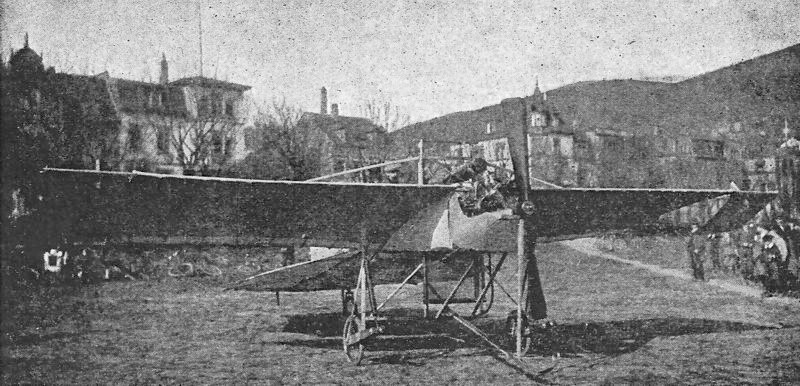
This monoplane was built by Firma Max Pause in Heidelberg, Germany, probably in 1909 and probably powered by an Antoinette engine.
This monoplane was built by Firma Max Pause in Heidelberg, Germany, probably in 1909 and probably powered by an Antoinette engine.

Single seat single engined high wing monoplane with two axis control (optional conventional three axis control). Wing has unswept leading edge, swept forward trailing edge and tapering chord; cruciform tail. Pitch control by elevator on tail; yaw control by fin mounted rudder; no separate roll control (optional roll control by ailerons); control inputs through stick for pitch/yaw and (optionally) pedals for roll. Wing braced from below by struts; wing profile; double surface. Undercarriage has three wheels in tail dragger formation; bungee suspension on all wheels. Push right go right tailwheel steering connected to yaw control. No brakes. Aluminium tube/steel tube framework, without pod. Engine mounted below wing driving pusher propeller. Framework in 2024T3 aluminium and 4130 chrome moly steel. Wing covering is Stits Polyfiber, doped.
Shown for the first time to the public at 0shkosh in August 1982, P Craft from D Paup appears to be a minimum aircraft and as such is directly descended from the Kolb Flyer and Ron Wheeler Scout.
This one offers the choice between two axis control, with steering by induced roll, or conventional three axis control when fitted with ailerons (an option on the standard kit). Where the lower longeron and a higher, nearly parallel tube which carries the pilot seat meet at the nose, there is a horizontal transverse tube on which can be hinged the rudder pedals.
Paup aircraft offers the two axis version in kit form, requiring 150 hours for completion, at the price of $3395 in 1983.
Engine: Cuyuna 215D, 20hp at 6000rpm
Propeller diameter and pitch 36 x 12 inch, 0.91 x 0.30 m
No reduction
Power per unit area 0.15hp/sq.ft, 1.6hp/sq.m
Fuel capacity 2.5 US gal, 2.1 Imp gal, 9.5 litre
Wing span 32.5 ft, 9.88 m
Total wing area 132 sq.ft, 12.3 sq.m
Wing aspect ratio 8.0/1
Main wheels diameter overall 20 inch, 51 cm
Empty weight 165 lb, 75kg
Max take off weight 402 lb, 182 kg
Payload 237 lb, 107 kg
Max wing loading 3.05 lb/sq.ft, 14.8 kg/sq.m
Max power loading 20.1 lb/hp, 9.1 kg/hp
Max level speed 60 mph, 97 kph
Never exceed speed 70 mph, 113 kph
Max cruising speed 50 mph, 80 kph
Economic cruising speed 35 mph, 56 kph
Stalling speed 22 mph, 35 kph
Max climb rate at sea level 300ft/min, 1.5m/s
Take off distance 75 ft, 23 m
1983: Paup Aircraft, Arthur Neu Airport, Carroll, Iowa 51401, USA.
UL builder
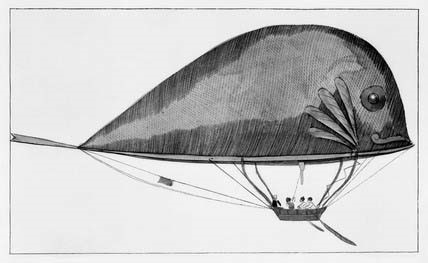
The creation of two Swiss-borne gunsmiths; eccentric engineer and inventor of the cartridge breech-loader (patented 1812), Jean Pauly, and Durs Egg, gun-maker to King George III – its construction was begun during June 1816 in Knightsbridge, London, and continued into the following year. The rigid craft, Pauly’s second dirigible flying fish – his first being a smaller one that he first flew in 1804 near Paris with little success – had an envelope 90 feet long and was notable for its intended use of trimmable ballast. The device, to have been either a sand-filled box or a water-filled barrel (accounts differ), was to be slung on ropes laid out between the airship’s tail and the rear of the gondola, and by using these ropes the ballast could then be hauled back and forth, thus moving the centre of gravity of the aerostat. For this, and its other innovations in aeronautic navigability, a patent, No.3909 dated April 15, 1815, was granted by the Great Britain Patent Office to Jean Samuel Pauly and Durs Egg. This patent became entangled in a lawsuit between the two gunsmiths, which was ostensibly about pistols. The lawsuit, Egg v. Pauly, lasted from 1817 until 1820 – the year previous to Pauly’s death. During the lawsuit Pauly claimed that Egg had failed to assist with the production of certain firearms in contravention of an agreement dated March 15, 1815, which dealt with the building of the airship. In the end, the venture, aptly named “Egg’s Folly” by those following its lack of progress, failed miserably, proving to be both too complex and too costly, resulting in the financial ruin of its inventors. A decade later, Durs Egg, having gone blind and insane, died in 1831. In January 1844, P. T. Barnum and General Tom Thumb (1838-1883) sailed for England to begin a European tour where at the Surrey Zoological Gardens a captive balloon ascent exhibition was made by the famous dwarf using the Dolphin’s still-existing goldbeater’s skin air bladder, or ballonet rather, capable of lifting fifty or sixty pounds when filled with gas.
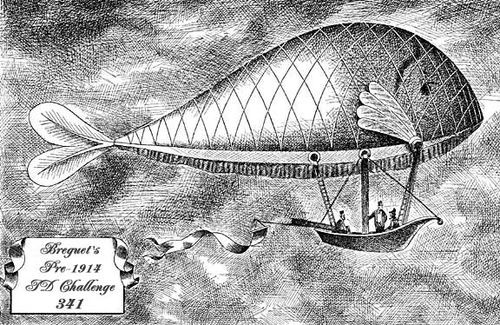
In 1789, Baron Scott, of Paris, proposed an aeronautic fish. Jean Samuel Pauly revived the plan with modifications. Marshal Michel Ney patronised it, and gave nearly 100,000 francs for the construction of an aerostat 50 feet long, and for experiments. Its first trial was made on August 22, 1804 at Sceaux, south of Paris; the success anticipated did not follow.
Albert Paulson, of Northwood ND., USA, built the single-place Aeronef, or Gold Bug, in 1910.
Built on the box-kite principle, with the forward box used for changing the angle of flight, while the rear box was adjusted for the direction of flight. Made its public appearance at the June 1910 Indianapolis Air Meet, but not known if it flew.
The Companhia Aeronáutica Paulista CAP-9 Carioca four-seat, single-engine high-wing monoplane with enclosed cockpit and fixed undercarriage, was CAP’s last attempt, in 1947, to remain in the aircraft market. The company had chosen to build the CAP-9 Carioca instead of the CAP-8. The CAP-8 (which reached the prototype stage) was a 4-seater low-wing aircraft and although the prototype was made of wood in order to gain time (the war was about to end but there was still a shortage of aluminum), the idea was to build an all-metal aircraft.
Without commercial success with its new projects and a vertiginous drop in its orders, CAP ends its activities in 1948.
The Companhia Aeronáutica Paulista CAP-8 of 1944 was a four-seat, single-engine low-wing monoplane with enclosed cockpit and fixed (retractable planned in series aircraft) undercarriage, inspired by Messerschmitt Bf 108 Taifun. Only one was built.
A high-wing cabin monoplane
An improved version was later built by Nieva.
Brazil
Companhia Aeronautica Paulista formed at Sao Paulo shortly after the Second World War to produce CAP 1 Planalto low-wing advanced trainer, CAP 4 Paulistinha high-wing cabin monoplane, and similar CAP 5 Carioca. The second was the most successful; improved version later built by Nieva. Company came under control of IPT in late 1940s.

