Phillips Multi-Wing

1907 Phillips Multi-Wing

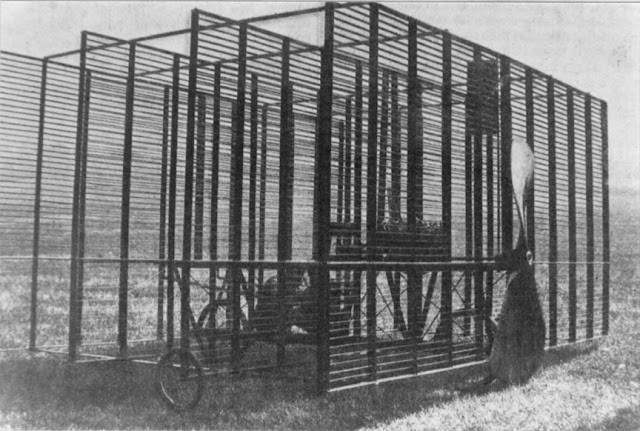
A second version of Horatio Phillips’ 1893 steam powered test-rig study model on its wooden 200 foot diameter circular test-track at Harrow, England, where, tied to a cable fixed on a central mast, its first test was made on June 19th. 9 ft 6 in tall and about 22 feet long, with 40 lifting surfaces arranged like Venetian blinds.

He continued to experiment with wing designs, and built another test rig in 1902, which had 120 wings and was powered by a gasoline engine.

The 1893 machine’s thin profile with one of Horatio Phillips’ sons.

Reaching a speed of 64 km/h with a total weight of 174 Kg, it rose to a height of 90 cm and covered a distance of 600 meters.

Phillips also built multiplane machines in 1904, 1907 and 1911; his elaborate multiwing approach – 40 double-surface airfoils grace this early example – is often referred to as the “Venetian Blind”.

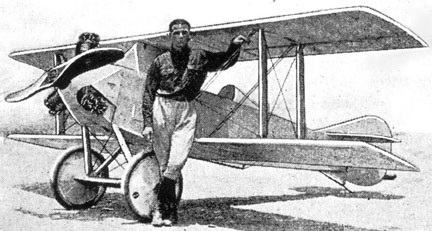
The 1907 Phillips Multi-Wing Flying machine was designed and built by Horatio Phillips in the UK. It featured 20 rows of aerofoils and flew more than 500 yards.

Phillips built his first man-carrying machine, with 20 lifting surfaces, in 1904, and was able to make at least one short hop of 50 feet. His 1907 machine had four banks of 50 wings each and an eight-foot propeller. In this machine Phillips made a powered, although uncontrolled, flight of about 500 feet.
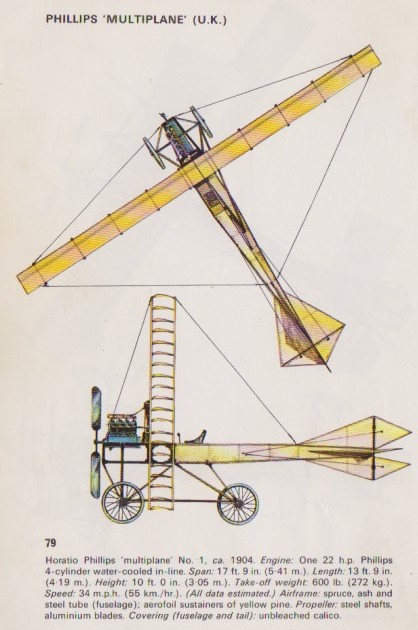
Philips Multiplane 1907

Engine: Phillips 4-cyl inline, water-cooled, 22 hp
Wingspan: 17 ft 9 in / 5.41 m
Length: 13 ft 9 in / 4.19 m
Height: 10 ft 0 in / 3.05 m
TO weight: 600 lb / 272 kg
Speed: 34 mph / 55 kph

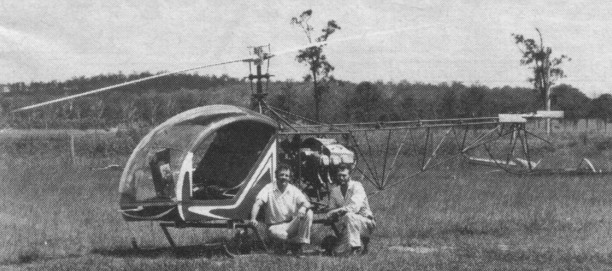
Phillips & Gerakiteys Phillicopter

Ten years’ of design and four years’ construction by Mr P. Gerakiteys and Mr D. Phillips went into the Australian two seat ‘Phillicopter” prototype beginning certification trials in 1972. The aircraft is expected to have a cruise speed of 70kt and a range of 200 miles. Powered by a 145 h.p. Continental A 300, it has a 5001b useful load. Eight firm orders had been received by 1972.

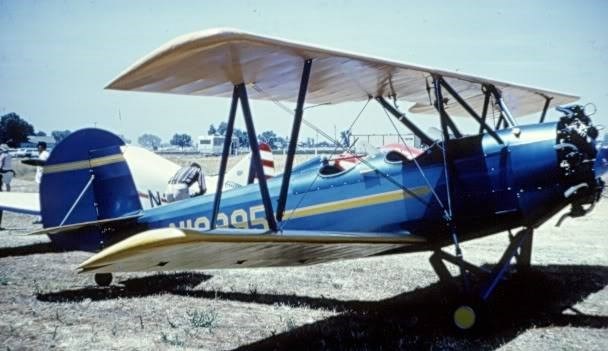
Phillips CT-2 Skylark

Phillips CT-2 Skylark NC19995 s/n 102

The 1941 Phillips CT-2 Skylark featured an optional sliding cockpit canopy and was priced at $2,500.

Phillips CT-2 N19989

Probably only two were built, N19989 c/n 101 and NC19995 s/n 102.

Engine: 120hp Phillips-Martin D-333
Wingspan: 28’3″
Length: 23’3″
Useful load: 570 lb
Max speed: 124 mph
Cruise: 115 mph
Stall: 45 mph
Range: 315 mi
Seats: 2

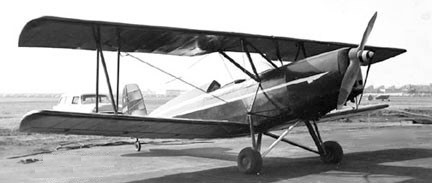
Phillips CT-1

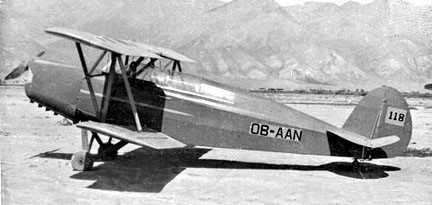
Philips CT-1 Perú OB-AAN

In 1940 Phillips Aviation Co built the CT-1 two-seat biplane (ATC 731) designed by Ivan Driggs. A continuation of the Driggs Skylark, offered with a 95hp Menasco B-4 engine or optional 125hp C-4 and sliding cockpit canopy.

Two or three were built, the prototype being NX18989 c/n 100, and one went to Peru.

CT-1 Skylark
Engine 95hp Menasco B-4
Wingspan: 28’3″
Length: 23’2″
Useful load: 586 lb
Max speed: 114 mph
Cruise: 100 mph
Stall: 45 mph
Range: 340 mi
Seats: 2

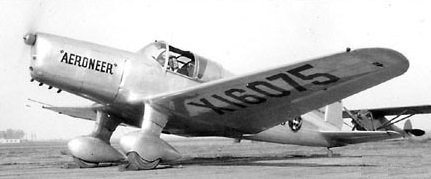
Phillips 1-B Aeroneer / XPT

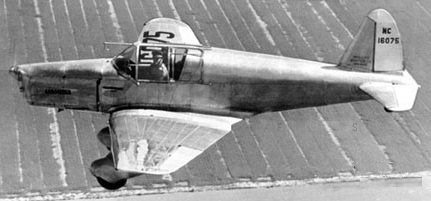
Phillips Aviation Co was founded at end of 1930s in Los Angeles, California, to continue development of light two-seat monoplane, the 1936 Phillips I-B (ATC 693), designed originally by Aero Engineering Corporation.

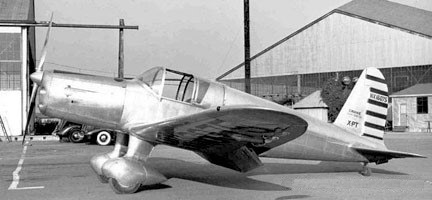
The one built, NC16075, was rebuilt in 1939 with a 145hp Ranger 6 engine as XPT (Experimental Primary Trainer) in an attempt to get an USAAC contract.

This failed, then MGM Studios reportedly bought it, as it has appeared in several films.

NX16075 posing as “Crane XPT” for a bit part in 1940 film, “House Across the Bay”
Actor Ray Milland spots it in a Burbank hangar during filming of “Men With Wings”

In 2005 it was stored in a hangar in Arizona. FAA says registered owner is, or was, in Oklahoma City but “sale reported” (2007).

1-B Aeroneer
Engine: 125hp Menasco C-4
Wingspan: 32’6″
Length: 24’0″
Useful load: 695 lb
Max speed: 140 mph
Cruise: 130 mph
Stall: 49 mph
Range: 600 mi
Seats: 2

XPT
Engine: 145hp Ranger 6
Wingspan: 32’6″
Length: 23’6″
Useful load: 810 lb
Max speed: 150 mph
Cruise: 130 mph
Stall: 46
Range: 500 mi
Seats: 2

Phillips Aviation Co.

1936: (James A) Phillips Aviation Co
South Pasadena & Van Nuys CA.
USA

Phillips Aviation Co was founded from Western Airmotive Corp in 1940 in Los Angeles, California, to continue development of light two-seat monoplane, the Phillips I-B, designed originally by Aero Engineering Corporation.

1940: Acquired rights from Aero Engineering Corp and Driggs (Western Airmotive), Long Beach CA.
Also built CT-1 two-seat biplane.

1941: Rights to Skylark and D-333 motor sold to Ayers Aviation Corp, Reno NV.