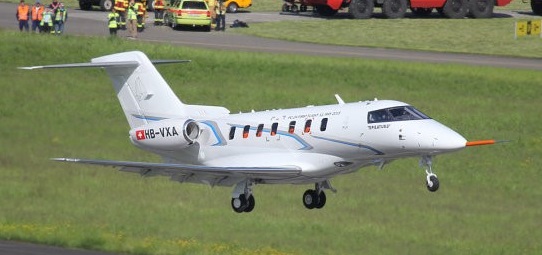
The PC-24 twin-engine business jet is equipped with a cargo door.
The first ever PC-24 took off on its maiden flight on 11 May 2014 at 10:00 local time from Buochs Airport. Prototype P01, callsign HB-VXA, flew across central Switzerland for a total of 55 minutes. The flight went exactly as planned with no problems. The aircraft took off from runway 07 in just under 600 meters and climbed to 10,000 feet (approx 3000 m ) in around three minutes. Test pilot Paul Mulcahy flew the PC-24 as Pilot in Command, with second test pilot, Reto Aeschlimann. The maiden flight followed a route across Central Switzerland – from Altdorf to Brünig via Engelberg. Twelve Flight Test engineers watched the flight from the ground on a stream of real-time flight data received from the PC-24.
A total of three PC 24 prototypes were to be built and used to complete a test programs of some 2,300 hours over the next two years.
Pilatus sold 84 PC-24’s in the space of just 36 hours at last year’s European Business Aviation Conference & Exhibition (EBACE) in May 2014. Certification and initial deliveries of the first aircraft were to come off the production line are planned from 2017.
The Pilatus PC-24, the “super versatile jet” from the Swiss manufacturer that is designed to bring many of the PC-12 turboprop’s unique capabilities to the bizjet market.
PC-24 production has started at Pilatus Aircraft’s headquarters in Stans, Switzerland, as the manufacturer readies to deliver the first customer airplane following certification.
In January 2017, fractional-ownership company PlaneSense was revealed as the launch customer for the jet, which features a large aft cargo door and the ability to operate from unimproved airstrips, both hallmarks of the PC-12 NG.
Flight testing to date has confirmed that the PC-24 will beat original projections and that the current flight test schedule is tracking on time, allowing for the handover of the first customer airplane two short weeks after certification is in hand.
Pilatus opened and closed the order book for the PC-24 at the EBACE show in Geneva in 2014, notching 84 sales, or three years’ worth of production. A long line of potential customers is said to be showing interest in the $9 million jet. Pilatus says it will reopen the order book after completing certification.
The PC-24 will boast a speed of 425 knots, a range of nearly 2,000 nm, a max operating altitude of 45,000 feet and a max payload figure of 2,500 pounds. The jet will be capable of carrying up to 10 passengers.