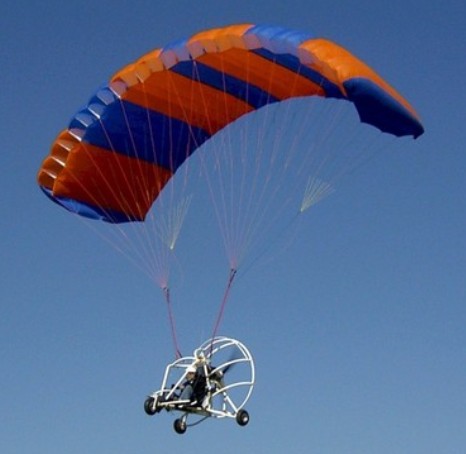
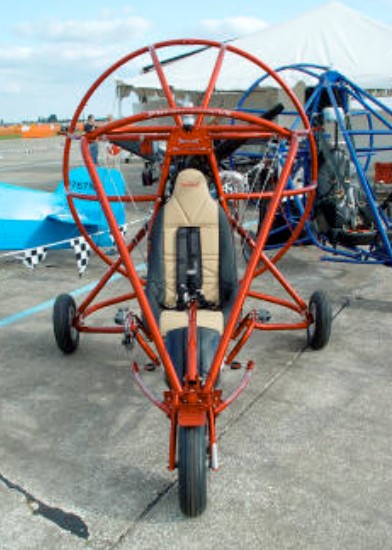
The Powrachute Sky Rascal is a single place sport machine circa 2006. It has a lightweight design, integral frontal fuselage bars, and Rotax engine. With in-House powder coating, the Sky Rascal features an instrument pod, and spun aluminum wheels.
Sky rascal standard features include – Frontal fuselage bars Front fender 3-blade composite prop analogue cht-tach/hour meter (standard for 447-(103 legal only) hydraulic spring-over strut suspension 5 gallon aluminum fuel tank Chute Bag & Line Ceramic Exhaust Basic EIS (Standard for 503) 4-Point Seat Belt Fuel capacity: 6-7 Gal
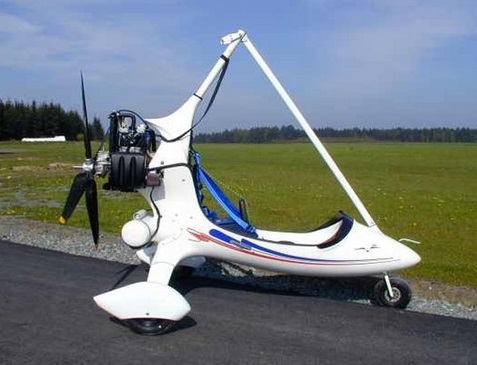
The PowerTrike Evolution is a German ultralight trike, designed and produced by PowerTrike of Mackenbach. The aircraft is supplied as a complete ready-to-fly-aircraft. As of 2014 the design was no longer available.
After a period of indifference, in June 1939 a demonstration of the Power Jets WU was made before a delegation of the Air Ministry, notably Dr Pye, Director of Scientific Research. The demonstration was so successful that the Ministry quickly arranged to buy the engine to give Power Jets working capital, lending it back to them for testing.
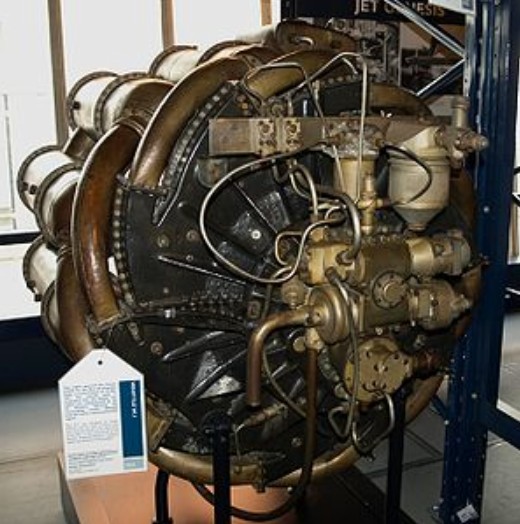
At the same time, a contract was placed for a “flight engine”, the W.1 (sometimes called the Whittle W.1). Designed by Frank Whittle and Power Jets, the W.1 was built under contract by British Thomson-Houston (BTH). Unlike the Whittle WU, that began bench testing in 1937, the W.1 was a symmetrical engine designed to facilitate, after development, installation in an aircraft. The W.1 used a double-sided centrifugal compressor of Hiduminium RR.59 alloy, reverse-flow combustion chambers and a water-cooled axial-flow turbine section; this was later modified to use air-cooling. The turbine blades were of Firth-Vickers Rex 78, a stainless steel developed under Dr. W. H Hatfield.
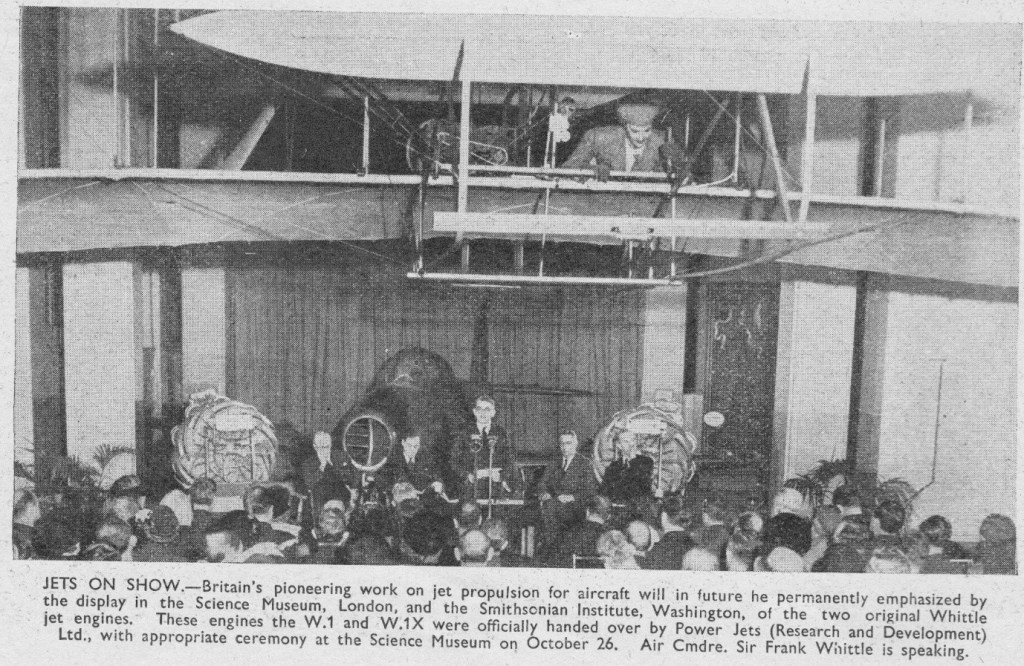
As development of the new design dragged on, it was decided to build a test unit “early engine” using any components that were deemed unairworthy along with test items. This was assembled to become the one-off W.1X.This officially unairworthy unit powered the Gloster E.28/39 on a short ‘hop’ during taxiing trials in April 1941, with flight trials taking place on 15 May 1941 at RAF Cranwell with a definitive W.1 engine.
After a visit to England in 1941, General Henry H. Arnold arranged for the W.1X to be shipped to the U.S, along with drawings for the more powerful W.2B engine. The former became the prototype of the General Electric I-16 and by April 1943 had been developed to produce 1,650 pounds force (750 kgf).
The Gloster E.28/39 and the Power Jets W.1 engine that powered it are both on public display at the Science Museum (London).
November 1949
The W.1A is preserved at the RAF College Cranwell, and the W.1X is at the Smithsonian Institution, Washington DC.
Variants: W.1(T) Bench-testing only.
W.1(3)
W.1X Intended for ground use only (aircraft taxi tests).
W.1A 1,450 lbf (6.45KN) air-cooled turbine disc
Variation: General Electric I-16 American-built version of W.1A. This is the only version of the W.1 to go into mass production.
Specifications: W.1 early development engine Type: Centrifugal flow turbojet Dry weight: 700 lb (320 kg) Compressor: Single-stage double-sided centrifugal flow Combustors: 10 reverse-flow can Turbine: Single stage axial flow Fuel type: Kerosene Maximum thrust: 850 lbf (3.8 kN) at 16,500 rpm Fuel consumption: 1,170 lb/hr (531 kg/h) Specific fuel consumption: 1.376 lb/hr/lb (38.98 g/s·kN) Thrust-to-weight ratio: 1.214:1
W.1 later development engine Type: Centrifugal flow turbojet Dry weight: 700 lb (320 kg) Compressor: Single-stage double-sided centrifugal flow Combustors: 10 reverse-flow can Turbine: Single stage axial flow Fuel type: Kerosene Maximum thrust: ~1,032 lbf (4.59 kN) Overall pressure ratio: ~3.8:1 Turbine inlet temperature: ~1,430 °C (2,610 °F) Fuel consumption: ~1401 lb/hr (~636 kg/h) Specific fuel consumption: ~1.358 lb/hr/lb (~38.47 g/s·kN) Thrust-to-weight ratio: ~1.474:1
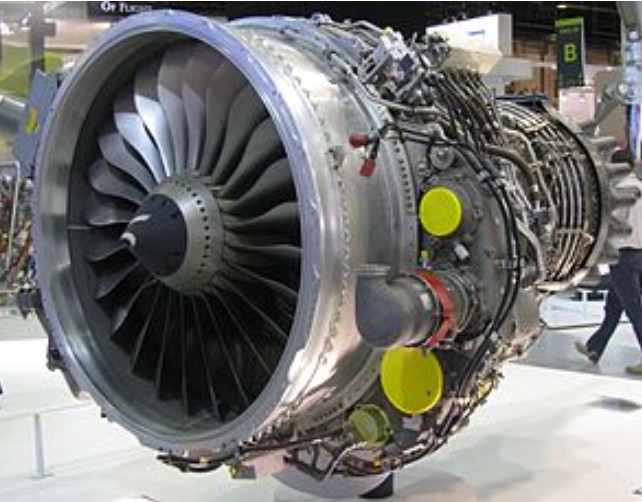
The PowerJet SaM146 is a turbofan engine produced by the PowerJet joint venture between Snecma of France and NPO Saturn of Russia. Snecma is in charge of the core engine, control system (FADEC), transmissions (accessory gearbox, transfer gearbox), overall engine integration and flight testing. The SaM146 design is based on the CFM56 and has been conceived to meet customer requirements regarding fuel burn, cost of operation and dispatch reliability.
The core was developed by Snecma, drawing on its M88 ‘hot section’ military engine experience and the DEM21 core demonstrator project – with its six-stage compressor and single-stage, high-pressure turbine with active blade-tip clearance control – and various other modern design features (such as single-piece bladed disks).
The SaM146 provides 62 to 77.8KN of thrust (6,200 to 7,700 kg). In April 2003, Sukhoi Civil Aircraft Company selected the SaM146 for its Superjet 100 regional aircraft, to be produced in 75 and 95-seat versions. NPO Saturn is responsible for the components in the low pressure section and engine installation on the Sukhoi Superjet 100 regional aircraft and ground testing.
First run in 2008, the SaM146 utilizes a single-stage turbine and as a new design has been developed to meet current and projected environmental standards, including regulations of the ICAO Committee of Aviation Environmental Protection Sixth Session (CAEP VI), set to become effective in 2008.
Blisk technology is used to improve fuel economy and lower maintenance.
On 23 June 2010, it was announced that EASA certified PowerJet for its SaM146 engine. It gained Russian certification in August 2010.
Applications: SaM146 1S15 Sukhoi Superjet 100/75
SaM146 1S17 Sukhoi Superjet 100/95
SaM146 1S18 Sukhoi Superjet 100/95LR
Specifications: SaM146-1S17 Type: Twin spool, High-bypass turbofan Length: 86 in (2.2 m) Diameter: 48.2 in (1.22 m) Dry weight: 1,708 kg (3,765 lb) Compressor: 1 stage fan, 3-stage low pressure, 6-stage high pressure axial compressor Combustors: Annular Turbine: 1-stage high pressure, 3-stage low pressure Fuel type: Jet A, Jet A-1, TS-1, RP Maximum thrust: 76.84 kN (17,270 lbf) (Maximum takeoff thrust) Overall pressure ratio: 23.8:1 Bypass ratio: 4.43:1 Specific fuel consumption: 0.374 lb/lbf-hr (Dry) and 0.629 lb/lbf-hr (Cruise) Thrust-to-weight ratio: 5.3:1
PowerJet is a joint venture between Snecma of France and NPO Saturn of Russia to produce PowerJet SaM146 turbofan engine. Snecma is in charge of the core engine, control system (FADEC), transmissions (accessory gearbox, transfer gearbox), and NPO Saturn is responsible for the components in the low pressure section and engine installation on the Sukhoi Superjet 100 regional aircraft and ground testing.