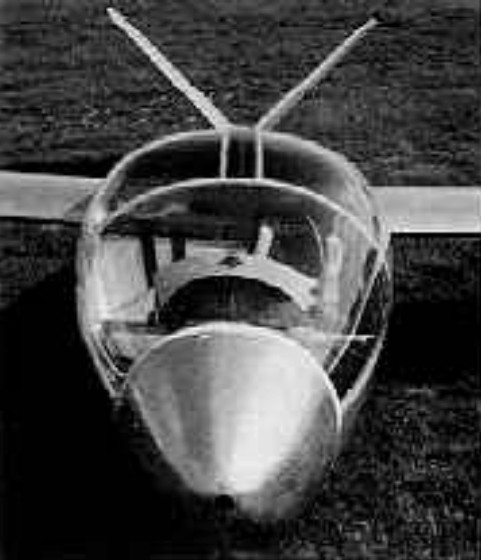
A development of the Preiss RHJ-8 (itself a T-tailed, larger span, improved version of the RHJ- 7), the RHJ-9 is similar to its predecessors, but with a larger span wing. The wing has foam ribs bonded to the aluminum spar and skins with PVC ribs. It first flew in 1978.
Wing span: 18.29 m / 60 ft Wing area: 14.38 sq.m / 154.8 sq.ft Empty Weight: 304 kg / 668 lb Payload: 196 kg / 432 lb Gross Weight: 500 kg / 1100 lb Wing Load: 34.77 kg/sq.m / 6.94 lb/sq.ft L/DMax: 38 MinSink: 0.70 m/s / 2.3 fps / 1.36 kt Aspect ratio: 26.6 Airfoil: Wortmann 63-3-318 Seats: 2
In 1966 Henry Preiss converted an all metal Schreder HP-14 into a 2-place ship with side-by-side seating (two sets of rudder pedals and a center control stick with a bar that swings from one side to the other) and a fixed landing wheel. The design used standard HP-14 wings with a 2-ft center section added in the fuselage.
Predappio sa, a division of the Caproni Group, produced two trainers in the late 1930s, the Ca.602 two-seat biplane and a single-seat aerobatic version, the Ca.603, both powered by Alfa-Romeo in-line engines.
Italy Predappio sa, a division of the Caproni Group, produced two trainers in the late 1930s, the Ca.602 two-seat biplane and a single-seat aerobatic version, the Ca.603, both powered by Alfa-Romeo in-line engines.
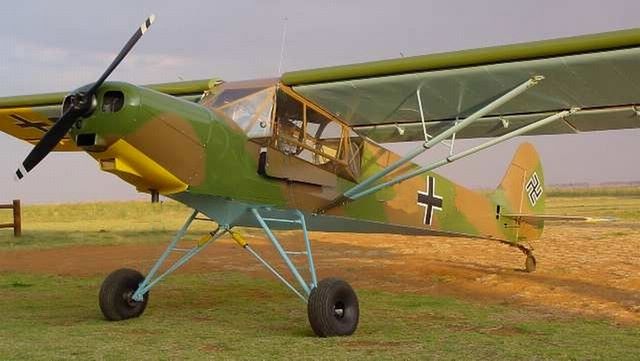
The LSA STOL King is of conventional tube and fabric design, approximately the size of a Cub, with a full glass enclosure and a tall stance for very rough field operation. Slow flights of 16 mph can be achieved and stall speeds of 15 mph let you land in some of the most remote areas of the world.
The construction material are 4130 steel tube & fabric and wing sub-kits come with ailerons, flaps, all hardware, brackets, fittings, fuel tanks, ribs, skins, spars and lift struts. No fabric.
Fuselage sub-kits come with stabilizers, elevators, rudder, landing gear, seat cusions, control systems, all glass, blank instrument panel, wheels and brakes, tailwheel, stringer formers, shock struts, brackets, fittings, firewall and all hardware and necessary accessories. No fabric or instruments.
Firewall forward package comes with engine, exhaust stacks, intake manifolds, carb heat, engine mount, prop, carburetor and hardware Engine prices will vary depending on model, horsepower and electrical option.
In 2009 the complete kit cost US$25,000 less engine, instruments, fabric, prop.
Engine: 75 hp Horsepower: 75 – 150 hp Propeller: 72 x 43 Overall length: 23 ft – 8 in Height: 7 ft – 3 in Wingspan: 31 ft – 6 in Wing area: 158 square feet Wing loading: 7.6 lb/sq.ft Empty weight: 600 lbs Gross weight: 1200 lbs Useful weight: 600 lbs Fuel capacity: 20 + US gallons Cabin width: 32.50 inches Ultimate “g” loading: +6.0 – 3.0 Best speed: 100 mph Cruise speed: 90 mph Stall Speed @ Gross w/Full Flaps: 15 mph Service ceiling: 12,000 Takeoff distance: 50 ft Landing distance: 50 ft Rate of Climb (gross): 1200 fpm Maximun range: up to 700 miles Landing gear: FG (Tailwheel) Seats: 2
Engine: 120 hp Horsepower: 75 – 150 hp Propeller: 72 x 43 Overall length: 23 ft – 8 in Height: 7 ft – 3 in Wingspan: 31 ft – 6 in Wing area: 158 square feet Wing loading: 7.6 lb/sq.ft Empty weight: 600 lbs Gross weight: 1200 lbs Useful weight: 600 lbs Fuel capacity: 20 + US gallons Cabin width: 32.50 inches Ultimate “g” loading: +6.0 – 3.0 Best speed: 130 mph Cruise speed: 100 mph Stall Speed @ Gross w/Full Flaps: 15 mph Service ceiling: 12,000 Takeoff distance: 50 ft Landing distance: 50 ft Rate of Climb (gross): 1200 fpm Maximun range: up to 700 miles Landing gear: FG (Tailwheel) Seats: 2
Engine: VW 50 hp HP range: 75-130 Length: 24 ft Wing span: 31.5 ft Wing area: 158 sq.ft Empty weight: 600 lb Gross weight: 1200 lb Fuel capacity: 20USG Cruise: 100 mph Stall: 15 mph Range: 520 sm Rate of climb: 1200 fpm Takeoff dist: 50 ft Landing dist: 50 ft Cockpit width: 33 in Seats: 2 tandem Landing gear: tailwheel
Markets plans and kits to build the N-3 Pup single-seat microlight representation of a Piper Cub, the Sport as a lighter version of Pup, the L-4 Super Pup as a more-powerful version of Pup, and the two-seat Ultra Pup, and kits for the Stinger single-seat parasol-wing monoplane (first flown 1995). Also produced the Storch Replica.
1995: 1230 Shepard St, Hendersonville, NC 28792, USA.
A never-completed 250 foot rigid airship, 24 feet in diameter, under construction during 1909-1910 by the Preble-Rekar Airship Company of Portland, Oregon.
Its dimensions were to have been 250 feet in length and 25 feet in diameter. Apparently bankrolled by Oregon investors, the Preble-Rekar Airship Company of C. H. Preble and J. J. Rekar (Rekar of San Francisco, CA), set up shop in Portland. The structure was made of spruce and no nails or bolts were used.
The Pratt & Whitney Canada PT6T Twin-Pac is a turboshaft engine designed for helicopters. Manufactured by Pratt & Whitney Canada, its first application was in the Bell 212 and UH-1N Twin Huey helicopter family. The PT6T Twin-Pac consists of two PT6 power turbines driving a common output reduction gearbox, producing up to 2,000 hp at 6,000 rpm. The engine is designated T400 by the U.S. military.
The U.S. military came very close to not procuring the UH-1N Twin Huey because of the PT6T. The purchase of the aircraft for U.S. military use was opposed by the Chairman of the House Armed Services Committee at the time, Mendel Rivers. Rivers took this position because the PT6T was produced in Canada. The Canadian government had not supported U.S. involvement in Vietnam, and had opposed U.S. policies in southeast Asia, as well as accepting U.S. draft dodgers. Rivers was also concerned that procurement of the engines would result in a negative trade deficit situation with Canada. Congress only approved the purchase when it was assured that a U.S. source would be found for the PT6T engines. This source was Pratt & Whitney Engine Services in Bridgeport, West Virginia, which was established in 1971 to assemble and test new T400-WV-402 engines. As a result, the U.S. military ordered 294 Bell 212s under the designation UH-1N, with deliveries commencing in 1970.
Variants: PT6T-3 Basic production model
PT6T-3A Same as the PT6T-3 but with aluminum (instead of magnesium) gearbox casting, No longer used.
PT6T-3B Same as the PT6T-3, except for the single power section contingency ratings and has PT6T-6 compressor turbine components.
PT6T-3BE Same as the PT6T-3B with the removal of the torque sharing function in the torque control and is a PT6T-3BE gearbox fitted with two PT6T-3B power sections.
PT6T-3BF Similar to the PT6T-3B, except 30-minute one engine inoperative (OEI) rating is equivalent to the 2½ minute OEI rating.
PT6T-3BG Similar to the PT6T-3BE, except 30 minute OEI rating is equivalent to the 2½ minute OEI rating.
PT6T-3D Same as the PT6T-3B, except for improved hot section hardware to allow for increased ratings.
PT6T-3DE Same as the PT6T-3D, except the continuous OEI rating is replaced by a 30 minutes rating.
PT6T-3DF Same as the PT6T-3DE, except for improved hot section hardware to allow for increased ratings.
PT6T-6 Same as the PT6T-3, except for the 2½ min rating and higher ratings and improved engine parts.
PT6T-6B Same as the PT6T-6 with the removal of the torque sharing function in the torque control and is a PT6T-6B gearbox with two PT6T-6 power sections.
PT6T-9 Similar to the PT6T-3DF, except for an improved hot section and it is equipped with an engine electronic control system.
T400-C-400 Military PT6T-3
T400-CP-401 Military variant used on the VH-1N variant of the UH-1N.
T400-WV-402 Military PT6T-6, assembled by Pratt & Whitney Engine Services, Inc. in West Virginia
Applications: AH-1J and AH-1T SeaCobra Bell 212 Bell 309 Bell 412 CH-146 Griffon UH-1N Twin Huey Sikorsky S-58T Sikorsky S-69