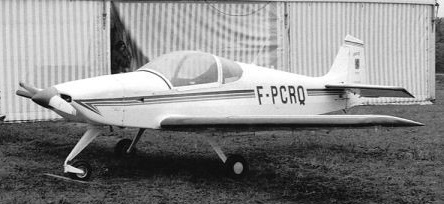
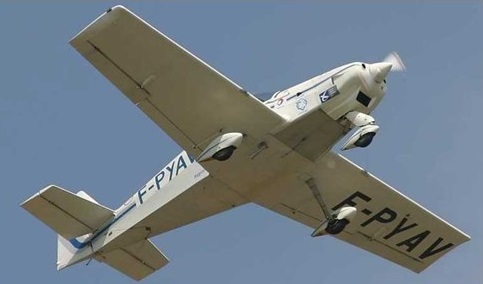
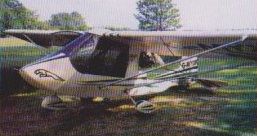
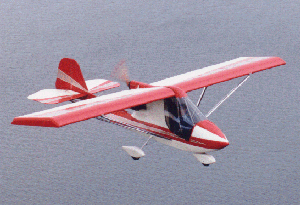
The CQR-1 two-seat homebuilt aircraft was more or less a scaled-up development of the Roussoulières Occitan and was a design of Louis Cariou, former RSA President.
The prototype CQR-1 was constructed by the RSA at Centre Régional de Construction Aéronautique Amateur Quercy-Rouergue (CQR) under the leadership of Charles Roussoulières and it flew for the first time on March 2, 1997. This aircraft was powered by a 90 hp Limbach L2400EO3 engine.
A second very similar aircraft was also completed in France in 1998 or 1999 and by late 2010 at least 6 were constructed.
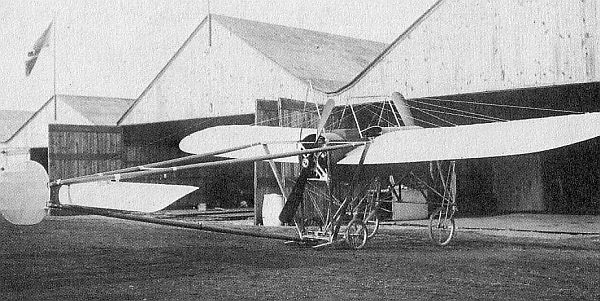
Taken at Mineola airfield, the Queen Speed Monoplane / Double Gnome Monoplane; fitted with two Gnôme rotary engines of 50 hp – the two bladed propellers driven in opposite direction to prevent torque. Its design influenced by the Blériot monoplane (Queen built Blériot XI monoplanes under license at the time), the twin engine construction was thought to be safer, that in the case of malfunction of one, flight could continue using the other. The machine was financed by the banker Willis McCormick, who was president of the New York Aeronautical Society. Built in Fort George, New York in 1911, its first flight was made by Frank Stone on July 10, 1911. Unfortunately the machine was unstable during the climb, turned and crashed, injuring the fearless Stone. The machine was ruined, never to fly again.
A two place version of the Challenger. This is a 2 seat high wing pusher microlight with a semi-enclosed cabin with a factory built airframe. All U.S. tubing. 10-15 minute set up time.
The Challenger II features two-seats and a 31.5 ft wingspan long wing. The Challenger II qualifies as a 51% kit for Experimental – Amateur-Built, can be flown with Sport Pilot Permit, and qualifies as Light Sport Aircraft.
In 2010 quick-build kits were from US$11,940 to US$16,035 ex engine with engine options being the Rotax 447, 503, 582 and HKS 700E.
The Challenger II Special is a 2 place with a 26 ft wingspan for quick roll rate and up 95 mph cruise speed. With a 30 mph cross-wind capability and 300 ft take-off roll (average dual), the Challenger II Special qualifies as a 51% kit for Experimental – Amateur-Built, can be flown with Sport Pilot Permit, and qualifies as Light Sport Aircraft.
Challenger II Special
In 2010 quick-build kits were from US$13,165 to US$16,035 ex engine and engine options were the Rotax 447, 503, 582 and HKS 700E.
A version released in the UK circa 1998 was revised by Mike Whittaker.
The Challenger Special is a single seat, clipped wing version, for a quicker roll rate. It qualifies as a 51% kit for Experimental – Amateur-Built, can be flown with a Sport Pilot Permit. And qualifies as a Light Sport Aircraft.
In 2010 quick-build kits were from US$10,215 to US$12,965 ex engine, and engine options include the Rotax 447, 503, 582 and HKS 700E.
The all have a 30 mph cross-wind capability and 200 ft take-off roll.
Engine: Rotax 447, 42 hp HP range: 42-50 Height: 6 ft Length: 18 ft Wing span: 26 ft Wing area: 117 sq.ft Weight empty: 270 lb Gross: 550 lb Fuel cap: 5 USG Speed max: 100 mph Cruise: 85 mph Range: 160 sm Stall: 32 mph ROC: 1000 fpm Take-off dist: 200 ft Landing dist: 200 ft Service ceiling: 14,400 ft Seats: 1 Landing gear: nose wheel Cockpit width: 24 in