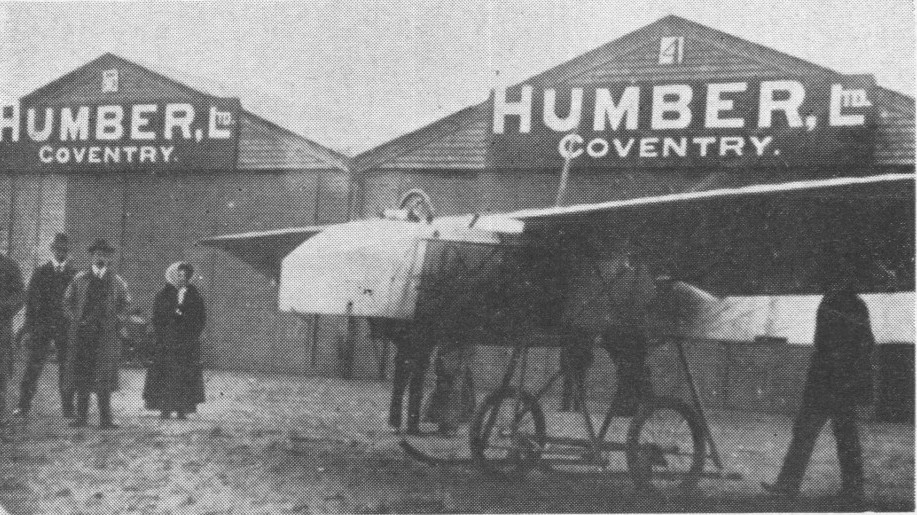
Edward and Henry Petre, both famous pilots, built this monoplane, with a propeller behind its tail, in 1909.
It did not fly.
Edward and Henry Petre, both famous pilots, built this monoplane, with a propeller behind its tail, in 1909.
It did not fly.
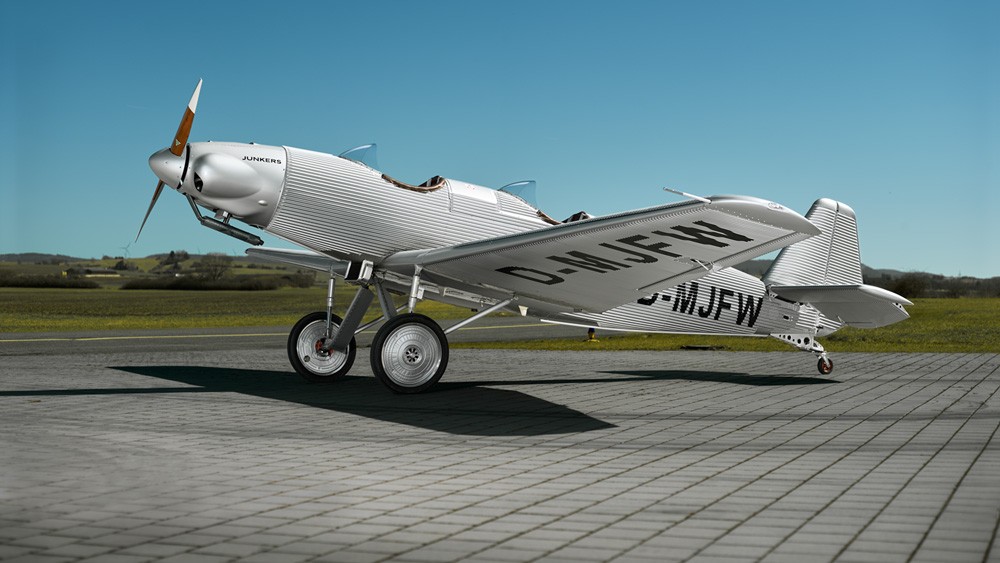
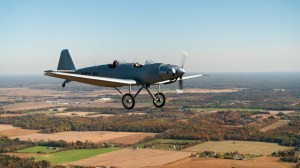
The Junkers Aircraft A50 Junior is a sleek, light sport two-seater that merges the pioneering spirit and flair of the 1930s with the very latest aviation technology and safety.
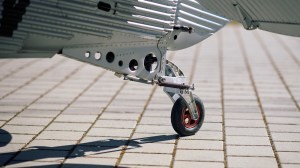
Inspired by the A50 Junior that first took flight back in 1929, this reborn, reimagined successor features the signature corrugated, lightweight aluminum skin, oval fuselage cross-section, twin-blade wooden propeller, and even the spoked wheels of the iconic original.
It’s a brand-new, fully certified model, handcrafted by Junkers Aircraft GmbH in Oberndorf, Germany.
Powering the A50 Junior is the proven and ultra-dependable, Rotax 912iS fuel-injected, 4-cylinder engine producing 100 hp.
It gives the lightweight, 1,323-pound (827 pounds empty) A50 a top speed of 112 knots and relaxed cruising at 84, coupled with an impressive fuel economy. With its 27-gallon (US) tank full, the A50 has a range of over 770 miles, sipping fuel at the rate of just four gallons an hour.
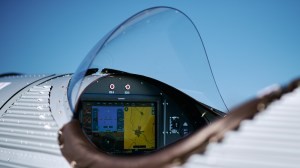
Built-in safety comes from the stiffness and rigidity of the fuselage, the integrated Galaxy ballistic parachute rescue system, Beringer brakes, and the latest Garmin G3X avionics with a 10.6-inch pilot touchscreen for advanced navigation.
It takes over 2,500 hours it takes to build one, to the more than 1,000 hand-built components—98 percent of which are crafted in-house—to the over 10,000 hand-applied rivets used in construction.
Like the 1929 original, the A50 Junior is defined by its streamlined, corrugated aluminum skin, designed to provide strength and rigidity while giving the aircraft a truly unique look.
The twin cockpit layout puts the pilot in the rear and the co-pilot up front, with rounded, frameless windshields for protection. Each cockpit features hand-stitched leather trim for comfort and style, while to personalize each A50 Junior, there’s a choice of six distinctive, art deco–style exterior colors. Everything from white aluminum, to carrara white, to bold saffron yellow and papaya metallic, to cool frozen blue and black metallic. Flying goggles and a leather helmet are custom to the pilot.
For true authenticity, JUNKERS also offers an A50 Heritage model, powered by a 124 hp Verner Scarlett 7U radial engine with old-school analog gauges. It comes standard as a single seater, with the option of a second seat up front.
Since the launch of this new A50 Junior in 2022, production has been centered on JUNKERS’ main facility in the heart of Germany’s Black Forest. But that was about to change with the opening of the company’s new manufacturing space in Battle Creek, Michigan.
Junker’s parent, DIMOR Group, headed up by passionate aviator and chairman Dieter Morszeck, was investing $12 million to add over 45,000 square feet of space to its existing Waco Aircraft Corporation campus, bringing the total to over 150,000 square feet, to manufacture Junkers Aircraft A50 Junior.


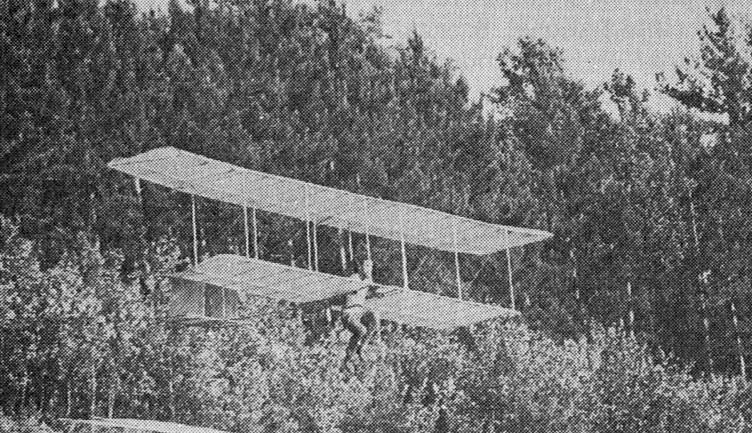
In the ski areas of New England, USA, Terry Sweeney of New Hampshire experimented with some Chanute typ. He and some friends made many flights, learned much and had fun. Their gliders replaced the older airfoils with more modern versions.
On the east coast, USA, in the summer of 1970, Robert G. Mixon of Miami, Florida, built and flew a Chanute-type biplane based on a plan found in a 1909 Popular Mechanics.
The local paper ran a front page headline “Those Magnificent Men In Their Flying Machine” on 15 June 1970. A local TV station even took some footage of a cliff launch. Mixon did it out of frustration due to the high cost of conventional flying.
Later, he offered plans, because of a large number of requests for his story which appeared in the February 1971 issue of Sport Aviation.

Richard Miller and his Conduit Condor was the highest performing hang glider at the first Universal Hang Glider Championships of 23 May 1971.
Pelzner was a builder of doppeldecker hangegleiter. In 1921 and 1922 he carried off many prizes. He built all his own craft and developed a simple structure that proved strong enough to carry him safely on flight after flight without serious mishap, yet light enough for him to control flight by bodily movements, changing the centre of gravity to trim the aircraft and overcome the upsetting effect of gusts or turbulence.
Pelzner’s gliders were astonishingly cheap despite financial trouble and inflation in Germany they cost him less than 20 marks to build. Derigged, they were small enough to be loaded onto a passenger train as traveller’s luggage at no extra charge; the parcel measured about 2.7m long, 1.3 m high, but only 50 cm thick.
The various Pelzner gliders differed a good deal in size and detail, although all were built roughly to the same basic scheme. The earlier models were built smaller and very light; 5.4 m span with total wing area of 14 sq.m. The weighed less than 10 kg. The later types spanned up to 7 m with areas of 16.5 sq.m, and weighed twice as much. Probably as Pelzner’s skill improved he was able to control bigger and more efficient gliders.
The framework was two tapered longerons, a shoulder width apart, running fore and aft with the lower wing main spars running cross wise and attached with bolts. At the rear these two main members were drawn together to support the tail unit, and from the tail to the upper end of the main wing struts two diagonal members ran. This basic framework was of oval or streamlined section timber, 2.5 cm by 4 cm in cross section where the loads were greatest, thinning down to 2 x 3 cm elsewhere. The upper and lower wings both had two spars, the front spars being 4 cm by 0.5 cm section, the rear spars 3.5 x 0.8 cm on the lower wing and 3.6 x 1.1 cm on the upper. Light curved ribs were bound to the spars, and the two wings were joined by light vertical struts, the outer ones being spindled I section to save weight. The whole structure was braced with wire.
Pelzner covered his surfaces with oiled paper, glued onto the underside of the ribs of wing and tail. The leading edge of the lower wing was formed by the front spar, but the upper wing apparently had a light front member of wood or wire which gave a stiff entry to the primitive aerofoil. Some models had double thickness paper covering around the leading edge. The earliest models had no movable control surfaces at all, but later Pelzner fitted a rudder which he controlled by means of a sling around his right hand – a forward movement for a left turn, a backwards push for a right turn.
To manage these craft Pelzner worked out an athletic style of flying. At the 1921 meeting he accumulated a total flying time of 38 minutes, higher than any other pilot. He did this in a total of 62 flights aeraging over a half a minute each, some of them covering 400 and 500 m at his best glide ratio of about 6 to 1. In cash prizes he paid for his gliders hundreds of times over.
After monoplane glider flights the future was clearly not biplanes. Pelzner played little in the subsequent development of gliding.

 All Aero