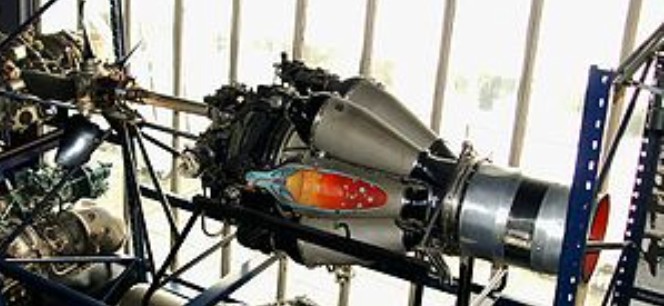
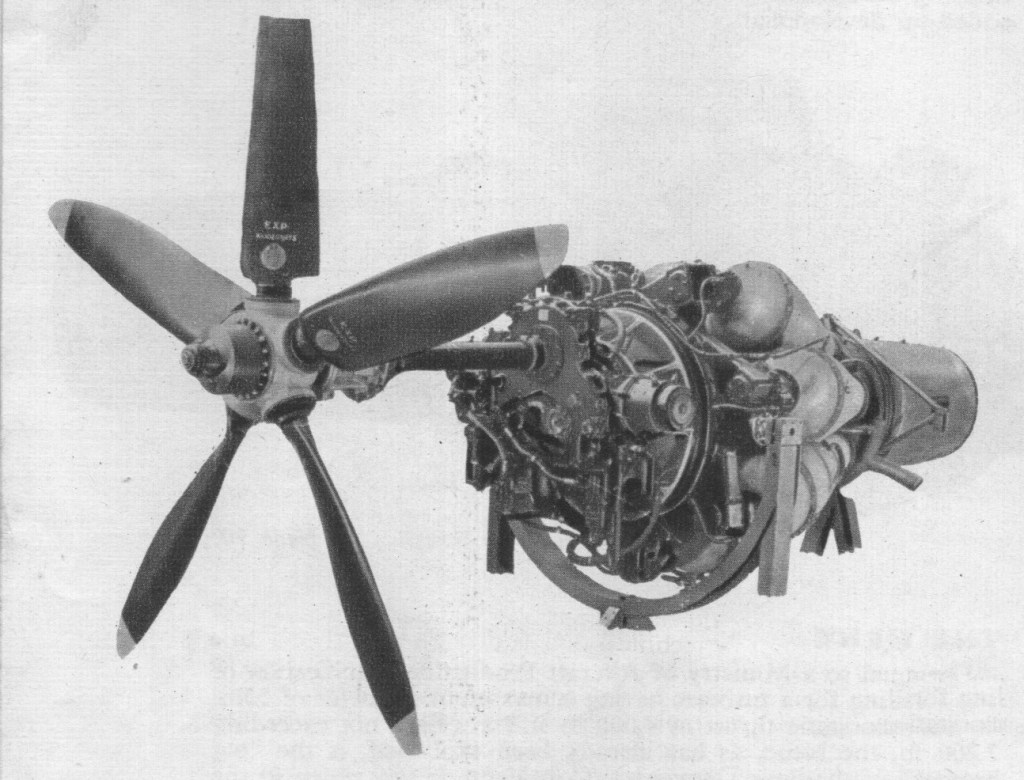
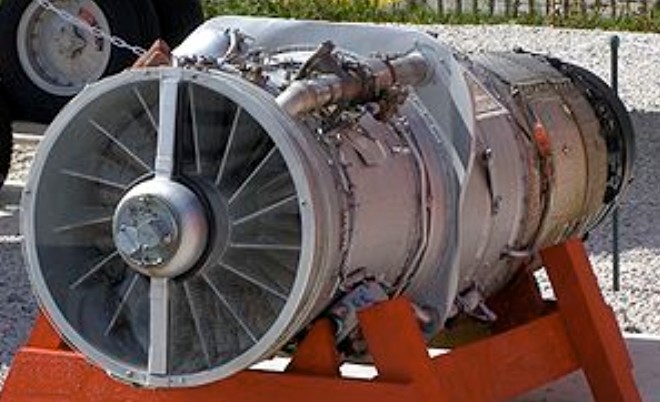
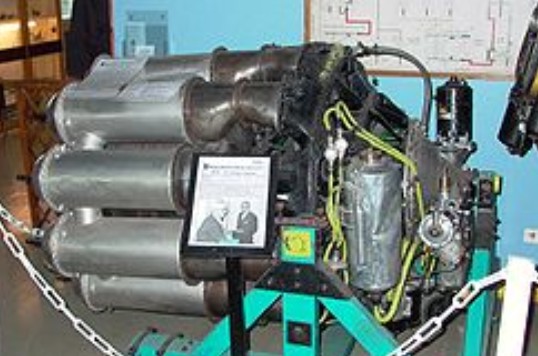
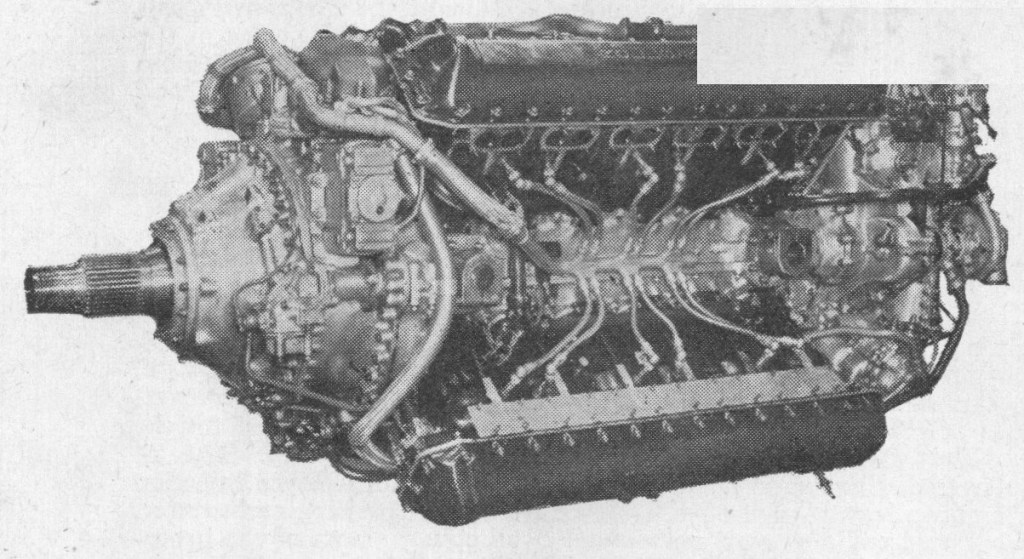
The Trent was based on a concept provided by Sir Frank Whittle and was essentially a Derwent Mark II turbojet engine with an additional turbine stage driving a reduction gearbox (designed by A A Rubbra) connected to a five-bladed Rotol propeller. Experimental work with the Trent (RB.50) actually dated back to May 1944, when a WelIand was equipped with a spur-type reduction gear and tested for shaft horsepower. First run in June 1944, the Trent ran for 633 hours on test before being installed in a Gloster Meteor (Trent Meteor) jet fighter which flew for the first time on 20 September 1945 at the start of a programme comprising 298 hours of flight tests.
The Rolls-Royce RB.50 Trent was the first Rolls-Royce turboprop engine.
Trent Type: Turboprop Dry weight: 1,000lb turbine unit, reduction gear 250lb, propeller 250lb, total engine/propeller weight 1,500lb Compressor: 1-stage double-sided centrifugal compressor Combustors: 10 x can combustion chambers Turbine: Single-stage axial Fuel type: Kerosene (R.D.E.F./F/KER) Oil system: pressure feed, dry sump with scavenge, cooling and filtration, oil grade 150 S.U. secs (32 cs) (Intavia 7106) at 38 °C (100 °F) Maximum power output: 750 shp, with 1,250 lb (570 kg) residual thrust
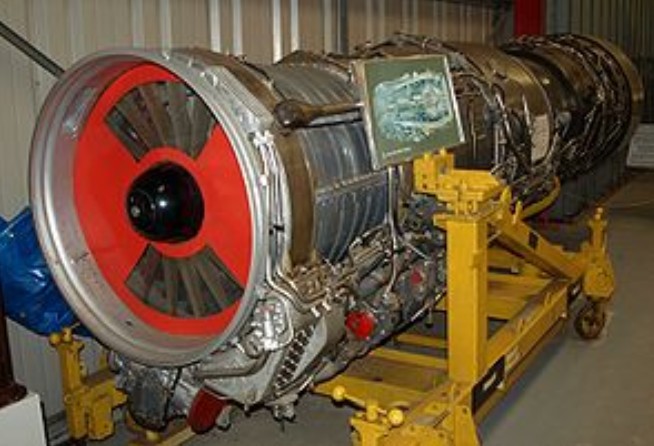
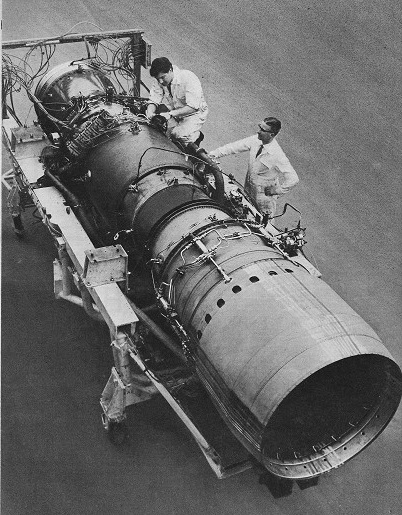
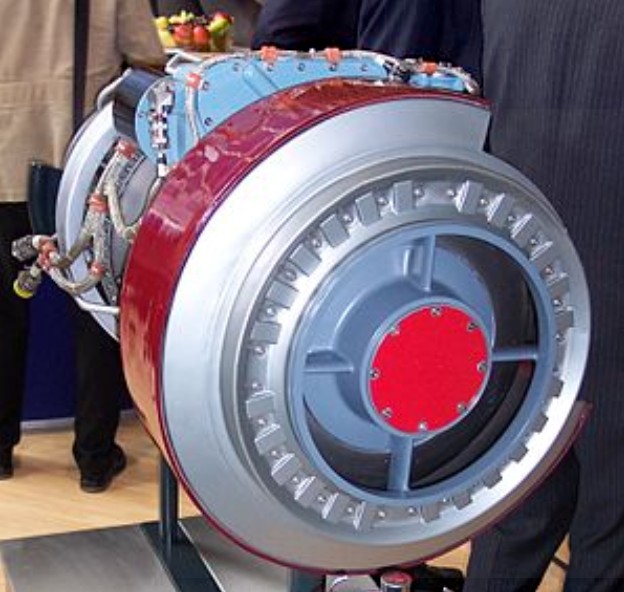
In 1954 Rolls-Royce introduced the first commercial bypass engine, the Rolls-Royce Conway, with a 21,000 lbf (94 kN) thrust aimed at what was then the “large end” of the market. This was far too large for smaller aircraft such as the Sud Caravelle, BAC One-Eleven or Hawker Siddeley Trident which were then under design. Rolls then started work on a smaller engine otherwise identical in design, the RB.163, using the same two-spool turbine system and a fairly small fan delivering bypass ratios of about 0.64:1. In keeping with Rolls-Royce naming practices, the engine is named after the River Spey.
The first versions entered service in 1964, powering both the 1-11 and Trident. Several versions with higher power ratings were delivered through the 1960s, but development was ended nearing the 1970s due to the introduction of engines with much higher bypass ratios, and thus better fuel economy. Spey-powered airliners continued in widespread service until the 1980s, when noise limitations in European airports forced them from service.
In the late 1950s the Soviet Union started the development of a new series of large cruisers that would put the Royal Navy at serious risk. After studying the problem, the RN decided to respond in a “non-linear” fashion, and instead of producing a series of new cruisers themselves, they would introduce a new strike aircraft with the performance needed to guarantee successful attacks on the Soviet fleet. The winning design was the Blackburn Buccaneer, which had an emphasis on low altitude performance (i.e. to evade enemy radar) as opposed to outright speed.
Flying at low altitude, in denser air, requires much more fuel; the air-fuel mixture in a jet engine needs to be kept very close to a constant value to burn properly, and more air requires proportionally more fuel. This presented a serious problem for aircraft such as the Buccaneer, which would have had very short range unless the engines were optimised for low-level flight. The early pre-production versions, powered by the de Havilland Gyron Junior, also proved to be dangerously underpowered.
Rolls-Royce attacked this problem by offering a militarized version of the Spey, which emerged as the RB.168. The resulting Spey-powered Buccaneer S.2 served into the 1990s. The Spey proved so successful in this role that it was produced under license, and developed, in the United States as the TF41 and F113, and was used in a number of British and US designs.
The British versions of the McDonnell Douglas F-4 Phantom II F-4K (designated Phantom FG.Mk.1) replaced the 16,000 lb thrust J79 turbojets with a pair of 12,250 lb thrust dry and 20,515 lb thrust with afterburning RB.168-15R Spey 201 turbofans. These provided extra thrust for operation from smaller British aircraft carriers, and provided additional bleed air for the boundary layer control system for slower landing speeds. The air intake area was increased by twenty percent, while the aft fuselage under the engines had to be redesigned. Compared to the original turbojets, the afterburning turbofans produced a ten and fifteen percent improvement in combat radius and ferry range, respectively, and improved take-off, initial climb, and acceleration, but a lower top speed.
Spey 25
A fully updated version of the military RB.168 was also built to power the AMX International AMX attack aircraft. A licensed version built by the XAEC is known as the WS-9 Qin Ling.
With the need for a 10,000 to 15,000 lbf (44 to 67 kN) thrust class engine starting up again with the removal of the Spey from service, Rolls then used the Spey turbomachinery with a much larger fan to produce the Rolls-Royce Tay.
A total of 2,768 were built.
Variants: RB.163-1 RB.163-2 RB.163-2W RB.163 Mk.505-5 RB.163 Mk.505-14 RB.163 Mk.506-5 RB.163 Mk.506-14 RB.163 Mk.511-8 Gulfstream II and Gulfstream III (USAF designation F113-RR-100 for the Gulfstream C-20) RB.163 Mk.512-14DW BAC One-Eleven AR 963 (RB.163) Boeing 727 (proposed); it was to have been built under licence by Allison F113-RR-100 US military designation for the Mk.511-8 engines fitted to the Gulfstream C-20. RB.168-62 RB.168 Mk.101 (Military Spey) Blackburn Buccaneer RB.168 Mk.202 (Military Spey) McDonnell Douglas F-4 Phantom II modified F4J for British service (“Phantom FG1”). (surplus engines were purchased and used by Richard Noble for the Thrust SSC land speed record car of 1997.) RB.168 Mk.250 (Military Spey) Hawker Siddeley Nimrod MR1/MR2 RB.168 Mk.251 (Military Spey) Hawker Siddeley Nimrod R1 and AEW RB.168 Mk.807 AMX International AMX, built under licence by FiatAvio WS-9 Qin Ling (Mk 202) powering the Xian JH-7 (Xian FBC-1 Flying Leopard) AR 168R Joint development with Allison Engine Company for the TFX competition (won by the Pratt & Whitney TF30 Allison TF41 (RB.168-62 and Model 912) LTV A-7 Corsair II (USAF -D and US Navy -E models), licence built by the Allison Engine Company RB.183 Mk 555-15 Spey Junior Fokker F28
First run in December 1967, the Rolls-Royce RB.203 Trent was a British medium-bypass turbofan engine of around 10,000lb thrust, bearing no relation to the earlier Rolls-Royce RB.50 Trent turboprop or the later high bypass Rolls-Royce Trent turbofan.
The RB.203 was a private venture engine based around the core of the Rolls-Royce Turbomeca Adour turbofan used in the SEPECAT Jaguar and the later Hawker Siddeley Hawk.
The RB.203, the first three-spool engine, was intended as a civilian replacement for the earlier Rolls-Royce Spey.
Type: Three-spool medium bypass turbofan Length: 82.2 in (208.8 cm) Diameter: 38.7 in (98.3 cm) Dry weight: 1,751 lb (794 kg) Compressor: Single-stage fan, four-stage intermediate pressure, five-stage high pressure Combustors: Annular chambers Turbine: Single-stage high pressure, single-stage intermediate, two-stage low pressure Maximum thrust: 16000 lb (71.4 kN) Overall pressure ratio: 16:1 Bypass ratio: 3:1 Thrust-to-weight ratio: 5.55:1
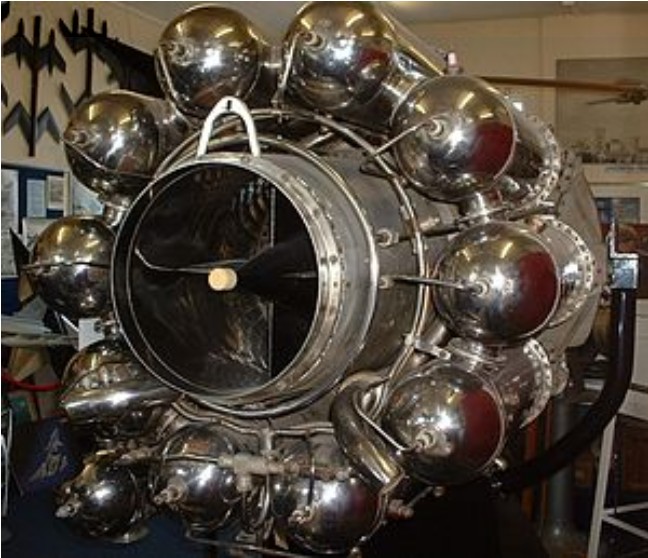
The Rolls-Royce RB.162 was a simply constructed and lightweight British turbojet engine produced by Rolls-Royce Limited. Developed in the early 1960s, the RB.162 was designed to meet an anticipated need for a lift engine to power VTOL aircraft with the emphasis on simplicity, durability and lightweight construction. Development costs were shared by Britain, France and Germany after signing a joint memorandum of agreement. The engine featured fibre glass compressor casings and plastic compressor blades to save weight which also had the effect of reducing production costs. The engine has no oil system, a metered dose of oil instead being injected into the two main bearings by the compressed air used to turn the compressor at startup. Although the RB.162 was a successful design the expected large VTOL aircraft market did not materialise and the engine was only produced in limited numbers.
In 1966 British European Airways (BEA) had a requirement for an extended range aircraft to serve Mediterranean destinations. After a plan to operate a mixed fleet of Boeing 727 and 737 aircraft was not approved by the British Government Hawker Siddeley offered BEA a stretched and improved performance version of the Trident that they were already operating. This variant, the Trident 3B, used, in addition to its three Rolls-Royce Spey turbofan engines, a centrally mounted RB.162-86 which was used for takeoff and climb in the hot prevailing conditions of the Mediterranean area. The ‘boost’ engine was shut down for cruising flight. Some conversion was needed for the change from vertical to horizontal installation. With the RB.162 fitted the Trident 3B had a 15% increase in thrust over the earlier variants for an engine weight penalty of only 5%.
First run in January 1962, only 86 were built.
A design study for a turbofan version of the RB.162 was designated RB.175. Another projected derivative, the RB.181 was to be a scaled down version of the RB.162 producing approximately 2,000 lbs of thrust. Seven of these lift engines were to power the unbuilt Lockheed/Short Brothers CL-704 VTOL variant of the F-104 Starfighter.
First run in 1953, the Rolls-Royce RB.106 was an advanced military turbojet engine by Rolls-Royce and was sponsored by the Ministry of Supply.
A two-shaft design with two axial flow compressors each driven by its own single stage turbine and reheat, it was of similar size to the Rolls-Royce Avon, allowing it to be used as a drop-in replacement, but it would have produced about twice the thrust at 21,750 lbf (96.7 kN). The two-shaft layout was relatively advanced for the era; the single-shaft de Havilland Gyron matched it in power terms, while the two-spool Bristol Olympus was much less powerful at the then-current state of development. Apart from being expected to power British aircraft such as those competing for Operational Requirement F.155 it was selected to be the powerplant for the Avro Canada CF-105 Arrow. However funding was cut with the 1957 Defence White Paper which terminated most aircraft development then under way. The Arrow moved to an indigenous two-spool design similar to the RB.106, the Orenda Iroquois.
A scaled-up version of the RB106 intended for F.155 was the Rolls-Royce RB122. The RB.106 project was cancelled in March 1957, at a reported total cost of £ 100,000.
RB.106 Type: Two-shaft turbojet Compressor: axial flow; LP followed by HP Turbine: axial flow; HP single stage; LP single-stage Maximum thrust: 21,750 lbf (96.7 kN)
The Rolls-Royce Turbomeca RTM322 is a turboshaft engine produced by Rolls-Royce Turbomeca Limited, a joint venture between Rolls-Royce plc and Turbomeca. The engine was designed to suit a wide range of military and commercial helicopter designs. The RTM322 can also be employed in maritime and industrial applications.
The first order for the RTM322 was received in 1992 to power 44 Royal Navy Merlin HM1s which subsequently entered service in 1998. According to Rolls-Royce 1,500 engines are made or ordered, and about 80% of AW101’s use the engine.
The Rolls-Royce/MAN Turbo RB.193 was a vectored thrust turbofan engine joint development project by Rolls-Royce/MAN Turbo originally designed to meet a requirement for the VFW VAK 191B project. Design work commenced after a contract from the Federal German Ministry of Defence was signed in December 1965. Bristol Siddeley (from 1966 part of Rolls-Royce) were sub-contracted to manufacture components for the engine.
The design was similar in concept and closely related to the earlier Bristol Siddeley Pegasus, employing the same layout of ‘hot’ and ‘cold’ pairs of rotating thrust nozzles, internal airflow was the same as the Spey. Tethered flight testing of the VFW VAK 191B commenced in 1966 with the first free hovering flight taking place at Bremen in October 1971. The aircraft later successfully transitioned from hovering to forward flight at Manching in October 1972. Production did not follow after cancellation of the associated aircraft project. By the end of the test programme in 1975 the RB.193 had accumulated 12 hours of flight time and 91 flights and cost £8,000,000 (1966).
A VFW VAK 191B aircraft fitted with an RB.193-12 is on display at the Deutsches Museum Flugwerft Schleissheim, panels have been removed to allow viewing of the rotating nozzle and mechanisms.
Specifications:
RB.193-12 Type: High bypass twin-spool turbofan Diameter: 33 in Dry weight: 1,742 lb (790 kg) Compressor: Axial compressor, 3-stage fan, 2-stage LP, counter-rotating 6-stage HP Turbine: 3-stage LP, Single-stage air cooled HP Maximum thrust: 10,163 lb (4,610 kg)
The Rolls-Royce/MAN Turbo RB.153 was a high-performance 6,850 pounds-force (3,110 kgf) dry thrust turbofan engine developed jointly by Rolls-Royce Limited and MAN Turbo. Developed for the German EWR VJ 101D interceptor with a German-developed thrust-deflector system and first run in January 1963. The engine was also proposed for a number of other military VTOL projects including the Hawker P.1157. A commercial-version of the engine was also considered for the Messerschmitt Me P.160 airliner. The VJ101D project was cancelled and the engine never flew, being retained as a test bed.
In 1940 the Air Ministry placed a contract with the Gloster Aircraft Company for prototypes of a new twin-engined jet fighter aircraft to the requirement of F.9/40, this aircraft became the Gloster Meteor. At the same time Power Jets was authorised to design a new engine that was intended to power the same aircraft. The W.2 was built under contract by the Rover Car Company in the early 1940s. It was originally intended to be produced by Rover as the W.2B/23.
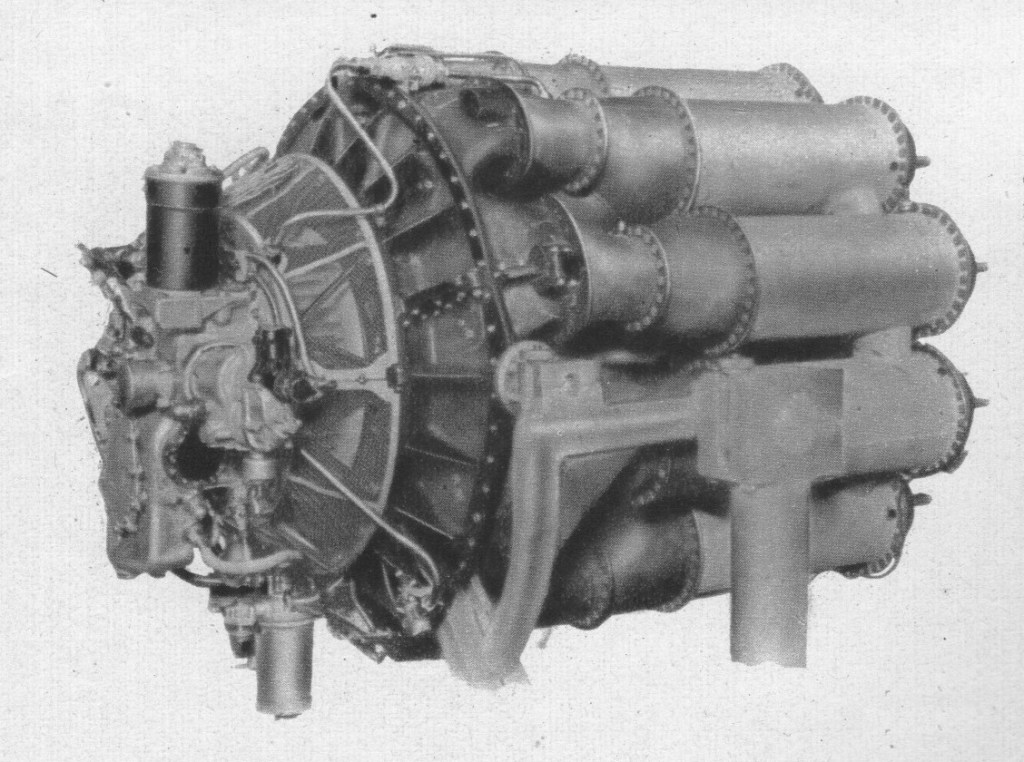
The W.2 was basically a larger version of Whittle’s original flying design, the Whittle Supercharger Type W.1, or simply W.1, which flew in 1941 in the Gloster E. 28/39 experimental testbed aircraft. The engines used a single double-sided centrifugal compressor, or impeller, with the compressed air being taken off at several ports around the extreme outer edge of the compressor disk. They both used Whittle’s “reverse flow” design, in which the flame cans (combustion chambers) were placed around the turbine to produce a shorter engine. This required the heated air to flow forward before reversing its direction to pass through the single-stage axial-flow turbine. For the W.2, the impeller was 19 inches (480 mm) in diameter and there were ten flame cans. Air was bled from the compressor and fed into the inner portion of the turbine for cooling. The entire engine weighed about 850 pounds (390 kilograms).
Whittle was constantly frustrated by Rover. He thought that that there was an inability to deliver production-quality parts, and became increasingly vocal about his complaints. Whittle accused Rover of “tampering” with the design of the engine in order to avoid patent fees and enable Rover to claim the design as their own, whilst Rover’s development work was proceeding at a slow pace. Rover was losing interest in the project after the delays and constant harassment from Whittle. Earlier, in 1940, Stanley Hooker of Rolls-Royce had met Whittle, and later introduced him to Rolls’ CEO, Ernest Hives. Rolls had a fully developed supercharger division, which Hooker directed, which was naturally suited to jet engine work. Hives agreed to supply key parts to help the project along. Eventually, in early 1943, Spencer Wilks of Rover met Hives and Hooker, and decided to trade the jet factory at Barnoldswick for Rolls’ Meteor tank engine factory in Nottingham. A handshake sealed the deal.
Power Jets W.2/700
Active interest in jet propulsion was first shown by Rolls-Royce during 1938, when a department was established for the design of gas turbines. In 1939 the first projects were put in hand, and by 1940 test rigs for components had been set up. Towards the end of that year the company was making components for Whittle units on behalf of Power Jets, Ltd., and was undertaking the manufacture of turbine blades, casings, pumps and other components.
During 1941 a special test plant was installed, with a Vulture to drive the compressors.
Rover handed over a total of 32 W.2B/23 engines to Rolls-Royce as well as four “straight-through” W.2B/26 engines, developed by Rover’s Adrian Lombard. Rolls-Royce named their engines, and the continuous flow of air through the jets inspired Hooker to name them after the flow of British rivers. The W.2B/23 became the RB.23 Welland (RB standing for Rolls Barnoldswick), and the W.2B/26 became the RB.26 Derwent. Adrian Lombard moved with the engines from Rover to Rolls-Royce. Stanley Hooker helped in the task of ironing out the remaining problems, and things soon improved. A flight-quality /23 was fitted to a Gloster G.40, an updated version of the E.28 that had flown the W.1, and was flown by John Grierson on 1 March 1943. Starting in April, the ratings had been improved to 1,526 lbf (6.79 kN) thrust, and passed a run at 1,600 lbf (7.1 kN) on 7 May 1943. The prototype F.9/40 was finally fitted with 1,700 lbf (7.6 kN) engines and was flown by Michael Daunt on 24 July 1943.
The first Rolls-Royce turbojet, known as the WR1, measured 54in in diameter and was designed for a thrust of 2,000 lb. Built primarily to demonstrate that the aircraft gas turbine could be made cornpletely reliable, it ran for some 35 hr. Two examples were built, but combustion trouble was experienced.
Rolls-Royce there upon assumed control of the W.2 project, with Frank Whittle and his small team at Power Jets acting in an advisory capacity. Together, they ironed out the problems with the W.2 and finally put the engine into mass production as the 1600lbf thrust Rolls-Royce Welland. These engines were installed in the Gloster Meteor F Mk1 and early F Mk3’s and entered service in 1944.
Early in 1943 Rolls-Royce took over research on the W2B/23 unit from the Rover company, whose engineers had developed straight-through combustion; units of the type were installed in the Gloster E.28/39 experimental aircraft, and in the tails of two Vickers-Armstrongs Wellingtons. Like the earlier Power Jets W.1, the trombone configuration featured a simple double-sided centrifugal compressor, reverse-flow combustion chambers and an air-cooled axial-flow turbine section. The first Rolls-Royce/Whittle W2B/23 passed its 100-hr type-test in April 1943, and was given the name Welland; in June 1943 two were fitted in the Gloster F.9/40 (prototype of the Meteor), and by May 1944 Wellands were being regularly delivered for R.A.F. Meteors. The Welland had a reverse-flow combustion system, a maximum diameter of 43in and could develop 1,700 lb, although for the F9/40 it was at first derated to 1,450 lb.
Rolls-Royce Welland
The Halford H1 development was not held up like the W2/B hence it powered the the first Meteor to fly on the 5th March 1943 beating the Rover W2/B 23 powered DG205 by a week.
The first examples produced by Rover had serious problems with “surging”, in which the speed of the engine would suddenly increase out of control. Maurice Wilks eventually delivered a solution, by adding a set of 20-vane diffusers to the exhaust area. This solved the surging, but they now found that they had serious problems with the turbines failing, due to heat. J.P. Herriot of the Air Inspection Department (A.I.D.) was sent to Rover to provide improved turbine materials, and soon the engine achieved a 25-hour test at 1,250 lbf (5.6 kN) in November 1942. Meanwhile, the prototype Gloster F.9/40, soon to be known as the Meteor, was ready for flight, although the engines were not. Taxi tests were started by test pilot Jerry Sayer while the flight-quality engines waited. A real flight-test of the engine itself took place on 9 August 1942, fitted in the tail of a Vickers Wellington bomber.
Two Wellands were installed in the first production Meteor Mk.1, Serial number EE210/G, (the “/G” signifying “Guard”, meaning that the aircraft was to have an armed guard at all times while on the ground) which was test flown by Daunt on 12 January 1944. This Meteor was then sent to the US in exchange for a General Electric J31 (Power Jets W.1) powered Bell XP-59A Airacomet, RG362/G. The Meteor was first flown at Muroc Army Airfield by John Grierson on 15 April. Several test flights followed, and by December it had been shipped back to the UK. Production of the Meteor continued, with EF211 to 229 and 230 through 244 entering service No. 616 Squadron RAF in May 1944. The Wellands were rated at 1,600 lbf (7.1 kN), with 180 hours between overhauls. The Jumo 004B, which entering service only a few weeks earlier, was rated at 1,984 lbf (8.8 kN), but required overhaul after 10–20 hours. Flying from RAF Manston, near the English Channel, the 616 first saw action against the V-1 flying bombs en route to London on 27 July 1944.
From October 1943 a total of 167 Wellands were dispatched from the Rolls-Royce facility at Barnoldswick. By this point, Adrian Lombard’s straight-through design, which became the Rolls-Royce Derwent, had proved to be both more reliable and somewhat more powerful, and production of the Welland ended.
Variants:
W.2 Design thrust of 1600 lbf and a dry weight of approximately 850lb. Early versions could not exceed 1000lbf thrust without compressor surge.
W.2Y Direct flow combustion chamber design, May 1940, unbuilt.
W.2B Rover developed unit.
W.2/700 New compressor diffuser, improved compressor rotor and a static thrust of 2,000 lbf at 16,700 rpm.
W.2/800
W.2/850 A developed version of greater thrust of 2,485 lbf (1,127 kgf) at 16,500 rpm and a higher dry weight of 950lb (431 kg).
Rolls-Royce Welland Mass produced version of the W.2. Developed 1600lbf static thrust. 167 built
Applications: The following aircraft were used for test purposes only: Gloster E.28/39 F.9/40 Vickers Wellington
Production aircraft: Gloster Meteor
The W.2B/700 was to be used in the Miles M.52 supersonic research aircraft. In order to achieve the thrust required for supersonic flight, a version of the engine was developed using a turbine-driven “augmenter” ducted fan (an early form of turbofan). The NO.4 augmenter was mounted behind the engine, drawing fresh air through ducts surrounding the engine. Power was boosted even further by supplying the air to the world’s first “reheat jetpipe” or afterburner which was actually a very early athodyd or ramjet. The hope was that this combination of the W.2/700, turbofan augmenter and re-heat/ramjet would produce the required power for the proposed 1,000mph aircraft.
First run in May 1937, the Rolls-Royce Vulture liquid-cooled engine had its 24 cylinders arranged in four banks of six, in the form of an X, and may be considered as two Kestrel-size units with a common crankshaft. It was test flown in a modified Hawker Henley and was used on operations in Avro Manchester bombers, though various troubles, and the desirability of concentrating on the Merlin and Griffon, led to discontinuance of development. (The basic Manchester airframe, with four Merlins in place of two Vultures, became the splendidly successful Lancaster.) The Vulture was also installed in the Hawker Tornado fighter and Vickers-Armstrongs Warwick bomber.
Although the Vulture used cylinders of the same bore and stroke of the Kestrel, the redesigned cylinder blocks had increased cylinder spacing to accommodate a longer crankshaft, necessary for extra main bearings and wider crankpins.
Few details of the engine were ever released, but when it was first described in Flight, in June 1942, it was noted that the capacity was 2,592 cu in. Maximum power ratings were 1,845 h.p. at 3,000 r.p.m. at 5,000 ft in low gear, and 1,710 h.p. at 3,000 r.p.m. at 15,000 ft in high gear. Detail construction followed previous practice in that light-alloy cylinder blocks, head and coolant jacket were employed, with “wet” cylinder liners of steel. The crankshaft was carried in seven bearings. Each cylinder had four valves, operated by overhead camshaft, and two sparking plugs; there were two independent screened magnetos. Variabledatum automatic boost control, with two-position mixture control, was used in conjunction with an S.U. twin-choke, down draught carburettor, and there were two vertical air intakes, coupled by a single entry. The two-speed supercharger delivered mixture to two trunk pipes, each feeding two blocks of cylinders.
The engine was originally designed to produce around 1,750 horsepower (1,300 kW), but continuing problems with the Vulture design meant that the engines were derated to around 1,450-1,550 hp in service by limiting the maximum rpm.
The Vulture had been intended to power the Hawker Tornado interceptor, but with the cancellation of Vulture development, Hawker abandoned the Tornado and concentrated on the Hawker Typhoon, which was powered by the Napier Sabre. Likewise, the same cancellation caused the abandonment of the Vulture-engined version of the Vickers Warwick bomber.
The only aircraft type designed for the Vulture to actually go into production was the twin-engined Avro Manchester. When the engine reliability problems became clear, the Avro team persuaded the Air Ministry that switching to a four-Merlin version of the Manchester, which had been in development as a contingency plan, was preferable to retooling Avro’s factories to make the Handley Page Halifax. The resulting aircraft was initially called the Manchester Mark III and then renamed Avro Lancaster, going on to great success as the RAF’s leading heavy bomber.
The engine suffered from an abbreviated development period and the reliability of the Vulture was very poor. Apart from delivering significantly less than the designed power, the Vulture suffered from frequent failures of the big end connecting rod bearings, which was found to be caused by a breakdown in lubrication, and also from heat dissipation problems. Rolls-Royce were initially confident that they could solve the problems, but the company’s much smaller Merlin was already nearing the same power level as the Vulture’s original specification, and so production of the Vulture was discontinued in 1943 after only 538 had been built.