By 1995 the Rowley P-40 was being marketed by 76th Fighter Squadron Inc, 3604 Galley Rd, Colorado Springs, CO 80909, USA.
Peter Rowley was killed in a wire strike accident.
By 1995 the Rowley P-40 was being marketed by 76th Fighter Squadron Inc, 3604 Galley Rd, Colorado Springs, CO 80909, USA.
Peter Rowley was killed in a wire strike accident.
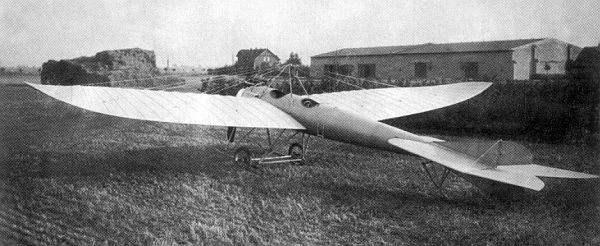
Hans Röver in 1912 built the Röver Monoplane with circular body covered with glue-laminated fabric for what Ernst Röver, his father, was granted German Patent Nr. 271112.
This monoplane was entered into meets in Johannisthal twice that year, with only minor success.
In 1913 Hans Röver rented a shed at Johannisthal, built a second monoplane, and trained pilots until August 1, 1914. Afterwards he flew for the navy and did not return from a reconnaissance mission in 1917.
Hans Röver (1890-1917), the son of an organ builder, received his technical training from Hans Grade in Bork. There he also earned his flying licence (Nr.56 on February 3, 1911). Leaving with a Grade Monoplane he flew at a few competitions with the goal to earn enough money to build his own aircraft. This was realised in 1912 – the Röver Monoplane
In 1913 Hans Röver rented a shed at Johannisthal, built a second monoplane, and trained pilots until August 1, 1914. Afterwards he flew for the navy and did not return from a reconnaissance mission in 1917.
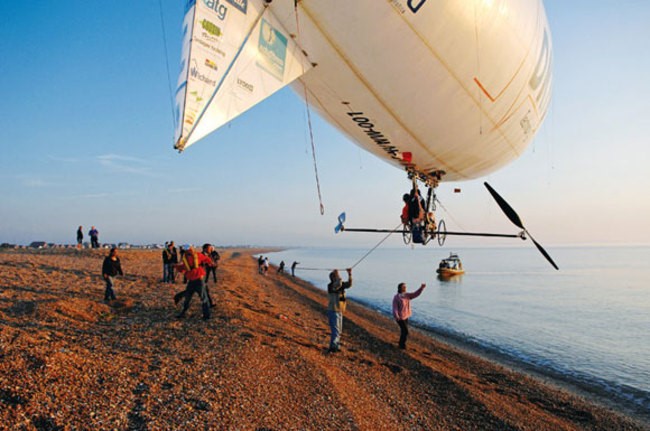
Rousson’s blimp, a crank-driven zeppelin known as Zeppy, is 16-meters-long with a 5-meter diameter, and a maximum speed of 20 kph. The craft’s forward momentum and steering come from a pair of 10-foot movable propellers turned by a recumbent bike hanging from the ship’s belly and pedalled.
Rousson, a 39-year-old Frenchman, attempted to cross The English Channel in a pedal-powered airship on 28 September 2008. He was forced to deflate his blimp and continue to France in a boat after a shift in winds made it impossible for him to progress, no matter how hard he pedalled.

“We were about three-quarters of the way across but the wind was flowing in the wrong direction for me to make it across,” he said. “I’m not disappointed. I feel happy because it had nothing to do with any technical failure, it was purely the wind that got in the way of this achievement.”
The failure is strike two for Rousson, whose June attempt to cross the Channel was also foiled by winds. This time around, he waited more than a week for the right conditions, but was doomed by a light breeze that picked up while he was in flight. “What feels breathlessly still to most people feels like a storm when you’re trying to fly a pedal-powered airship,” he says.
Rousson’s singular focus on flight also seems to be taking over his life. “All of my money has gone into this,” he says. I’m in quite a bit of debt.” He was also dumped by his girlfriend; presumably he loves his blimp more than he loves her.

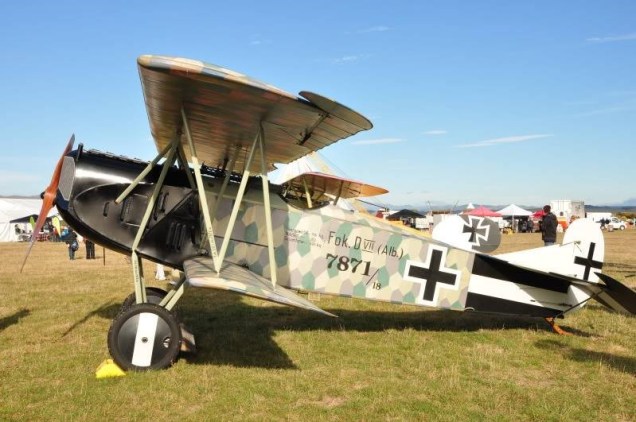
20th Century Fox purchased the film rights of Jack D Hunter’s “The Blue Max” and the film was to be a multi-million dollar production, and the stars were to be the full sized reproductions of World War I fighters constructed for the film- two Pfalz D.III biplanes, two Fokker Dr.I triplanes, two S.E.5a scouts and three Fokker D.VII biplanes.

The reproductions had to be built in a hurry to meet the time frame for shooting and were constructed in different locations. At Dinard airport in France, Claude Rousseau constructed three Fokker D.VII fighters (F-BNDF to F-BNDH) in six months. At the time it was stated that the machines were constructed to original plans and dimensions. The two former Federated Fruit Dragon Rapides, G-AKJS and G-ANZP, left Liverpool destined to become part donors for the three Fokker D.VII. The limited choice of engines led to the Gypsy Queen being also installed in the D.VII reproductions. The Gypsy Queen is a six cylinder in-line inverted air-cooled direct-drive engine, as a result the prop emerges through what would be the radiator shell of a true D.VII. Since the Fokkers’ original Mercedes weighed almost twice as much, they required some 200 pounds of nose-ballast for balance. Rousseau Aviation named the reproduction the D.VII-65. They were painted in lozenze camouflage pattern colours.

Rousseau delivered its D.VIIs by actually flying them from France to the set in Exeter-Dublin, Ireland, during August 1965, their German crosses and lozenge camouflage no doubt raising eyebrows below.
The replicas were:
F-BNDF, EI-APT painted as 6796/18

F-BNDG, EI-APU painted as 8520/18

F-BNDH, EI-APV


They later appeared in “Darling Lili”.

One Fokker D.VII now belong to New Zealand film director Peter Jackson’s 1914–18 Trust, kept in fully airworthy condition.
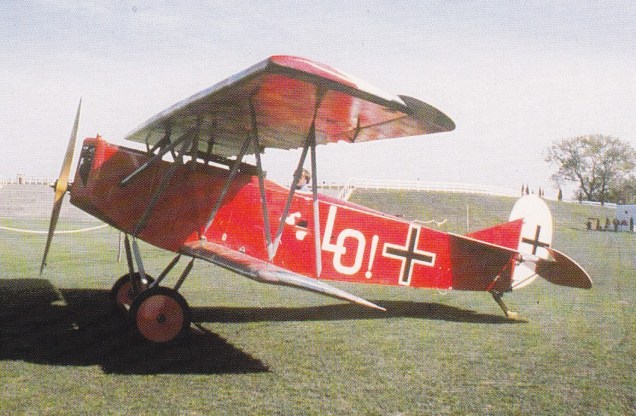
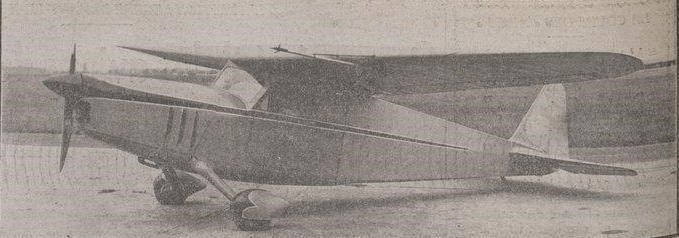
Roussel 10 of 1938.

Fourth construction of Emmanuel de Rougé; and piloted by Sadi Lecointe (1891-1944) who obtained French civil brevet No. 431 on February 10, 1911. Before this 1911 machine, de Rougé designed and built two helicopters and one biplane. The Aéro-voile is probably his last venture as after this machine little or nothing was heard of de Rougé.

In early 2007 Rotron founder and chief technology officer, Gilo Cardozo, pursued a childhood dream: to fly a paramotor 30,000ft over the summit of Everest.
Having teamed up with friend and TV personality Bear Grylls, Cardozo had just seven months to build two paramotors. The most powerful paramotor engine available was barely producing 30hp and was far too heavy to launch at the desired altitude. So, he also set about building a four-stroke rotary engine that was more compact and 50 per cent lighter than a piston engine equivalent.
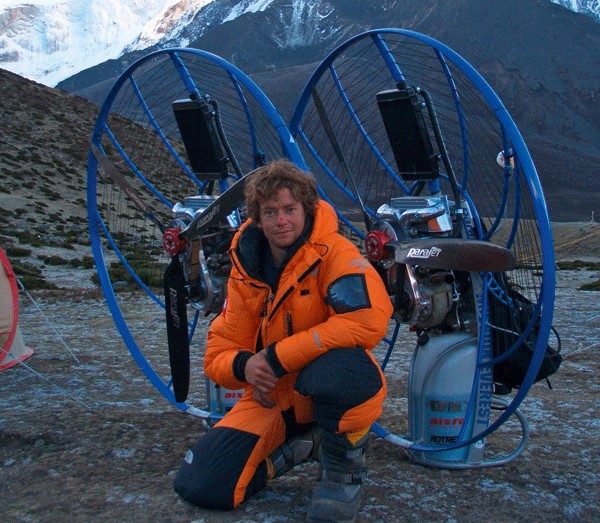
The basis of the Everest engine was a 294cc single rotor engine producing 40hp as a standard normally aspirated engine.
The engine included a miniature centrifugal supercharger fitted with a miniature intercooler to ensure the air was as cold and dense as possible when entering the combustion chamber. The supercharger was modified to be spun at up to 200,000rpm in order to simulate sea level atmospheric pressure of 1 bar at 30,000ft.
To eliminate the problem of icing, the supercharger was placed before the fuel delivery system. The heated and supercharged air was then sent through an intercooler before passing the injector at an average of 25 degrees Celsius.
After four months of design, development, testing and manufacturing, the engine was finally ready. With just two days before departure, the second engine was completed.
On 14 May 2007 the two pilots took off and in a flight that lasted four hours they achieved a paramotoring world record of 29,494 feet.
On completion of the expedition and building on its success, Cardozo continued to develop his rotary engine and looked for a commercial platform for the technology. Rotron Power was born.
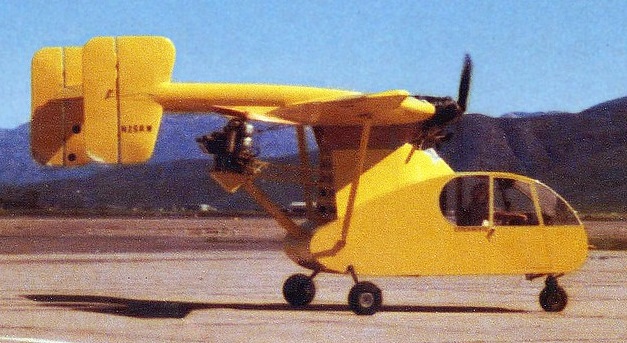
Described by its manufacturer as an “experimental ‘Three Passenger Airplane’ to demonstrate the high lift capability of an aircraft equipped with ‘Turbo Wing Technology.'” The Rotor Wing Ultra-Stol N25RW was developed in California in the late-1970s. It was reported as the Ultra-Stol by a company named Rotor Wing System and reportedly the aircraft flew at least twice.
Note the second engine and propeller, vertically mounted behind the trailing edge of the wing.
It had a relatively small wing and engines were reported as two Continental C85s and the rear could be tilted.
A very similar aircraft (maybe a rebuilt of the first?) was photographed in 1984 at Brown Field (near San Diego Ca), but it did not show a registration and was almost certainly never really completed. It differed in having a new wings, possibly from a Cessna Ce.150 and small canards. A company named High Technology Aircraft System, Inc (also in California). may be connected with this aircraft.

USA
Offers plans to build former Flaglor Scooter single-seat high-wing monoplane, first flown 1967.

