Samsonov, Pyotr Dmitievich

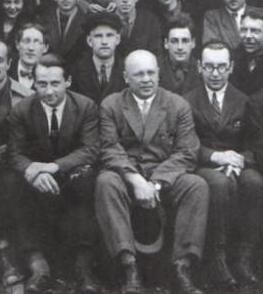
Piotr Samsonov. He began his aeronautical work in Moscow, under the direction of DP Grigorovich. From the beginning he showed himself to be a talented engineer. In 1924 Grigorovich began the projection of the MRL-1 reconnaissance plane with the Liberty engine. Calculations and drawings were made by engineers PD Samsonov and KA Vigand.

Starting in the summer of 1925, D. P. Grigorivich moved with his team to Leningrad, locating in the “Krasni Liotchik” factory, where the Department of Experimental Shipbuilding (OMOS according to the acronym of Otdiel morskovo opytnovo samoliotoestroyenia) was created. As of October 1925, it became an independent organization. DP Samsonov started working there in the area of aircraft construction together with BV Shavrov.

In 1925 Grigorovich began development of the ROM-1 from a request considered to be of high priority. The construction of the hull was commissioned to BV Shavrov, while the wings and the power plant were left under the responsibility of Samsonov.

After the failures of DP Grigorovich, the Soviet government decided to invite the French aircraft builder Paul Aimé Richard, who arrived in the USSR in August 1928, to the country. The OPO-4 department, also known as the Experimental Union of Naval Aeronautical Construction (MOS VAO) subordinated to the Moscow Factory No.28, was created for him. The KB offices were located on Krasnaya Presnya street and the production facilities in the Factory itself. Samsonov was selected to work in the technical section, taking part in the development of the Richard TOM-1 naval bomber and torpedo bomber.
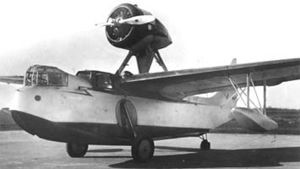
Samsonov MDR-5 amphibious flying boat during tests.

In 1933 Georgi Mikhailovich Beriev was appointed head of the TsKB brigade No.5 at the Menzhinsky Factory No.39, which designed naval models. As his second he was designated Pyotr Dmitrievich Samsonov, known for his ability and initiative. In December 1933 Samsonov managed to obtain, independently and without Beriev ‘s authorization, the task to develop a new amphibious flying boat. It was a development of the Beriev MBR-2 characterized by its more aerodynamic lines and its retractable landing gear towards the hull. The MBR-5 was designed to obtain a model with better performance. Although it presented a similar scheme, the weight was significantly lower. A prototype was built that was characterized by a number of problems that led to its abandonment.

In 1936 Samsonov was in charge of designing the weapons bay for a future long-range strategic bomber based on the American Martin M-156 passenger flying boat. Internal problems in the VVS resulted in the abandonment of this project.

By 1938, the construction of a new model of long-range amphibious flyingboat began, the MBR-7. The first prototype was destroyed in 1940 due to construction problems. Two other prototypes were never tested due to the start of the war and the need to concentrate on more prospective projects.

After the war Samsonov started working in the construction bureau of AS Yakovlev, taking an active part in the creation of the Yak-16 and leading the development of the Yak-100 helicopter.

Published works
Samsonov P. d. Projecting and construction of hydrosamelets. М., Oborongiz, 1938.

Own creations
Samsonov GM-156
Samsonov MBR-5
Samsonov MDR-7

Participated in
Grigorovitch MRL-1
Grigorovich ROM-1
Richard TOM-1
Yakovlev Yak-16
Yakovlev Yak-100
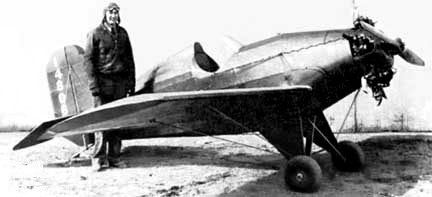
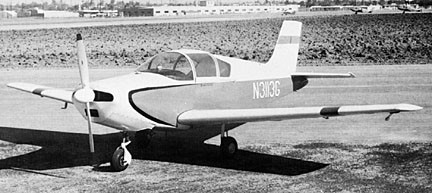
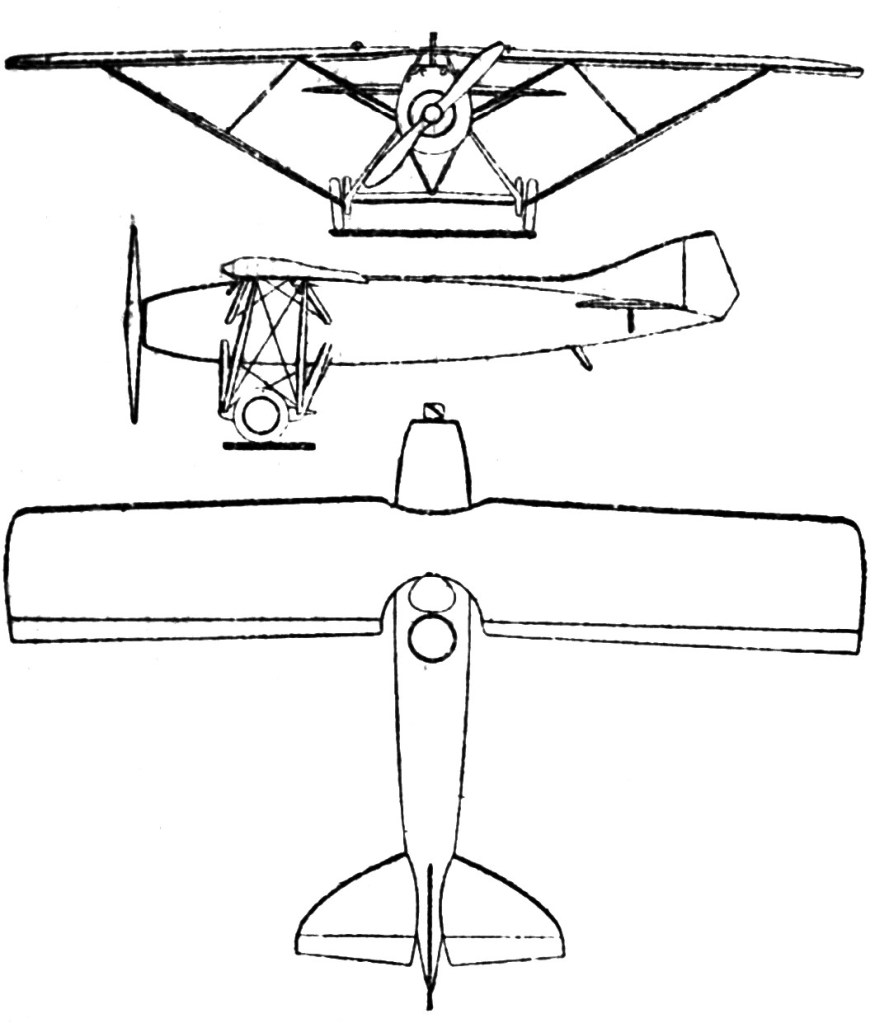
Salvay-Stark Skyhopper / Sport Aire II / Trefethen Sport-Aire II / TT-1

Trefethen Sport-Aire N3113G

Designed by George Stark as the Salvay-Stark Skyhopper, the prototype TT-1 (N3113G) with a 90hp Continental, was built by Al Trefethen and Art Thistle. It first flew on 9 November 1959.

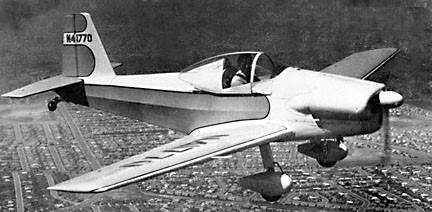
Salvay-Stark Skyhopper 10 N41770

The 1946 Skyhopper 10 plans were marketed for home-builders with a 65hp Continental engine. Designed to sell for around $1,000, a prototype, N41770, was built.

The Skyhopper 10 design modified by Al Trefethen in 1959 as tri-gear Sport Aire II. Also seen under the company names of Avia-Boosters and Skyhopper, but still the same Salvay-Stark design.

It was claimed to be the inspiration for the 1948 Morrisey Nifty.

The Skyhopper 11 of 1959 two place version of the Skyhopper 10 had a greater span wing and 65-85hp Continental; also 108-125hp Lycoming. Registrations N197N, N4787T and possibly others.

Skyhopper 10
Engine: Continental, 50hp
Wingspan: 25’0″
Length: 18’10”
Useful load: 315 lb
Max speed: 130 mph
Cruise speed: 120 mph
Stall: 42 mph
Range: 275 mi
Seats: 1-2

Skyhopper 11
Engines: Continental 65-85hp; Lycoming 108-125hp
Wingspan: 26’4″
Seats: 2

Sport-Aire II / TT-1
1961
Engine: 125hp Lycoming
Wingspan: 26’5″
Length: 21’9″
Useful load: 475 lb
Max speed: 142 mph
Cruise speed: 128 mph
Stall: 62 mph
Range: 400 mi
Ceiling: 13,000 ft
Seats: 2

Salvador Monoplane

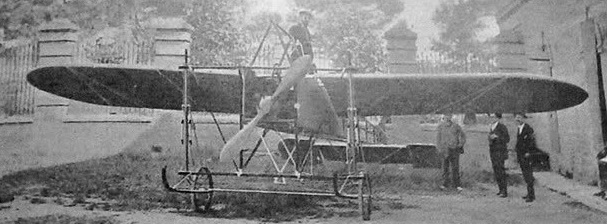
In 1910, mechanic-electrician of the Carcel Modelo de Valencia, Arturo Salvador Gómez, designed and constructed a monoplane at Valencia, Spain, completing the craft in 1911.

The airplane was presented in public on the occasion of the Valencia-Alicante-Valencia aerial raid and subsequent Aviation Festival held at the airfield of La Malvarrosa Beach from 29 to 31 July.

Lacking the engine, the plane was bought by the Aragonese pilot Gregorio Campaña, who had broken his own design plane by falling into the water during the Raid. Campaña intended to equip the Salvador monoplane with the 50 hp Anzani engine from its shattered plane. On August 6, 1911, Campaña departed from Valencia in the direction of Huesca taking with him the plane of Salvador and the remains of his own.

He arrived in Huesca on 9 August and flew on 11 and 12 August. It is not know if the flights made were with the airplane of Salvador with the Anzani engine or if he repaired his own airplane.

Wingspan: 8.9 m
Length: 9 m

Salmson-Béchereau SB-7 / AMBC1

The Salmson-Béchereau SB-7 was a fighter aircraft built by French company Salmson in 1925. The SB-7, listed elsewhere as ‘AMBC1’ single-seat, was a high-wing monoplane of all-wood construction, with a canvas coating. Only one aircraft was built, and it was intended as a navalized SB-5.

Only the one was built.

Engine: 1 × Salmson 18Cmb, 390 kW (520 hp)
Propeller: 2-blade
Wingspan: 14.00 m (45 ft 11 in)
Wing area: 39 m2 (420 sq ft)
Length: 11.15 m (36 ft 7 in)
Height: 3.00 m (9 ft 10 in)
Empty weight: 1,600 kg (3,527 lb)
Maximum speed: 200 km/h (120 mph, 110 kn)
Crew: Two

Salmson-Béchereau SB-5 / SB-6 / S.R.A.P. 2 / Béchereau C.2

SB-5

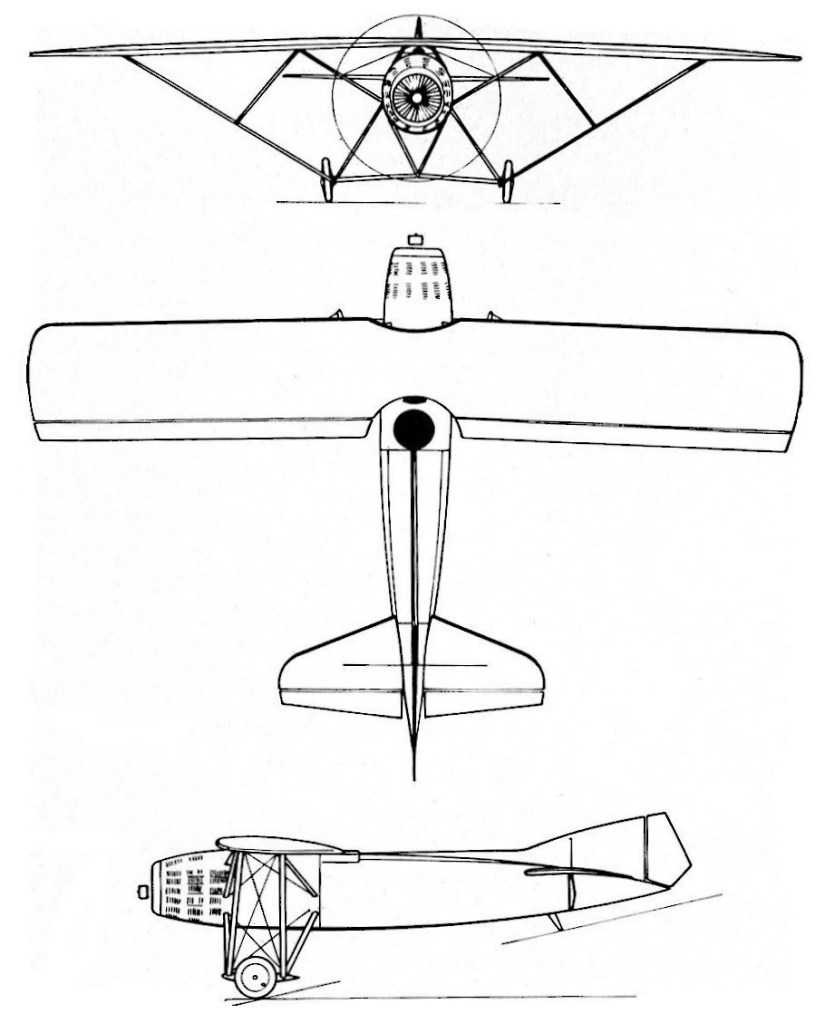
The Salmson-Béchereau SB-5, sometimes known as the Béchereau C.2 (C.2 denoting a two-seat chasseure or fighter) was Salmon’s response to the French 1925 two seat fighter programme. Its strut-braced, parasol wing design owed much to Béchereau’s 1921 Letord-Béchereau 2 and 1924 Buscaylet-Béchereau 2 single seat fighters and, like them, it used a similar type of 370 kW (500 hp) Salmson 18Cm eighteen cylinder water-cooled radial engine.

The wing of the SB-5 was in two parts, joined low over the fuselage by a pair of cabane struts. Beyond the section, where a pronounced reduction (c.50%) in chord, particularly on the trailing edge, provided a better field of view for the pilot, the wings were straight edged and of constant chord out to almost square tips. The wings were mounted with about 2° of sweep and 3° of anhedral. Each half-wing was built around two spruce longerons with pine ribs and plywood covered at the leading edge with fabric elsewhere.

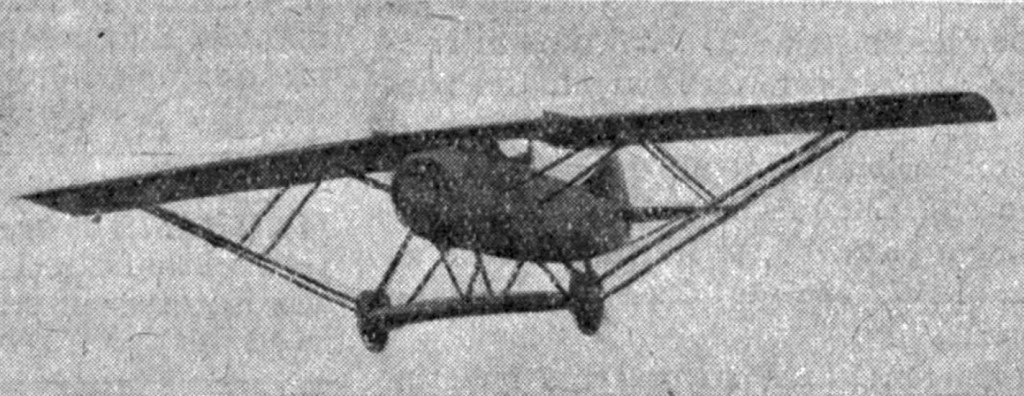
It was noted at the time that the wings were very thin and so required elaborate struttage which also involved the fixed landing gear. The central part of the latter was a wooden airfoil section, 3 m (9 ft 10 in) span plane which contributed an extra 13% lifting area. This had metal carriers at its tips, each supported by a pair of almost parallel struts to the lower fuselage. Split axles, mounted centrally on a transverse V-strut from the fuselage, were connected to the carriers via rubber shock absorbers and mounted the wheels. The main wing struts converged slightly from the carriers to the wing longerons at about 80% span. From near the midpoint of these struts a further pair of inverted Vs braced the inner wing to the upper fuselage.

Salmson-Béchereau C.2 photo from Les Ailes April 15, 1926

The forward part of the SB-5’s fuselage was designed around the 390 kW (520 hp) Salmson 18Cmb water-cooled radial engine, which was set back from the propeller on a 1.00 m (3 ft 3 in) extension shaft. The fuselage was built around four longerons but had a near-circular cross-section shaped by formers and covered with fabric. The pilot’s open cockpit was entirely under the central trailing edge opening and the rear cockpit was very close behind, still partly forward of the outer trailing edge. The intention, probably never realised, was that the SB-5 should have two fixed, forward firing 7.7 mm (0.303 in) machine guns controlled by the pilot and another pair on a flexible mount for the gunner. The fuselage tapered to the rear with a ridge fairing which began behind the gunner’s cockpit, ran along the spine and blended into a slightly rounded, low and broad fin, integral with the fuselage, which carried a pentagonal rudder. The SB-5’s tailplane, at the top of the fuselage, was generous and more rounded in plan than the fin and braced on each side by a strut from below. Its elevator trailing edges were level with the rudder hinge.

The exact date of the first flight of the SB-5 is not known but, described as new, it was being test flown by Duchamps in the last week of January 1926. By April it was at the government testing ground at Villacoublay, where tests revealed handling problems sufficiently serious to require significant modifications. When these were completed in the summer of 1926, the aircraft was redesignated the Salmson-Béchereaux SB-6. The most important changes were to the wings, where the ailerons now occupied all the trailing edge, and the size of its central cut-out was reduced. In addition the propeller drive shaft was shortened, reducing the SB-6’s length by 300 mm (11.8 in).

SB-6

Further testing showed the performance of the SB-6 did not meet the requirements of the two-seat programme specification. Béchereaux then left Salmson to form his own company, the Société pour la Réalisation d’Avion Prototypes (S.R.A.P.) and the SB-6 was displayed at the Paris Aero Salon in December 1926 as the S.R.A.P. 2; shortly afterwards the C.2 programme itself was abandoned and development of the S.R.A.P. 2 ended.

SB-6
Powerplant: 1 × Salmson 18Cmb, 390 kW (520 hp)
Propeller: 2-bladed
Wingspan: 14.6 m (47 ft 11 in)
Wing area: 35 m2 (380 sq ft)
Length: 9.7 m (31 ft 10 in)
Height: 3.0 m (9 ft 10 in)
Empty weight: 1,558 kg (3,435 lb)
Gross weight: 2,360 kg (5,203 lb)
Maximum speed: 220 km/h (140 mph, 120 kn) at 3,000 m (9,800 ft)
Service ceiling: 7,150 m (23,460 ft)
Time to altitude: 3,000 m (9,800 ft) 9.0 min
Crew: Two
Armament: provision for 2×7.7 mm (0.303 in) fixed, forward firing machine guns, plus another pair on a flexible mount in rear cockpit.

Salmson-Béchereau SB-5
SB-6