S. E. Ltd Saunders aircraft built postwar included the Medina ten-passenger twin-engined wooden flying-boat of 1926.
Era
Saunders Kittiwake
S. E. Ltd Saunders aircraft built postwar included the Kittiwake seven-passenger twin-engined wooden amphibian of 1920 with camber-changing gear on wing leading and trailing edges
Saunders T.1
S. E. Ltd Saunders began own design, first of which was T.1 two-seater (1917) with detachable wings for ship-board stowage.
Saunders, S. E. Ltd
UK
Based at Cowes, Isle of Wight. Originally built boats, and later hulls for fast motor boats and some of earliest flying-boats (e.g. Sopwith Bat Boat). Especially famous for “Consuta” copper-sewn plywood construction.
In 1913 received order for B.E. biplanes. During First World War built under subcontract Avro 504 landplanes, Short 184 floatplanes and Norman Thompson and Felixstowe F.2A and F.5 flying-boats.
Began own design, first of which was T.1 two-seater (1917) with detachable wings for ship-board stowage. Aircraft built postwar included the Kittiwake seven-passenger twin-engined wooden amphibian of 1920 with camber-changing gear on wing leading and trailing edges; Medina ten-passenger twin-engined wooden flying-boat of 1926; and Valkyrie three-engined military flying-boat of 1927 with developed form of Linton-Hope hull.
Saunders S4-A Jet Hawk II
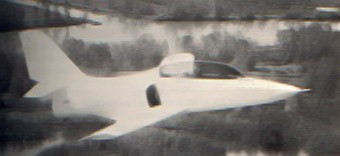
Don R. Saunders tried in the 70s and 80s to offer a homebuilt propeller jet utlising a blower driven by an internal combustion engine located inside the fuselage.
The engine was a Mazda 300 hp which resulted in a five-bladed fan ejecting air at the rear of the fuselage.
Saunders ST-28
Saunders Aircraft Corporation produced 13 completed ST 27s and was beginning work on its all new ST 28, a commuter/taxi aircraft designed to meet FAR 25 for the U.S. market. In December 1975, the first production airplane flew; almost at the same time, Manitoba withdrew funding.
Saunders ST-27A
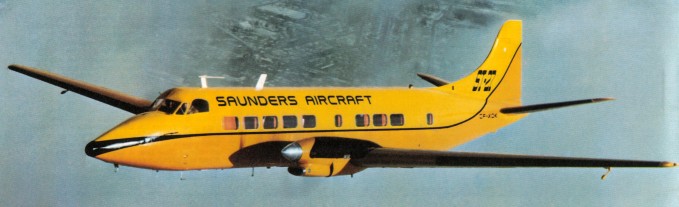
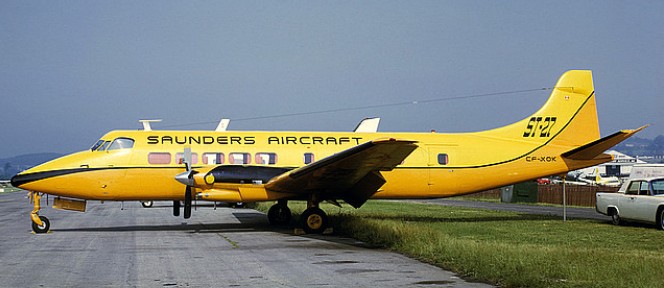
Saunders Aircraft Corporation in Canada flew the ST-27A prototype (CF-FYBM-X) for the proposed ST28 on 18 July 1974. The ST-27A was a lengthened fuselage conversion of the de Havilland D.H.114 Heron with turboprop powerplant, but production ST-28s were intended to be newly-built; because of financial problems no series aircraft were manufactured. Saunders Aircraft Corporation produced 13 completed ST 27s.
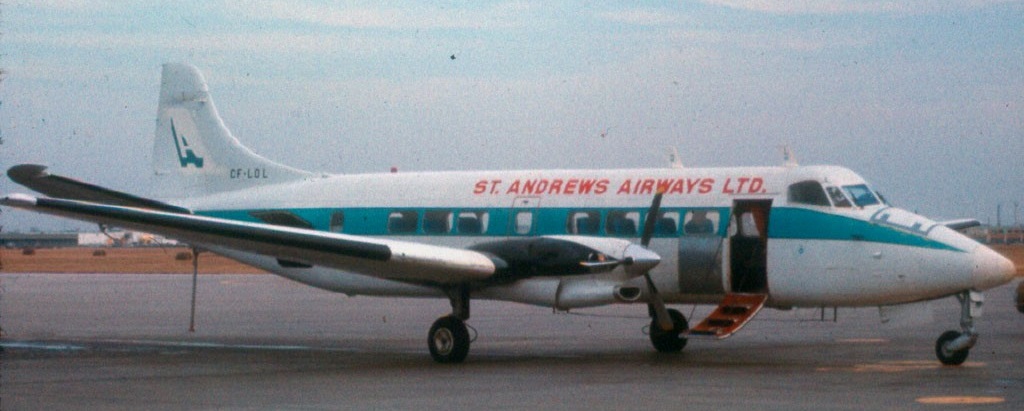
The Heron has been stretched by 8 ft 6 in (2.59 m) to carry 24 passengers, and re engined with two PT6A 27 turboprops instead of four Gipsy Queen piston engines.
Saunders Aircraft Corp
Canada
Formed 1968 to design and manufacture ST-27 conversion of British de Havilland Heron light transport. Major changes included turboprop power. Was working on successor (ST-28) when financial support ended 1976.
Saulnier 1910 Monoplane
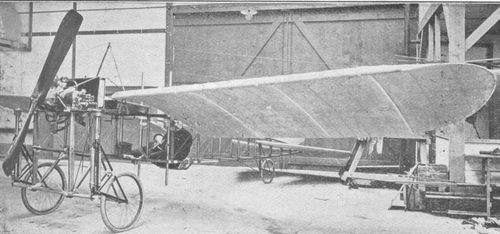
Raymond Saulnier did design work on the Blériot VIII and XI (the famous Channel machine). Some sources say he did most or all of the designing of the Type XI. He then started his own aeroplane construction firm at Courbevoie. His monoplane – which looks like a development of the Blériot XI – was an excellent flyer. The pilot was seated low in the completely open fuselage, a great difference with the Blériot. The machine was fitted with a two-cylinder Darracq engine and later with an Anzani 3-cylinder. The machine was mostly piloted by Emile Duval.
Saul No. 1 tandem biplane
The 1909 Saul No. 1 tandem biplane was designed by G. P. D. Saul and built by Handley Page in the UK.
Span: 20′
Length: 20′
Weight allup: 320 lbs
Speed: 30 mph
Price: £250

